• Home
  • Latest
  • Fortune 500
  • Finance
  • Tech
  • Leadership
  • Lifestyle
  • Rankings
  • Multimedia
Commentary

A case study to consider for AI adoption: GM versus Toyota in the 1980s

By
Nelson Repenning
Nelson Repenning
and
Don Kieffer
Don Kieffer
Down Arrow Button Icon
By
Nelson Repenning
Nelson Repenning
and
Don Kieffer
Don Kieffer
Down Arrow Button Icon
September 3, 2025, 8:30 AM ET
GM
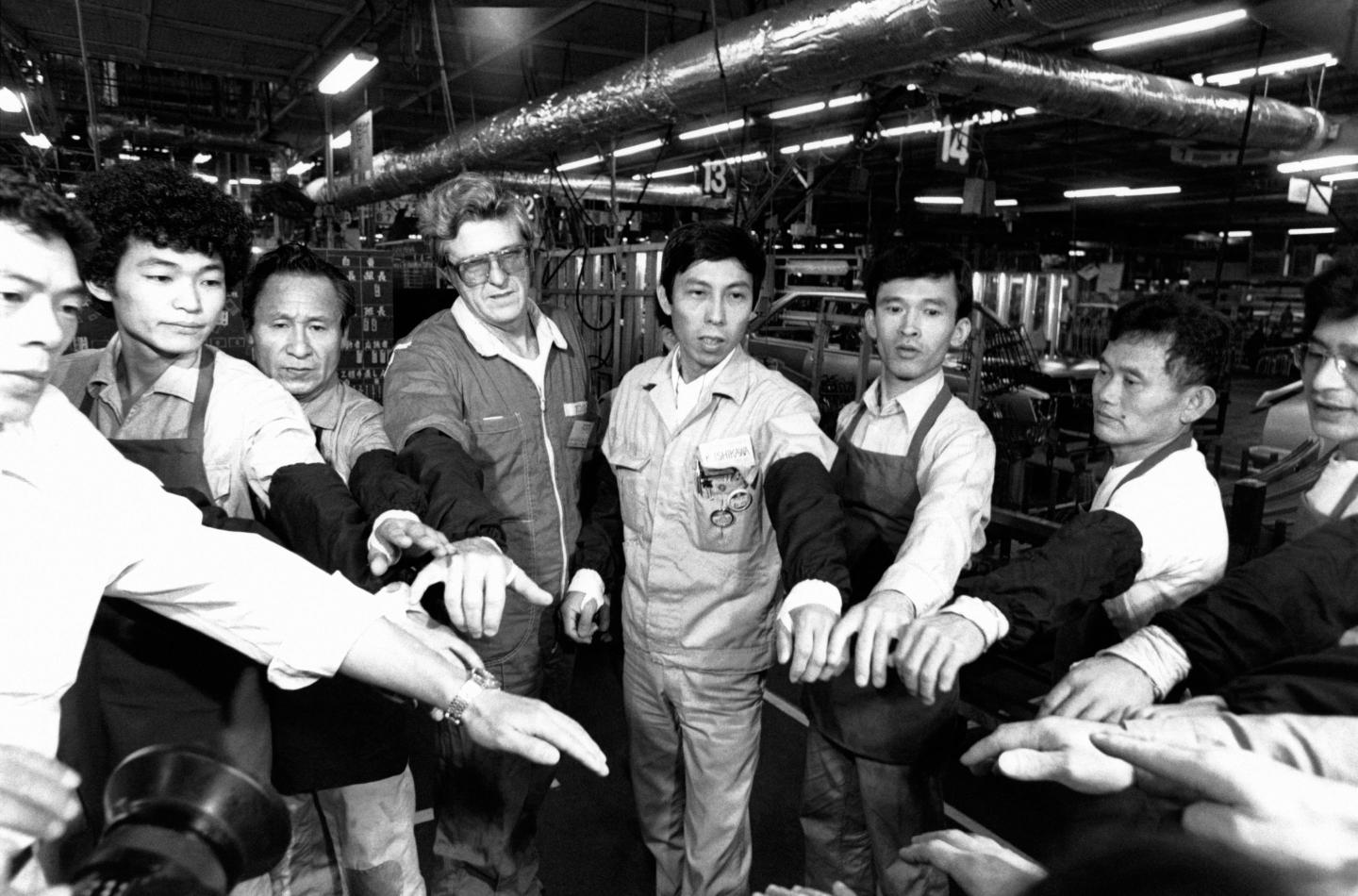
Toyota and General Motors workers in 1984.Kurita KAKU/Gamma-Rapho via Getty Images

On October 20, 1984, The New York Times ran an article headlined, “GM Factory of the Future Will Run with Robots.” In it, Roger Smith, then GM’s CEO, claimed that automation would save the company from increasingly formidable Asian competitors.

Recommended Video

But that didn’t happen. Smith’s robotic factories struggled to match the productivity of their human-run counterparts. Robots sometimes painted each other instead of cars or welded doors shut. And they carried much higher costs.

Today, the assembly of automobiles and countless other products is done primarily by robots. Smith had the right idea; he just went about it the wrong way. Artificial intelligence poses a similar challenge.

A recent report by our colleagues at MIT suggests that despite the $30 billion-$40 billion currently being invested in enterprise AI, 95% of pilots are getting zero return. Just as automation ultimately changed manufacturing, AI will undoubtedly reshape how companies operate; however, GM’s experience highlights the pitfalls of not thinking about its implementation carefully. Throwing technology at problems without understanding how work gets done day-to-day is a surefire way to waste money and breed cynicism.

Take a cue from Taiichi Ohno, the engineer known as the father of the Toyota Production System. He argued for “autonomation:” or automation with a human touch. Here’s how leaders can put his insight into practice with AI:

Step one: understand how work actually gets done

One of the students we taught at MIT Sloan School of Management likes to say, “There are few ways to lose money faster than automating a process you don’t understand.” That was Smith’s first error.

Automotive assembly plants are complex environments. Every process combines formal procedures and countless local refinements to get work done. Most of these tweaks, while necessary, are invisible to people one level up, let alone the CEO.

Knowledge work is even harder to map and is often shaped by thousands of micro adjustments. Consider all the emails and hallway conversations needed to move any decision forward. Leveraging automation requires understanding both the way work is supposed to be performed and how it’s actually done.

Successfully using AI requires a similar approach. You have to understand the work, otherwise you risk creating tools that, as the MIT report concluded about current AI applications, are “…brittle, overengineered, or misaligned with actual workflows.”

Next, run targeted trials

Smith’s second mistake was going too big, too fast—trying to replace entire systems overnight rather than proceeding incrementally with small, focused experiments.

Toyota pinpointed jobs where robots could make the work better by doing things like eliminating unsafe activities and physically taxing jobs. Then they ran experiments. Safety and productivity improved without upending the whole system, which allowed them to learn how to design work that robots could do repeatably. With this knowledge in hand, using robots for the next round of changes was easier and less disruptive.

The AI analogy is clear: repetitive tasks are dull and create the mental equivalent of repetitive stress injuries. Look for processes that are predictable and repeatable. Start where boredom is high and variability is low then use these simpler automation successes as learning experiences toward automating more sophisticated, complex work.

AI will never grasp the full context of your organization or the surrounding social and political dynamics. AI only knows what it has learned from experience. You still need employees who know the work and the organization to oversee AI to make sure its learning is headed in the right direction.

Then, redeploy, don’t just reduce

There’s little doubt that AI will eventually eliminate jobs, but if your company hopes to grow and thrive, choose this as a last resort. Smith didn’t think this way. His tenure was marked by plant closures and job losses. He famously told auto workers, “Every time you ask for another dollar in wages, a thousand more robots start looking practical.”

This is misguided. The “machines versus people” dynamic has fueled labor tensions, slowed technology adoption, and hurt organizational performance for over a century. It’s also bad business. Technology should improve productivity and fuel growth, not just slash costs.

AI frees up capacity. Use this newly available bandwidth to dust off ideas that have been sitting on the shelf: new services to offer, new markets to enter, and nagging problems to finally solve. Position employees where their skills are strongest; you know them, and they know the business.

Our approach requires a strong stomach, at least initially. At first, it’ll feel too small and too slow, especially when competitors boast about “doing AI everywhere.” But as you clear away work that is easily automated, building skills along the way, and delivering returns on the AI investment, more complex challenges will appear. Rinse and repeat with the next opportunity, ensuring that AI is not just cutting costs, it is helping you redesign and grow the business.

Much as robots are everywhere in factories now, AI will find a permanent place in most organizations. Your company will get there faster and with less heartache if you understand how work gets done, start with small experiments and prioritize growth over cuts.

The opinions expressed in Fortune.com commentary pieces are solely the views of their authors and do not necessarily reflect the opinions and beliefs of Fortune.

Join us at the Fortune Workplace Innovation Summit May 19–20, 2026, in Atlanta. The next era of workplace innovation is here—and the old playbook is being rewritten. At this exclusive, high-energy event, the world’s most innovative leaders will convene to explore how AI, humanity, and strategy converge to redefine, again, the future of work. Register now.
About the Authors
By Nelson Repenning
See full bioRight Arrow Button Icon
By Don Kieffer
See full bioRight Arrow Button Icon

Latest in Commentary

Finance
Lorem ipsum dolor sit amet, consectetur adipiscing elit, sed do eiusmod tempor incididunt ut labore et dolore magna aliqua. Ut enim ad minim veniam
By Fortune Editors
October 20, 2025
Finance
Lorem ipsum dolor sit amet, consectetur adipiscing elit, sed do eiusmod tempor incididunt ut labore et dolore magna aliqua. Ut enim ad minim veniam
By Fortune Editors
October 20, 2025
Finance
Lorem ipsum dolor sit amet, consectetur adipiscing elit, sed do eiusmod tempor incididunt ut labore et dolore magna aliqua. Ut enim ad minim veniam
By Fortune Editors
October 20, 2025
Finance
Lorem ipsum dolor sit amet, consectetur adipiscing elit, sed do eiusmod tempor incididunt ut labore et dolore magna aliqua. Ut enim ad minim veniam
By Fortune Editors
October 20, 2025
Finance
Lorem ipsum dolor sit amet, consectetur adipiscing elit, sed do eiusmod tempor incididunt ut labore et dolore magna aliqua. Ut enim ad minim veniam
By Fortune Editors
October 20, 2025
Finance
Lorem ipsum dolor sit amet, consectetur adipiscing elit, sed do eiusmod tempor incididunt ut labore et dolore magna aliqua. Ut enim ad minim veniam
By Fortune Editors
October 20, 2025

Most Popular

Finance
Lorem ipsum dolor sit amet, consectetur adipiscing elit, sed do eiusmod tempor incididunt ut labore et dolore magna aliqua. Ut enim ad minim veniam
By Fortune Editors
October 20, 2025
Finance
Lorem ipsum dolor sit amet, consectetur adipiscing elit, sed do eiusmod tempor incididunt ut labore et dolore magna aliqua. Ut enim ad minim veniam
By Fortune Editors
October 20, 2025
Finance
Lorem ipsum dolor sit amet, consectetur adipiscing elit, sed do eiusmod tempor incididunt ut labore et dolore magna aliqua. Ut enim ad minim veniam
By Fortune Editors
October 20, 2025
Finance
Lorem ipsum dolor sit amet, consectetur adipiscing elit, sed do eiusmod tempor incididunt ut labore et dolore magna aliqua. Ut enim ad minim veniam
By Fortune Editors
October 20, 2025
Finance
Lorem ipsum dolor sit amet, consectetur adipiscing elit, sed do eiusmod tempor incididunt ut labore et dolore magna aliqua. Ut enim ad minim veniam
By Fortune Editors
October 20, 2025
Finance
Lorem ipsum dolor sit amet, consectetur adipiscing elit, sed do eiusmod tempor incididunt ut labore et dolore magna aliqua. Ut enim ad minim veniam
By Fortune Editors
October 20, 2025
Fortune Secondary Logo
Rankings
  • 100 Best Companies
  • Fortune 500
  • Global 500
  • Fortune 500 Europe
  • Most Powerful Women
  • World's Most Admired Companies
  • See All Rankings
  • Lists Calendar
Sections
  • Finance
  • Fortune Crypto
  • Features
  • Leadership
  • Health
  • Commentary
  • Success
  • Retail
  • Mpw
  • Tech
  • Lifestyle
  • CEO Initiative
  • Asia
  • Politics
  • Conferences
  • Europe
  • Newsletters
  • Personal Finance
  • Environment
  • Magazine
  • Education
Customer Support
  • Frequently Asked Questions
  • Customer Service Portal
  • Privacy Policy
  • Terms Of Use
  • Single Issues For Purchase
  • International Print
Commercial Services
  • Advertising
  • Fortune Brand Studio
  • Fortune Analytics
  • Fortune Conferences
  • Business Development
  • Group Subscriptions
About Us
  • About Us
  • Press Center
  • Work At Fortune
  • Terms And Conditions
  • Site Map
  • About Us
  • Press Center
  • Work At Fortune
  • Terms And Conditions
  • Site Map
  • Facebook icon
  • Twitter icon
  • LinkedIn icon
  • Instagram icon
  • Pinterest icon

Nelson Repenning is the faculty director of the MIT Leadership Center, and the School of Management Distinguished Professor of System Dynamics and Organization Studies at the MIT Sloan School of Management. Don Kieffer is a senior lecturer in Operations Management at MIT Sloan and the founder of ShiftGear Work Design, LLC. They are the authors of the new book, There’s Got to Be a Better Way: How to Deliver Results and Get Rid of the Stuff in the Way of Real Work (Hachette Books, August 26, 2025)


Latest in Commentary

agentic
CommentaryAI agents
Why your data infrastructure — not your AI model — will determine whether Agentic AI scales
By Jeffrey Sonnenfeld, Stephen Henriques, Catherine Dai and Zander JeinthanuttkanontApril 30, 2026
3 hours ago
hoskins
Commentaryoffices
Gensler Co-Chair: Hot-desking was supposed to save money. It may be costing you your culture
By Diane HoskinsApril 30, 2026
4 hours ago
tillis
CommentaryCongress
Thom Tillis: Free markets built American prosperity. Government intervention puts it at risk
By Thom Tillis and John StanfordApril 30, 2026
6 hours ago
iran
CommentaryIran
The Strait of Hormuz is a data problem, not just a military one
By Erik Bethel and Ami DanielApril 30, 2026
6 hours ago
hollywood
CommentaryMarketing
I spent 20 years learning to navigate an industry. Then I built a campaign for the man who’s dismantling it
By Matti YahavApril 29, 2026
1 day ago
aging
HealthLongevity
We’re the CEOs of Peloton and the Hospital for Special Surgery. Living longer isn’t enough, we need to live better, too
By Bryan T. Kelly and Peter SternApril 29, 2026
1 day ago

Most Popular

Apple cofounder Ronald Wayne—whose stake would be worth up to $400 billion had he not sold it in 1976—says that at 91, he has no regrets
Success
Apple cofounder Ronald Wayne—whose stake would be worth up to $400 billion had he not sold it in 1976—says that at 91, he has no regrets
By Preston ForeApril 27, 2026
3 days ago
Jamie Dimon gets candid about national debt: ‘There will be a bond crisis, and then we’ll have to deal with it’
Economy
Jamie Dimon gets candid about national debt: ‘There will be a bond crisis, and then we’ll have to deal with it’
By Eleanor PringleApril 29, 2026
1 day ago
‘They left me no choice’: Powell isn’t going anywhere—blocking Trump from another Fed appointee
Banking
‘They left me no choice’: Powell isn’t going anywhere—blocking Trump from another Fed appointee
By Eva RoytburgApril 29, 2026
20 hours ago
‘The cost of compute is far beyond the costs of the employees’: Nvidia executive says right now AI is more expensive than paying human workers
AI
‘The cost of compute is far beyond the costs of the employees’: Nvidia executive says right now AI is more expensive than paying human workers
By Sasha RogelbergApril 28, 2026
2 days ago
‘Take the money and run’: Johns Hopkins economist Steve Hanke on why the UAE quit OPEC
Energy
‘Take the money and run’: Johns Hopkins economist Steve Hanke on why the UAE quit OPEC
By Shawn TullyApril 29, 2026
1 day ago
Google Cloud revenue is now 18% of Alphabet's business. Is this the beginning of the end of Google's search identity?
Big Tech
Google Cloud revenue is now 18% of Alphabet's business. Is this the beginning of the end of Google's search identity?
By Alexei OreskovicApril 29, 2026
13 hours ago

© 2026 Fortune Media IP Limited. All Rights Reserved. Use of this site constitutes acceptance of our Terms of Use and Privacy Policy | CA Notice at Collection and Privacy Notice | Do Not Sell/Share My Personal Information
FORTUNE is a trademark of Fortune Media IP Limited, registered in the U.S. and other countries. FORTUNE may receive compensation for some links to products and services on this website. Offers may be subject to change without notice.