
• Home
  • Latest
  • Fortune 500
  • Finance
  • Tech
  • Leadership
  • Lifestyle
  • Rankings
  • Multimedia
EconomyTariffs

Trump said foreign countries would ‘eat’ tariffs—but U.S. consumers and businesses will actually pay 75% at best

Eleanor Pringle
By
Eleanor Pringle
Eleanor Pringle
Senior Reporter, Economics and Markets
Down Arrow Button Icon
Eleanor Pringle
By
Eleanor Pringle
Eleanor Pringle
Senior Reporter, Economics and Markets
Down Arrow Button Icon
August 11, 2025, 6:15 AM ET
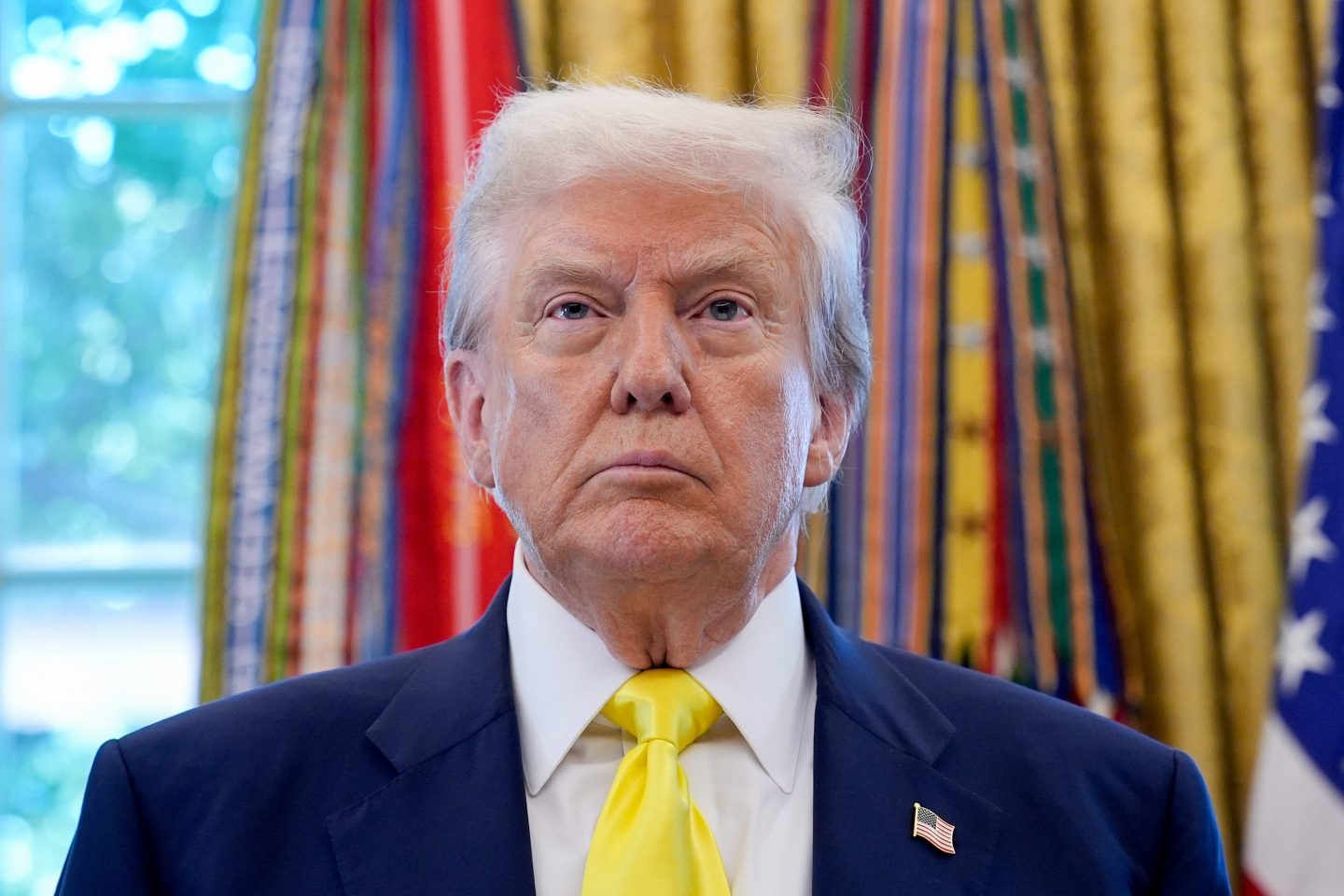
Photo of Donald Trump
U.S. President Donald Trump said foreign nations would “eat” tariffs, but analysts suggest that has not been the case.Yuri Gripas/Abaca/Bloomberg - Getty Images
  • Goldman Sachs estimates U.S. consumers now shoulder two-thirds of President Trump’s new tariff costs, with more companies planning to pass them on in the future and foreign exporters refusing to “eat” the price hikes. The bank expects the measures to lift core PCE inflation (personal consumption expenditures) to 3.2% by year-end, adding pressure to the Fed’s 2% target.

When President Trump announced his tariff agenda, he said it would be foreign companies and consumers that would “eat” the price hikes. That’s a take that may be proved optimistic at best and misguided at worst.

Recommended Video

While tariffs have yet to significantly shift the dial on inflation—prompting individuals like Treasury Secretary Scott Bessent to label them the “dog that didn’t bark”—analysts are widely expecting the hikes to ultimately be paid for by the U.S.

So far the sharpest end of the tariff regime has yet to be felt. President Trump delayed his “Liberation Day” tariffs by three months in order to reach agreements with trading partners.

Some negotiations have proved successful, with framework deals done with the U.K., the EU, and Japan to name a few, drastically lowering tariff rates from Trump’s initial threats back in April. Yet countries that haven’t yet agreed to a deal (which received letters informing them of their new tariff rate) saw their effective export rate rise on the deadline of Aug. 7.

That includes nations like India, which is facing a rate of 25% that may double on Aug. 27 as punishment for buying Russian oil. Likewise, while the Trump administration on many occasions has touted a deal nearly done with China, nothing beyond an agreement to delay tit-for-tat price increases until this week has been confirmed.

With a slew of tariffs now effectively in place, Goldman Sachs believes that the cost absorbed by foreign exporters will grow over time, but will remain low.

Economist Elsie Peng wrote in a note yesterday seen by Fortune that Goldman believes exporters absorbed 14% of the costs of all tariffs in June, which will rise to 25% by October if the sanctions follow a similar trajectory to the price hikes administered by the Trump administration in his first term.

But the portion consumers can expect to pay is also on the rise. Peng noted that around 36% of the 2025 tariff costs were passed on to consumer prices after three months of implementation and around 67% were passed on after four months.

The economist added that “although the pass-through rate appears to be increasing rapidly over time, it still remains somewhat below the pass-through rate that we estimate at the same point in time during the 2018–2019 trade war.”

One portion of the economy that intends to reduce its share is U.S. businesses. The Conference Board released its U.S. CEO Confidence report for the third quarter last week, which revealed 64% are certain they would be passing the price hike on to consumers, and a further 16% said they’re still considering.

This is a higher rate than previously identified (following the prediction of Goldman Sachs) as only in June the New York Fed reported a smaller 45% of services firms were intending to pass on the full extent of their tariff-related increases.

Peng noted that her math “implies that U.S. businesses have absorbed more than half of the tariff costs so far but that their share would fall to less than 10%. This net impact on U.S. businesses likely masks that some companies have absorbed a larger share of tariff costs, while some domestic producers shielded from import competition have raised their own prices and benefited.”

Inflation pass-through

Of course, if consumers are paying higher prices for goods and services then the Federal Reserve’s job of keeping inflation to 2% will only get more difficult.

Goldman Sachs believes this will be the case, writing, “Our analysis implies that tariff effects have boosted the core PCE price level by 0.20% so far.

“We expect another 0.16% impact in July, followed by an additional 0.5% from August through December. This would leave core PCE inflation at 3.2% year over year in December, assuming that the underlying inflation trend net of tariff effects is 2.4%.”

Reflecting on the June consumer price index report (the latest available at the time of writing), Macquarie’s North America economists David Doyle and Chinara Azizova commented that the data was already showing hints of pass-through inflation.

They wrote last month: “Notable price pressures were apparent in household furnishings and supplies, apparel, video and audio products, sporting goods, and toys. This list suggests impacts from tariffs on the data. One measure that reflects this is core goods ex used cars and trucks. This accelerated to +0.3% MoM, its strongest pace since Feb-23. It also shows an accelerating monthly trend.”

Many economists are hoping Fed Chairman Jerome Powell will see through this inflation and lower the base rate, in part to offset an alarming jobs report from the Bureau of Labor Statistics a matter of weeks ago. But analysts can’t hold their breath. After all, Powell made the point at his last press conference that by not raising rates (a move which truly would have upset markets) he is already seeing through such pressures.

Join us at the Fortune Workplace Innovation Summit May 19–20, 2026, in Atlanta. The next era of workplace innovation is here—and the old playbook is being rewritten. At this exclusive, high-energy event, the world’s most innovative leaders will convene to explore how AI, humanity, and strategy converge to redefine, again, the future of work. Register now.
About the Author
Eleanor Pringle
By Eleanor PringleSenior Reporter, Economics and Markets
LinkedIn icon

Eleanor Pringle is an award-winning senior reporter at Fortune covering news, the economy, and personal finance. Eleanor previously worked as a business correspondent and news editor in regional news in the U.K. She completed her journalism training with the Press Association after earning a degree from the University of East Anglia.

See full bioRight Arrow Button Icon

Latest in Economy

Spanish Prime Minister Pedro Sánchez often praises the financial and social benefits that immigrants bring to the country.
EuropeSpain
In a continent cracking down on immigration and berated by Trump’s warnings of ‘civilizational erasure,’ Spain embraces migrants
By Suman Naishadham and The Associated PressDecember 13, 2025
16 hours ago
EconomyAgriculture
More financially distressed farmers are expected to lose their property soon as loan repayments and incomes continue to falter
By Jason MaDecember 13, 2025
17 hours ago
PoliticsAffordable Care Act (ACA)
With just days to go before ACA subsidies expire, Congress is about to wrap up its work with no consensus solution in sight
By Kevin Freking, Lisa Mascaro and The Associated PressDecember 13, 2025
22 hours ago
HealthAffordable Care Act (ACA)
A Wisconsin couple was paying $2 a month for an ACA health plan. But as subsidies expire, it’s soaring to $1,600, forcing them to downgrade
By Ali Swenson and The Associated PressDecember 13, 2025
23 hours ago
Julian Braithwaite is the Director General of the International Alliance for Responsible Drinking
CommentaryProductivity
Gen Z is drinking 20% less than Millennials. Productivity is rising. Coincidence? Not quite
By Julian BraithwaiteDecember 13, 2025
1 day ago
EconomyFederal Reserve
Trump names Warsh, Hassett as top Fed contenders, WSJ says
By Jennifer A. Dlouhy and BloombergDecember 12, 2025
2 days ago

Most Popular

placeholder alt text
Economy
Tariffs are taxes and they were used to finance the federal government until the 1913 income tax. A top economist breaks it down
By Kent JonesDecember 12, 2025
2 days ago
placeholder alt text
Success
Apple cofounder Ronald Wayne sold his 10% stake for $800 in 1976—today it’d be worth up to $400 billion
By Preston ForeDecember 12, 2025
2 days ago
placeholder alt text
Success
40% of Stanford undergrads receive disability accommodations—but it’s become a college-wide phenomenon as Gen Z try to succeed in the current climate
By Preston ForeDecember 12, 2025
2 days ago
placeholder alt text
Economy
The Fed just ‘Trump-proofed’ itself with a unanimous move to preempt a potential leadership shake-up
By Jason MaDecember 12, 2025
2 days ago
placeholder alt text
Success
Apple CEO Tim Cook out-earns the average American’s salary in just 7 hours—to put that into context, he could buy a new $439,000 home in just 2 days
By Emma BurleighDecember 12, 2025
2 days ago
placeholder alt text
Uncategorized
Transforming customer support through intelligent AI operations
By Lauren ChomiukNovember 26, 2025
18 days ago
Rankings
  • 100 Best Companies
  • Fortune 500
  • Global 500
  • Fortune 500 Europe
  • Most Powerful Women
  • Future 50
  • World’s Most Admired Companies
  • See All Rankings
Sections
  • Finance
  • Leadership
  • Success
  • Tech
  • Asia
  • Europe
  • Environment
  • Fortune Crypto
  • Health
  • Retail
  • Lifestyle
  • Politics
  • Newsletters
  • Magazine
  • Features
  • Commentary
  • Mpw
  • CEO Initiative
  • Conferences
  • Personal Finance
  • Education
Customer Support
  • Frequently Asked Questions
  • Customer Service Portal
  • Privacy Policy
  • Terms Of Use
  • Single Issues For Purchase
  • International Print
Commercial Services
  • Advertising
  • Fortune Brand Studio
  • Fortune Analytics
  • Fortune Conferences
  • Business Development
About Us
  • About Us
  • Editorial Calendar
  • Press Center
  • Work At Fortune
  • Diversity And Inclusion
  • Terms And Conditions
  • Site Map

© 2025 Fortune Media IP Limited. All Rights Reserved. Use of this site constitutes acceptance of our Terms of Use and Privacy Policy | CA Notice at Collection and Privacy Notice | Do Not Sell/Share My Personal Information
FORTUNE is a trademark of Fortune Media IP Limited, registered in the U.S. and other countries. FORTUNE may receive compensation for some links to products and services on this website. Offers may be subject to change without notice.