
• Home
  • Latest
  • Fortune 500
  • Finance
  • Tech
  • Leadership
  • Lifestyle
  • Rankings
  • Multimedia
AIAutomation

AI is helping blue-collar workers do more with less as labor shortages are projected to worsen 

Sage Lazzaro
By
Sage Lazzaro
Sage Lazzaro
Contributing writer
Down Arrow Button Icon
Sage Lazzaro
By
Sage Lazzaro
Sage Lazzaro
Contributing writer
Down Arrow Button Icon
June 11, 2025, 6:00 AM ET
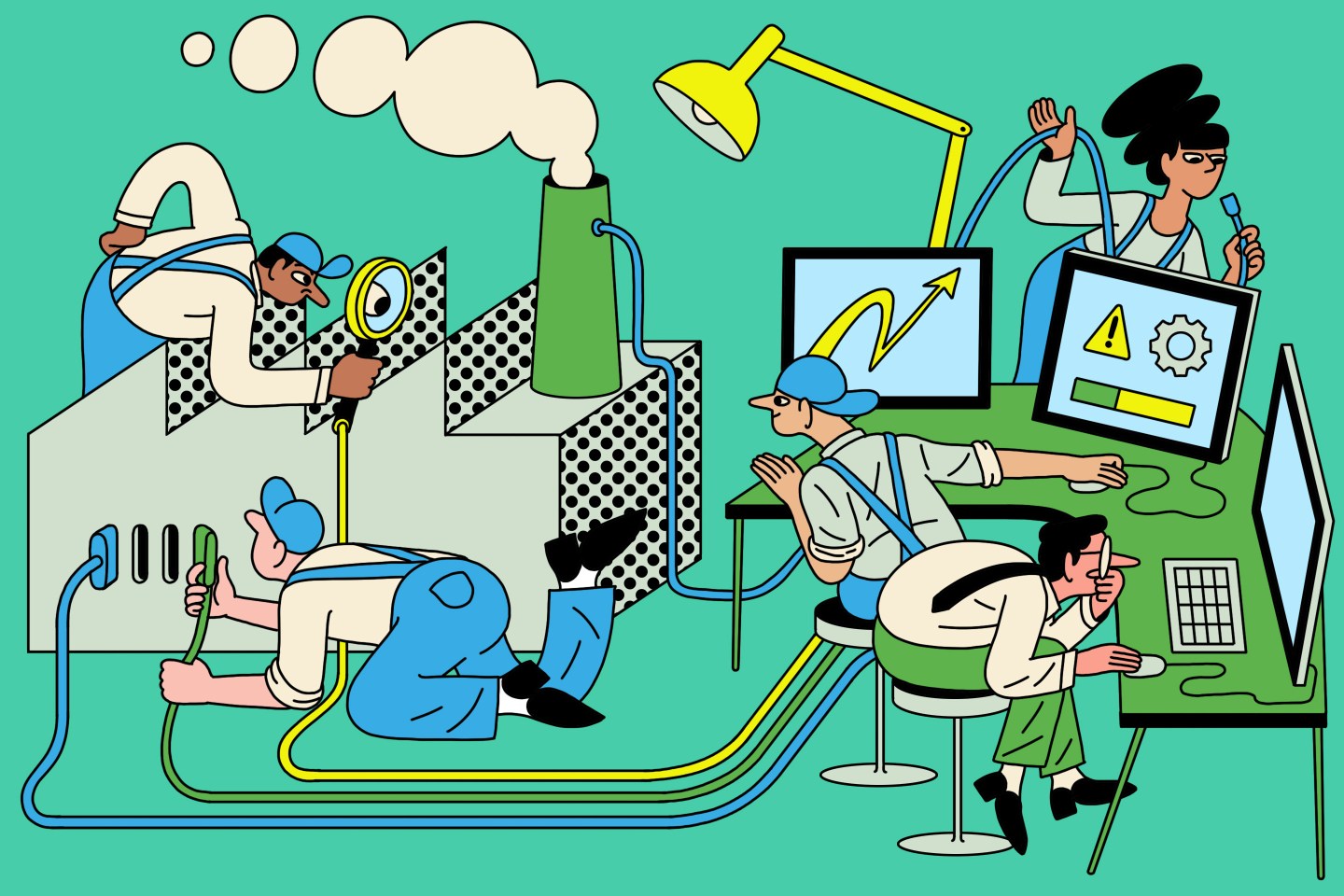
Illustration of workers both in the office and out in the field
Illustration by Simon Landrein

There are an estimated 180 million utility poles currently in operation in the U.S., and every so often, they need to be inspected. Historically, crews of specialized workers would go from pole to pole, climbing to the top and evaluating the integrity of the structure, regardless of whether or not the pole had a known problem. Today with AI, sensors, and drones, teams can detect the state of this critical infrastructure without physically being there, sending a worker on site only when there’s an issue that needs to be addressed. What’s more, the data made possible by these remote monitoring systems means workers are more informed and prepared for the job when they are deployed to a pole.  

“There’s a lot of diagnostic time to figure out what’s going on, but now imagine that you just show up on a site with the information. So you’re sending somebody to the right spot when there’s an actual issue, and then they’re much more likely to have the right part, or the right truck, or the right materials they need in that moment,” said Alex Hawkinson, CEO of BrightAI, a company using AI solutions to address worker challenges in the energy sector and other blue-collar industries including HVAC, water pipeline, construction, manufacturing, pest control, and field service. 

It’s just one example of how AI-enabled technologies are increasingly helping workers in blue-collar industries do their jobs, saving them time and energy, and reducing their exposure to risky situations (like having to climb to the top of utility poles). The new wave of AI is also allowing workers across these fields to get more out of the technologies they’ve already been using and data they’ve been collecting. AI’s long-term impact on jobs is an increasingly important topic of debate, as analysts and economists look for clues by examining hiring practices at different companies. But in many of these blue-collar fields that are currently struggling with labor shortages, AI is a welcome helper.

Labor shortages drive blue-collar appetite for automation 

Blue-collar industries that require specialized trade skills are some of the most labor-squeezed parts of the workforce, particularly as aging workers who were trained for them years ago start to retire. Between 30% and 50% of water pipeline workers are expected to retire in the next decade, for example, and there aren’t enough younger workers entering the field to replace them. It’s a similar situation in farming: The average age of the U.S. farmer is 58.1 years old, and there are four times as many farmers who are 65 or older than those younger than 35, according to the 2022 U.S. Census of Agriculture. Farming also has to deal with the seasonality of its labor needs, which sway dramatically throughout the year.

“Another big misconception is that autonomy is about labor replacement,” said Willy Pell, CEO of John Deere subsidiary Blue River Technology, regarding AI in the farming industry. “In many cases, it just isn’t there to begin with. So it’s not replacing anything—it’s giving them labor.”

Whether it’s a utility worker inspecting a pole or a farmer harvesting crops, doing more with less time is paramount when there aren’t enough people to get the work done. 

“One of the biggest things is that farmers never have enough time. When we can give them their time back, it makes their lives meaningfully better. They get to spend more time with their family. They get to spend more time running the higher-leverage parts of their business, the higher-value parts of their business, and they have less stress,” said Pell. “There’s an incredible amount of anxiety that comes with not knowing if you can run your business because you’re relying on an extremely sparse, fragile labor force to help you do it. And autonomy helps farmers with this problem.”

Crucially, it’s not just industry leaders who are on board, but workers too. A study on workers’ openness to automation performed by Massachusetts Institute of Technology researchers (and backed by Amazon) found that those without college degrees, or “blue-collar” workers, are more open to automation than those with degrees. According to the study, 27.4% of workers without a college degree said they believe that AI will be beneficial for their job security, compared to 23.7% of workers with a college degree.

AI supercharges the data and technologies workers are already relying on 

For many blue-collar workers, the problems they’re facing on the job are increasingly measurable. For example, Blue River Technology has neural networks that integrate directly into field-spraying machines, detecting the crops and weeds in order to spray herbicides only on the weeds. Technologies like sensors and drones have been around for years, but recent progress in AI is allowing them to derive more benefit from these technologies and the data they produce.

“A lot of factories and other industrial environments have had data around for a long time and haven’t necessarily known what to do with it. Now there are new algorithms and new software that’s allowing these companies to be a lot more intelligent with using that data to make work better,” said Ben Armstrong, coauthor of the study on worker attitudes surrounding automation and an MIT researcher who focuses on the relationship between technology and work, especially in American manufacturing.

BrightAI’s Hawkinson echoes this, saying that “a simple sensor reading isn’t enough to give you the pattern that you care about” and that it’s the maturation of AI that’s made the difference. For example, the company has tapped large language models (LLMs) for voice interaction to allow workers to interact with sensor data via wearable devices, which is crucial for workers who need to have their hands free, as is common in the fields BrightAI operates in. Hawkinson said that companies working with BrightAI’s platform are seeing productivity lifts between 20% and 30% within three to six months of getting up and running.

Overall, a lot of the potential benefits hinge on using AI to improve organization and access to the information that’s vital to get these jobs done. Blue River Technology, for example, is tapping LLMs to turn the very complicated information around equipment error codes into a more readable format with easy-to-understand troubleshooting tips. 

“In a lot of the companies we’re studying, there are these companies’ specific tools that workers can use to solve problems in their job by either doing a different kind of research or trying to organize information in a new way,” Pell said. “And I think for blue-collar workers who have a lot of knowledge about the particular processes and technologies that they work on, that can be really exciting.”

Explore more stories from Fortune AIQ, a new series chronicling how companies at the front lines of the AI revolution are navigating the technology’s real-world impact.

About the Author
Sage Lazzaro
By Sage LazzaroContributing writer

Sage Lazzaro is a technology writer and editor focused on artificial intelligence, data, cloud, digital culture, and technology’s impact on our society and culture.

See full bioRight Arrow Button Icon

Latest in AI

Finance
Lorem ipsum dolor sit amet, consectetur adipiscing elit, sed do eiusmod tempor incididunt ut labore et dolore magna aliqua. Ut enim ad minim veniam
By Fortune Editors
October 20, 2025
Finance
Lorem ipsum dolor sit amet, consectetur adipiscing elit, sed do eiusmod tempor incididunt ut labore et dolore magna aliqua. Ut enim ad minim veniam
By Fortune Editors
October 20, 2025
Finance
Lorem ipsum dolor sit amet, consectetur adipiscing elit, sed do eiusmod tempor incididunt ut labore et dolore magna aliqua. Ut enim ad minim veniam
By Fortune Editors
October 20, 2025
Finance
Lorem ipsum dolor sit amet, consectetur adipiscing elit, sed do eiusmod tempor incididunt ut labore et dolore magna aliqua. Ut enim ad minim veniam
By Fortune Editors
October 20, 2025
Finance
Lorem ipsum dolor sit amet, consectetur adipiscing elit, sed do eiusmod tempor incididunt ut labore et dolore magna aliqua. Ut enim ad minim veniam
By Fortune Editors
October 20, 2025
Finance
Lorem ipsum dolor sit amet, consectetur adipiscing elit, sed do eiusmod tempor incididunt ut labore et dolore magna aliqua. Ut enim ad minim veniam
By Fortune Editors
October 20, 2025

Most Popular

Finance
Lorem ipsum dolor sit amet, consectetur adipiscing elit, sed do eiusmod tempor incididunt ut labore et dolore magna aliqua. Ut enim ad minim veniam
By Fortune Editors
October 20, 2025
Finance
Lorem ipsum dolor sit amet, consectetur adipiscing elit, sed do eiusmod tempor incididunt ut labore et dolore magna aliqua. Ut enim ad minim veniam
By Fortune Editors
October 20, 2025
Finance
Lorem ipsum dolor sit amet, consectetur adipiscing elit, sed do eiusmod tempor incididunt ut labore et dolore magna aliqua. Ut enim ad minim veniam
By Fortune Editors
October 20, 2025
Finance
Lorem ipsum dolor sit amet, consectetur adipiscing elit, sed do eiusmod tempor incididunt ut labore et dolore magna aliqua. Ut enim ad minim veniam
By Fortune Editors
October 20, 2025
Finance
Lorem ipsum dolor sit amet, consectetur adipiscing elit, sed do eiusmod tempor incididunt ut labore et dolore magna aliqua. Ut enim ad minim veniam
By Fortune Editors
October 20, 2025
Finance
Lorem ipsum dolor sit amet, consectetur adipiscing elit, sed do eiusmod tempor incididunt ut labore et dolore magna aliqua. Ut enim ad minim veniam
By Fortune Editors
October 20, 2025
Fortune Secondary Logo
Rankings
  • 100 Best Companies
  • Fortune 500
  • Global 500
  • Fortune 500 Europe
  • Most Powerful Women
  • Future 50
  • World’s Most Admired Companies
  • See All Rankings
Sections
  • Finance
  • Fortune Crypto
  • Features
  • Leadership
  • Health
  • Commentary
  • Success
  • Retail
  • Mpw
  • Tech
  • Lifestyle
  • CEO Initiative
  • Asia
  • Politics
  • Conferences
  • Europe
  • Newsletters
  • Personal Finance
  • Environment
  • Magazine
  • Education
Customer Support
  • Frequently Asked Questions
  • Customer Service Portal
  • Privacy Policy
  • Terms Of Use
  • Single Issues For Purchase
  • International Print
Commercial Services
  • Advertising
  • Fortune Brand Studio
  • Fortune Analytics
  • Fortune Conferences
  • Business Development
  • Group Subscriptions
About Us
  • About Us
  • Editorial Calendar
  • Press Center
  • Work At Fortune
  • Diversity And Inclusion
  • Terms And Conditions
  • Site Map
  • About Us
  • Editorial Calendar
  • Press Center
  • Work At Fortune
  • Diversity And Inclusion
  • Terms And Conditions
  • Site Map
  • Facebook icon
  • Twitter icon
  • LinkedIn icon
  • Instagram icon
  • Pinterest icon

Latest in AI

Even Nvidia’s own research teams can’t get enough GPUs amid the race for AI computing power
NewslettersEye on AI
Even Nvidia’s own research teams can’t get enough GPUs amid the race for AI computing power
By Sharon GoldmanApril 9, 2026
13 hours ago
You’re looking at the AI revolution all wrong, top economist says: 40% unemployment and a 3-day work week are the same thing
AIdisruption
You’re looking at the AI revolution all wrong, top economist says: 40% unemployment and a 3-day work week are the same thing
By Nick LichtenbergApril 9, 2026
14 hours ago
Zoom CEO Eric Yuan
Successthe future of work
‘I hate working 5 days’: Zoom CEO says traditional work schedules are becoming obsolete—and predicts a 3-day workweek by 2031
By Preston ForeApril 9, 2026
15 hours ago
lego
PoliticsIran
AI-savvy pro-Iran groups troll America with Lego Movie-style propaganda videos mocking American failure
By Sam McNeil and The Associated PressApril 9, 2026
17 hours ago
data centers
EnergyData centers
Data centers are destroying states’ clean energy dreams
By Jessica Hill and The Associated PressApril 9, 2026
17 hours ago
Photo: A fireball rises from a building hit by an Israeli airstrike in the area of Abbasiyeh, on the outskirts of the southern Lebanese city of Tyre, on April 8, 2026. Lebanon's army warned people against returning to the country's south on April 8, where the Israeli military is still launching attacks, as Israel said the ceasefire with Iran did not include its conflict with Hezbollah. (Photo by Kawnat HAJU / AFP via Getty Images)
PoliticsMarkets
Too much fire, not enough cease: Iran tightens its grip on global oil trade on eve of peace talks
By Jim EdwardsApril 9, 2026
19 hours ago

Most Popular

The U.S. government is spending $88 billion a month in interest on national debt—equal to spending on defense and education combined
Economy
The U.S. government is spending $88 billion a month in interest on national debt—equal to spending on defense and education combined
By Fortune EditorsApril 9, 2026
18 hours ago
A Meta employee created a dashboard so coworkers can compete to be the company's No. 1 AI token user—and Zuckerberg doesn't even rank in the top 250
AI
A Meta employee created a dashboard so coworkers can compete to be the company's No. 1 AI token user—and Zuckerberg doesn't even rank in the top 250
By Fortune EditorsApril 9, 2026
21 hours ago
Gen Z doesn't want your full-time job. They want several part-time roles, and it's reshaping the entire workforce
Success
Gen Z doesn't want your full-time job. They want several part-time roles, and it's reshaping the entire workforce
By Fortune EditorsApril 9, 2026
22 hours ago
2 years ago, Saudi Arabia quietly canceled the ‘petrodollar’ deal with America that wired the world economy for 50 years. Then war broke out in Iran
Energy
2 years ago, Saudi Arabia quietly canceled the ‘petrodollar’ deal with America that wired the world economy for 50 years. Then war broke out in Iran
By Fortune EditorsApril 7, 2026
2 days ago
White-collar workers are quietly rebelling against AI as 80% outright refuse adoption mandates
AI
White-collar workers are quietly rebelling against AI as 80% outright refuse adoption mandates
By Fortune EditorsApril 9, 2026
20 hours ago
Gen Z workers are so fearful AI will take their job they’re intentionally sabotaging their company’s AI rollout
AI
Gen Z workers are so fearful AI will take their job they’re intentionally sabotaging their company’s AI rollout
By Fortune EditorsApril 8, 2026
2 days ago

© 2026 Fortune Media IP Limited. All Rights Reserved. Use of this site constitutes acceptance of our Terms of Use and Privacy Policy | CA Notice at Collection and Privacy Notice | Do Not Sell/Share My Personal Information
FORTUNE is a trademark of Fortune Media IP Limited, registered in the U.S. and other countries. FORTUNE may receive compensation for some links to products and services on this website. Offers may be subject to change without notice.