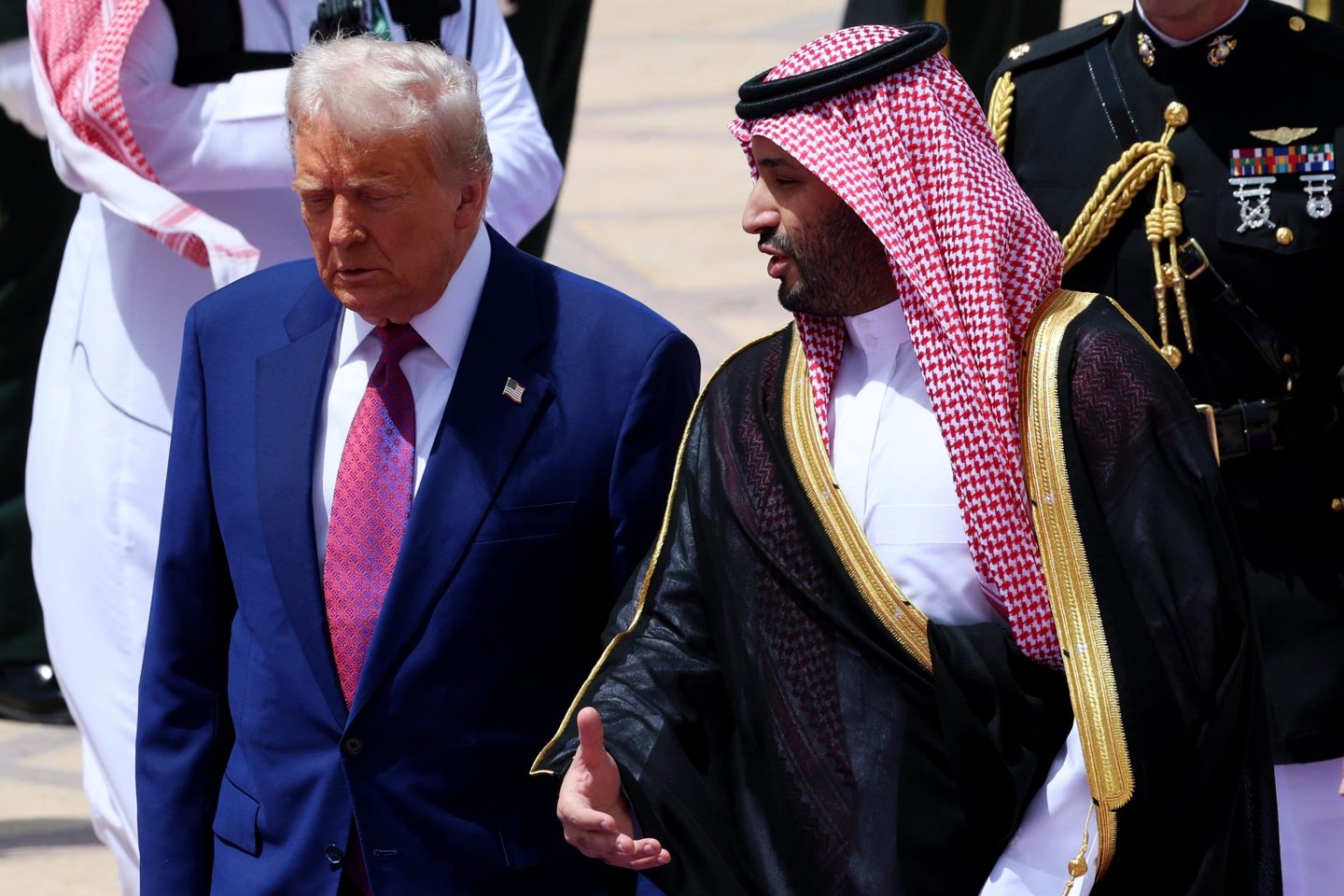
- Saudi Arabia promised to invest $600 billion in the U.S. during President Donald Trump’s trip there. But the kingdom is currently running a deficit, and boosting its spending to promised levels would be extremely difficult unless the price of oil goes higher—complicating Trump’s math.
If there’s one thing President Donald Trump likes almost as much as big economic deals, it’s low gas prices.
His current trip to the Gulf states is bringing those two goals into conflict.
The administration has touted an investment from Saudi Arabia described as totaling $600 billion or, in one case, $1 trillion.
It’s a massive number: At $1 trillion, the investment would be equivalent to the entire value of Saudi Arabia’s sovereign wealth, or the nation’s GDP. For the nation to be able to sustain that level of investment in the U.S. long-term, it would likely require hiking currently-low oil prices—a prospect sure to anger Trump.
“The number is impressive, but its significance will ultimately depend on the depth, timeline, and the price of oil,” John Sfakianakis, chief economist and head of research at the Gulf Research Center in Riyadh, told Fortune. “Unless oil revenues rise, financing such commitments will strain public finances unless managed prudently.”
Oil currently accounts for about 60% of the kingdom’s revenue, according to Gulf News.
“These pledges will of course have to face up to reality as indeed they are large,” Maya Senussi, lead economist at Oxford Economics, told Fortune in an email. “In our view, the headwinds to public finances from lower energy prices and focus on domestic Vision 2030 priorities mean the announced pledges will likely only partly materialise within the four-year timeframe.” (Vision 2030 aims to diversify the Saudi economy through massive public-works projects, whose cost has been pinned as high as $1.5 trillion.)
In order to break even on spending, the state of Saudi Arabia needs the price of oil to be at least $96 a barrel, Bloomberg estimated. (Other estimates put the number above $100 a barrel.)
Brent crude, the international benchmark, is currently trading at about $65 a barrel. That price was $79 in January, when Trump took office—a number the president thought was too high.
“I’m also going to ask Saudi Arabia and OPEC to bring down the cost of oil,” he told the World Economic Forum on Jan. 23. “You got to bring it down, which, frankly, I’m surprised they didn’t do before the election,” Trump said. “That didn’t show a lot of love.”
That love was maybe some months late in coming, but it has arrived, with OPEC announcing production increases for May and June that pushed the price of oil lower. The Saudis’ move “looks like [an] unspoken gift to Trump,” wrote Reuters columnist Ron Bousso. Lower gasoline prices mean “Trump has already scored his big Saudi win,” Clayton Seigle, a senior fellow in the Energy Security and Climate Change Program at the Center for Strategic and International Studies, wrote Wednesday.
How long that price stays low remains to be seen.
Economist question $600B figure
Many observers have cast doubt on the $600 billion deal, calling it unusually large. A fact sheet provided by the White House details investments totaling $282 billion, including the $142 billion in promised U.S. arms sales.
Paul Donovan, chief economist of UBS Global Wealth Management, wrote this week the $600 billion plan has “a fanfare of spin, which does not necessarily change anything in reality. The announcement does not require economic forecasts to change.”
When it comes to the $1 trillion in spending that Trump reportedly sought, Ziad Daoud, Bloomberg’s chief emerging markets economist, told The New York Times it was “far-fetched.”
As it is, $600 billion is roughly 60% of Saudi Arabia’s GDP and about 40% of its current foreign assets, according to Tim Callen, a visiting fellow at the Arab Gulf States Institute and former IMF official. Meeting that target would require the country to quintuple the portion of foreign imports it sources from the U.S. over the next four years, Callen wrote earlier this year. While “it seems likely that Saudi investments in the United States will grow,” he said, “the scale of the commitment looks too large.”
Complicating the commitment is Vision 2030, an ambitious program of public works and economic diversification whose cost has been estimated at $1.3 trillion. These domestic demands have pushed the kingdom into deficit spending. Now add the falling price of oil, and Saudi Arabia’s deficit could double by the end of this year to $70 billion, Goldman Sachs’ Farouk Soussa told CNBC.
To be sure, Saudi Arabia can afford some short-term deficit spending, but it will likely look to close the gap, either by cutting back projects, selling assets, or raising taxes, Soussa said.
Huge numbers, scant details
Trump claims Saudi Arabia bought $450 billion of U.S. exports during his first term, a figure that Callen, of the Arab Gulf States Institute, says was not “anywhere near” reality.
Trump would hardly be the first public official to announce a bombastic public project only to be disappointed by reality. Politicians love to tout their business-friendly bona fides, so much so that debunking these claims has become a cottage industry.
“Let’s be honest, announcements are always at the high end. I don’t think the actual effect is as big as the headline. But the sign is positive,” Simon Johnson, a Nobel prize-winning MIT economist, told Fortune. Johnson previously suggested CEOs get on Trump’s good side by announcing development deals in swing states, even if those promises later turn out to be “vaporware.”
During Trump’s first term, “there were a lot of promises that didn’t come to fruition,” Johnson said. “But that is kind of the nature of the business: If you’re making big investments, they don’t happen overnight.”