• Home
  • News
  • Fortune 500
  • Tech
  • Finance
  • Leadership
  • Lifestyle
  • Rankings
  • Multimedia
FeaturesBill Gates

How the Gates Foundation quietly changed American education: From algebra classes to smaller schools

Geoff Colvin
By
Geoff Colvin
Geoff Colvin
Senior Editor-at-Large
Down Arrow Button Icon
Geoff Colvin
By
Geoff Colvin
Geoff Colvin
Senior Editor-at-Large
Down Arrow Button Icon
May 8, 2025, 8:00 AM ET
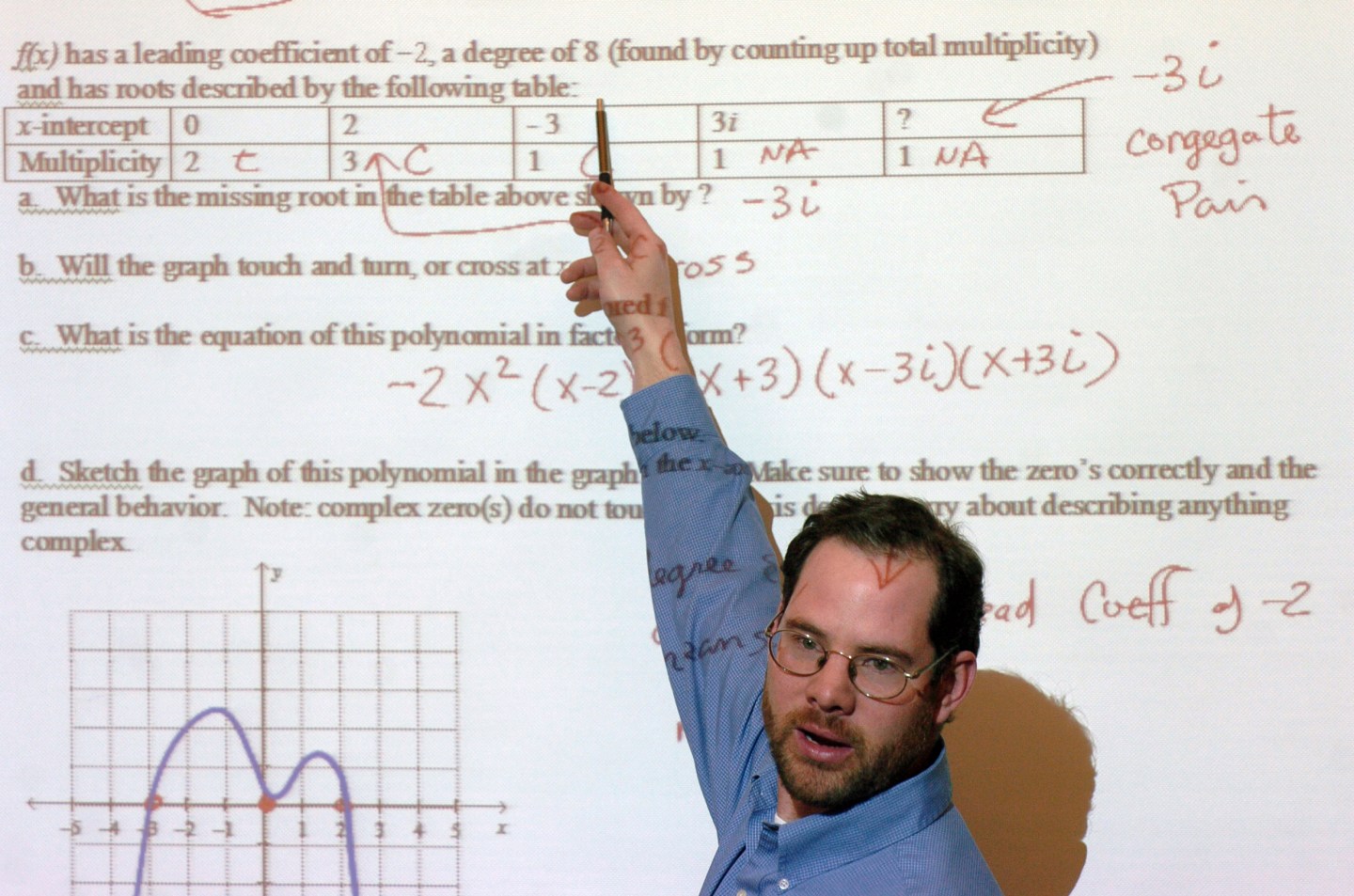
Algebra is a key to successful education, argues the Gates Foundation's education arm.
Algebra is a key to successful education, argues the Gates Foundation's education arm. Helen H. Richardson—The Denver Post/Getty Images

Though most of the billions a year that the Gates Foundation spends go to health projects in Africa and Asia, about 10% goes to a much different program in the U.S. Its ambitious goal: improve public education from kindergarten through high school, especially in cash-strapped or underserved school districts—and then guide high school graduates to good jobs.

Recommended Video

Using its signature combination of data-driven insights, a tech-industry-derived focus on return on investment, public-facing advocacy, and collaborations across a range of public and private entities, the Gates Foundation has quietly nudged school districts toward its core tenets. Those include a focus on math, especially algebra; professional development for teachers; and reform-minded experimentation.

Since the United States Program at the Gates Foundation began 25 years ago, it has partnered with more than 3,700 organizations—including school districts, colleges, nonprofits, community groups, research institutions, and businesses—across the nation. In that time, U.S. public education has improved by several important measures: Most notably, the high school graduation rate has risen from 71% in 2001 to 87% in 2022, the latest available data. The foundation can’t take all the credit for that improvement, says Allan Golston, who runs the Gates Foundation’s U.S. Program, but “we have certainly contributed to that, and are very proud of that.”

The program’s first problem mirrored what confounded the tropical-disease fighters in the foundation’s international operations: lousy data. Most high schools defined their graduation rate as the percentage of 12th-graders who graduated, ignoring all those who dropped out in the previous three years. With the help of the National Governors Association, all states now use the foundation’s comprehensive definition of the graduation rate, which of course produces lower numbers. That change alone shocked officials and parents into demanding action, but it was only a beginning.

Equipped with better data, the foundation identified some 2,000 “dropout factories” across the country, mostly in urban centers—schools with terrible graduation rates. They tended to be big schools, so the foundation reasoned that smaller schools with more individualized support and more engagement between students and teachers would yield better results.

The model worked, up to a point. In some of the big cities where it was tried, significantly more students graduated, went to college, and received bachelor’s degrees. But in other cities, improvements were modest.

Unfortunately, the model was also impractical as a nationwide template. For starters, breaking up a big high school isn’t easy. “There are 15,000 school districts in the U.S.,” says Golston. “Each has different contexts, different boards, different perspectives, different views on how to teach and what to teach.” The model was also expensive. New York City has kept many of these small high schools, and hundreds of high schools elsewhere have adopted the model successfully, but they’re a small proportion of America’s 24,000 public high schools. Bottom line, small schools are great, but in the real world not a broad-based answer.

Today the foundation focuses on factors that any school, regardless of size, can benefit from—improved curriculum, professional development of teachers, tutoring. Research has revealed the crucial importance of one course: algebra. “It’s a critical success factor to graduating and has a number of other predictive factors,” Golston says. Students who pass Algebra 1 in ninth grade are twice as likely to graduate from high school, more likely to enroll in and complete college, and better positioned for careers that increasingly require analytical skills. “It’s so significant in a student’s trajectory,” he says, “that if you could move that metric, you could unlock a lot of progress and success.”

More jobs every year require postsecondary education, which means focusing on high school graduation isn’t enough. The foundation wants students to get good jobs, so it helps them get a postsecondary credential with value—even if that doesn’t always mean a four-year college degree. It could be a two-year course, or some type of certificate, but research shows that momentum is critical: The student should ideally enroll immediately after high school.

The foundation’s U.S. Program is constantly experimenting, which by its nature proves some hypotheses and disproves others. “You see progress in certain parts, and that gives you some optimism,” Golston says. “It also gives you a sense of determination, because we cannot rest until those pockets of success for students aren’t pockets.”


Fortune Brainstorm AI returns to San Francisco Dec. 8–9 to convene the smartest people we know—technologists, entrepreneurs, Fortune Global 500 executives, investors, policymakers, and the brilliant minds in between—to explore and interrogate the most pressing questions about AI at another pivotal moment. Register here.
About the Author
Geoff Colvin
By Geoff ColvinSenior Editor-at-Large
LinkedIn iconTwitter icon

Geoff Colvin is a senior editor-at-large at Fortune, covering leadership, globalization, wealth creation, the infotech revolution, and related issues.

See full bioRight Arrow Button Icon

Latest in Features

FeaturesThe Boring Company
Two firefighters suffered chemical burns in a Boring Co. tunnel. Then the Nevada Governor’s office got involved, and the penalties disappeared
By Jessica Mathews and Leo SchwartzNovember 12, 2025
24 days ago
CoreWeave executives pose in front of the Nasdaq building on the day of the company's IPO.
AIData centers
Data-center operator CoreWeave is a stock-market darling. Bears see its finances as emblematic of an AI infrastructure bubble
By Jeremy Kahn and Leo SchwartzNovember 8, 2025
28 days ago
Libery Energy's hydraulic fracturing, or frac, spreads are increasingly electrified with natural gas power, a technology now translating to powering data centers.
Energy
AI’s insatiable need for power is driving an unexpected boom in oil-fracking company stocks 
By Jordan BlumOctober 23, 2025
1 month ago
Politics
Huge AI data centers are turning local elections into fights over the future of energy
By Sharon GoldmanOctober 22, 2025
2 months ago
A plane carrying Donald Trump Jr. arrives in January in Nuuk, Greenland, where he is making a short private visit after his father, President Trump, suggested Washington annex the autonomous Danish territory.
EnergyGreenland
A Texas company plans to drill for oil in Greenland despite a climate change ban and Trump’s desire to annex the territory
By Jordan BlumOctober 22, 2025
2 months ago
Three of the founders of Multiverse Computing.
AIChange the World
From WhatsApp friends to a $500 million–plus valuation: These founders argue their tiny AI models are better for customers and the planet
By Vivienne WaltOctober 9, 2025
2 months ago

Most Popular

placeholder alt text
Economy
Two months into the new fiscal year and the U.S. government is already spending more than $10 billion a week servicing national debt
By Eleanor PringleDecember 4, 2025
2 days ago
placeholder alt text
Big Tech
Mark Zuckerberg rebranded Facebook for the metaverse. Four years and $70 billion in losses later, he’s moving on
By Eva RoytburgDecember 5, 2025
1 day ago
placeholder alt text
Success
Nvidia CEO Jensen Huang admits he works 7 days a week, including holidays, in a constant 'state of anxiety' out of fear of going bankrupt
By Jessica CoacciDecember 4, 2025
2 days ago
placeholder alt text
Success
‘Godfather of AI’ says Bill Gates and Elon Musk are right about the future of work—but he predicts mass unemployment is on its way
By Preston ForeDecember 4, 2025
2 days ago
placeholder alt text
Success
Nearly 4 million new manufacturing jobs are coming to America as boomers retire—but it's the one trade job Gen Z doesn't want
By Emma BurleighDecember 4, 2025
2 days ago
placeholder alt text
Uncategorized
Transforming customer support through intelligent AI operations
By Lauren ChomiukNovember 26, 2025
10 days ago
Rankings
  • 100 Best Companies
  • Fortune 500
  • Global 500
  • Fortune 500 Europe
  • Most Powerful Women
  • Future 50
  • World’s Most Admired Companies
  • See All Rankings
Sections
  • Finance
  • Leadership
  • Success
  • Tech
  • Asia
  • Europe
  • Environment
  • Fortune Crypto
  • Health
  • Retail
  • Lifestyle
  • Politics
  • Newsletters
  • Magazine
  • Features
  • Commentary
  • Mpw
  • CEO Initiative
  • Conferences
  • Personal Finance
  • Education
Customer Support
  • Frequently Asked Questions
  • Customer Service Portal
  • Privacy Policy
  • Terms Of Use
  • Single Issues For Purchase
  • International Print
Commercial Services
  • Advertising
  • Fortune Brand Studio
  • Fortune Analytics
  • Fortune Conferences
  • Business Development
About Us
  • About Us
  • Editorial Calendar
  • Press Center
  • Work At Fortune
  • Diversity And Inclusion
  • Terms And Conditions
  • Site Map

© 2025 Fortune Media IP Limited. All Rights Reserved. Use of this site constitutes acceptance of our Terms of Use and Privacy Policy | CA Notice at Collection and Privacy Notice | Do Not Sell/Share My Personal Information
FORTUNE is a trademark of Fortune Media IP Limited, registered in the U.S. and other countries. FORTUNE may receive compensation for some links to products and services on this website. Offers may be subject to change without notice.