The U.S. doesn’t export much crude oil or gas to China, but there is a third, lesser-known commodity class that faces dramatic consequences in an escalating trade war—natural gas liquids, especially propane and ethane.
China is by far the largest importer of American ethane—the most common building block for petrochemicals and plastics worldwide—and the second-biggest importer of U.S. propane after Japan. Many countries rely on propane for heating or cooking oil, but China uses it to make propylene—the second-most-utilized petrochemical.
“This is really destruction of demand,” said Rob Wilson, COO for East Daley Analytics, arguing that many of these volumes have nowhere else to go. “The [125%] tariffs are a game changer. It really does change the math.”
There are no easy solutions for rerouting ethane and propane exports, creating the likelihood of plummeting prices, upended supply chains, mothballed chemical plants in China, and financial challenges for U.S. producers, transporters and exporters of natural gas liquids (NGLs), Wilson and other energy analysts said.
Propane and ethane prices already are down about 25% and 15%, respectively, since March with more downward momentum anticipated, said Kristen Holmquist, managing director of analytics for RBN Energy.
Typically produced as a byproduct along with oil or natural gas, U.S. NGL volumes more than doubled in a decade to over 7 million barrels a day, nearly 6 million barrels of which are ethane, propane, and butane, according to the U.S. Energy Information Administration (EIA). That spike triggered a U.S. petrochemical plant construction boom, as well as burgeoning export markets because domestic supplies now far exceed demand.
Unless a tariff exemption for NGLs is offered, China will be forced to shutter petrochemical plants, pay much more for U.S. feedstock supplies, or find new sources—of which there aren’t many alternatives, Holmquist said. After all, no other country exports large volumes of ethane, and only Qatar and the United Arab Emirates are notable propane exporters.
Many of the goods—from toys to car parts—that China manufactures from these petrochemicals are exported back to the U.S., essentially making them double tariffed and larger inflationary contributors, Holmquist said.
“Will it impact how much you pay at the pump for gasoline? No,” she said. “But it could affect how much you pay for your next Barbie doll.”
What happens next?
After grains, especially soybeans, corn, and wheat, NGL products are China’s top U.S. import. All of China’s imports of U.S. fossil fuels accounted for nearly $18 billion last year, according to the U.S.-China Business Council.
The U.S. energy industry has growing concerns but is largely staying mum publicly for now. Fortune 500 players Enterprise Products Partners, Energy Transfer, Targa Resources, Phillips 66, and ONEOK count among the top transporters or exports of NGLs. They all declined comment for this story.
The lobbying arm, the American Petroleum Institute, weighed in via a prepared statement: “NGLs are a critical part of American energy trade, and we will continue to engage the administration and our partners around the world on trade policies that support American energy dominance,” said Dustin Meyer, API senior vice president of policy, economics and regulatory affairs.
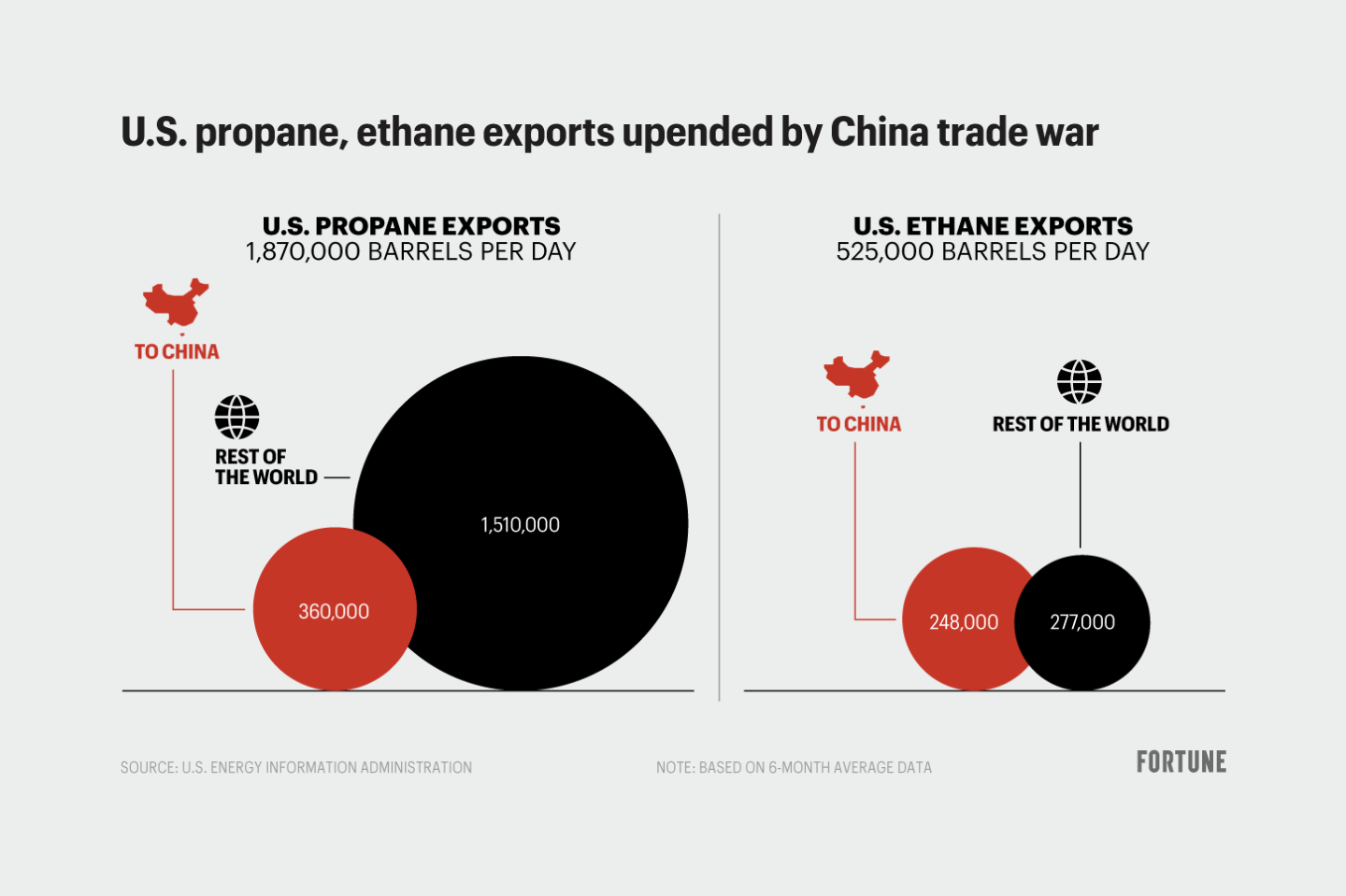
The U.S. exports more than 80% of its propane volumes, and roughly 20% of those exported volumes head to China.
Conversely, the U.S. only ships out about 20% of its ethane, but nearly half of the exports head to China, according to the EIA. Combined, China receives well more than 600,000 barrels a day of U.S. ethane and propane.
The U.S. can’t just stop producing NGLs because doing so would dramatically reduce crude oil and natural gas outputs. While lower crude prices are decreasing forecasts for production growth, the volumes aren’t shrinking, and they all must find somewhere to go.
For propane, the issue is whether the Chinese chemical plants are willing to pay far more, or if they can negotiate spreading the pain between themselves and the U.S. exporters.
“The two industries need each other,” Holmquist said. “The U.S. needs to be able to send its propane to China. For a large portion of it, the propane has nowhere else to go except China.”
If China mothballs plants, then the U.S. could max out its propane storage capacity in a matter of months, she said. Then, it becomes a matter of cheap domestic dumping of propane to U.S. petrochemical plants as prices further collapse.
Wilson said it will be interesting to see what happens with Energy Transfer because it has an NGL export joint venture called Orbit in Texas with China’s Satellite Chemical. The JV is a major source of ethane exports to China. For Satellite, the tariffs hurt both the JV and its chemical plants in China, so the JV may opt to push ahead and keep the exports flowing anyway, he said.
Ethane is a different story because, while the ethane cannot be easily rerouted to other countries, it can essentially disappear within the U.S., largely eliminating much of the ethane export industry temporarily.
That’s because of a phenomenon called ethane rejection. When ethane prices crater, the volumes can simply be rejected by keeping the ethane flowing in the natural gas production stream, meaning the ethane would contribute to domestic natural gas consumption for power generation and other uses.
But ethane rejection still cuts into profits for ethane transportation, storage and exports.
“Ethane is the ultimate chameleon molecule,” Wilson said. “You can reject it into the gas stream and remove about 250,000 barrels a day.”
That math would mean virtually eliminating ethane exports to China.
“We’re already within ethane rejection economics,” Holmquist said.