• Home
  • Latest
  • Fortune 500
  • Finance
  • Tech
  • Leadership
  • Lifestyle
  • Rankings
  • Multimedia
PoliticsTariffs and trade

Trump eyes new tariffs on semiconductors and pharmaceuticals as U.S. only makes 20% of world’s drugs and 0% of advanced logic chips

By
Elaine Kurtenbach
Elaine Kurtenbach
and
The Associated Press
Down Arrow Button Icon
By
Elaine Kurtenbach
Elaine Kurtenbach
and
The Associated Press
Down Arrow Button Icon
April 15, 2025, 4:44 AM ET
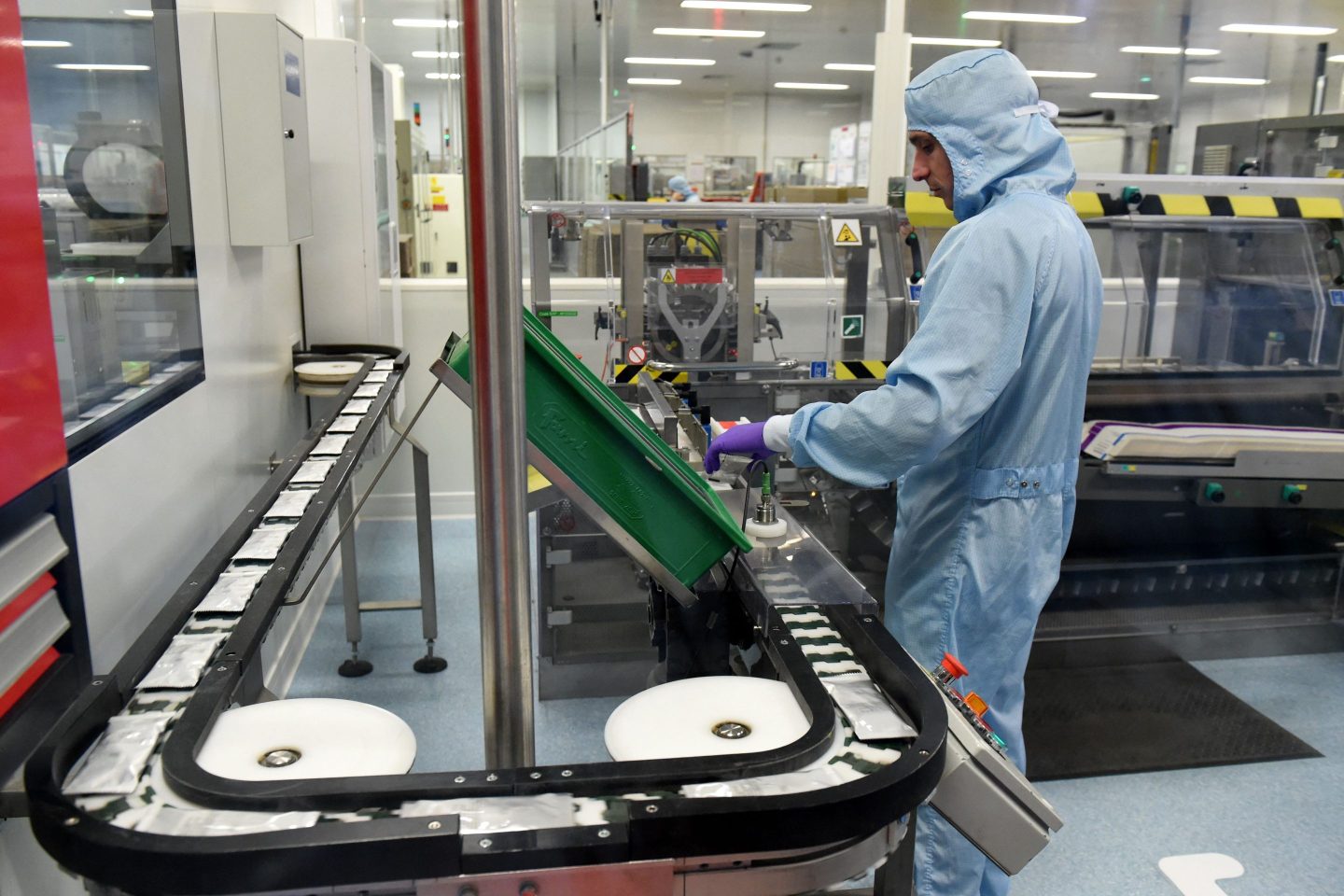
An employee poses controls Augmentin tablets on a production line at the GSK pharmaceutical laboratory in Mayenne, western France, on Jan. 5, 2023.
An employee poses controls Augmentin tablets on a production line at the GSK pharmaceutical laboratory in Mayenne, western France, on Jan. 5, 2023.JEAN-FRANCOIS MONIER—AFP via Getty Images

The Trump administration has taken its next steps toward imposing more tariffs on key imports, launching investigations into imports of computer chips, chip making equipment and pharmaceuticals.

Recommended Video

The Department of Commerce posted notices about the probes late Monday on the Federal Register, seeking public comment within three weeks. It had not formally announced them earlier.

Although President Donald Trump paused most of his biggest tariff hikes last week for 90 days, apart from those for imports from China, he has said he still plans tariffs on pharmaceutical drugs, lumber, copper and computer chips.

The Commerce Department said it is investigating how imports of computer chips, equipment to make them and products that contain them — which include many daily necessities such as cars, refrigerators, smart phones and other items — affect national security. Section 232 of the Trade Expansion Act of 1962 permits the president to order tariffs for the sake of national security.

The probe includes assessing the potential for U.S. domestic production of computer chips to meet U.S. demand and the role of foreign manufacturing and assembly, testing and packaging in meeting those needs.

Among other aspects of the entire computer chip supply chain, the government intends to also study the risks of having computer chip production concentrated in other places and the impact on U.S. competitiveness from foreign government subsidies, “foreign unfair trade practices and state-sponsored overcapacity.”

After Trump said electronics would not be included in what his administration calls “reciprocal” tariffs of up to 50% on some nations, U.S. Commerce Secretary Howard Lutnick explained in an interview on ABC News that pharmaceuticals, semiconductors and autos will be handled with “sector specific” tariffs.

“And those are not available for negotiation,” Lutnick said. “They are just going to be part of making sure we reshore the core national security items that need to be made in this country. We need to make medicine in this country,” he said. “We need to make semiconductors.”

The investigation into pharmaceutical imports includes ingredients used to make such drugs and touches on many of the same aspects of relying on imports to make them.

Asked about his plans for more tariffs on pharmaceuticals, Trump said Monday, “Yeah, we’re going to be doing that.”

He said it would be in the “not too distant future.”

“We’re doing it because we want to make our own drugs,” he said.

More than 70% of the materials, or active pharmaceutical ingredients, used to make medicines made in the United States are produced in other countries, with India, the European Union and China leading suppliers. The U.S. produces about a fifth of all pharmaceuticals made worldwide, but consumes about 45%, far more than any other country.

The U.S. also is a major producer of semiconductors, but only in some areas. It relies heavily on imports from Taiwan and South Korea for certain kinds of advanced chips. In particular, Taiwan dominates advanced logic chip production at 92% of all fabrication capacity according to the International Trade Administration, with South Korea making 8%.

Products like laptops, smartphones and the components needed to make them accounted for nearly $174 billion in U.S. imports from China last year. The administration’s plans suggest that such electronics will still be taxed by previous (non-“reciprocal”) tariffs — and potentially under additional, sector-specific levies.

Although major computer chip makers like Taiwan Semiconductor Manufacturing Corp. are investing heavily in U.S. manufacturing facilities, partly due to incentives put in place during former President Joe Biden’s time in office, the costly process of changing entire supply chains would take years.

Separately, the Commerce Department said Monday that it was withdrawing from a 2019 agreement that had suspended an antidumping investigation into imports of fresh tomatoes from Mexico, effective in 90 days. It said the current arrangement failed to protect U.S. growers from “unfairly priced” imports of tomatoes. Most tomatoes from Mexico will be subject to a 20.91% tariff, it said.


Join us at the Fortune Workplace Innovation Summit May 19–20, 2026, in Atlanta. The next era of workplace innovation is here—and the old playbook is being rewritten. At this exclusive, high-energy event, the world’s most innovative leaders will convene to explore how AI, humanity, and strategy converge to redefine, again, the future of work. Register now.
About the Authors
By Elaine Kurtenbach
See full bioRight Arrow Button Icon
By The Associated Press
See full bioRight Arrow Button Icon

Latest in Politics

North AmericaMexico
U.S., Mexico strike deal to settle Rio Grande water dispute
By Fabiola Zerpa and BloombergDecember 13, 2025
1 hour ago
Danish military forces participate in an exercise with hundreds of troops from several European NATO members in the Arctic Ocean in Nuuk, Greenland, Monday, Sept. 15, 2025.
PoliticsDonald Trump
Danish intelligence report warns of U.S. economic leverage and military threat under Trump
By The Associated PressDecember 13, 2025
3 hours ago
Ukrainian President Volodymyr Zelensky gives a joint press conference in Kyiv, Ukraine in 2023 as European leaders visit the country 18 months after the start of Russia's invasion.
EuropeUkraine invasion
EU indefinitely freezes Russian assets to prevent Hungary and Slovakia from vetoing billions of euros being sent to support Ukraine
By Lorne Cook and The Associated PressDecember 13, 2025
3 hours ago
Spanish Prime Minister Pedro Sánchez often praises the financial and social benefits that immigrants bring to the country.
EuropeSpain
In a continent cracking down on immigration and berated by Trump’s warnings of ‘civilizational erasure,’ Spain embraces migrants
By Suman Naishadham and The Associated PressDecember 13, 2025
3 hours ago
Politicsdavid sacks
Can there be competency without conflict in Washington?
By Alyson ShontellDecember 13, 2025
8 hours ago
PoliticsAffordable Care Act (ACA)
With just days to go before ACA subsidies expire, Congress is about to wrap up its work with no consensus solution in sight
By Kevin Freking, Lisa Mascaro and The Associated PressDecember 13, 2025
9 hours ago

Most Popular

placeholder alt text
Economy
Tariffs are taxes and they were used to finance the federal government until the 1913 income tax. A top economist breaks it down
By Kent JonesDecember 12, 2025
2 days ago
placeholder alt text
Success
Apple cofounder Ronald Wayne sold his 10% stake for $800 in 1976—today it’d be worth up to $400 billion
By Preston ForeDecember 12, 2025
1 day ago
placeholder alt text
Success
40% of Stanford undergrads receive disability accommodations—but it’s become a college-wide phenomenon as Gen Z try to succeed in the current climate
By Preston ForeDecember 12, 2025
1 day ago
placeholder alt text
Economy
The Fed just ‘Trump-proofed’ itself with a unanimous move to preempt a potential leadership shake-up
By Jason MaDecember 12, 2025
1 day ago
placeholder alt text
Economy
For the first time since Trump’s tariff rollout, import tax revenue has fallen, threatening his lofty plans to slash the $38 trillion national debt
By Sasha RogelbergDecember 12, 2025
1 day ago
placeholder alt text
Success
Apple CEO Tim Cook out-earns the average American’s salary in just 7 hours—to put that into context, he could buy a new $439,000 home in just 2 days
By Emma BurleighDecember 12, 2025
1 day ago
Rankings
  • 100 Best Companies
  • Fortune 500
  • Global 500
  • Fortune 500 Europe
  • Most Powerful Women
  • Future 50
  • World’s Most Admired Companies
  • See All Rankings
Sections
  • Finance
  • Leadership
  • Success
  • Tech
  • Asia
  • Europe
  • Environment
  • Fortune Crypto
  • Health
  • Retail
  • Lifestyle
  • Politics
  • Newsletters
  • Magazine
  • Features
  • Commentary
  • Mpw
  • CEO Initiative
  • Conferences
  • Personal Finance
  • Education
Customer Support
  • Frequently Asked Questions
  • Customer Service Portal
  • Privacy Policy
  • Terms Of Use
  • Single Issues For Purchase
  • International Print
Commercial Services
  • Advertising
  • Fortune Brand Studio
  • Fortune Analytics
  • Fortune Conferences
  • Business Development
About Us
  • About Us
  • Editorial Calendar
  • Press Center
  • Work At Fortune
  • Diversity And Inclusion
  • Terms And Conditions
  • Site Map

© 2025 Fortune Media IP Limited. All Rights Reserved. Use of this site constitutes acceptance of our Terms of Use and Privacy Policy | CA Notice at Collection and Privacy Notice | Do Not Sell/Share My Personal Information
FORTUNE is a trademark of Fortune Media IP Limited, registered in the U.S. and other countries. FORTUNE may receive compensation for some links to products and services on this website. Offers may be subject to change without notice.