• Home
  • Latest
  • Fortune 500
  • Finance
  • Tech
  • Leadership
  • Lifestyle
  • Rankings
  • Multimedia

Trendingnow

1

Mark Cuban says he has the solution to growing income inequality, and it's to reward every employee—from CEO to janitor—with company stock

2

OpenAI says its AI models secretly broke out of a secure test environment and hacked into AI company Hugging Face in order to cheat on an evaluation

3

Mathematicians grapple with a ‘very rapid and very unsettling change’ as AI cracks yet another century-old problem

1

Mark Cuban says he has the solution to growing income inequality, and it's to reward every employee—from CEO to janitor—with company stock

2

OpenAI says its AI models secretly broke out of a secure test environment and hacked into AI company Hugging Face in order to cheat on an evaluation

3

Mathematicians grapple with a ‘very rapid and very unsettling change’ as AI cracks yet another century-old problem
TechAI

The CEO of CoreWeave explains why they went public—And why they scaled back their initial offer

Diane Brady
By
Diane Brady
Diane Brady
Executive Editorial Director
Down Arrow Button Icon
Diane Brady
By
Diane Brady
Diane Brady
Executive Editorial Director
Down Arrow Button Icon
March 28, 2025, 5:06 PM ET
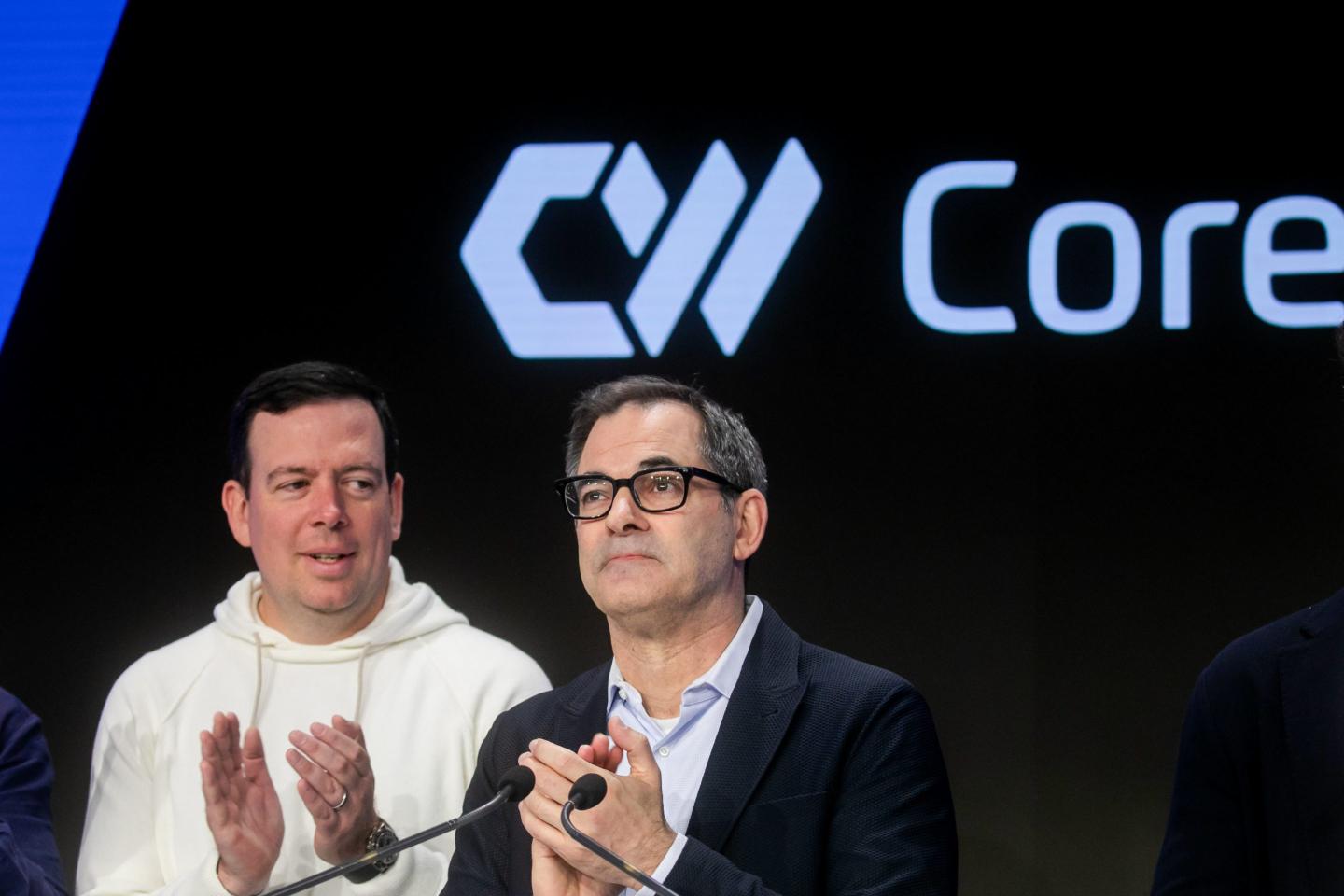
Michael Intrator, co-founder and chief executive officer of CoreWeave Inc., right, during the company's initial public offering at the Nasdaq MarketSite in New York, US, on Friday, March 28, 2025.
Michael Intrator, co-founder and chief executive officer of CoreWeave Inc., right, during the company's initial public offering at the Nasdaq MarketSite in New York, US, on Friday, March 28, 2025. Michael Nagle/Bloomberg — Getty Images
Add Fortune on Google for similar content.

Shares of CoreWeave, an AI cloud provider, started trading Friday following a much-anticipated IPO that is being seen as a litmus test for other AI companies hoping to go public. 

Recommended Video

Originally founded as a crypto mining company, CoreWeave pivoted to renting out its Nvidia graphic processing units to companies desperate to train AI. The New Jersey-based company is the first tech listing this year, but its debut does not come without controversy. While revenue is up more than 700% year over year, only two customers account for 77% of that figure, and the company has warned of “material weaknesses,” including its capacity for internal financial reporting.

The company’s shares opened at $39, and reached $41.79 earlier today after being priced at $40 in the IPO. The company—founded by Michael Intrator, Brannin McBee, and Brian Venturo—now has a market cap of around $19.44 billion. The stock closed at just under $40. 

I sat down with Intrator, the company’s CEO, to hear more about what differentiates their business, and why they decided to go public. 

This interview has been edited and condensed for clarity


Fortune: To be an AI company based in New Jersey is like being East Coast rap.  

Michael Intrator: Funny, because that’s sort of how we feel. 


So how are you feeling about the IPO? 

I am unbelievably excited about what we’ve accomplished and it’s just so incredible for the company. It’s incredible for our ability to continue to execute and scale our business. I’m really, really excited about where we are.  


What differentiates you in the market? 

There are three things that we do as a company. The first piece is that we built a beautiful technical solution to how to run parallelized computing in the cloud. It’s a software solution that is specifically specialized to make the compute performant available, scalable, flexible, all the things that you need to build and train and serve artificial intelligence use cases. When the hyperscalers built a function for CPU computing, they built a minivan—a configuration of compute that was really good at everything, but not great at anything, and that was exactly what you needed to build a cloud for [a] CPU-based computer, sequential based. What we did is we stepped back and said, “How do you architect a beautiful technical solution to this new problem associated with how you run cloud computing for parallelized workloads?” We have a better software solution to optimize the infrastructure.  

The second one is, you need to understand the power markets, the data, to ultimately make the compute available and useful for your clients. And we’re able to do that at massive scale. 

And the third area of the business is that we need to be able to use the financial markets to access the size and scale of capital that allows you to build at a scale that lets you be relevant in this revolution.  


What made you decide to tap the capital markets right now?  

Going public was a means to an end for us. We are focused on the debt markets, because the debt markets are how we will finance and build the business and scale it. By becoming public, by continuing to scale the business, we will be able to more effectively tap the debt markets, which will drive down the cost structure associated with building at this magnitude. And so ultimately, the company will become a rated entity, and we’ll be able to borrow at a much tighter spread to the other folks that we’re competing with in the market. The objective was to get to the market, to build a syndicate of buyers that are very sticky and believe in the mission that we are building, that are going to be long-term shareholders that will give us an opportunity to drive value over the next 20 years.  


You scaled back the size of the offer. 

When you take into account the broader market headwinds, the AI headwinds around that specific trade, it just made sense to shrink the size of the offering and to adjust the price to account for the current risk profile on the market. And ultimately, today is the best day to go public, because it puts us on the path towards what we need to accomplish as a business. Yeah, so, a little bigger, a little smaller, a little higher, a little lower. That’s not going to matter. What’s going to matter is, how do we execute on our business? How do we scale our business? How do we build our client base? How do we diversify our clients, all of those things that are just so important and so much easier when you are a public company than a private company.   


What’s your reaction to the media coverage around the IPO? You’re not too concentrated on one client?  

Well, they say that we had 60% of revenue from Microsoft, and then we signed a contract with OpenAI for just under $12 billion and now we’re less than 50%. All the big players that need this type of infrastructure, that understand the quality of the infrastructure we deliver and the skill and performance that they will be able to achieve with it, those are our customers. And then we’ll have other customers like JPMorgan and IBM and, you know, Jane Street Training that use the infrastructure in a different way to solve for a very specific problem. They will be wonderful clients too, but they’re not going to be building a three gigawatt facility. There’s just not that many people that need that. So there will be concentration when you win one of those mind-bendingly large deals, and you’re going to win a lot of other deals in the enterprise space that are really, really interesting.  


So what is the market getting wrong?  

I think that the market needs to understand over time that there will be concentration for everyone that’s serving us.  


Alibaba’s chairman said that he thinks there could be a data center bubble. And DeepSeek planted the idea we may not need all this compute.  

I think there’s a divergence between what the capital markets and what the media is thinking, and what I am feeling down in the trenches. What I am feeling—and then I’ll tell you what I think the media saying—is relentless demand. We need more compute. We need larger compute. We have many, many clients in line to get into our infrastructure, and we are throttled by our ability to bring it up online as we build up the data center and infrastructure to deliver it. I think that’s true for a lot of other really important clients out there, like Meta.  


Have you become too emblematic of broader trends? Do you feel that too much is being thrust on you in terms of what this IPO represents, what you represent?  

I really don’t think about it that way. I think about it as this idea is important for our company to continue to execute on our strategy, and one of the things that we do really well is execute, so I don’t get too distracted by the noise. I know what my clients want. I know the type of infrastructure they need. I know the type of scale that they’re requesting, and I build for them and we are client-led.  


What’s your message for those who wonder about your boldness in coming to market now?  

I think that the boldness of coming to this market amid the turmoil is because of a fundamental belief that, over time, I will be able to generate enormous value for my investors. I don’t really care where it is today or tomorrow or the day after, but I believe fundamentally, the business model that we have, the software solutions that we have, the capacity to build and deliver this and the demand we see in front of us will lead to enormous value to our clients over time. 


Given your history with crypto mining, any thoughts on that?  

Yeah, I don’t. I don’t spend too much time on that. My business is really focused on this, and I got my hands full, as I’m sure you can imagine.   


The stock opened $1 below the IPO price. Do you feel like there’s some fatigue setting in?  

I think there’s a lot of people who are talking their book and causing an echo chamber. Look at the end of the day, the overriding lens that I use here is that in entering the public markets, I have prepared this company to be able to continue to build and execute, and when you can do that, you can drive enormous shareholder value to your investors. That’s what we’re going to do every day.  

About the Author
Diane Brady
By Diane BradyExecutive Editorial Director
LinkedIn icon

Diane Brady writes about the issues and leaders impacting the global business landscape. In addition to writing Fortune’s CEO Daily newsletter, she co-hosts the Leadership Next podcast, interviews newsmakers on stage at events worldwide and oversees the Fortune CEO Initiative. She previously worked at Forbes, McKinsey, Bloomberg Businessweek, the Wall Street Journal, and Maclean's. Her book Fraternity was named one of Amazon’s best books of 2012, and she also co-wrote Connecting the Dots with former Cisco CEO John Chambers.

See full bioRight Arrow Button Icon
Add Fortune on Google for similar content.

Latest in Tech

Finance
Lorem ipsum dolor sit amet, consectetur adipiscing elit, sed do eiusmod tempor incididunt ut labore et dolore magna aliqua. Ut enim ad minim veniam
By Fortune Editors
October 20, 2025
Finance
Lorem ipsum dolor sit amet, consectetur adipiscing elit, sed do eiusmod tempor incididunt ut labore et dolore magna aliqua. Ut enim ad minim veniam
By Fortune Editors
October 20, 2025
Finance
Lorem ipsum dolor sit amet, consectetur adipiscing elit, sed do eiusmod tempor incididunt ut labore et dolore magna aliqua. Ut enim ad minim veniam
By Fortune Editors
October 20, 2025
Finance
Lorem ipsum dolor sit amet, consectetur adipiscing elit, sed do eiusmod tempor incididunt ut labore et dolore magna aliqua. Ut enim ad minim veniam
By Fortune Editors
October 20, 2025
Finance
Lorem ipsum dolor sit amet, consectetur adipiscing elit, sed do eiusmod tempor incididunt ut labore et dolore magna aliqua. Ut enim ad minim veniam
By Fortune Editors
October 20, 2025
Finance
Lorem ipsum dolor sit amet, consectetur adipiscing elit, sed do eiusmod tempor incididunt ut labore et dolore magna aliqua. Ut enim ad minim veniam
By Fortune Editors
October 20, 2025

Most Popular

Finance
Lorem ipsum dolor sit amet, consectetur adipiscing elit, sed do eiusmod tempor incididunt ut labore et dolore magna aliqua. Ut enim ad minim veniam
By Fortune Editors
October 20, 2025
Finance
Lorem ipsum dolor sit amet, consectetur adipiscing elit, sed do eiusmod tempor incididunt ut labore et dolore magna aliqua. Ut enim ad minim veniam
By Fortune Editors
October 20, 2025
Finance
Lorem ipsum dolor sit amet, consectetur adipiscing elit, sed do eiusmod tempor incididunt ut labore et dolore magna aliqua. Ut enim ad minim veniam
By Fortune Editors
October 20, 2025
Finance
Lorem ipsum dolor sit amet, consectetur adipiscing elit, sed do eiusmod tempor incididunt ut labore et dolore magna aliqua. Ut enim ad minim veniam
By Fortune Editors
October 20, 2025
Finance
Lorem ipsum dolor sit amet, consectetur adipiscing elit, sed do eiusmod tempor incididunt ut labore et dolore magna aliqua. Ut enim ad minim veniam
By Fortune Editors
October 20, 2025
Finance
Lorem ipsum dolor sit amet, consectetur adipiscing elit, sed do eiusmod tempor incididunt ut labore et dolore magna aliqua. Ut enim ad minim veniam
By Fortune Editors
October 20, 2025
Fortune Secondary Logo
Rankings
  • 100 Best Companies
  • Fortune 500
  • Global 500
  • Fortune 500 Europe
  • Most Powerful Women
  • World's Most Admired Companies
  • See All Rankings
  • Lists Calendar
Sections
  • Finance
  • Fortune Crypto
  • Features
  • Leadership
  • Health
  • Commentary
  • Success
  • Retail
  • Mpw
  • Tech
  • Lifestyle
  • CEO Initiative
  • Asia
  • Politics
  • Conferences
  • Europe
  • Newsletters
  • Personal Finance
  • Environment
  • Magazine
  • Education
Customer Support
  • Frequently Asked Questions
  • Customer Service Portal
  • Privacy Policy
  • Terms Of Use
  • Single Issues For Purchase
  • International Print
Commercial Services
  • Advertising
  • Fortune Brand Studio
  • Fortune Analytics
  • Fortune Conferences
  • Business Development
  • Group Subscriptions
About Us
  • About Us
  • Press Center
  • Work At Fortune
  • Terms And Conditions
  • Site Map
  • About Us
  • Press Center
  • Work At Fortune
  • Terms And Conditions
  • Site Map
  • Facebook icon
  • Twitter icon
  • LinkedIn icon
  • Instagram icon
  • TikTok icon
  • YouTube icon

Latest in Tech

Larry Page and Sergey Brin
SuccessBillionaires
Google’s founders are snapping up Miami mansions, as billionaires flee California’s proposed tax—and the company is buying office space to accommodate
By Emma BurleighJuly 22, 2026
3 hours ago
orson
CommentaryOpenAI
We got California to intervene about OpenAI’s corporate switch from nonprofit status. It’s time for the SEC to come to the table
By Orson Aguilar and Catherine BracyJuly 22, 2026
6 hours ago
A woman observes stock trends on her smartphone while a computer screen displays financial graphs.
NewslettersCFO Daily
Beyond SpaceX: Why great IPOs depend on more than first-day demand
By Sheryl EstradaJuly 22, 2026
6 hours ago
Arrakis cofounder and CEO Rafael Quintanilla.
Startups & VentureVenture Capital
Exclusive: Arrakis, betting AI’s biggest payoff is in industrial sectors not office work, emerges from stealth with $38 million in venture funding
By Jeremy KahnJuly 22, 2026
6 hours ago
ls
Commentarybooks
Confessions of an award-winning AI memoirist — the ‘slop’ debate isn’t really about good writing, and you know it
By Luke StoffelJuly 22, 2026
7 hours ago
b
Commentarythe future of work
Manpower President: The future of work question that even CEOs can’t answer
By Becky FrankiewiczJuly 22, 2026
7 hours ago

Most Popular

Mark Cuban says he has the solution to growing income inequality, and it's to reward every employee—from CEO to janitor—with company stock
Success
Mark Cuban says he has the solution to growing income inequality, and it's to reward every employee—from CEO to janitor—with company stock
By Sasha RogelbergJuly 20, 2026
2 days ago
OpenAI says its AI models secretly broke out of a secure test environment and hacked into AI company Hugging Face in order to cheat on an evaluation
Cybersecurity
OpenAI says its AI models secretly broke out of a secure test environment and hacked into AI company Hugging Face in order to cheat on an evaluation
By Jeremy Kahn and Emily ForliniJuly 21, 2026
23 hours ago
Mathematicians grapple with a ‘very rapid and very unsettling change’ as AI cracks yet another century-old problem
AI
Mathematicians grapple with a ‘very rapid and very unsettling change’ as AI cracks yet another century-old problem
By Eva RoytburgJuly 21, 2026
1 day ago
Despite a $156 million contract, Knicks star Jalen Brunson still calls his parents for financial advice any time he makes a big purchase
Success
Despite a $156 million contract, Knicks star Jalen Brunson still calls his parents for financial advice any time he makes a big purchase
By Emma BurleighJuly 21, 2026
1 day ago
‘I want to die broke’: Billionaire philanthropist Denny Sanford dies after giving away $4 billion
Success
‘I want to die broke’: Billionaire philanthropist Denny Sanford dies after giving away $4 billion
By Sydney LakeJuly 20, 2026
2 days ago
'Dr. Doom' Nouriel Roubini says we're headed for universal basic income or 'some form of socialism' as AI revolutionizes work—He calls that optimistic
AI
'Dr. Doom' Nouriel Roubini says we're headed for universal basic income or 'some form of socialism' as AI revolutionizes work—He calls that optimistic
By Jason MaJuly 18, 2026
4 days ago

© 2026 Fortune Media IP Limited. All Rights Reserved. Use of this site constitutes acceptance of our Terms of Use and Privacy Policy | CA Notice at Collection and Privacy Notice | Do Not Sell/Share My Personal Information
FORTUNE is a trademark of Fortune Media IP Limited, registered in the U.S. and other countries. FORTUNE may receive compensation for some links to products and services on this website. Offers may be subject to change without notice.