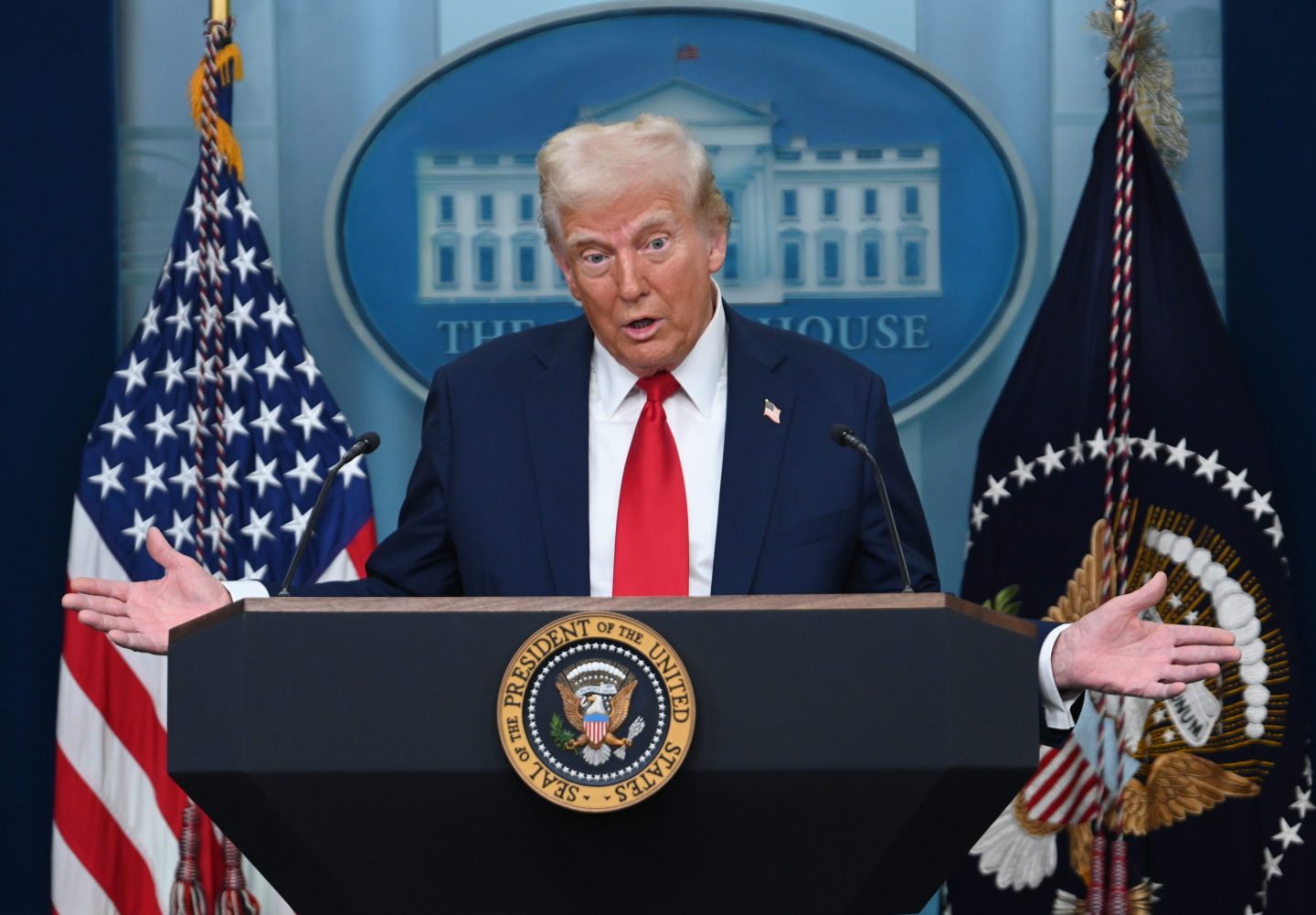
President Donald Trump’s move to further decouple economic ties between the US and China rattled global investors, who had bet on a sustained rebound in Chinese stocks.
The Hang Seng Tech Index slid 1.6% on Tuesday, taking its two-day loss to nearly 3%. The Nasdaq Golden Dragon China Index slumped 5.2% on Monday following the US leader’s sweeping directive to limit investments between the world’s two largest economies.
Geopolitical risks have taken center stage again as investors fear that Trump’s renewed scrutiny of Chinese companies will worsen trade relations. The impact was more pronounced in US-listed stocks due to worries of a revival of 2022 — when bilateral tensions pushed Chinese firms to the brink of a mass delisting from US exchanges.
At the same time, investors in mainland China have viewed any drop in shares as an opportunity to buy. They added another HK$22 billion ($2.8 billion) of Hong Kong stocks on Tuesday, doubling down their bets on China’s artificial intelligence sector as a priority for President Xi Jinping.
“US investors tend to take profit much quicker especially since Chinese investors have more visibility around the tech and AI developments in China,” said Ken Wong, an Asian equity portfolio specialist at Eastspring Investments. “US investors have a much smaller appetite to ride the momentum at this point given how Chinese markets have performed over the past few years.”
The wide performance gap between Alibaba’s securities in the US and Hong Kong is the latest sign of diverging investor sentiment. In the US, its ADRs plunged 10%, while in Hong Kong, shares trimmed losses to less than 4%.
Alibaba’s ADRs traded at a 7.6% discount to its Hong Kong listing on Monday, the widest since May 2022, Bloomberg-compiled data shows. That compares to around 0.1% discount on a five-year average.
AI Euphoria
Before this week’s slowdown, Chinese internet megacaps were on a tear as DeepSeek gave investors confidence on the industry’s growth potential.
A bulk of that rally has been driven by mainland traders. They extended buying for the year to nearly HK$240 billion as of Tuesday close.
A report that Trump’s team was looking to toughen restrictions on Chinese chipmakers likely emboldened the buying, as mainland investors envisioned the move will accelerate Beijing’s bid for tech self-sufficiency.
US investors were unnerved by Trump’s directive to review the ownership structure of foreign companies on American exchanges and prevent pension plans from investing in businesses of foreign adversaries.
Analysts interpreted the orders as taking aim at China and potentially calling into doubt the “variable interest entity” structure that underpins many Chinese listings in the US.
For market watchers, the decoupling worries are a long time coming. An analysis of filings by 14 US pension funds with investments in Chinese stocks showed that the majority have reduced their holdings since 2020. The ex-China theme has continued to gain traction for emerging-market investors. Last year saw 24 ex-China emerging market equity fund launches, a new annual record, and up from 19 in 2023, data compiled by Bloomberg show.
Despite the day’s swings, the Hang Seng Tech Index has gained more than 27% for the year. Wall Street analysts have been saying the once-shunned sector is at a turning point, especially in the wake of President Xi’s high-profile meeting with Chinese tech business leaders.
“This is without doubt a buying opportunity for southbound investors like us, especially as the drop in ADRs does not impact the changed narrative around China tech,” said Zeng Wenkai, managing director at Shengqi Asset Management Co. “I would compare China’s AI rally to the mid-to late 2023 rally for Nvidia so it has much more of the journey to go.”