
• Home
  • Latest
  • Fortune 500
  • Finance
  • Tech
  • Leadership
  • Lifestyle
  • Rankings
  • Multimedia
EnvironmentNew York

Armies of rats are laying waste to cities and the $27 billion-a-year problem is only getting worse

Irina Ivanova
By
Irina Ivanova
Irina Ivanova
Deputy US News Editor
Down Arrow Button Icon
Irina Ivanova
By
Irina Ivanova
Irina Ivanova
Deputy US News Editor
Down Arrow Button Icon
February 6, 2025, 9:02 PM ET
Rat on a traffic cone
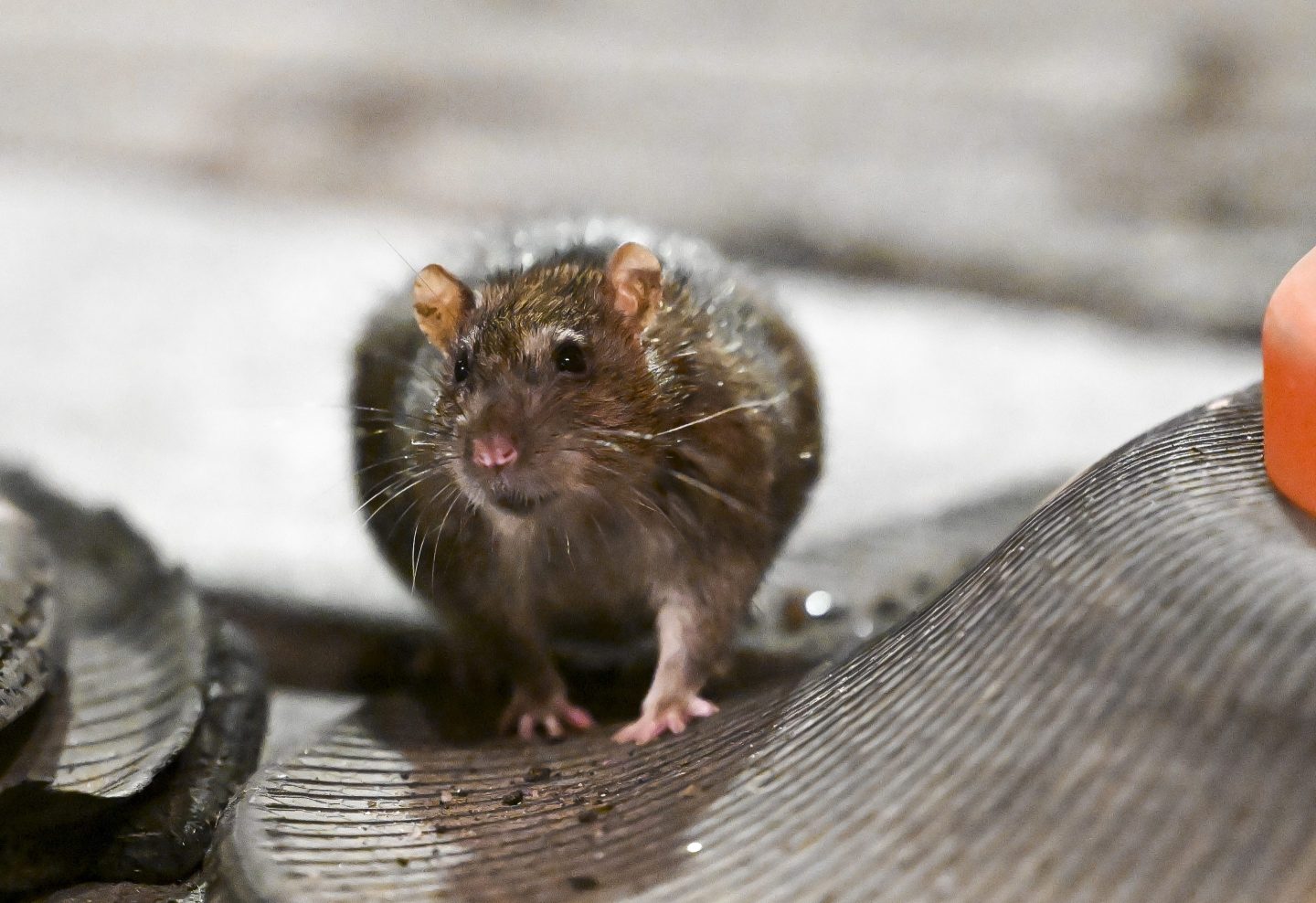
New York, home to nearly as many rats as people, has been fighting the rodent incursion for centuries.Getty Images
  • The saying goes that Kansas City in August is hotter than two rats in a wool sock, but it turns out the rising temperatures from climate change are fueling explosive growth in the global rat population. The warmer weather potentially expands the time they have to breed, putting cities on the back foot in their fight against the vermin.  

The latest chapter of New York’s centuries-long war on rats has the city throwing everything at the problem—from enforcing new garbage laws, to enlisting bands of vigilante rat hunters, to putting the rodents on birth control. But while the U.S.’s largest city may be gaining ground in the anti-rat battle, the global fight is getting much harder, thanks to problems of humans’ own making, new research suggests. 

Rising temperatures and more people living in dense environments are set to increase rat presence in some of the world’s most important cities, suggests a study published last week in Science Advances. That’s bad news for a future where ongoing climate change is projected to push already elevated temperatures even higher.

“The warmer cities are getting, the faster their rat populations are increasing,” lead author Jonathan Richardson, assistant professor of biology at the University of Richmond, told Fortune. 

Richardson and his coauthors found that 11 of 16 global cities for which they obtained data saw their rat populations grow over a decade-long period, with the biggest growth happening in Washington, D.C., San Francisco, Toronto, New York, and Amsterdam. Cities where temperatures were rising fastest showed the biggest rodent gains. High rates of urbanization (defined as low rates of green space) as well as larger populations were also objectively rattier, the researchers found.  

Only three cities—New Orleans, Louisville, and famously clean Tokyo—saw rat populations drop over this period, Richardson said.

As perhaps the most successful mammal in colonizing the globe after Homo sapiens, rats are humans’ longtime foils and foes. A constant companion to people ever since the first urban settlements formed thousands of years ago, the rodents have metastasized into a $27 billion-a-year problem in the U.S. alone, damaging crops, chewing up wires, spreading at least 50 distinct diseases, and ripping up lawns, to name just a few issues.  

Warmer weather, especially in the winter, gives rats more opportunities to secure food and a potentially longer breeding window, the researchers noted. 

“A rat doesn’t hibernate, so if it has just a day or two to come above ground and replenish its food cache in its burrow, that can bolster its survivorship and lead to more baby rats come spring,” Richardson said. “A rat that is well-fed in the winter can reproduce in the winter.”

Rats’ remarkable multiplying properties are one reason that pest-control efforts have barely made a dent in urban rat populations: In good conditions, a female rat can produce a litter of a dozen or more pups every month. “This species is exquisitely adaptive to reproducing and pumping out new rats,” Richardson said. The other is their status as a commensal mammal, meaning one that lives alongside people, “feeding on our resources and exploiting our own mess that we create for ourselves.” In the Science Advances study, more urbanized environments, defined as those with less green space, were the second-biggest factor behind rat increases after warming temperatures. 

All that means that to effectively deal with the problem, cities have to take a more proactive approach, Richardson said: Rather than trying to poison the rodents into oblivion, cities should make living environments more hostile to rats by eliminating easy food sources and comfortable breeding quarters. In this regard, he praised New York’s efforts to put more trash in secured containers and limit how much time garbage spends on the street before being collected. An early effort in upper Manhattan has shown positive results and is expanding to more neighborhoods, he noted. Cities could also encourage homeowners to clean up their properties to make them inhospitable to rats, even fining those who don’t comply.

“Sanitation is the number-one strategy that we can use effectively to limit rats,” he added. “Any city rodent management plan that doesn’t start with sanitation and trash removal is bound to fail.”


Join us at the Fortune Workplace Innovation Summit May 19–20, 2026, in Atlanta. The next era of workplace innovation is here—and the old playbook is being rewritten. At this exclusive, high-energy event, the world’s most innovative leaders will convene to explore how AI, humanity, and strategy converge to redefine, again, the future of work. Register now.
About the Author
Irina Ivanova
By Irina IvanovaDeputy US News Editor

Irina Ivanova is the former deputy U.S. news editor at Fortune.


See full bioRight Arrow Button Icon

Latest in Environment

carbon
Commentaryclimate change
Banking on carbon markets 2.0: why financial institutions should engage with carbon credits
By Usha Rao-MonariDecember 13, 2025
10 hours ago
mackenzie
Personal Financephilanthropy
‘This year, I really see education and climate’: Patterns in billionaire MacKenzie Scott’s massive giving emerge with time
By Thalia Beaty and The Associated PressDecember 11, 2025
2 days ago
Google DeepMind cofounder and CEO Demis Hassabis
AIU.K.
Google DeepMind agrees to sweeping partnership with U.K. government focused on science and clean energy
By Jeremy KahnDecember 10, 2025
3 days ago
InnovationBrainstorm AI
Rivian CEO says buying an EV isn’t a political choice, pointing out that R1 buyers are split evenly between Republicans and Democrats
By Jason MaDecember 10, 2025
3 days ago
AIBrainstorm AI
Google Cloud CEO lays out 3-part strategy to meet AI’s energy demands, after identifying it as ‘the most problematic thing’
By Jason MaDecember 8, 2025
5 days ago
Apple CEO Tim Cook wearing a white polo shirt and throwing up a peace sign
Big TechApple
Apple won’t be the same in 2026. Meet the company’s next generation of leaders and rising stars after its biggest executive exodus in years
By Dave SmithDecember 8, 2025
5 days ago

Most Popular

placeholder alt text
Economy
Tariffs are taxes and they were used to finance the federal government until the 1913 income tax. A top economist breaks it down
By Kent JonesDecember 12, 2025
1 day ago
placeholder alt text
Success
Apple cofounder Ronald Wayne sold his 10% stake for $800 in 1976—today it’d be worth up to $400 billion
By Preston ForeDecember 12, 2025
1 day ago
placeholder alt text
Success
40% of Stanford undergrads receive disability accommodations—but it’s become a college-wide phenomenon as Gen Z try to succeed in the current climate
By Preston ForeDecember 12, 2025
1 day ago
placeholder alt text
Economy
The Fed just ‘Trump-proofed’ itself with a unanimous move to preempt a potential leadership shake-up
By Jason MaDecember 12, 2025
1 day ago
placeholder alt text
Economy
For the first time since Trump’s tariff rollout, import tax revenue has fallen, threatening his lofty plans to slash the $38 trillion national debt
By Sasha RogelbergDecember 12, 2025
1 day ago
placeholder alt text
Success
Apple CEO Tim Cook out-earns the average American’s salary in just 7 hours—to put that into context, he could buy a new $439,000 home in just 2 days
By Emma BurleighDecember 12, 2025
1 day ago
Rankings
  • 100 Best Companies
  • Fortune 500
  • Global 500
  • Fortune 500 Europe
  • Most Powerful Women
  • Future 50
  • World’s Most Admired Companies
  • See All Rankings
Sections
  • Finance
  • Leadership
  • Success
  • Tech
  • Asia
  • Europe
  • Environment
  • Fortune Crypto
  • Health
  • Retail
  • Lifestyle
  • Politics
  • Newsletters
  • Magazine
  • Features
  • Commentary
  • Mpw
  • CEO Initiative
  • Conferences
  • Personal Finance
  • Education
Customer Support
  • Frequently Asked Questions
  • Customer Service Portal
  • Privacy Policy
  • Terms Of Use
  • Single Issues For Purchase
  • International Print
Commercial Services
  • Advertising
  • Fortune Brand Studio
  • Fortune Analytics
  • Fortune Conferences
  • Business Development
About Us
  • About Us
  • Editorial Calendar
  • Press Center
  • Work At Fortune
  • Diversity And Inclusion
  • Terms And Conditions
  • Site Map

© 2025 Fortune Media IP Limited. All Rights Reserved. Use of this site constitutes acceptance of our Terms of Use and Privacy Policy | CA Notice at Collection and Privacy Notice | Do Not Sell/Share My Personal Information
FORTUNE is a trademark of Fortune Media IP Limited, registered in the U.S. and other countries. FORTUNE may receive compensation for some links to products and services on this website. Offers may be subject to change without notice.