• Home
  • Latest
  • Fortune 500
  • Finance
  • Tech
  • Leadership
  • Lifestyle
  • Rankings
  • Multimedia
Personal Financestudent loans and debt

Trump wants to abolish the Department of Education: What that could mean for student loan borrowers

Alicia Adamczyk
By
Alicia Adamczyk
Alicia Adamczyk
Senior Writer
Down Arrow Button Icon
Alicia Adamczyk
By
Alicia Adamczyk
Alicia Adamczyk
Senior Writer
Down Arrow Button Icon
February 5, 2025, 11:40 AM ET
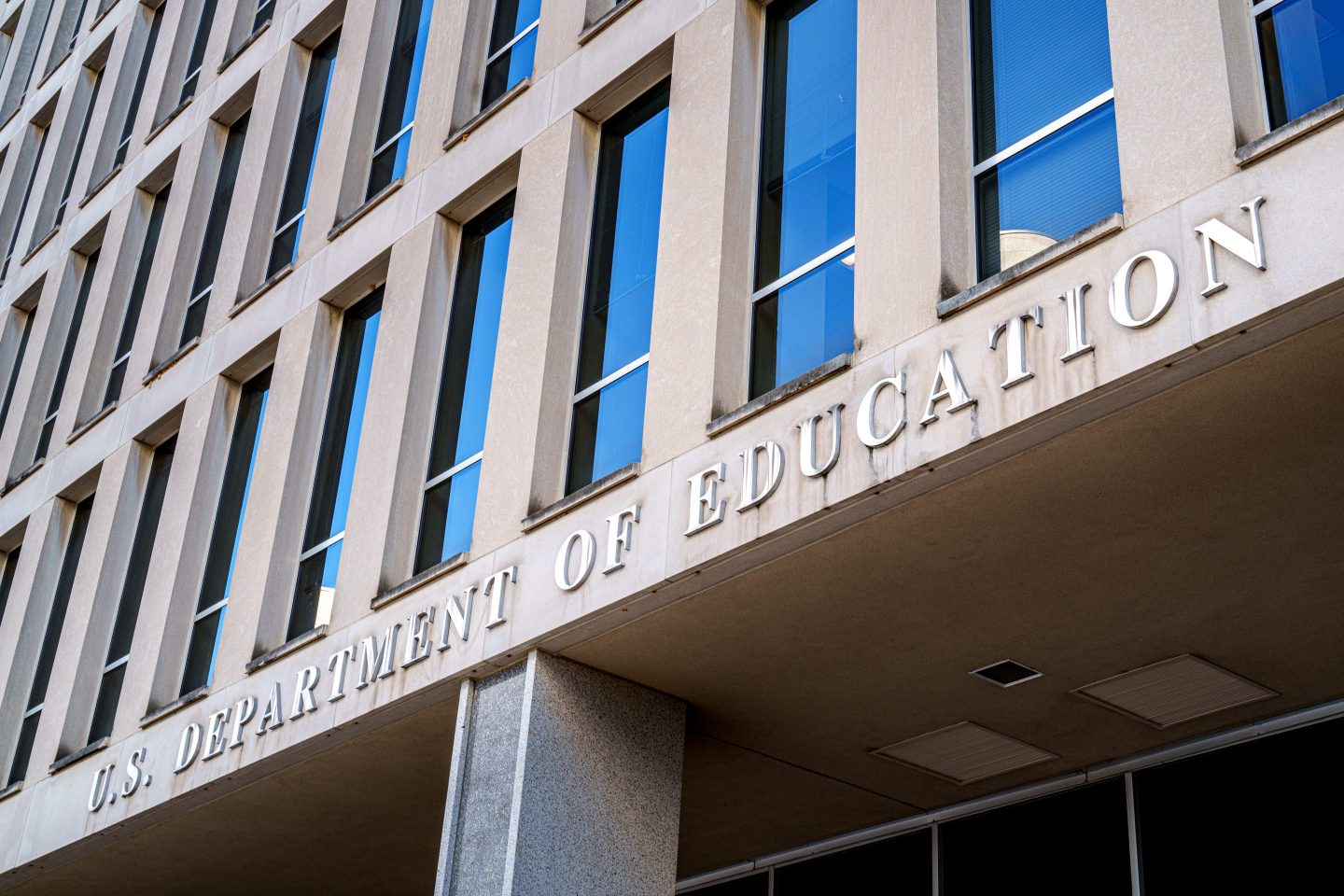
President Donald Trump wants to eliminate the U.S. Department of Education.
President Donald Trump wants to eliminate the U.S. Department of Education.J. David Ake / Getty

President Donald Trump has reportedly set his sights on eliminating the U.S. Department of Education, a long-time Republican goal and promise from his campaign. The proposed plan, though, gives rise to a host of unanswered questions—not least of which is what happens to the 42-plus million Americans with federal student loan debt.

Recommended Video

While actually shuttering the department would require an act of Congress, the president’s promises and recent actions in office—including signing a flurry of legally dubious Executive Orders—have left borrowers confused and worried.

It remains to be seen what exactly Trump will order or if he has the authority to carry out such a sweeping measure in the first place. But if the Department of Education (ED) were to close, it is possible that management of its current $1.7 trillion federal student loan portfolio would be moved to a different department or agency, like the Treasury Department, says Betsy Mayotte, president of the Institute of Student Loan Advisors.

“The terms and conditions are written into federal law and regulations and wouldn’t change,” says Mayotte. “In the very unlikely event the ED does go away, the transition could create some delays in some actions but the terms themselves wouldn’t change.”

Still, the transfer would cause “considerable upheaval initially and the issues could persist for years,” says Kevin Ladd, chief operating officer and co-creator of Scholarships.com, who has worked in the higher education funding field for 25 years. The new department tasked with the management of loans would need more staffing and new computer systems, and there would need to be new oversight and other protection processes put in place.

Programs like Public Service Loan Forgiveness (PSLF) and income-driven repayments plans that help students discharge their loans more quickly could be at risk of “going away,” he says.

“While federal student loans would likely continue to be an option for current and future college students, the terms would likely be much stricter and students should be taking that into consideration before signing off on anything,” says Ladd.

ED manages not only the processing of loan payments and forgiveness programs, but the application for student loans as well (under the Free Application for Federal Student Aid, or FAFSA, and studentaid.gov). It also funds special needs programming around the country and enforces federal statutes prohibiting discrimination. All of this is codified in federal law and must be carried out, regardless of if the department exists or not.

Dismantling financial aid programs could also lead to fewer lower-income students attending college. It could also exacerbate the issue of students dropping out of college before they graduate because they cannot afford to stay. Already, 31% of students think about dropping out due to financial challenges, a 2024 Sallie Mae study found.

That “could have a profoundly negative impact downstream on the economy,” says Dan Ulin, founder and CEO of Elite Student Coach in Los Angeles, California. 

Student loan programs could face changes

Even if the ED isn’t shut down, recently proposed legislation includes a number of changes that could affect students and families across the country, including to student loan eligibility and the discontinuation of the Parent and Grad PLUS Loan programs.

The proposal includes a new income-drive repayment (IDR) plan that “would decrease the amount undergraduate borrowers and certificate earners would eventually see canceled while increasing the amount canceled for the typical graduate school borrower” compared to the IDR plan implemented by the Biden-Harris administration, according to an analysis by the nonpartisan Center for American Progress (CAP).

It would also impose new student loan borrowing limits, which could further reduce access to higher education, CAP finds, or push more students into taking on more private loans—particularly for those coming from lower-income backgrounds.

“Private student loans are less regulated and less transparent, and they come with fewer protections than federal student loans,” CAP higher education analysts write. “They may have variable interest rates, for example, and may not offer the deferments, forbearances, repayment plan options, and targeted cancellation pathways that federal student loans do.”

Some borrowers are also concerned the Trump administration could try to reverse or hinder student loan forgiveness programs enacted under the Biden administration, of which Republicans were deeply critical. But Mayotte says that is not currently on the table.

“No. Full stop,” she says of if reversing forgiveness is a possibility. “They could try, but there’s no chatter about that and the courts have made it very clear they have no interest in doing that.”


Join us at the Fortune Workplace Innovation Summit May 19–20, 2026, in Atlanta. The next era of workplace innovation is here—and the old playbook is being rewritten. At this exclusive, high-energy event, the world’s most innovative leaders will convene to explore how AI, humanity, and strategy converge to redefine, again, the future of work. Register now.
About the Author
Alicia Adamczyk
By Alicia AdamczykSenior Writer
LinkedIn iconTwitter icon

Alicia Adamczyk is a former New York City-based senior writer at Fortune, covering personal finance, investing, and retirement.

See full bioRight Arrow Button Icon

Latest in Personal Finance

Julian Braithwaite is the Director General of the International Alliance for Responsible Drinking
CommentaryProductivity
Gen Z is drinking 20% less than Millennials. Productivity is rising. Coincidence? Not quite
By Julian BraithwaiteDecember 13, 2025
18 hours ago
Personal Financemortgages
7 best HELOC lenders in 2025: How to choose the best home equity line of credit for your situation
By Joseph HostetlerDecember 12, 2025
2 days ago
Personal FinanceCertificates of Deposit (CDs)
Truist CD rates 2025: Probably not your best option (but here’s how to decide)
By Joseph HostetlerDecember 12, 2025
2 days ago
The Citibank logo on a green layered background.
Personal FinanceCertificates of Deposit (CDs)
Citibank CD rates 2025
By Joseph HostetlerDecember 12, 2025
2 days ago
The Bank of America logo on a green layered background.
Personal FinanceCertificates of Deposit (CDs)
Bank of America CD rates 2025: How to ensure you get the highest APY
By Joseph HostetlerDecember 12, 2025
2 days ago
The Citizens Bank logo on a green layered background.
Personal FinanceCertificates of Deposit (CDs)
Citizens Bank CD rates 2025: Strong APY (but can you afford it?)
By Joseph HostetlerDecember 12, 2025
2 days ago

Most Popular

placeholder alt text
Success
Apple cofounder Ronald Wayne sold his 10% stake for $800 in 1976—today it’d be worth up to $400 billion
By Preston ForeDecember 12, 2025
2 days ago
placeholder alt text
Economy
Tariffs are taxes and they were used to finance the federal government until the 1913 income tax. A top economist breaks it down
By Kent JonesDecember 12, 2025
2 days ago
placeholder alt text
Success
40% of Stanford undergrads receive disability accommodations—but it’s become a college-wide phenomenon as Gen Z try to succeed in the current climate
By Preston ForeDecember 12, 2025
2 days ago
placeholder alt text
Economy
The Fed just ‘Trump-proofed’ itself with a unanimous move to preempt a potential leadership shake-up
By Jason MaDecember 12, 2025
1 day ago
placeholder alt text
Success
Apple CEO Tim Cook out-earns the average American’s salary in just 7 hours—to put that into context, he could buy a new $439,000 home in just 2 days
By Emma BurleighDecember 12, 2025
2 days ago
placeholder alt text
Economy
For the first time since Trump’s tariff rollout, import tax revenue has fallen, threatening his lofty plans to slash the $38 trillion national debt
By Sasha RogelbergDecember 12, 2025
2 days ago
Rankings
  • 100 Best Companies
  • Fortune 500
  • Global 500
  • Fortune 500 Europe
  • Most Powerful Women
  • Future 50
  • World’s Most Admired Companies
  • See All Rankings
Sections
  • Finance
  • Leadership
  • Success
  • Tech
  • Asia
  • Europe
  • Environment
  • Fortune Crypto
  • Health
  • Retail
  • Lifestyle
  • Politics
  • Newsletters
  • Magazine
  • Features
  • Commentary
  • Mpw
  • CEO Initiative
  • Conferences
  • Personal Finance
  • Education
Customer Support
  • Frequently Asked Questions
  • Customer Service Portal
  • Privacy Policy
  • Terms Of Use
  • Single Issues For Purchase
  • International Print
Commercial Services
  • Advertising
  • Fortune Brand Studio
  • Fortune Analytics
  • Fortune Conferences
  • Business Development
About Us
  • About Us
  • Editorial Calendar
  • Press Center
  • Work At Fortune
  • Diversity And Inclusion
  • Terms And Conditions
  • Site Map

© 2025 Fortune Media IP Limited. All Rights Reserved. Use of this site constitutes acceptance of our Terms of Use and Privacy Policy | CA Notice at Collection and Privacy Notice | Do Not Sell/Share My Personal Information
FORTUNE is a trademark of Fortune Media IP Limited, registered in the U.S. and other countries. FORTUNE may receive compensation for some links to products and services on this website. Offers may be subject to change without notice.