Elon Musk has a new job doing something he knows a great deal about: firing people. Lots of people. Now he’s about to test his axing skills on the greatest downsizing challenge in American history.
Musk is the leader of the Department of Government Efficiency (DOGE), a nongovernmental group formed in November by President-elect Trump to cut back government regulations, dismiss unneeded workers, and save money. Musk has said DOGE could cut “at least $2 trillion” from the $6.75 trillion federal budget.
Musk’s original co-leader at DOGE was Vivek Ramaswamy, a former biotech entrepreneur and candidate for the 2024 Republican presidential nomination. A White House spokesperson said on Monday that Ramaswamy was leaving DOGE; sources close to Ramaswamy told the New York Times and other news organizations that he planned to run for governor of Ohio. But over the first two months of the initiative, the two have rallied tech-industry luminaries to pitch ideas for rooting out cumbersome rules and eliminating waste. Venture capital titan Marc Andreessen described himself on a recent podcast as an “unpaid intern” for DOGE.
DOGE’s overall ambition is staggering; its leaders’ most specific rhetoric, however, has focused on slashing jobs. In a Wall Street Journal op-ed, Musk and Ramaswamy wrote that they anticipate “mass headcount reductions across the federal bureaucracy,” which they said would be a primary tool for cutting costs.
If that’s the goal, Musk looks like the ideal man for the job. He has sacked significant numbers of workers at SpaceX and Tesla—he’s CEO of both. For sheer exuberant terminating, nothing can match his performance at Twitter, since renamed X. When he bought the company in 2022 he began mass layoffs almost immediately, firing thousands of Twitter’s 8,000 workers overnight. Some got the news by email. Others could only infer they were dismissed when they couldn’t log into the internal computer system. A few were even fired by accident and had to be brought back. Musk later said he had reduced staff by about 80%.
Among federal employees, DOGE anxiety has been rising, enhanced by the fact that the group has shrouded its plans in deep secrecy and has been ultra-disciplined about avoiding leaks. It’s easy to picture Washington trembling at the thought of being subjected to the Twitter playbook.
But as other captains of industry have painfully found, government is different from the private sector in peculiar ways. Shrinking any element of it—from headcount to the budget to the pages of rules in the Federal Register—is a thankless and often Sisyphean task.
DOGE and the Trump transition team did not respond to requests for comment for this story. But here’s what they’re up against.
- Dismissals and regulatory change go hand in hand—very slowly. DOGE’s publicly stated plan is to identify federal regulations that appear to be invalid under two Supreme Court decisions, from 2022 and 2024, that limit the rulemaking power of federal agencies. President Trump will then nullify “thousands of such regulations,” Musk and Ramaswamy wrote in their op-ed. Fewer regulations mean a lighter workload and fewer employees. But they also noted that to reach their goals, regulations will have to be “fully rescinded.” That’s a potentially multiyear process that requires explaining proposed changes and inviting public comments. Many regulations have constituencies, including in the business world, with a stake in the status quo, and any changes are subject to legal challenges even after the regulation is gone. Bottom line: Some regulations won’t succumb easily.
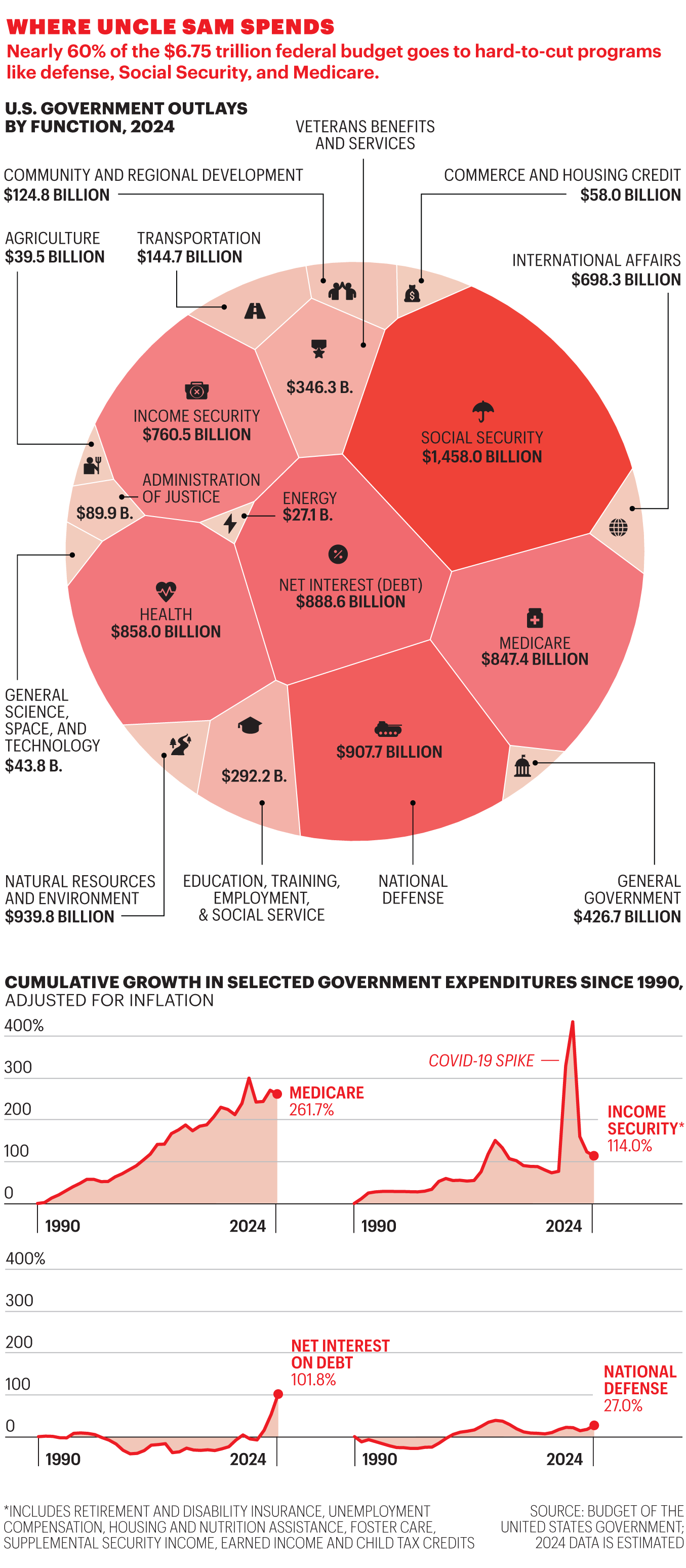
- Layoffs don’t save much money. Musk has emphasized that cost savings are central to DOGE’s mission, but labor costs are a small part of federal spending—between 4% and 5% of Uncle Sam’s budget. Payrolls are not where the money is. “If you eliminate 25% of all federal jobs, you would save roughly 1% of federal spending” says Brian Riedl, a Washington-based economist who has been a Senate staffer and worked for Republican officeholders. The vast majority of government spending goes out the door in the form of benefits to voters—Social Security, veterans’ benefits, food stamps, and many more. All those benefits have powerful constituencies and are extremely difficult to reduce.
- Federal workers will fight back. About 1 million federal employees belong to unions, according to the Bureau of Labor Statistics, and they have been preparing to take on the new administration since before the election. Trump has said he will impose an employee category called Schedule F, reclassifying career civil service employees as political employees, who lack civil service protections and can be fired quickly. (On Monday, he issued an executive order to this effect.) Government unions are trying to protect their members from being classified as Schedule F by appealing to the federal Office of Personnel Management and the Merit Systems Protection Board. Even if they lose, they may throw sand in the gears.
- DOGE won’t have the power a CEO enjoys. Musk could fire employees of his companies in an eyeblink because he’s CEO (and at Twitter, majority owner). But DOGE “doesn’t have any power,” says Douglas Holtz-Eakin, former director of the Congressional Budget Office and now president of the center-right American Action Forum. “They’re an outside advisory group who are going to generate ideas. They are essentially a very high-profile think tank.” DOGE’s power arises from President Trump’s presumed willingness to execute its recommendations; he could ignore any or even most of them if the political price of job and spending cuts were to become too high.
Momentum, as represented by Trump’s decisive win in November, is on DOGE’s side. History is less so. DOGE is looking broadly for ways to reduce costs. But in the past 50 years, annual federal spending has shrunk from the previous year only five times, never by more than 8%—and only in the aftermath of elevated spending during the financial crisis of 2008–09 and the COVID-19 pandemic. Even under Ronald Reagan, who created a commission to cut costs and commanded its members to “work like tireless bloodhounds,” spending increased every year.
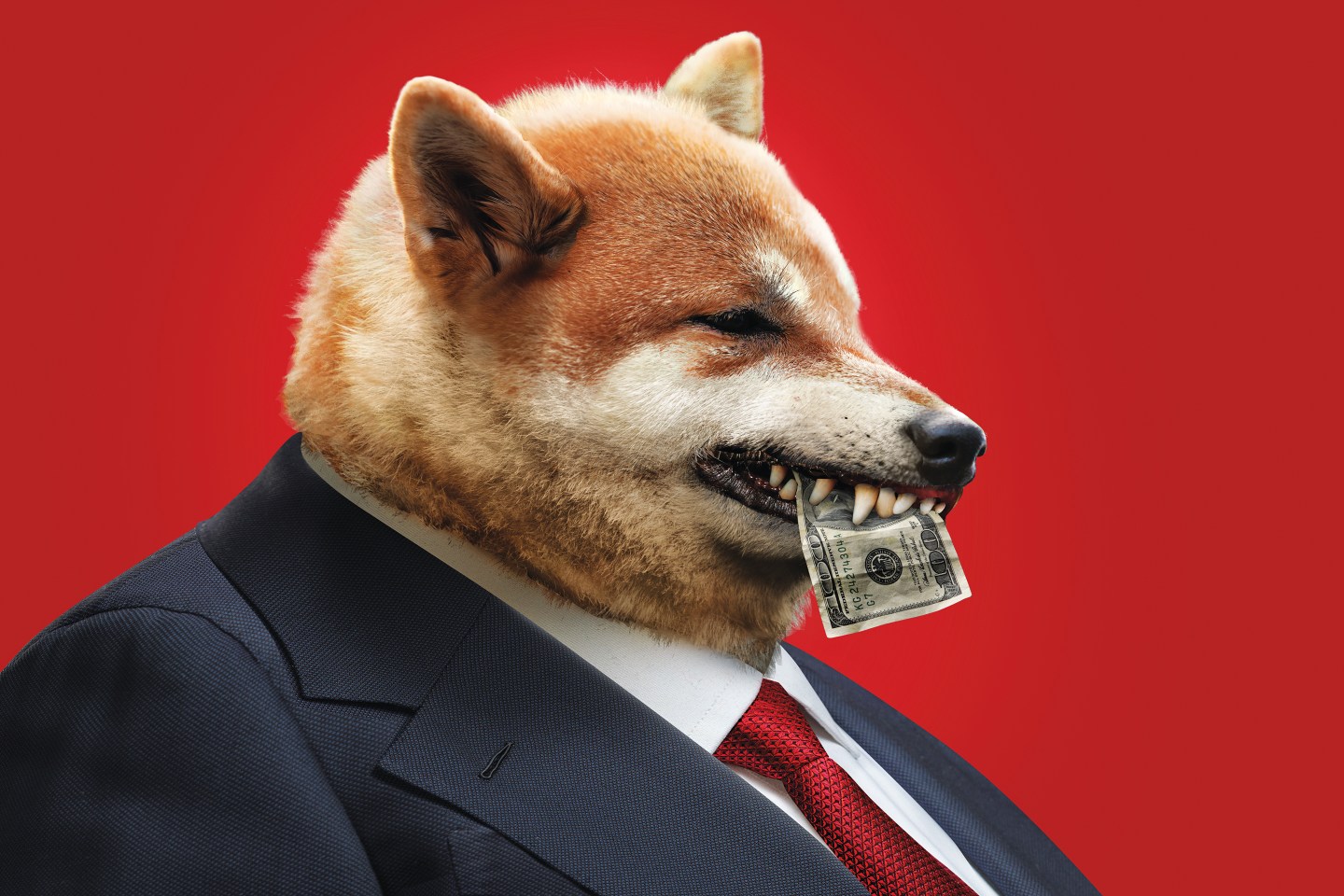
The hounds of DOGE have signed up to work “80+ hours per week on unglamorous cost-cutting,” as the group’s X account puts it, but their results may be similar to Reagan’s. Spending is in the hands of Congress, and as Musk will learn, Congress can’t resist spending more. (Case in point: Congress routinely passes an annual defense spending bill that includes projects the Pentagon doesn’t want.) Even as lawmakers on both sides of the aisle wring their hands about the federal government’s $35 trillion in public debt, federal projects bring dollars to legislators’ homes, and their incentives aren’t likely to change.
Reality may be setting in at DOGE. In a January interview, Musk allowed that his projected 30% cut in the federal budget might not be achievable. “I think that’s like the best-case outcome,” he said. “I think if we try for $2 trillion, we’ve got a good shot at getting 1 [trillion].”
Even that objective may be a reach. Social Security, Medicare, defense, and net interest on the national debt consume 59% of the federal budget. If those expenses are considered untouchable, a trillion-dollar cut would have to come out of the $2.8 trillion a year that funds all the other federal programs—Veterans Affairs, Homeland Security, the federal judiciary, the Food and Drug Administration, and many more services that taxpayers rely on. Tellingly, DOGE insiders told the New York Times in January that DOGE planned to station recruits for longer stints inside federal agencies—seemingly an acknowledgement that real cost-cutting reform will require a deeper intimacy with the costs being cut.
Musk and Ramaswamy said in their op-ed that their “top goal for DOGE is to eliminate the need for its existence by July 4, 2026.” Ostensibly that expiration date was chosen to celebrate DOGE’s work as America celebrates its 250th anniversary. Practically, it’s to leave six months with GOP control of Congress in case its work requires legislation. Given the complexity of government and its deep roots across the country, the DOGE team is going to need every moment.
Portions of this article were previously published on Fortune.com
This article appears in the February/March 2025 issue of Fortune with the headline “How much can DOGE do? Elon Musk and Donald Trump aim to cut as much as $2 trillion in federal spending. It’ll be even harder than it sounds.”