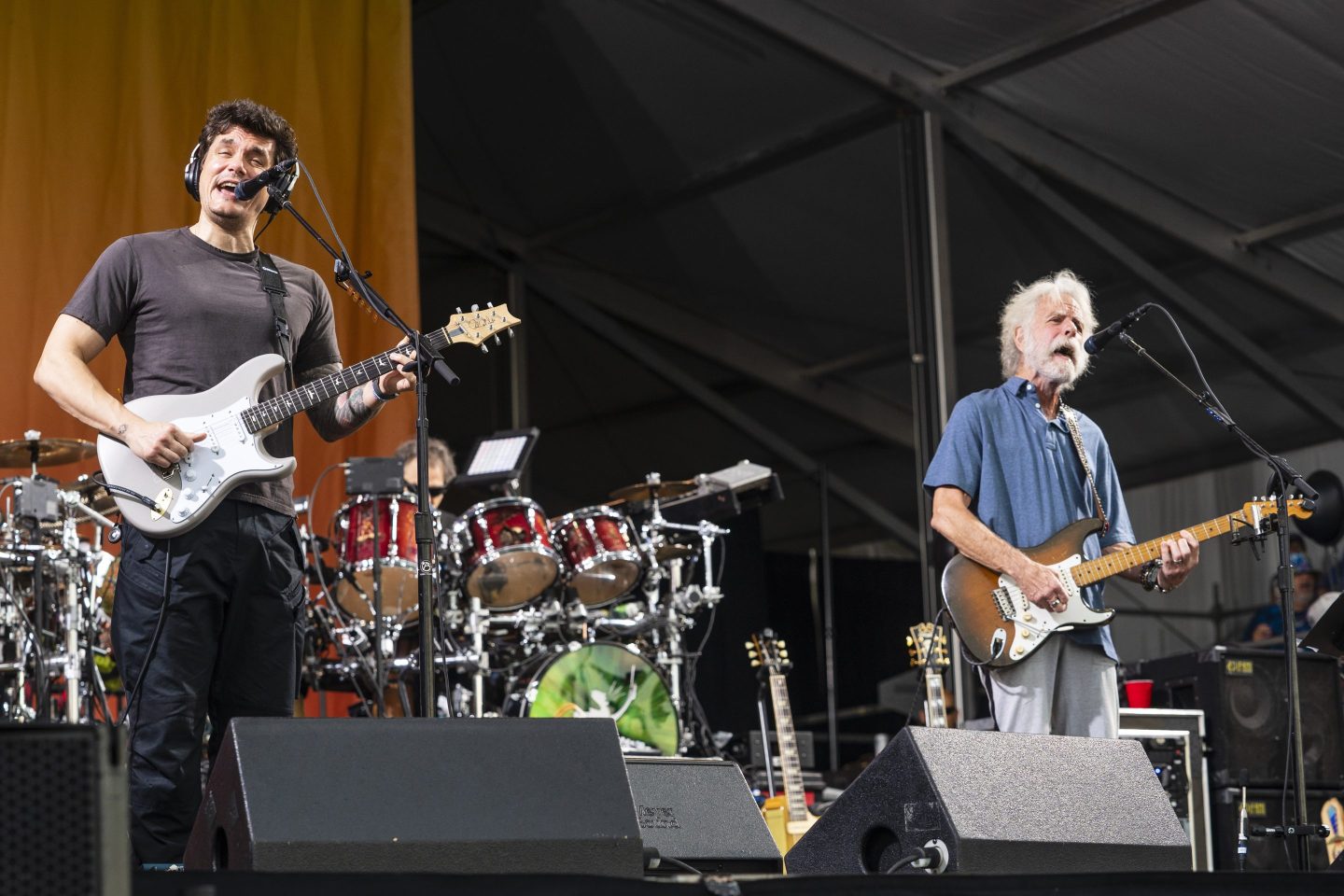
I was at a concert when it hit me: This is what effective succession looks like.
Allow me to explain. About seven years ago, I went to see Dead & Company perform for the first time. The group, made up of both former Grateful Dead musicians plus new artists—including John Mayer—was playing at Shoreline Amphitheater, an outdoor venue not far from where I live in Silicon Valley. It was a warm July evening, and I was there with my husband—a great night out without the kids and the worries of work. We were mesmerized as Mayer and Bob Weir, one of the original Grateful Dead members, jammed together on songs like Ripple and Sugaree, which were both released before I was born.
I’m no Dead Head, by the way. But I love music, and even before going to my first Dead & Co show, I knew all about the iconic original band, who had gotten their start in 1965 in Palo Alto, right in my backyard. Until that moment at Shoreline, though, I hadn’t appreciated just how profound it was that Dead & Co, which was formed a full 50 years after the birth of its predecessor, had managed to appeal to both veteran Dead Heads and a new, younger audience. This harmonious passing of the baton, done posthumously (Jerry Garcia died in 1995), was a shining example of a process many successful corporations can’t seem to get right: succession.
I should know. As a partner at Egon Zehnder, one of the world’s top leadership advisory and executive recruiting firms, I have helped leaders navigate through their hardest challenges, succession being top of the list. It is difficult to discern who will be the most impactful leader to lead an organization into the future, especially in a world with ever-changing dynamics. Over the years, I’ve tried to bring an anthropological lens to my work, observing, listening, and learning about different corporate cultures. I’ve deepened my understanding of human psychology—from motivations to derailers to potential—in an effort to better pattern match leaders to organizations. And I’ve realized that this equation is even more complex when faced with a deeply embedded culture set by an iconic founder, as is the case with many tech companies and creatively-driven organizations (including, as it turns out, bands). Take, for example, Apple and Dell, both of which dabbled—and failed—with outside CEOs in their earlier days. Companies with deeply rooted founder cultures across other sectors have struggled to replace their leaders, too. Think Walmart, Starbucks, and Under Armour.
The difficulty of this process is why lots of ink has been spilled—and lots of dollars have been spent—on getting it right. Still, few examples of what success looks like stand out. Effective blueprints are hard to come by.
This is why I was so gleeful that day, seven years ago, watching as Mayer and Weir defied the odds on stage. While my husband laughed when I excitedly told him about my epiphany (okay, I’ll admit, leaning into one’s professional breakthrough at a concert is not “the vibe”), I couldn’t let it go. I kept going back to my revelation—and to Dead & Co shows. I was determined to dig deeper, to better understand how these artists were able to get this process down so well, when some of the world’s most successful companies couldn’t seem to. And I discovered that, indeed, there’s a lot to be learned from this unlikeliest of succession stories.
It all starts with creativity and courage. What do I mean by that? Mayer, whose earlier work cast him more as chart-topping heartthrob than counterculture hippie, was not the obvious choice to fill Garcia’s shoes. Mayer first crossed paths with the original band when he was guest hosting the Late Late Show in 2015 and invited fellow guitarist Weir to join him in a studio performance. The two hit it off right away, despite a 30-year age gap. (Coincidentally, though three decades apart, the duo share a birthday: October 16.) As they jammed out to Althea, one of the Grateful Dead’s most recognizable songs, it was clear to both that something magical had taken place.
Mayer, who had discovered the Grateful Dead’s music just a few years earlier, started poring over the band’s songbook. Weir, for his part, knew that he had to do more with Mayer. The elder guitarist had already helped form several spin-off bands, so he was comfortable integrating new artists. But, he also knew that some of the Dead’s die-hard fans might not take to this new lineup.
At a recent Dead & Co show at the Las Vegas Sphere—which the band is returning to for another residency in 2025—I had the opportunity to meet Bernie Cahill, their comanager alongside Azoff/Moir. The former IP lawyer, who also oversees the Grateful Dead’s legacy, says Weir saw past the superficial differences right away. Despite how unobvious the mashup might have seemed to outsiders at first glance, the longtime musician knew he was on to something.
“On paper it may have seemed incongruous in some way, but on stage, you could see the sparks,” Cahill later told me.
Indeed, the decision to bring Mayer on board, and form a new band that would take on the Grateful Dead’s songbook, did have its naysayers. (The full lineup also included former Grateful Dead members Mickey Hart and Bill Kreutzmann, plus new artists Oteil Burbridge and Jeff Chimenti—Jay Lane was later added as well.) But that’s because it was a creative and courageous choice, not an easy one.
The more obvious pick would have been to bring in another frontman from a similar genre and era—just like the obvious replacement for a leader at Coca Cola is to bring in an executive from Pepsi. But today’s talent solutions require organizations to push beyond their traditional comfort zones, despite the fact that this carries more perceived risk. That’s because current corporate environments require constant change, which in turn requires leaders who are agile and versatile—and have diverse experience under their belt. That diversity of experience? It doesn’t usually come from those who are already in your orbit.
Weir saw something in Mayer that others might have missed: a musical genius who could successfully integrate into a new iteration of the original band precisely because he didn’t come from the same world. But there was something more that needed to happen in order to make that integration work.
A leader who comes into a new organization must have both knowledge and appreciation for what came before, and Mayer had that in spades. This is where the process became bidirectional, and it’s critical that this happens on a deep, deep level. From the get-go, Mayer indulged himself in intense study of the Grateful Dead’s songbook. He wanted to understand the music on both a technical and philosophical level, to delve into what has made it so appealing and enduring over the decades—and so ripe for live improvisation, something the Dead (both old and new) is known for. At the same time, he didn’t try to be Jerry Garcia—just as a CEO coming from the outside shouldn’t try to copy the outgoing founding CEO. In fact, when Mayer first started playing with Weir and the band, he was careful not to mimic Garcia, avoiding the late musician’s specific guitar “licks” and finding his own ways of expressing the original music. As I’ve seen on stage, it’s like he’s in the service of the music, not in service of his ego.
This is easier said than done, of course. Plenty of new CEOs take a monthslong period to just immerse themselves in their new company. But it’s what they do with that immersion process that matters. Can they hold on to the foundational principles of the organization while crafting their own style of leading, making shifts while bringing everyone along? That’s what Mayer has been able to do. He immerses himself into the band but also brings his own distinction, elevating the collective.
“John’s reverence and the respect from John is so evident,” Cahill, Dead & Co’s comanager, told me. “Once people felt that, I think they opened themselves up to enjoying the [new] band, and now they’re all on the bus.”
At my last Dead & Co show—trust me, there will be many more in the future—it was clear that even the most loyal of Dead Heads were all in on the new band. Not only that, but so were the younger, more recent fans. In fact, the intergenerational appeal of a Dead & Co show is palpable. Such a bridge is not easy to achieve, even for the most successful of brands. But it’s also key to building a sustainable business model, something Weir in particular has a lot to say about—even if he doesn’t think of it in those kinds of corporate-speak terms. The longtime musician has a 300-year plan for the Grateful Dead’s music to continue to be interpreted and reinterpreted, enjoyed by generations of fans to come.
“That’s his dream,” Cahill told me. “And in order for that to happen, he has to have the next generation of artists that are along for the ride and can pick up the baton.”
Keeping the music going is more challenging than it sounds. It requires not just an understanding and appreciation of the actual songbook of the Grateful Dead, but also of their original ethos. At the core of the Dead’s values is a focus on music that is both live and improvisational, and therefore ever-changing. This is what fans have grown to expect. No two concerts are ever the same, and the length of individual songs can vary, given the fact that musicians are jamming in real-time, not adhering to how they played a particular hit just the day before. Here too there is a lesson for all kinds of corporations: While many companies strive to become more agile and less rigid, this mentality is baked into the Dead’s “business model.” Flexibility is key, not just for transformation but also for the successful integration of new leaders.
As the Grateful Dead’s 60-year anniversary comes up in 2025—coinciding with Dead & Co hitting its 10-year mark—it’s clear that both bands play a unique role in our country’s musical history. They are legends, both old and new. But maybe, just maybe, the Dead’s legacy can be even more than a songbook. It’s a playbook for corporations—at least the ones flexible enough to look for inspiration in the unlikeliest of places.