It’s become increasingly difficult to argue that any job will exist in five or 10 years without some artificial intelligence getting involved.
During a discussion at Fortune Global Forum earlier this week, sponsored by Novartis, panelists across industries discussed how workers at all levels can best prepare for the growing wave of automation that will impact the workforce.
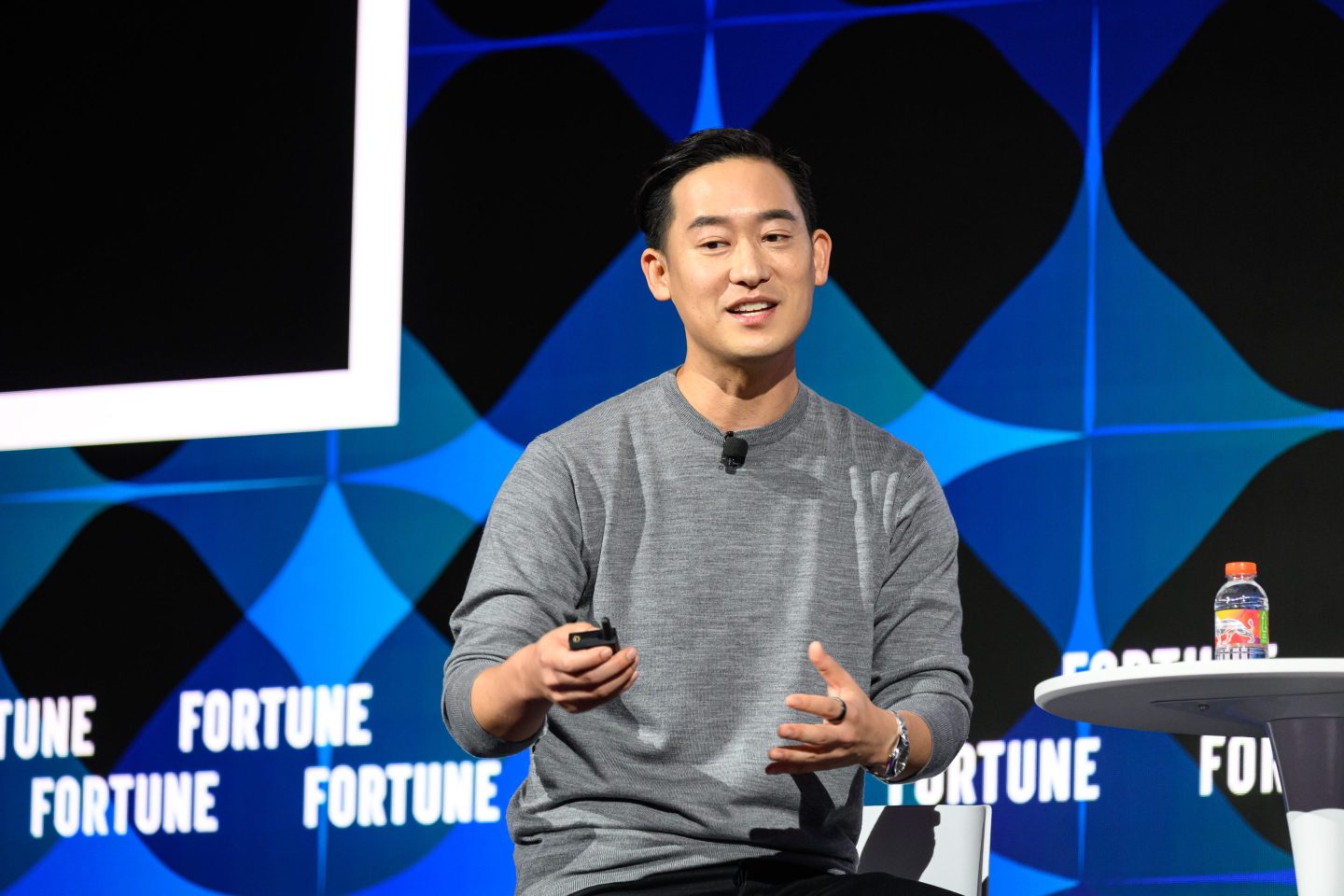
“I have this argument that college education has to evolve rapidly because we can’t be afraid of our kids interacting with technology,” said Krish Venkataraman, president at software firm Dataiku. “Because the first day they actually start a real job, they have to interact with technology.”
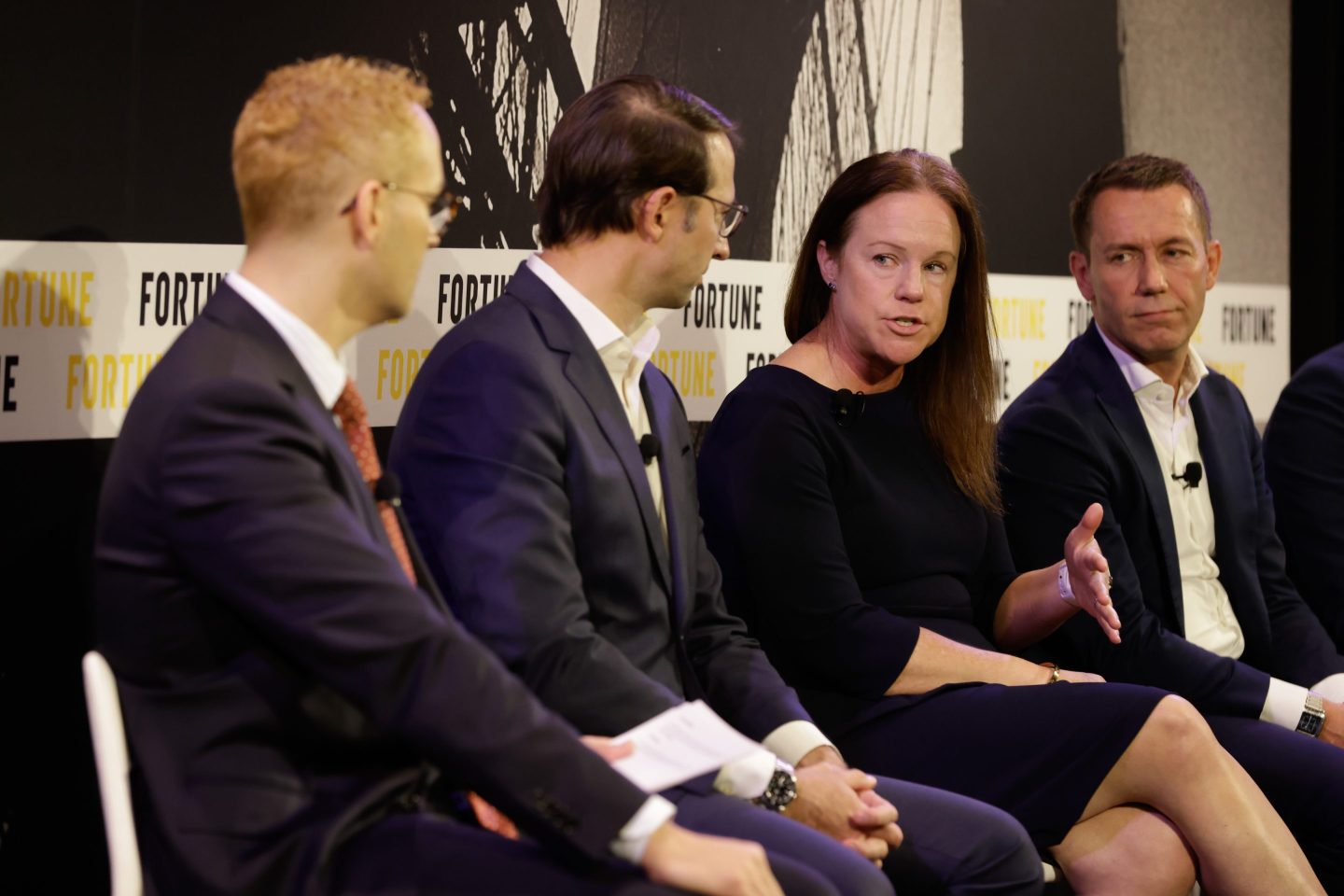
Venkataraman spoke alongside Victor Bulto, the U.S. president at Novartis, Jennifer Nuckles, the Chief Executive Officer at real estate firm R-Zero, Charles van der Steene, North American president at Maersk, and Fortune editor Alex Wood Morton.
You can watch a recording of the panel here.
The following transcript has been lightly edited for clarity.
Alex Wood Morton: Welcome to our lunchtime breakout session pioneering tech that delivers next gen solutions presented by our partners Novartis. I’m Alex Wood Morton. I’m going to be your host for the next 45 minutes or so. I’m Fortune’s executive editor in Europe. It’s an absolute honor to be here with you.
It’s my hope, my dream and my aspiration to make this as interactive as possible. So I’m going to be getting you guys involved in the conversation as soon as I possibly can. But before we do that, I think it will be wonderful to introduce you to our amazing panelists.
On my left, we have Victor Bulto. He’s the U.S. president at Novartis. We have Jennifer Nuckles, she is the Chief Executive Officer at R-Zero. And we also have Charles van der Steene, President, North America, at Maersk, and Krish Venkataraman, president at Dataiku. Please give a round of applause to our panelists.
Victor, I’m going to turn to you first. Novartis has undergone a real transformation over the last few years into a technology leader, but talk me through the journey you’ve gone through with some of your recent cancer drug developments.
Victor Bulto: I think when we talk about technology, everyone tends to think about digital technology. The way we think about technology is quite different. We think about how we can harness the power of scientific technology to actually make drugs that change patients’ lives, and we tend to think about, how can we harness these technologies to make a difference in patients’ lives?
One of the most interesting technologies we’ve been working on as of late is called Radioligand Therapies. And these are therapies that I dream will one day become the standard of care for many cancer treatments. The way they work is basically, we look at specific surface markers that cancer cells express and are not expressed in healthy cells, and we design molecules that latch onto them. And on the other hand, they have a radioactive payload. So they do have a radioactive atom, in this case, lutetium, that then basically disrupts the cancer cells while sparing the healthy cells.
So in a way, we’re looking at what we call the ideal therapeutic index, and we already have approval of these medicines that actually are showing really good promise. Now the challenge—and I know we’re talking technology and we’re talking supply—that we found with these medicines, is that now we have to be as innovative in how we bring them to patients as the technology itself.
Because I was sharing with Charles, with our resident expert in logistics here, that we have to produce them just in time, because they have an average half-life of six days. So in six days, they basically decay very quickly. So every one of these doses that we ship to patients wherever they are, need to be produced just in time for that particular patient, every time. And man, it’s been quite a journey over the last two years to understand how we manufacture them at scale, but then, how do we make sure that every time a patient is hoping and waiting for a cancer treatment, they get it just in time? Because two hours too late is too late. We cannot use that dose. And we’ve been learning that actually it makes a difference to have several manufacturing sites that are redundant, that are in different locations in the US, that we need to have plan A, plan B and Plan C for our logistical routing, that each one of these doses needs GPS to be tracked, 24/7 to know exactly what it is at every point in time.
But it’s been a fascinating journey, and today we bring those medicines on time, 99 99.7% of the time. We’re still working on that extra 0.3%, but the big lesson to me, Alex, has been that when people in our company understand the mission that we’re after, and they understand that we’re not shipping boxes, we’re not shipping product, but we’re actually shipping hope to patients that have none otherwise, it’s amazing to see how people rally around and gather any new technology and idea they can find to actually make it happen.
Alex Wood Morton: That feels like a fantastic point to bring Charles into the conversation. So delivering cutting edge healthcare like this—we’ve heard a real example of the challenges around logistics. Talk to me: how you are responding to these kinds of challenges at Maersk?
Charles van der Steene: It’s a great question, actually. If you think about the timelines that we’re now talking about, we’re not talking about three weeks anymore. We’re talking about six days to bring medication from one end to the other with an impact of delay that in this particular case is life-threatening or life-changing.
For us, when we think about supply chain, two things normally are at play. One is speed, or rather the lack thereof. And will you be on time, regardless of what that time normally would be, and do you have control of that speed? Many of those in this room that might have been exposed to the supply chain would have experienced that you’re not always in control of your supply chain. Your plane did not leave on time, the vessel got stuck somewhere in a typhoon in Asia. And there’s nothing worse than to not necessarily know where you are, when you’ll be delivered, and how much more time you need for your product, your promise to your customer to be there on time.
So for us, our primary purpose has been, if you take a step back, what do you want to make sure you have? You want to make sure you’re able to provide speed, provide [someone] with an ability to live within six days. And you want to make sure you have control. So for us, the big thing over the last five years has been significant investment in those items where the supply chain traditionally goes south.
You want to be able to control those bottlenecks in the supply chain to be able to make a difference, and whether that’s to have your own plane, whether that’s to have your own vessel, or whether that’s to have your own terminal, to make sure you have those critical nodes across the global supply chain that if things do go south, you’re able to mitigate, speed up, and exercise your control to get that promise to the customer in the end.
Alex Wood Morton: Thank you for that overview. Jennifer, I’m going to turn to you. Let’s just move the conversation on to climate for a moment. I mean, if we think about what’s happened just over the past couple of months, we’ve seen storms across North America. We’ve seen a real crisis in Valencia with the floods. How are you using your technology to mitigate these challenges?
Jennifer Nuckles: I think what’s most interesting about the worldwide climate change is that it’s really unprepared for it currently. So you’re seeing the dichotomy between the public sector and the private sector, and you’re seeing these emergence of resilience hubs throughout North America, specifically where cities are trying to get more prepared. Florida, as many of you know, if you live on the east coast, a couple months ago, we had back-to-back hurricanes, which was unprecedented. It really caused an enormous amount of flooding and damage to the Gulf Coast.
We’ve seen this internationally as well, and you exacerbate that by some of the other implications that we’ve all heard about over the past two days, which is the rising cost of energy and the amount of energy infrastructure that’s necessary, specifically, given the build of data centers that are coming online.
It’s all coming to a head. When you think about the next five years, there are a lot of mandates that have been put in place for net zero by 2030. I always kind of draw the analogy back to Y2K. No one was really prepared for Y2K until like 1997, and then everyone started really focusing on it. We’re going to see the same start happening over the next couple of years. And so when you think about being unprepared, the rising cost of energy, that inability and inaccessibility of energy, it’s all coming to a head right now.
So what we do is we really allow data points at the very granular level. So we ingest billions of data points on a five-minute basis in the built environment. You understand how many people are in this room, what the indoor air quality is, the particulate matter, the temperature, the ozone level, the CO2 level. You understand what actually has to happen in the built environment in the United States.
Just to put this in perspective, $100 billion is spent on commercial real estate a year in the cost of energy, and the preponderance of that is on the HVAC system. So many of you, if you were in that auditorium earlier today—it was pretty chilly, right? The air conditioning had been running for hours when it didn’t need to be run. That’s the biggest thing that we can change. All of us probably live in smart houses where we have Nest thermostats, and we talk to Alexa and we order things. The actual application for AI and the enterprise is exacerbated.
It’s unparalleled, because these buildings that we’re all sitting in right now aren’t as smart as our homes, and so we should think about all of the existing infrastructure internationally and be prepared.
90% of the buildings are calling for retrofits. There’s only 10% new buildings. So you have to think about all these old buildings that we’re living and working out of, and getting them prepared for these enormous changes that are happening that are being exacerbated by overall climate change.
Alex Wood Morton: Krish, it really feels timely to bring you into the conversation about the topic that’s come up so many times over the last day or so. AI, it’s, I think it’s really good to hear from you how the business leaders in this room can really leverage some of these benefits. Can you connect the dots for us?
Krish Venkataraman: Yeah, surely. So we can talk about a boring topic called AI. I know everybody’s excited to talk about where AI will be going, but for most business users, if you think about the phases in terms of technology investment, whether it is AI, the early days of the Internet, or the early days of cloud, they’re actually following the same pattern, right?
In the early days of cloud, a lot of investment actually went in the infrastructure layer. The same thing is happening in AI right now: a huge amount of investment in the infrastructure layer, a huge amount of investment in computing.
The next phase, which actually is the most important phase, is after the base infrastructure is built: how do we get everyday business users, a.k.a. users, in all your companies, who actually have domain expertise, who really understand where the data is, how to connect the data, how to actually use data.
They’re not data scientists, but they actually have the expertise to create value from it. That’s where the focus of AI is going to be shifting towards, because now, finally, in most companies, the methodology to connect the dots has been done, but now how to actually use all those creative dots and actually use your data correctly is actually going to be focus number one.
Our customers are using more generative AI in a lot of unique ways. In pharma, they’re using it. Every time somebody has ever gone to a doctor and you see them prescribing a note, no human being can read it, but AI can read it. But these are all important things in terms of getting and transcribing all the structured and unstructured data. So actually, we can actually advance medicine or logistics in a highly organized manner, and that’s where the value of generative AI is really coming in. We’re about six to 12 months from the aha moment that it’s going to hit everybody in terms of the value it’s creating. But it’s there.
Alex Wood Morton: Just diving more into AI and obviously all of these technologies that all the panelists have introduced—that takes talent and labor. We’re in a hotter-than-ever labor market. Jennifer, how are you addressing the labor market, and how are you finding that talent to be able to drive this innovation?
Jennifer Nuckles: I think it’s really interesting. I have three daughters, and I always tell them, it’s never been more important to go to college, and it’s never been less important what college you go to. Make sure you get the skills that are going to be useful for the next 20, 30 years. San Francisco is a very constrained labor market right now. Many people have moved out of the state, if not the city. So we source internationally a lot for engineering talent.
We’re also looking for deep expertise in pockets where people understand commercial real estate or health care. For example, our key verticals, and I think, also probably most pertinent to every function is making sure that you are integrating AI into your core functionality.
Many of the tasks that our QA team did before are now automated, and they’re not done by actual manual labor. And if we can pull out 10% of a QA engineer’s time and free up space so that the line engineers can do more work, it just saves us overall and makes us more productive.
I say that to everyone. I say that to our marketing teams. I say that to our Customer Support Teams. Any team that’s not using technology right now to be more efficient is going to be left behind. And the hardest thing, as a technology company, is you’re always looking over your shoulder to see where the competition is and making sure that you’re keeping up with them and not beating them.
Alex Wood Morton: Victor, what’s your perspective?
Victor Bulto: Well, as a father of three daughters as well, I would fully concur with that. I don’t mean to put you on the spot here, but my thought of AI is that it’s becoming more and more of a commodity. My perspective, of course, from yours is a very different story. But in our industry, probably the LLM we choose, or the solution we choose, is less relevant.
What is most relevant is how I train my workforce—from a cultural standpoint, from a capability standpoint, from an incentives perspective—to actually mesh with AI. So that idea of diffusion of the technology is what I’m really passionate about, because I would rather have 5000 people in my organization using AI on a single day basis to make a 5% better decision in every decision that they make than actually thinking about the big, big transformation.
We’ve been putting a lot of effort on the cultural side, helping people come along and understand, to your point, that if they don’t use it, then it was when they’re going to be obsolete, then they’ll be obsolete. Therefore, how do we just co-develop some of these tools with them, without having to know exactly how the algorithm works. That’s not our job, it will never be. But knowing how to apply it to a point in each function will actually be an imperative.
And I think that’s probably a call to action to colleges. I’m working with my daughter’s schools to actually try to make sure that their teachers understand that it is their duty to help these kids understand the power of AI and the ethics of AI, and it’s more important than the content itself or the algorithm itself.
Krish Venkataraman: I’m going to say something controversial. Actually, talent is not the issue. I think most people have an abundance of talent in their companies. What I think, as Victor mentioned, is a fear and the knowledge, and the fear and knowledge go together. Most people who are business users feel that AI is such a difficult thing, you need a PhD from Stanford or Carnegie Mellon to actually figure out what AI does. Actually, that is not the case at all. Really.
The hardest part of AI is the business intelligence that most people already have and use every day. That is the hardest part. And the only way you’re going to actually see true progress in AI and enterprise is for us leaders to basically give that intelligence back to the user who owns the data. That means that for all of us here, we can’t think about AI is okay, fine. I’m gonna buy 50 seats for the data scientist who’s gonna figure it out. For me, it’s actually the opposite.
We need to see whether we can infuse data and the logic of data and the logic of AI to everyday users. So I’ll give you an example. We’re talking about medicine right now. One of our biggest use cases is a person who’s sitting on a line who’s building medical devices. Medical devices where you cannot have an error rate of almost close to zero, right? That person who’s actually using the machinery to build the medical device. They are using the intelligence of AI and data to make that error rate as small as possible. Do you think the data scientist knows more about that, or the person who’s actually running the machine?
We need a mindset where we can educate our workforce fast, because the productivity of our workforce can gigantically grow. One person’s output today can be a 10% output without you increasing your head count, and you’ll make everybody’s job even more satisfying. So that is what I think we all need to focus on.
Remember, AI is still a baby right now, just born, so it takes time before the technology really gets really comfortable for everybody to use it.
Jennifer Nuckles: I don’t think that’s that controversial, though. I think there is a scarcity of talent across certain functions, but I think in general, there is a fear of like, will my job be displaced? I actually see this at the customer level too, because we automate a lot of their data, which is displacing either facilities or in the hospital setting, operational workers. And I think if you, to your point, embrace the technology, then you realize that it’s freeing you up to do more high value-add activities, it’s actually pretty empowering to the workforce.
Alex Wood Morton: I just want to switch gears for a moment. We’ve heard so much about tariffs, protectionism, and new governments coming in. Charles, I want to bring you in. How are you responding to this? From a logistics point of view, is it business as usual?
Charles van der Steene: It’s the million-dollar question. I might actually say something controversial myself. I’m actually deescalating the discussion in most of the cases, from the perspective that tariffs clearly are a tool of trade, and it’s clear that also the very likely first action of the new administration will be to use that tool on global trade.
But if you look across the past few years, if you look across the last decades, then global trade as a whole isn’t actually impacted as much by these tariffs as you might think, believe, or fear. The big change underlying is that trade patterns will most likely change. And the reason why I’m deescalating most of the cases today’s discussion is that if you look at what happened under the Trump administration, back in 2017, the initial move towards tariffs that were more punitive to certain parties was made, and as a result, trade patterns changed quite dramatically across the world.
That means that China, as a primary source for most of the global supply chains, lost quite a lot of flows and volumes to neighboring countries. And that dynamic hasn’t changed in the last five years. We would expect that maybe this time around, tariffs will impact the trade patterns again, and might, once more, impact China, and maybe other countries too.
But overall, these goods will still need to be manufactured, will still need to be bought, and they will still need to be transported. And hence, as a result, we’ll still see these flows just coming from different locations.
Alex Wood Morton: I’m happy to hear some more questions in there. We have mics in the room, and we have our first question. Thank you. If you can say your name and company, please.
Jane Thier: Jane Thier, reporter at Fortune. Thanks. I’m just curious. Jennifer, I’d love to go back to something you were saying earlier about the continued importance of college and college degree, while also maintaining a specific focus on skills and maintaining skills that will be needed in the next generation and increasingly digitized workforce. Can you talk a little bit about why college remains so crucial when skills are overwhelmingly proving to be quite important and often much more usable for many companies that are strongly investing in new tech?
Jennifer Nuckles: Yeah, I’ll relate this to a conversation I had this morning at the Women’s breakfast. There were a group of us sitting at a table who had all grown up in the same management consulting firm. And I think it’s very much what you learn about yourself and the way you learn frameworks and how to approach and how to think and you know how to put analyses together.
That’s what you’re doing in college. You’re learning new ways of thinking. You’re getting exposed to a variety of information that you didn’t know existed. You’re maybe moving to a different location. You’re growing as a human, away from your parents. It really is a time of enormous growth, and I think for our next generation of emerging leaders, recognizing all the tools they have available to them—it’s a pretty empowering time to be a young adult right now. The rate of technology is unparalleled. The jobs that existed when we started the workforce, some of them will be obsolete, you know, in 10 years, 15 years, and they will be taken over by artificial intelligence.
So I think just getting those core foundational skills, business intelligence, ways to look at markets, ways to identify trends, is really core. Because I would say in the next 10 years, five years even, even using AI, what’s really important is not only the data. We all have so much data at our fingertips, but there’s a McKinsey study that just came out that 60% of commercial real estate owners don’t know what to do with the data, so then you have the need for insights.
Insights are more important—that comes out to your college training. But then even more important, I would say, is automation. That’s, I think, what’s going to happen in the market in the next five years, pretty exponentially.
Victor Bulto: If I may, I will just add, we just created in our company a new function that we call Decision Sciences. To your point on, we used to have data functions. Then we had insight functions, and now I believe the true value is on the decision sciences. Are you equipping your teams, your college students, to make better decisions with what they have? Do you build the tools that make them more empowered to actually make better calls?
I think that’s going to be the key. The key question I have is, what role does content play in that? Can you teach in college, or otherwise, you know, to young associates, how to think, if they don’t have the contextual value of content? I don’t have a good answer to that, but I don’t know that we can progress in the world without some focus on developing content knowledge and certain domain experience as well.
Jennifer Nuckles: I always look to hire what I call T-shaped people. And these are people who are specifically deep in one vertical, but they have the breadth that they can span multiple. So I have my MBA. I went and focused on marketing for a very long time. I would say I’m very deep in go-to market, but I have enough knowledge to span HR and operations, and I’ve run very large operation teams at scale. So those types of individuals, where you can see the holistic picture, but you have one core competency, are really, really valuable team members. And I think you get that with some of these young athletes who are joining. They know how to look at the full picture, but they’re specifically trained in one area.
Krish Venkataraman: I’ll add one point. I have family who are educators, and I have this argument with them that college education has to evolve rapidly because we can’t be afraid of our kids interacting with technology. Because the first day they actually start a real job, they have to interact with technology. So that starts with my 13 year old, where in school, [their teacher says] AI is all about plagiarism, plagiarism, plagiarism. Guess what? The 13-year-old doesn’t need to be taught that. They need to be taught about how to use AI to actually progress.
Same thing with college education. Taking notes at a faster pace is valuable because then a person can actually grasp knowledge in a way that they themselves can adjust to. Everybody’s mind is different. So I think this goes back to the fear. The point is that the more we fear AI, the less we’re going to evolve our education tactics, and the less we evolve our education tactics, the more behind we are going to be as a society.
For us to embrace that and say it’s not going back, it’s only going to go forward—let’s figure out how education can evolve rapidly to actually grasp the potential of AI.
Lindsay Nuckles: I’ll just give one real-world example. I was out at probably the most infamous healthcare system in the world recently, so I’m sure many of you can gather what that is. And I was talking with their chief nursing officer, and she was very frustrated because her nurse, or her nursing population, is spending a lot of time on discharges, identifying where wheelchairs are, identifying which rooms aren’t occupied, and the amount of hospital-acquired infections and readmit rates increases by the length of time that you’re staying in a hospital.
From a business perspective, the CFO perspective, all he wants to do is help his bottom line. But the chief nursing officer is super frustrated that her staff is spending time doing these manual tasks. And so I said, What would you want your staff to do? And she said, I want them to focus on patient care. That’s why you go to nursing school, right? That’s why you would get this core training. And instead, they’re like, you know, ordering meals or whatever for their patients. And I said, Okay, well, we can actually tell you when your patient is ready for the meal, or where the wheelchair is located, or when they’ve gotten out of the operating room and they’re moving into the corridor, and she was super reticent. And she was like, oh, but my nurses do that. So that comes down to that fear of, like, it’s removing your manual labor, but it’s been, like, generations in the making, and so there is a reticence.
Alex Wood Johnson: Any more questions in the room? Yes, we have one back here. Thank you.
Deborah Weinswig: Deborah Weinswig with Coresight Research. We have representatives on the stage from healthcare, commercial real estate, supply chain, logistics, some regulated industries and some not. Can you talk about how you train your workforce? And obviously, you have people who are very seasoned. You have those who are fresh out of college. And how is that different, and what are some of the learnings that you can share with us in terms of how to do this for our own organizations?
Victor Bulto: I can give it a try. Interestingly enough, we’re not finding that many differences between generations in how to train, because it’s actually not technical training. To Krish’s point and Jennifer’s point, what we find is that you have to go over the hump of the initial reticence of, I’m going to lose my job.
That’s something that Gen AI is allowing us to do for the first time. You show them that actually, utilizing technology is way simpler than actually not utilizing it. In the past five years, you needed to be an expert in Excel, and coding, to get the minimum benefit from these tools. The beauty of Gen AI, from my perspective, is that it adds a layer that actually can prompt into the more core machine learning and AI tools that we have been using for the last decade, but that now are fully democratized, because you just need to be able to write and type something in a text box, and the answer comes through.
I would say that, in a way, what seems like a breakthrough in technology will bring it so much closer to, you know, our everyday worker. And actually I see that whoever’s closer to the actual impact of the decision they’re making is actually moving to adopt it faster. So for example, right now we have, you know, we have a field force of about 3,000 sales reps. When they see that whatever comes out of the system makes their day more successful, it does create a feedback loop that actually immediately drives adoption.
Now it also happens in the opposite direction. If the input you provide and the AI that you provide all the data underlying is bad, they reject it right away, so you have an immediate test. But I think it has revolutionized even training, because there’s not much training required at all. If you think about it for the end user, you just give them a simple tool and say, use it. And so in that sense, I would say both people who have been with us for 30 years, or those who joined a year ago have a very similar human reaction to it, which I think is part of the paradox of this technology.
Charles van der Steene: it’s not going to be a very exciting or sexy answer in terms of what is different. Building upon Victor, we have a 15,000-people workforce of frontline workers whose work has changed materially in the last 10 years. It’s been overtaken almost entirely by technology that has made its way into their day-to-day activities. Our initial approach had always been that training was going to be a once-a-year sit-down, a very formalized environment, and that was it.
The reality is, as the progress of technology has made this huge step in the last few years, this is not a very sexy environment in terms of workload. But the appointment of sponsors, the appointment of individuals that have embraced technology, have not decided that they fear technology as the center points throughout locations, and then be the coach for those that come in have proven to be the most effective. And that allows us in a workforce that is from a demographic point of view, very diverse, from very young to somewhat older employees that join at a high attrition level, because this is not a workforce that joins and stays for 15 years. The sponsor model has proven to be extremely effective, even more now that AI makes its way into the workforce.
Guest: Jennifer, you mentioned the companies are sitting on a lot of data, and we know this data is lvital to producing future value, but I think there’s also a lot of confusion about what data to share with vendors, with partners. We work with Maersk, and the data that’s necessary to make robots do exciting things could also be sensitive data. So how do you all think about what data you have, what data you share with partners, what data you don’t, and the general topic of data privacy?
Jennifer Nuckles: Yeah, it’s a really good question. When you first work with a customer, you understand, first and foremost, who owns the data, and that’s a big component of the contract, whether it’s mutually owned or whether the customer owns the data. The second is, all of our data is actually anonymized when it’s pulled onto the platform, so you don’t see it at the individual level. For example, we have a number of different technologies we use. Some are camera-based, if they’re in the hospital setting. In the commercial real estate, they’re not, for example, because there’s a lot of concerns about privacy and commercial real estate. So I think that’s the first.
The second, I would say, is interoperability. To your point, many customers are sitting on a ton of data, but they’re using it from like 26 different vendors, and it’s a huge frustration because they actually don’t know how to bring them in. So we have an open platform where we use open APIs, we ingest data from other people’s hardware. We also have our own hardware. We’re really hardware-agnostic.
I think understanding who the end user is and what their pain point is, and it’s all a bespoke solution, which is actually much easier now with technology to do. We couldn’t have done this 10 years ago, even being that specific to one individual use case. What that means is that, you know, large commercial real estate owner operators, like the Cushmans or the REITs of the world, like they have hundreds of millions of square feet, and they can model one building in their portfolio after a different building, and actually use the machine learning to be smarter without actually having to go into the building where some of that data might exist. So you’re really training the models, so that long-term, you’re using one data point, but it’s extended across the entire universe.
Krish Venkataraman: I can add one thing. Being in the data space for some time, I can tell you the biggest fear that I had 10 or 15 years back is, I wanted to build a big lake or big ocean or big whatever and put everything in it, so that all my end business users will be able to use it. Brilliant idea, but now it’s an obsolete idea. Absolutely obsolete idea.
Any vendor who tells you that you want to build a big lake and put all your data in it is selling something that should not be sold anymore. That divide is gone. The second part you said is, who gets access to data? Why do they get access data? Whose data goes into which LLM, which system? In most cases, those answers have already been figured out multiple times, because when you guys had access to the data, there’s somebody in the database team, somebody in technology has already created the logic behind how the data can be used when it could be used.
Before AI came into play, we were still using machine learning algorithms. All those things in terms of where your data is, how your data needs to be accessed, who needs to be accessed, is largely being structured, and all the new tooling that has come into place automatically has the ability to push all that information back in, so you’re not actually going to create an enormous amount of regulatory issues associated with using a modern AI tool.
We’ve not spoken of regulation, but it’s actually important to understand, because every regulatory industry is going to be regulated on AI. Whether it’s California, whether it’s US, Europe already has, most companies have European presence. There’s already a lot of regulation coming on in Europe on AI. And now individual countries in Singapore and others in Asia have started doing it. The hard part is not, who should get access to data? Why should they have access to data? The hard part for folks here is, am I doing something which is good in one regulatory area, but not good in the other regulatory area?
Guess what? If there’s confusion, I should just not do it. That’s the answer that most of us do. But I think now you’re using AI to actually solve for understanding your regulatory habits and understanding where you can actually do certain things with what type of data—it’s hard for a human being to do it, but a machine is very, very good at reading 10,000 pages of regulation and actually figuring out what to do or what not to do.
Victor Bulto: Maybe I can offer a quick example of what Jennifer was saying. We work in the healthcare space with probably some of the most sensitive data out there. We protect very clear regulations, and yet this idea Jennifer introduced of lookalikes is something that we use more and more.
We tend to think that, because we have all the data, we should use all the data. But actually, the ability to predict how certain patterns actually can be recognized and utilized is what we’re using more and more. For example, how can we predict, through machine-learning tools, that actually that patient has gone through a certain care path, and has a 95% probability of having a certain disease?
We cannot know who that person is, but we can understand what is the digital footprint that patients like that one actually leave, and we can find an appropriate way of targeting everyone who has a similar pattern. We found that we can reduce target audiences by almost 90% in an appropriate way, in a moment where it actually matters for these patients.
So I think these are a paradox that, yes, you have a lot of data, but actually, should you use all that data on a one-to-one basis, versus these lookalike models that I personally found are a game-changer for at least our industry, where that firewall needs to be exceptionally strict.
Jennifer Nuckles: I think that’s amazing, and it’s not just the healthcare industry. You can expand that across the world. Obviously we’re in commercial real estate, so we have healthcare, we have public sector, we have firms, we have schools, anyone that actually has a building. And if you think about this building that we’re all in right now, I imagine there are a lot of floors that aren’t fully occupied. And so if you think about the predictive modeling, and you think, Okay, actually everyone who comes into floor six should be on floor five today, and we shouldn’t operate floor floor six, and we can put the shades down, and the sun’s not brightly shining in from Manhattan, and the air conditioning doesn’t need to run on that zone, and the lights are down, and the cleaning staff doesn’t need to come in. Like you use that predictive modeling to say on a Tuesday, there’s going to be 40% occupancy across the portfolio, rather than, like, analyzing every specific building.
Waynn Wu: Hi, Waynn Wu, Philip Morris International. There’s a data point this morning that was shared around, the fact that every prompt in ChatGPT requires 10 times more energy compared to a prompt of Google Search. So a twofold question to the panel. First, how do you actually look at the framework, or at least in very, very early stages, around the return on investment of AI. I think the thinking process of it is relatively critical for the crowd. And I think the second vote is, if you already are enjoying a high rate of return of AI, would you be happy to share with us? How are you looking at the materiality when it comes to the return of investment?
Krish Venkataraman: Yeah, surely. Let’s talk about the first point about prompting. There are three points on the prompt. For the last two decades or so, we’ve become very, very efficient in Google Search, all of us. We know exactly, because we have searched a million times, we know what to search for on prompt. We’re still in the elementary stages of prompt in terms of how to prompt AI correctly, right. That’ll change as we all get more comfortable.
You know, the greatness about ChatGPT is that everybody uses it. It doesn’t matter what age you are, and you could trust me, I’ve seen some of the prompts that my parents put in. Man, it’s scary stuff, but they are improving every year. Every month, I ask them to do something different. They’re learning. And the same thing about the cost of prompt. The cost of prompt is going to go down significantly. It’s at the peak right now. It’s going to drop significantly.
We are in the very, very early stages in terms of cost optimization of models, LLMs and infrastructure, and we believe that it’s all working beautifully together. I feel 100% a year from now, when you ask me the same question, you’ll say that’s getting closer and closer. It’s never gonna be parity. One is a different type of intelligence than the other, but they’ll get much closer.
Charles van der Steene: I can speak to ROI. It might not be on the prompt, but in general, the way we look at our AI within our organization is twofold. There’s the direct return on investment, and that’s very heavily linked to our own organization, our own employees, our own material. If you think about how we’ve deployed AI, it’s mostly, as I’ve learned earlier today, in the agent space, or in the introduction of chat bots, in the introduction of engagement with our customers that is now entirely supported by AI, that has allowed us to shave off roughly 50% of the engagement of our frontline staff with customers on a daily basis.
If you think about the impact that we have, we went across the globe, roughly 1/5 of global trade, we get, on an average per week, 150,000 questions from our customers. Shave 50% off, and you’ll see that the return on investment is almost immediate. So that’s very selfish, but that’s very much internally focused. If you then look at what I would feel is the more holistic, broader global value, we use AI very much in predictive analytics.
Predictive analytics for the global supply chain, in which we help our customers predict how to run their supply chain in the best way possible, considering all the disruptions that are out there, which helps us reduce the amount of air freight that most of our customers do, which is both expensive and extremely polluting to the environment, and introduce, in turn, a significantly larger amount of the supply chain on more clean ways, ocean shipping, and more cost efficient. So for most of our customers, it means millions in savings over time, and for us as the global population, it means a significantly lower footprint for the supply chain globally. So the return is real. It’s here, and it’s still growing.
Alex Wood Morton: Victor, I’d love to hear how you’re measuring the ROI piece.
Victor Bulto: I think in our industry, it has two very different components as well. The first one is on drug discovery and drug development. So many of the technologies that have evolved over the last months actually can shave off years in the drug development process or the drug discovery process, and all it takes is for us to find and develop one new medicine to actually pay off all that effort upfront.
So that would be the first one. Then I would say that ROI is almost infinite compared to the cost that you incur. And the second one is really on stacking AI for better decision making, as I’ve mentioned. If you get your drug developers to better understand where they can recruit for a clinical trial, rather than just trying to find their way along every single hospital across the country to see who has certain types of patients, we can predict that.
And those models in general, the cost that they incur give us immediate return. And I think that’s a keyword, rather than magnitude, which is there. I think the speed of return is amongst the most immediate that I’ve ever seen for any technology that we develop, because time to training and try to time to impact tends to be almost immediate. And that’s what I really find most fascinating, and that’s what makes it, for leaders like us, a very easy sign-off, because you don’t have that delay compared to our product development cycle, which is 15 years. For me to invest in something that has a very high probability of success tomorrow, like, I’ll go for it every day.
Alex Wood Morton: Unfortunately, we are running tight on time, so I’m going to ask a quickfire question to all of the panelists. Jennifer, I’m going to start with you. If we had the opportunity to be together again, same place, same time, next year, what looking into your crystal ball? How do you see your industry changing? What do you think is going to be different in a year’s time?
Jennifer Nuckles: I think the biggest move is going to be the difference between regulation at the local level and regulation at the global level. And so there’s been a number of conversations over the past past day as to how the election impacts all of us. I think what you’re seeing emerge, even more importantly, is the local levels. Local law 97 here in New York, California, has a series of them as well, all of the local governments that are calling for either cost avoidance, greenhouse gas emission avoidance, or net zero, by 2030 are going to become even more important.
There have been a lot of conversations around, you know what? If climate change isn’t as bad as everyone’s saying, it doesn’t really matter if you’re betting that climate change is bad, then we should all do what? Even if it’s not as bad, okay, then we have a hard ROI that we’re delivering. Emerging rising costs of energy are only going higher, and there’s a lack of availability on the grid. So in general, I think you’re going to see leaders on the forefront start really breaking away from the pack. And it’s going to be even more exacerbated in a year.
Alex Wood Morton: Charles, what’s in your crystal ball?
Charles van der Steene: It’s Misty. I’ll give it a try. I’ll combine both a prediction together with a hope, if you’ll allow me, the prediction would be that come next year, we’ll be on stage once more, having Krish assist us on AI talk about the prompting at that stage, but more importantly, recognize that we’re still at the very early days of monetizing, capitalizing the value of AI within our industries.
AI for us is here. The ability to progress our industry and drive value out of it is only at the early stages. The hope I have is that we deploy, not just for ourselves as Marsh, but together with our industry, the knowledge that we’re able to generate the value we’re able to generate to the betterment of the environment, and also see a significantly lower footprint in terms of our carbon, as an industry, throughout the world. So while we’re working on this, we’re advocating, asking, pleading with everyone to come along on that journey. So the hope would be that we use AI to help us make a cleaner world, but also a cleaner industry as a result of it.
Krish Venkataraman: For me, hopefully in a year, we move away from data and AI being a subset of a very, very small special people in your companies, to democratization. AI that every user has, doesn’t have the fear of AI and is using it to actually make their jobs more effective, which means that we have to educate, we have to train, and we have to ensure that our workforce actually uses technology in a more effective way, and building those tools in a less complicated and fast ROI way will be, hopefully, what AI will deliver for us a year from now.
Victor Bulto: Well, my prediction is that in a year from now, everyone in this room will be working for a tech company, not because we change jobs, but because, if you reframe it, we’ll all end up understanding that no matter which industry we work for or with, you know, actually, the core of what we will be doing will be powered by technology and digital technologies.
If you take our field, particularly, I don’t know how many of you realize, but the 2024 Nobel Prize in Chemistry, for the first time, was awarded not to a scientist, but actually to an AI tool that is called AlphaFold, that was able, within a year, to elucidate the three-dimensional structure of every single protein known to mankind, when it used to take six months to elucidate one single structure. So if you take that and you just democratize it to every single industry, we at Novartis will end up just being a technology company that happens to research, develop and commercialize medicines, to extend and improve patients’ lives. But after all, a technology company.
Alex Wood Morton: I think that is a wonderfully optimistic note to end on. That’s all we have time, unfortunately. But I want to say a huge thank you to you to you for joining us, and also a big thank you to our discussion leaders and Novartis for making today’s session possible.