• Home
  • Latest
  • Fortune 500
  • Finance
  • Tech
  • Leadership
  • Lifestyle
  • Rankings
  • Multimedia
CommentaryTech

Former Intel CEO Craig Barrett: Splitting up America’s leading chipmaker is a bad idea

By
Craig Barrett
Craig Barrett
Down Arrow Button Icon
By
Craig Barrett
Craig Barrett
Down Arrow Button Icon
October 25, 2024, 10:33 AM ET
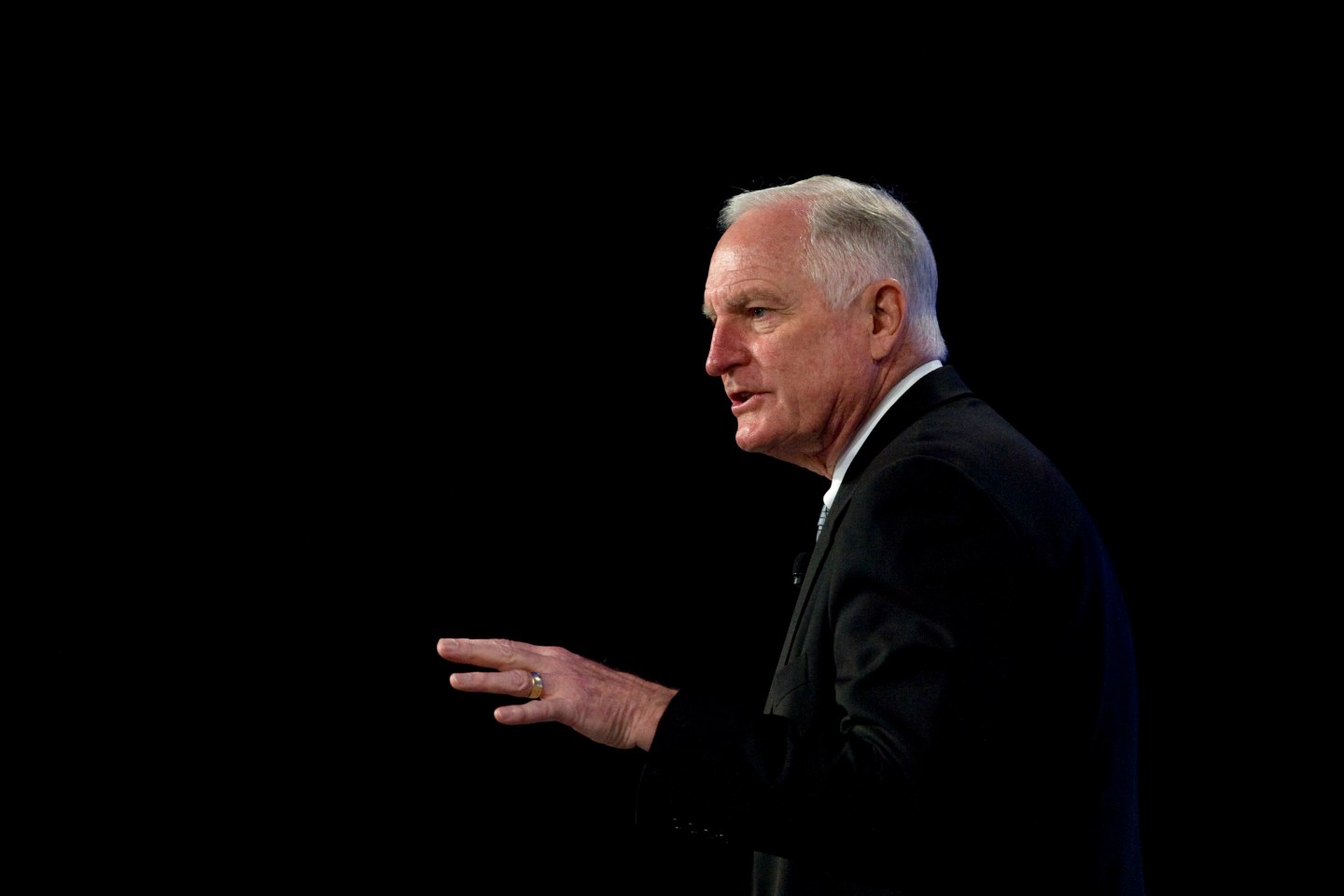
Craig Barrett is a former CEO and Board Chairman of Intel.
Craig Barrett is a former CEO and Board Chairman of Intel Corp.

Throughout the 59-year history of Moore’s Law, the only consistent truth in the semiconductor industry has been that performance wins. Competitors come and go, and new technologies like PCs, smartphones, and artificial intelligence rapidly change the landscape. But in the end, the company with the best technology and ability to manufacture in high volume wins the prize.

For decades, this was Intel. The company’s mantra was to drive technology leadership at all costs and push Moore’s Law to the limit. That’s how Intel became the most successful semiconductor company on the planet, with manufacturing technology consistently one generation (about two years) ahead of everyone else.

During the last decade, this all changed. Intel stumbled and lost its leadership position—and now it’s viewed by some as just another company struggling to survive. 

Some pundits think there is a simple solution: split the company into two. That way, their argument goes, the Intel design company can compete with other chip designers (AMD, Qualcomm, NVIDIA, etc.) while the foundry part of the company can be free to serve all chip designers. This simplistic solution ignores the existence of Moore’s Law—and would be bad for Intel and the United States.

Every design company wants the best manufacturing technology available so as to maximize the performance of its chips. This holds true for companies that sell chips on the open market as well as those that design for the internal use of the likes of Apple and Amazon. Whichever foundry has the latest and greatest technology will win the lion’s share of all the chip designer’s business. Today, that position is held by TSMC. Much of the industry relies on the same manufacturer to build their products—their only manufacturing advantage is TSMC’s technology leadership.

Intel can attract these same chip customers by restoring its foundry technology leadership. Even if you compete with Intel designs, why put yourself at a disadvantage? As long as Intel has the best technology and is competitive on price, competitive issues can be resolved.

This is all unfolding at a time when the world needs a more globally diverse and resilient semiconductor supply chain. Geopolitical tensions around the world are escalating, making the urgent need for having a strong U.S. manufacturing capability on our own shores even more pressing.

Splitting Intel into two separate companies wouldn’t do the U.S. any good if the Intel design business succeeds and the foundry business does not. In that case, the U.S. would remain dependent on a foreign supplier for leading-edge technology—and the $50 billion in the CHIPS ACT would have been wasted.

We’ve seen this movie before. Years ago, a struggling AMD split off its manufacturing capacity into Global Foundries. Pundits applauded the split at the time. A decade later, AMD is doing well using TSMC, while Global Foundries has little if any differentiated technology. Global Foundries just didn’t have enough research and development (R&D) budget, and with limited production and revenue, struggled to keep up with market leaders. 

The economic reality is that it takes massive investment to drive Moore’s Law. In today’s semiconductor industry, only three companies (Intel, Samsung, and TSMC) have sufficient revenue to contend for technology leadership. If you split up Intel, the foundry portion will probably fail because of decreased R&D spending along with the complex realities of splitting up a huge multinational company in the midst of a multiyear turnaround effort.

Instead of wasting time and effort splitting Intel into two separate companies, why not focus on the real issue? The Intel of tomorrow needs to be like the Intel of 15 years ago—the driver and leader of Moore’s Law. That way, you get a win-win scenario with U.S.-based design and manufacturing technology.

This starts with rebuilding Intel’s technology leadership. The current CEO, Pat Gelsinger, has precisely the right strategy and attributes, and he is already driving the right changes.

Intel is on the verge of completing an unprecedented pace of node development to catch up to TSMC. It has taken the lead on next-gen technologies that will shape the semiconductor industry for years to come, such as high NA EUV lithography and backside power delivery.  Yes, more work is needed—but this is a good start, and they must keep going.

The U.S. government must do its part as well. This includes increased funding of basic pre-competitive research in semiconductor technology in our research universities and national laboratories. The U.S. has made a small step in this direction with the creation of the National Semiconductor Technology Center, but there is still a ways to go, especially when you consider the NSTC budget for five years is less than what Intel spends annually on R&D.

There are immense challenges as leading manufacturers race to create technologies that combine 100 billion transistors into a piece of silicon the size of a fingernail. These are the most complicated things mankind has ever built, and semiconductor leaders will spend tens of billions of dollars to make it happen.

Let’s not kid ourselves: If the U.S. wants to be a leader in this game once again, simply slicing Intel in half is not the solution. We must be willing to invest and do the hard work of leading Moore’s Law into the future, not waste time rearranging the deck chairs.

I remember a similar time in Intel’s history—the dot-com bubble crash of the early 2000s. Customer demand evaporated. Wall Street said we should have layoffs, close factories, and cut R&D spending. The Intel board agonized over the situation but followed management’s plan to maintain investment in R&D and build new factories. The stock price crashed, but when demand returned, Intel was in a stronger position than before. It wasn’t pretty but it was the right thing to do. Pat Gelsinger is doing the right thing now.

More must-read commentary published by Fortune:

  • Why breaking Intel in two is the only way to save America’s most important manufacturer, according to its former board directors
  • Here’s why the gap between Americans’ perception of U.S. economic performance and reality has doubled since 2019, according to economists
  • How the Democrat-leaning news media is unwittingly aiding Trump
  • As activist Starboard engages constructively, here’s a potent prescription for Pfizer’s future success under Dr. Bourla’s watch

The opinions expressed in Fortune.com commentary pieces are solely the views of their authors and do not necessarily reflect the opinions and beliefs of Fortune.

Join us at the Fortune Workplace Innovation Summit May 19–20, 2026, in Atlanta. The next era of workplace innovation is here—and the old playbook is being rewritten. At this exclusive, high-energy event, the world’s most innovative leaders will convene to explore how AI, humanity, and strategy converge to redefine, again, the future of work. Register now.
About the Author
By Craig Barrett
See full bioRight Arrow Button Icon

Latest in Commentary

Finance
Lorem ipsum dolor sit amet, consectetur adipiscing elit, sed do eiusmod tempor incididunt ut labore et dolore magna aliqua. Ut enim ad minim veniam
By Fortune Editors
October 20, 2025
Finance
Lorem ipsum dolor sit amet, consectetur adipiscing elit, sed do eiusmod tempor incididunt ut labore et dolore magna aliqua. Ut enim ad minim veniam
By Fortune Editors
October 20, 2025
Finance
Lorem ipsum dolor sit amet, consectetur adipiscing elit, sed do eiusmod tempor incididunt ut labore et dolore magna aliqua. Ut enim ad minim veniam
By Fortune Editors
October 20, 2025
Finance
Lorem ipsum dolor sit amet, consectetur adipiscing elit, sed do eiusmod tempor incididunt ut labore et dolore magna aliqua. Ut enim ad minim veniam
By Fortune Editors
October 20, 2025
Finance
Lorem ipsum dolor sit amet, consectetur adipiscing elit, sed do eiusmod tempor incididunt ut labore et dolore magna aliqua. Ut enim ad minim veniam
By Fortune Editors
October 20, 2025
Finance
Lorem ipsum dolor sit amet, consectetur adipiscing elit, sed do eiusmod tempor incididunt ut labore et dolore magna aliqua. Ut enim ad minim veniam
By Fortune Editors
October 20, 2025

Most Popular

Finance
Lorem ipsum dolor sit amet, consectetur adipiscing elit, sed do eiusmod tempor incididunt ut labore et dolore magna aliqua. Ut enim ad minim veniam
By Fortune Editors
October 20, 2025
Finance
Lorem ipsum dolor sit amet, consectetur adipiscing elit, sed do eiusmod tempor incididunt ut labore et dolore magna aliqua. Ut enim ad minim veniam
By Fortune Editors
October 20, 2025
Finance
Lorem ipsum dolor sit amet, consectetur adipiscing elit, sed do eiusmod tempor incididunt ut labore et dolore magna aliqua. Ut enim ad minim veniam
By Fortune Editors
October 20, 2025
Finance
Lorem ipsum dolor sit amet, consectetur adipiscing elit, sed do eiusmod tempor incididunt ut labore et dolore magna aliqua. Ut enim ad minim veniam
By Fortune Editors
October 20, 2025
Finance
Lorem ipsum dolor sit amet, consectetur adipiscing elit, sed do eiusmod tempor incididunt ut labore et dolore magna aliqua. Ut enim ad minim veniam
By Fortune Editors
October 20, 2025
Finance
Lorem ipsum dolor sit amet, consectetur adipiscing elit, sed do eiusmod tempor incididunt ut labore et dolore magna aliqua. Ut enim ad minim veniam
By Fortune Editors
October 20, 2025
Rankings
  • 100 Best Companies
  • Fortune 500
  • Global 500
  • Fortune 500 Europe
  • Most Powerful Women
  • Future 50
  • World’s Most Admired Companies
  • See All Rankings
Sections
  • Finance
  • Leadership
  • Success
  • Tech
  • Asia
  • Europe
  • Environment
  • Fortune Crypto
  • Health
  • Retail
  • Lifestyle
  • Politics
  • Newsletters
  • Magazine
  • Features
  • Commentary
  • Mpw
  • CEO Initiative
  • Conferences
  • Personal Finance
  • Education
Customer Support
  • Frequently Asked Questions
  • Customer Service Portal
  • Privacy Policy
  • Terms Of Use
  • Single Issues For Purchase
  • International Print
Commercial Services
  • Advertising
  • Fortune Brand Studio
  • Fortune Analytics
  • Fortune Conferences
  • Business Development
About Us
  • About Us
  • Editorial Calendar
  • Press Center
  • Work At Fortune
  • Diversity And Inclusion
  • Terms And Conditions
  • Site Map
  • Facebook icon
  • Twitter icon
  • LinkedIn icon
  • Instagram icon
  • Pinterest icon

Latest in Commentary

journalists
CommentaryMedia
I’m a war gamer for the Navy and I know why you don’t trust the media anymore. It’s fighting yesterday’s battles
By Charles Edward Gehrke and The ConversationFebruary 9, 2026
11 hours ago
super bowl
CommentaryAdvertising
The Super Bowl reveals a dangerous gap in corporate strategy 
By Christopher VollmerFebruary 9, 2026
16 hours ago
tara comonte
CommentaryAdvertising
Weight Watchers CEO: what the GLP-1 Super Bowl ads are missing
By Tara ComonteFebruary 9, 2026
17 hours ago
ceo
CommentaryLeadership
The next 18 months of the agentic era will feel like a slow-motion stress test for CEOs. Most will make the same critical mistake
By Amy Eliza WongFebruary 9, 2026
18 hours ago
CommentaryHealth
Patient private capital is needed to help Asia plug its healthcare gaps
By Abrar MirFebruary 8, 2026
1 day ago
nfl
CommentaryTV
The Super Bowl was made for TV and instant replay was made for visual AI. Here’s how it could be better and what it would look like
By Jason CorsoFebruary 8, 2026
2 days ago

Most Popular

placeholder alt text
C-Suite
Meet Jody Allen, the billionaire owner of the Seattle Seahawks, who plans to sell the team and donate the proceeds to charity
By Jake AngeloFebruary 9, 2026
11 hours ago
placeholder alt text
AI
As billionaires bail, Mark Zuckerberg doubles down on California with $50 million donation
By Sydney LakeFebruary 9, 2026
14 hours ago
placeholder alt text
Economy
China might be beginning to back away from U.S. debt as investors get nervous about overexposure to American assets
By Eleanor PringleFebruary 9, 2026
19 hours ago
placeholder alt text
Economy
Elon Musk warns the U.S. is '1,000% going to go bankrupt' unless AI and robotics save the economy from crushing debt
By Jason MaFebruary 7, 2026
2 days ago
placeholder alt text
Commentary
America marks its 250th birthday with a fading dream—the first time that younger generations will make less than their parents
By Mark Robert Rank and The ConversationFebruary 8, 2026
2 days ago
placeholder alt text
Economy
Russian officials are warning Putin that a financial crisis could arrive this summer, report says, while his war on Ukraine becomes too big to fail
By Jason MaFebruary 8, 2026
1 day ago

© 2026 Fortune Media IP Limited. All Rights Reserved. Use of this site constitutes acceptance of our Terms of Use and Privacy Policy | CA Notice at Collection and Privacy Notice | Do Not Sell/Share My Personal Information
FORTUNE is a trademark of Fortune Media IP Limited, registered in the U.S. and other countries. FORTUNE may receive compensation for some links to products and services on this website. Offers may be subject to change without notice.










