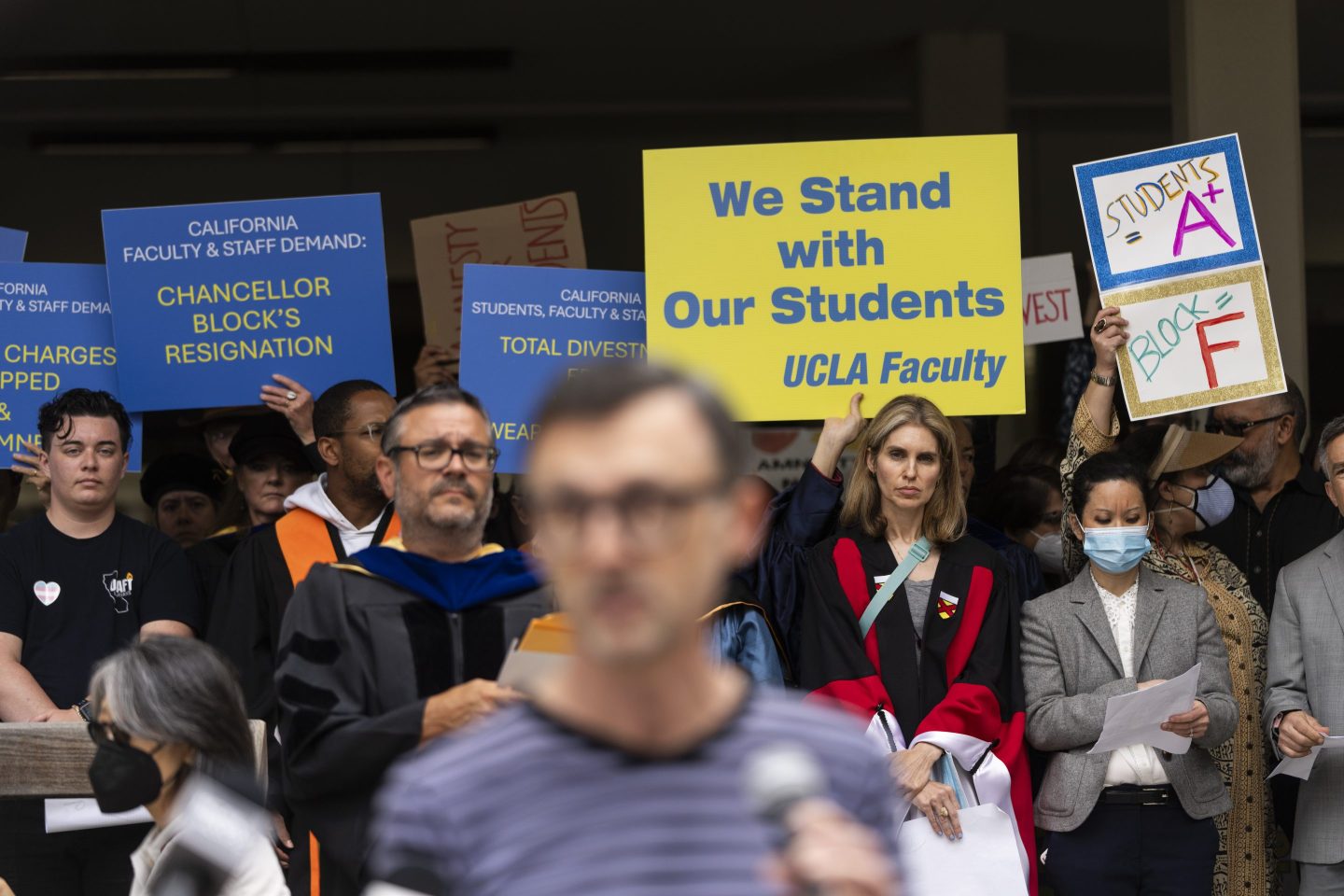
Dissent is thriving this fall at American colleges, and not just among student activists. With student protests limited by new restrictions, faculty have taken up the cause.
To faculty, new protest rules threaten freedom of speech — and the freedom to think, both central to university life. This semester, some of the most visible demonstrations have involved professors speaking up for the right to protest itself.
Last spring, pro-Palestinian tent encampments crowded schools and disrupted commencement plans, drawing accusations of antisemitism and prompting new limits.
At Indiana University, an “expressive activity policy” rolled out in August prohibits protests after 11 p.m., bans camping on campus, and requires pre-approval for signs. In defiance, each Sunday a group of faculty members, students and community members gather on campus for candlelight vigils that extend past the 11 p.m. deadline.
Russ Skiba, a professor emeritus who has attended the vigils, said the new restrictions are part of a larger movement to limit academic freedom on campuses.
In Indiana, the Republican governor in March signed a law increasing state oversight of public universities. The law, sponsored by a lawmaker who said colleges suffer from “monolithic thinking,” subjects faculty to post-tenure reviews over whether they are fostering diversity of thought and keeping their political views out of the classroom. Skiba and other Indiana professors widely opposed the bill, which they criticized as vague and subject to interpretation.
“Universities are bastions of free speech, but when you have a movement that is anti-democratic, one of the places that is most attacked is freedom of speech,” Skiba said.
Faculty members at colleges elsewhere around the country have pushed back on the new rules with protests, vigils and demands for explanation.
A group of Harvard University professors held a “study-in” at a campus library on Oct. 16 in support of pro-Palestinian students who were temporarily banned from the library for holding a similar demonstration. In September, a group representing University of California faculty filed a complaint alleging the system sought to chill their academic freedom and keep from teaching about the Israel-Hamas war “in a way that does not align with the University’s own position.”
To some professors, the protest restrictions are also a labor issue.
Colleges have been granting tenure to fewer professors, and facing pressure in some areas to do away with it altogether. Legislatures in several states have taken an interest in how topics around race, gender and history are taught. Protest guidelines handed down by administrators are another way the faculty’s say in university affairs is being diminished, some professors say.
“We have to, as faculty, organize and demand the sort of shared governance that gives us a right to review and challenge these policies,” said Todd Wolfson, a journalism and media studies professor at Rutgers University and the president of the American Association of University Professors. “They’re not made by people coming out of the academic arm of our institutions.”
Tensions on campuses nationwide have been high since the war began over a year ago, when Hamas-led militants stormed into southern Israel, killing some 1,200 people, mostly civilians, and abducting around 250. Israel’s offensive has killed over 42,000 Palestinians, according to the Gaza Health Ministry, which does not say how many were fighters.
Colleges have been under tremendous pressure, including from Republicans in Congress, to protect students from discrimination while upholding free speech. Demonstrations last spring blocked foot traffic in parts of some campuses and included instances of antisemitic imagery and rhetoric. Some Jewish faculty members and students have the protests made them feel unsafe.
Shirin Vossoughi, a Northwestern University professor, was among 52 faculty members who signed an open letter opposing the school’s new demonstration policy as caving to political pressure to silence certain types of activism. She said the rules crack down not just on free speech, but pro-Palestinian voices in particular.
“A lot of universities have rewritten their demonstration and code of conduct policies this summer, and I think my first thought is that it is very clear that it’s in response to dissent around Palestine,” she said.
During the protests last spring, some faculty members joined ranks with demonstrators. Others acted as mediators for students they see as under their care and protection. Faculty voted no confidence against leaders of schools including Columbia University, the University of Massachusetts, Brandeis University, and Cal Poly Humboldt over their handling of the protests.
At Northwestern University, Steven Thrasher was among three faculty members charged by university police for obstructing law enforcement during last spring’s protests. He was suspended and removed from teaching this fall while under investigation by the university.
“The way that I saw my role was as a protector of the students’ safety and of their ability to express themselves,” Thrasher said this fall. “I knew as soon as I started seeing violence happening towards students that I would do what I could.”
While schools say the rules are meant to limit disruptions, faculty members say they have the effect of neutralizing dissent.
“The whole point of a protest is to be seen and heard,” said Michael Thaddeus, a mathematics professor at Columbia University, where new rules require advance notice and prevent demonstrations that “substantially inhibit the primary purposes” of an area of campus. “Free speech rights aren’t served if you can only speak into the void and not have anybody hear you, and that includes the right to be seen and heard by people who don’t like what you have to say.”
Professors also drew a connection to the growing percentage of lecturers, adjuncts and professors who do not have tenure protections. Professors increasingly see the issue of speech and academic freedom as a labor issue as a result of the crackdowns, said Risa Lieberwitz, AAUP’s general counsel.
“We’re seeing unionization growing and increasing,” she said. “I think to some extent it’s because it’s so important to organize, to claim democratic rights.”
Wolfson said professors must stand up for students’ rights to demonstrate and speak freely.
“Their freedom of speech rights are the lifeblood of the university,” Wolfson said. “We cannot have a university based on critical thinking and exploring questions if we’re going to clamp down on students’ rights to protest something they think is a massive problem, and if they see a way for the university to actually engage in it productively.”