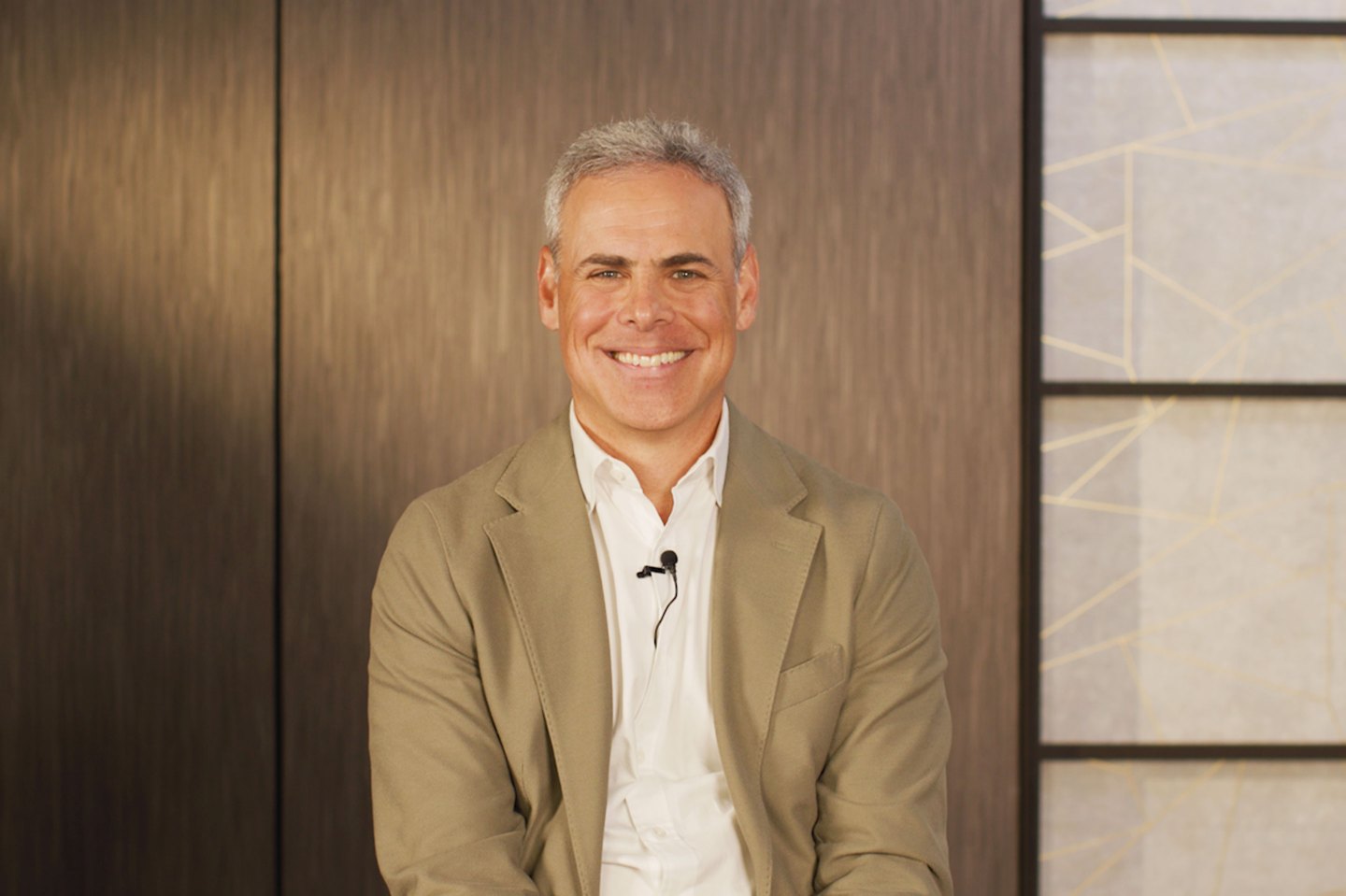
Brett Schulman knows crazy—and he’s not talking about the feta.
The 52-year-old CEO and co-founder has watched Cava, the cult-classic Mediterranean fast-casual spot, skyrocket. Since its IPO last summer, the chain’s stock has grown over 300%; it hit a new peak—$128 per share—in late September.
The smash success hardly came overnight. Following a brief but unfulfilling career in finance—and a brief foray into consumer packaged goods—Schulman was introduced to his future partners, with whom he developed the Cava from a single sit-down restaurant, Cava Mezze, in a suburb of Washington, D.C.
The process was guided by a day-one commitment to a handful of tenets: bringing heart, health, and humanity to food—and taking care of both the customers and the staff (above-minimum wage pay, long before other chains caught up). They even have a special “love button,” which, when a cashier pushes it, the patron gets an automatic free meal. (Used wisely, of course.)
In an interview with Fortune, Schulman details his first job washing cars, his uphill battle after a risky acquisition of another chain, how many times he eats Cava a week—and whether there’s a secret formula to ordering the perfect bowl.
The following has been lightly condensed and edited for clarity.
Tell us about your background.
I was born and raised just outside Philadelphia. My father worked in the car business and had an opportunity to invest in a car dealership in Bethesda, Maryland, and become a partner there. So we packed up and we moved to Maryland right before I started high school.
I had a lot of jobs when I was a teenager, whether it was chopping or selling firewood, or selling mulch and landscaping. But my very first job was washing cars, probably making $6 or $7 an hour.
I walked into high school not knowing anyone. I had to figure out how to build new friendships and establish a new world for myself in Washington, D.C. I graduated high school and started college in Arizona. But that was a little bit far for me, and wound up coming back and eventually transferring to the University of Maryland, where I graduated.
My original major at Maryland was criminal justice and criminology. I thought I wanted to go to law school and be an attorney. My senior year of college, I interned at a law firm, and I did not like it, and realized that that wasn’t for me. So I figured out what I was going to do next, and was able to get an internship at an investment bank called Alex Brown. I was able to use that internship to get a full-time job after I graduated. Eventually, I went into equity trading.
I loved the finance world. It was exciting and fun. Around 1997, there was a law called Glass-Steagall, and when they repealed that law, it allowed commercial banks and investment banks to merge and partner up—and that created many different mergers in the industry.
So our company, Alex Brown, got bought by Bankers Trust, and then Bankers Trust got bought by Deutsche Bank. One year, the head of our group said, “Everything’s going really well. We’re not going to fix it. We’re going to leave you all be. You’re doing a great job.” And then two weeks later, [it was]: “We’re moving you all to New York.”
I was actually living in Baltimore, Maryland at the time, where the headquarters was. That really was the beginning of thinking about, maybe I want to do something different. I thought the world was going to be very predictable and I was going to work my way up. All of a sudden, that changed very rapidly. If they hadn’t repealed Glass-Steagall, I don’t know that Cava would have ever existed.
I then started to think about what we were going to do next. I had met my wife, Mary, who had always been a very healthy eater. Around 2004, we started to think about leaving our careers to do something more entrepreneurial; that really came to life in a natural snack-food company.
The company was called Snikiddy Snacks. It was really the idea of better-for-you snacks for kids, because we had just started to have kids. At that time, we had a young daughter, and Mary was about to have our second child, our younger daughter, and so we literally just created it and went and found co-manufacturers to produce the products, and cold-called Whole Foods Market and other retailers, and we were able to get distribution. So we started to grow that business.
We had some success, but it was always kind of an uphill struggle. We brought on a gentleman to be our CEO. At the time, I was the chief operating officer. I ran all of our manufacturing and logistics and shipping to all of our retail partners, and Mary did all the sales and marketing. So it was really complementary.
A couple years later, as we were growing that business—I hadn’t necessarily planned to do that full-time—I decided with our CEO at the time that I was going to do something different, and we had actually disagreed on some of the strategy. I decided I was going to do something on my own, and figured out what that was going to be.
Around that same time, a friend of mine from college called me and said, Hey, will you talk to my cousin Ted Xenohristos? They have a restaurant called Cava Mezze, do you know it? And I said, I think I’ve heard of it. They said, well, they partnered with a customer to sell their dips and spreads in a couple of local Whole Foods Markets. I said, yeah, we’ve actually got the hummus in our refrigerator. He said, Well, you’re working with Whole Foods, will you talk to them and help them? I said, Sure.
So I met with Ted and Ike [Grigoropoulos], one of my other co-founders, and they talked about the challenges they were having with that business. At the time, my partners Ted, Ike, and Chef Dimitri [Moshovitis], had opened a full-service restaurant in 2006 called Cava Mezze. That was really the origin of our brand; they wanted to put a modern American perspective on their family’s heritage and cuisine and that came to life in that restaurant.
Cava Mezze still exists today in Rockville, Maryland. They were opening their second full-service restaurant, and they had partnered with a customer to sell these dips and spreads in a couple local Whole Foods Markets. But that business was struggling.
They said they were focused on the full-service restaurants and asked for my advice. So I gave them some advice, and we agreed to stay in touch. And then about two months later, when I decided I was going to do something different, I called Ted back up. I said, How’s everything going? He said, “not well, but what are you doing?” I said, “Well, I’m thinking about what I’m doing next.” And he said, “Well, why don’t you come on board? Would you want to consult for us and help us fix this business? You know we’re focused on our two full-service restaurants.” I said sure.
I really believed in the products: the hummus, the crazy feta tzatziki. So I was able to go in and get the business profitable and get it turned around, and me and the guys hit it off. They said, Brett, why don’t you become our fourth partner? And I said, well, that’s a great offer, let me talk to my wife, Mary.
Mary and I went down to that second full-service restaurant—I didn’t tell the guys that we were going—to go have dinner, because I really wanted to see, deep down, their operation. And what I saw was so impressive. How happy their team was working, how great the food was, and most importantly, how great we felt after we ate the food.
So I went back to the guys the next day and said I was in. Let’s be partners. But I asked them, have you ever thought about taking what we do in full-service and in the grocery stores and kind of combining it and bringing this amazing Mediterranean cuisine to a larger audience in a fast health-based format? And Chef Dimitri loved the idea.
We spent about a year figuring out how that food would translate from a full-service, made- to-order format into a fast format, and ultimately settled on the Walk the Line format. We really settled on the Walk the Line format for three reasons, and I’ll go from the least important to most important one.
First: We’re a little impatient, so we like the idea that, even if the line was long, you knew you got your food when you got to the register. You didn’t have to wait for a buzzer to buzz, or your name to be called. But more importantly: that power of customization. Within our 38 ingredients on the line, you can make over 17 billion combinations and make them to your specific needs and preferences. And we felt customization was going to be a much larger trend as time went on.
And third and most importantly, the Walk the Line operating model allows us a highly productive production model. If you think about it, it’s like the old Henry Ford production line. It allows for very efficient labor productivity, which then allows us to take that efficiency and invest in our food quality. We always felt that we were going to succeed with our high-quality food that we were already serving in the full-service restaurants, or the ingredients we were using in that crazy feta tzatziki that we were selling at Whole Foods Markets.
So we went ahead. I’ll never forget: We got a bunch of folks together at the original restaurant out in Rockville, and closed for lunch one day, and a lot of customers had been approaching the guys about investing in a new full-service restaurant. We presented our idea, and we mocked up the food, and we said, you know, this isn’t going to be a full-service restaurant, but here’s our idea. We want to open two or three and see if we can prove this idea out. So we raised friends-and-family money that summer of 2010 and we opened our first fast-casual location in January of 2011. Fast forward to today, and we have over 340 restaurants operating in 25 states and the District of Columbia.
Did you ever aspire to be a CEO?
No, I never specifically thought I wanted to be a CEO. But when I worked in finance in a large corporation, I knew I wanted to build something different. I felt very unfulfilled, and that led me to the idea that I wanted to make a greater impact than what I was making in that career, and I wanted to be more creative or build something that helped others and lifted others up. I think that’s what led me, eventually, down the entrepreneurial path.
We tell this to our team every day. We don’t want you hitting the snooze button on Monday morning. We want you jumping out of bed excited to make an impact. I wanted to create something where we could build careers for our team members, not just give them employment. And that really led, I think, to the role I’m in today, to help lead those efforts and create that kind of environment and make that kind of impact.
How did you go from becoming a fourth partner in Cava Mezze to becoming CEO?
Ted jokes about it, saying, “you know, we hired ourselves a boss.” Ironically, Mary and I did that at the snack-food company. We hired ourselves a boss because we didn’t have real industry expertise or knowledge. I think Ted and the guys recognized that we had this philosophical alignment. We very much viewed the world and how we wanted to show up and build the business similarly.
We found ourselves with very complementary skills, and I think they felt that I brought to the table a passion for some of the aspects of the business that they weren’t as interested in. Whether it’s the culinary side, or the concept side that Ted works on, or the operations side that Ike had a passion for, or the food itself, which Chef Dimitri certainly had a passion for—we all found ourselves with complementary skill sets. And they asked me to take the lead from a CEO perspective.
Is Snikiddy Snacks still around today?
It was acquired by Utz, the potato-chip company, back in 2014. We were making baked puffs, baked veggie fries, kind of like veggie straws. Originally it was also better-for-you cookies, but that line got discontinued. It was really focused on the baked puffs and veggie straws.
Did you ever, as an entrepreneur, have moments where you thought you would fail?
All the time. I say that being an entrepreneur is very much the cliche of riding a roller coaster. Even at Cava, we’ve stared into the abyss a few times and lived to talk about it. I think that’s a really important lesson: You learn more from your adversity than you do from your success. And it’s those moments that really test you and really help you understand how you can overcome those hurdles. If you can overcome those hurdles, that’s what typically leads to great outcomes.
Bloomberg recently estimated that each Cava location is now worth roughly $33 million. To what would you attribute that success?
We don’t focus on metrics like that, but I think the success we’ve had is really a byproduct of everything we put into it, how we invest in our team, how we invest in our guest and the guest experience, and how we’ve tried to strategically build this business to be sustainable in its growth—and to be able to deliver that value, both to our team members and our guests.
Even the operating model we chose to use—the Walk the Line format—allowed us to deliver the cuisine the way we wanted to, at a price and a value that was compelling. The way we’ve always paid our team members helps, too.
Back in 2016, we took our national starting wage to $13 an hour, which was substantially higher than most states were mandating at the time. Even our competitors were paying $9 or $10 an hour. We’ve obviously raised wages significantly higher since then, and even today, we pay at the top end in most markets, and not just headline wage. We invest in team-member benefits. In 2021, we rolled out mental health benefits to all team members and their families, regardless of whether they’re on our health plans or not.
We also invest in our guests. I talked about food quality, but also, we’re not passing along price increases as much as maybe some of our peers do. We’ve been living through a high inflationary period recently. Between the end of 2019 and the end of 2023, we raised prices around 12%. The CPI grew at 18%. The Labor Department has noted that many fast-food companies have raised [wages] upwards of 30%. Even more specifically, there was legislation passed in California called AB-1228 which required chains of a certain size, like us, to be paying a minimum wage of $20 or more.
We didn’t have quite as much ground to make up there as some others did, because we were already paying close to those [new requirements]. But we increased our wages further, and chose not to pass along those incremental costs to our customers.
We were the only limited-service brand not to raise prices as a result of that legislation. It kind of all comes together to talk about how we view building our business. It really comes from an investment standpoint; if we invest in our team and our guests, great financial results and success will ultimately be a byproduct of that.
Cava stock has skyrocketed 300% since your IPO. What do you think has been the main contributor to that growth?
I told the team the night before the IPO that this was not the destination. This was the beginning of the next chapter of our journey, and that stock prices will go up and down every day. But if we focus on our mission to bring heart, health, and humanity to food, and if we continue to be constantly curious and generous, and have a passion for positivity, and we focus on our strategic plan, that stock performance will follow. That again, is a byproduct of all this stuff we’re doing, and how we take care of our team and our guests. We’re building this business not for the next 10 weeks or the next 10 months, but the next 10 years and beyond.
I don’t know if you know, but Panera Bread’s founder [Ron Shaich] just became a billionaire thanks to his investment in Cava. Do you and Ron ever talk to each other?
Yeah, we text all the time. Ron likes to fashion himself as “Sherpa Capital,” and I think it’s a good metaphor. Ron had climbed the fast-casual mountain building Panera. An incredibly large-scale business. He’s been down the path we’ve embarked upon, and he knows what may be around the corner or where a wrong turn might lie. It’s invaluable to have that experience and that perspective at the table as we navigate our own journey.
I have a standing meeting with Ron every month, but we text back and forth all the time, and that’s been very helpful in how I operate as a CEO. I’ve had to reinvent myself four times as a CEO. First, I was a startup CEO and a founder. Then I was a growth CEO. Then a growth company CEO. Then I was a private company enterprise CEO. We bought a company called Zoe’s Kitchen back in 2018. It was three times’ our size at the time, so overnight, I went from running a company of around 70 restaurants to running almost 300 restaurants. That’s a very different company to manage.
Now as a public company enterprise CEO, it’s been helpful to have that advice along the journey, especially at an enterprise level, where Ron had deep experience running that kind of scaled organization.
Tell us about the Zoe’s Kitchen acquisition.
That’s how I got all my gray hair. We had this really unique opportunity brought to us in 2018. Our investor and chairman, Ron Shaich, had been approached by a public company at the time called Zoe’s Kitchen that was having a lot of challenges.
Cava had roughly 55 restaurants. We were going to open about 29 new restaurants that year, and had been on a straight growth trajectory. That spring, Ron came to me and said, “Hey, would you be interested if we got our investors together and acquired this company, and gave this company to you and your management team? They want to engineer a turnaround. I don’t think that they’re capable of doing that, but this could be a unique way to catapult Cava.”
As I thought about it, there were two real theses we had that intrigued me. One was that Zoe’s had a real-estate footprint in a large part of the country we were trying to enter, which was the Sun Belt. And this was back in 2018. We were already seeing population migration towards the Sun Belt. Second: 80% of our restaurants at Cava were already in the suburbs, and we were seeing how well-received we were and how well we were performing in the suburbs. Zoe’s real-estate portfolio was 100% in the Sunbelt and 100% in the suburbs. So this was a great complementary footprint to our existing real-estate footprint and where we were trying to expand.
Zoe’s restaurants were doing about half of our revenue at some similar locations where we had Cavas. So we felt there was an opportunity, if we converted it to a Cava, we could unlock significant revenue growth.
And then the second big thesis was that scale was going to matter more than ever in our industry, and technology was being a big driver of that, bifurcating the industry into the haves and the have-nots. Those that have the relevant resources to invest in technologies to create differentiated guest experiences, as well as the operational insights to compete in a modern business environment versus those who are relegated to more out-of-the-box, commoditized solutions—as well as being able to have the scale to withstand the cost and labor pressure inflation we’ve seen in recent years—that’s all played out.
What didn’t play out as expected when we ultimately decided to acquire the business, was the distress of the Zoe’s business.
I’ll never forget, it was about a week after we had taken control. Our leadership team went and visited. We did regional town halls with all of our Zoe’s operators to understand what was going on in the business, and what was challenged, so that we could continue to operate it with stability as we prepped it to convert locations to Cavas.
I was on a plane going from one regional town hall to another, and I got an email [saying] Zoe’s same-restaurant sales had declined 12%, which is pretty significant. So that was a bit of a shock. It was not quite as expected. And I remember going to my co-founders the next day, and said, OK, we have to stabilize this. We have to triage this business. So we spent the next six months really almost firefighting, in a sense, trying to stabilize that business. And at the same time, it took our attention a bit away from Cava.
And I’ll tell you, it was a really critical moment in our journey and our history, and it was the idea of really having perseverance, continuing to figure out how we were going to be the victor, not the victim, of our circumstances. We were not going to let this undermine the eight years of great work we did building Cava. So I think the biggest lesson learned came at a critical moment when we were basically just trying to hold the line.
I met with some of my board members and Ron, and we said, Okay, we’re gonna spend the day together and really strategize how to get the business moving forward positively. And we spent about four or five hours whiteboarding, and they said, Brett, you’re doing everything everywhere. What are the five things that are going to change the trajectory of this? What are the five things that matter most that are going to be really the catalyst to get this turned around?
So we synthesized it into five pillars. And then they challenged me again. They said, Brett, you can only be leading one or two of those. Who else can you count on to lead those others?
I think it goes back to the idea of simplifying and focusing. And so once we synthesized that, and we had our five pillars, and we had who was going to lead those pillars, that basically became my stump speech to the organization. And so that Monday, I would say to the team, here are the five things we’re working on. If you’re not working on one of those, come talk to me, because it’s a problem. It was amazing to watch the business start to bottom and turn when we gave the team that kind of clear focus and direction.
It took a little while, but by January of 2020, we were positively comping at Zoe’s for the first time since that brand had comped positively since 2017, which was a year before we bought it, and Cava was positively comping double digits. Same thing in February and in March. We were doing a market conversion in Denver, Colorado, where we had six struggling Zoe’s Kitchens that we were going to convert to Cavas. We had done a single restaurant conversion in fall of 2019 that was very successful, so now we were going to do a market conversion, and in the first week of March, we were training in Denver, about to open, and the pandemic hit.
I just remember saying to the team, “Hey, listen, you know what? We don’t deserve to be here.” We just kind of stared into the abyss and came out of it. But we know what matters. We know how to get through this. And in the pandemic, we’re going to focus on team member safety, we’re going to focus on guest safety, and contactless ordering. It goes back to simplifying and focusing—that got us through the Zoe’s challenges and ultimately allowed us to be successful in navigating the pandemic.
How many Zoe’s have you successfully converted?
When we bought Zoe’s, its restaurant count was almost three times ours. We knew that about two-thirds of the real-estate portfolio was what we called strategic that we wanted to convert, and about one-third of that was deemed non-strategic. So we either let those leases naturally end, or we struck an agreement with the landlord to exit the site and then ultimately converted roughly 170 of Zoe’s locations to Cavas, which really helped accelerate our growth. It also helped us get a great footprint in a part of the country that we were really trying to establish Cava in.
Do you regret the decision to acquire Zoe’s?
Not at all. Our thesis has played out the way we had hoped. I think what we maybe got wrong in the moment was how distressed the business was. But again, we learned so much, and being able to overcome that adversity ultimately propelled us to the success that we have today,
When we acquired Zoe’s, we acquired a company that had been challenged, and a much larger organization that had had a reduction in force earlier that year, so the morale was pretty low. And at Cava, we had a more startup growth organization that was confused about why we bought this struggling company that was bigger than us, and the combined company was now a very different company. It had a lot of folks on the Cava team who didn’t want to be in that large-scale of an organization anymore, and we had folks on the Zoe’s team who didn’t want to embark on the transformation challenge that we were about to do. So we had a lot of people leave. We had a great culture at Cava going into that acquisition; the culture got really challenged when a lot of folks started leaving.
We had had so much success at that point, then we were having adversity. This was all new to us, different from what we had been experiencing the last few years. And then the pandemic hit, and then the Great Resignation, and you had a lot of people moving around the country. And it really challenged our culture.
I could feel it in the business. And it hurts your heart when you’re feeling that kind of challenge in the business culturally, when it was such a badge of pride that we had and how we had built it before the Zoe’s acquisition. And so I was fortunate to recruit and hire a woman named Kelly Costanza, who is my current chief people officer. She’s been with me over four years now, and we talked about this, and about how we were going to get back to the type of energy and culture we had pre-acquisition.
So in 2021, we decided to embark on what we call our ENPs, our employee net promoter score. We started to really measure the health of our culture, like we measure the health of many other areas of the business. And we got all the data back, and we saw the areas that we scored really poorly in, which, at the time, were pretty much all. As we were working through the Zoe’s conversions, we realized we were going to exit and come out the other side a new collective. And with this new collective, we needed to give this group, this new organization, its own set of mission, values, and competencies.
So we took our original mission and values and really put pen to paper and thought about how it needed to evolve with this new collective, and it’s really a core part of our culture today. Then we created the launch plan, and we cascaded it throughout the org. By the end of 2022, we had moved those scores from abysmal ratings to top-decile and top-quartile ratings. You could feel the organization coalesce.
It was a lot of work, and it was very intentional. It wasn’t set-it-and-forget-it. I think that’s another lesson learned: You have to continue to work at this, and reinforce this every day through all parts of the business, especially at our scale.
Can you walk us through your morning routine and how you mentally prepare for the day?
I wake up, and I try not to look at my phone. I try to let my head adjust to the day and not get on the screen right away. Then I start to look at the previous day’s sales and data. I always look at that, every morning.
I work out, typically, four times a week. I like to say healthy body, healthy mind, and you have to take care of yourself to be able to take care of others. I really focus on that. After I work out, I become a barista in our house. I make coffee for my wife and for one of our daughters before she heads to school. I’m able to spend a little bit of quality time and be grounded before I go into the office. Then, I read a number of publications to get a sense of what’s happening in the world at that moment, and what may have shifted from the day before.
How often do you actually eat at Cava?
About four times a week. In fact, my family gets a little annoyed with me, because I’ll eat it for lunch a lot. There’s a Cava a five-minute walk from our office. So typically, I’m eating Cava if I’m at the office. Some days I will do a doubleheader, lunch and dinner, because you can get so many different flavors.
Many people lately have been pushing back against processed foods. How is Cava responding to that? Have you changed anything?
I think [our ingredients] are one of the core aspects of our business and how we’re vertically integrated. We now have two large-scale production facilities. We just opened our second in Verona, Virginia. It’s 55,000 square feet. We’ve invested in very unique fresh production capabilities to be able to deliver this high-quality food, not ultra-processed, at scale across the country.
In our facility, we’re making 9,000, 10,000-pound batches of tzatziki using fresh dill, fresh garlic, lemon juice, and fresh cucumber, where many other co-manufacturers may be using powdered or dried ingredients. We felt like this was critical to be able to deliver high-quality Mediterranean cuisine across the country consistently with quality and cost effectiveness at scale.
What’s your go-to Cava order?
I typically have two at a given time, and it shifts, probably every six months or so. My partner, Ted Xenochristos, is our chief concept officer and he leads our culinary innovation team with our chefs, including Chef Dimitri, and brings great new items to market. So I always have to try them.
We recently launched steak, so my bowl today is arugula and saffron basmati rice as my base. And then I get a scoop of hummus and a scoop of crazy feta—always have to get crazy feta. And then I get half steak, half harissa honey chicken—a nice balance there. And then I’ll do a bunch of toppings, like our fiery broccoli, our roasted corn, pickled onions, a little crumbled feta, some pita crisp for some crunch, and then top it off with either lemon herb tahini or tahini Caesar. But if I want it really spicy, I’ll go with our hot harissa vinaigrette.
Have you ever worked at a Cava restaurant before?
Yes, in the early days, I worked a lot on the line. But as we’ve gotten bigger, because we want to make sure we’re staying connected to the business, we do two things. First: For all of our corporate team members, we call it shoulder-to-shoulder. Every quarter you have to do a shoulder-to-shoulder shift, at least a four-hour shift, in a restaurant. My current quarter, one’s coming up. I’m gonna go work in our Laurel, Maryland restaurant.
It’s a way not only to stay connected with our team members, but for us to understand what’s happening on the front lines with our guests and operations. It can often spur great inspiration. The other thing we do as an executive leadership team is make quarterly visits to certain markets across the country.
So this quarter, we visited our teams in Nashville, Tennessee, Columbia, South Carolina and Raleigh-Durham, North Carolina. It’s an opportunity for us to get out again and connect with our teams, but also to recognize them. We celebrate them, and then we go out to team dinners. So it’s invaluable when you have a distributed workforce, and we’re trying to operate restaurants across 25 states and the District of Columbia, and scale further. It’s critical that we stay connected to our frontline team members and understand how we can best support them, what their challenges are, where the opportunities are, and how we make their lives easier, which ultimately delivers a better guest experience.
What do you think sets Cava apart from its competitors?
Firstly, it’s our cuisine. We are Mediterranean through and through, and we think we’re creating the next large-scale cultural cuisine category, bringing Mediterranean across the country, and again, this unique cuisine where taste and health unites. As our country continues to get more diverse, people’s palates are shifting. They’re seeking bolder, more interesting flavors that our cuisine delivers on. You match that with interest and desire for modern health and wellness perspectives in food. And that’s where our cuisine really serves that need and solves that problem.
Then, secondarily, is the other aspect of our brand: our Mediterranean hospitality. You know, when I first met the guys, Ted said something that’s always stuck with me. He said, “We don’t really think we’re in the restaurant business. We’re in the hospitality business.” And it goes back to that in-person human connection. Even on our digital channels, we ask, How do we deliver that hospitality, whether digitally or physically? We want you to feel that when you come into our restaurants.
One of the things that we’ve seen get a little bit of buzz on TikTok is that we have what’s called a “love button.” We’ve had this since our very first restaurant, and it goes to our spirit of generosity as a brand, where we empower our team members every shift to be able to give away a few meals. The idea is that they’re seeing a guest who’s maybe having a really rough day. Or it may be a guest that comes all the time. And we want to say thank you.
Or it could be a guest that forgot their wallet, or their phone died, and they’re trying to pay with mobile pay. We get to say, hey, you know what? This is on us. It’s that random act of kindness, and it resonated with our guests and is so appreciated. It’s an expression of our spirit of generosity that you’re sharing a meal with us. We’re welcoming you to our table, so we want you to feel that hospitality, and we think that that’s a differentiator, especially when combined with our unique cuisine.
Do you remember when that started? Or has that always been a thing?
We started that with our very first restaurant. If you’re one of the recipients of the love button, on the credit line at the bottom of the check, it’ll say “love” next to it. It’s been a fun thing we’ve done since our origins. Me and the guys came up with that idea.
Cava is being referred to on social media as the next Chipotle. What are your thoughts on that?
I think that’s high praise. Chipotle has built an incredible business. There are 3,500 restaurants, I think, today across the country. That’s a much larger scale than us. But we focus on trying to be the best Cava, or the next Cava. And again, I think we’re creating something very unique with our cuisine. Certainly, we share a very similar operating model [with Chipotle] with the Walk the Line format, but we’re focused on bringing Mediterranean to folks across the country.
Do you think Cava’s portion sizes are consistent?
Yes, we work on it every day. Do I think they’re consistent across every restaurant? No. Do we want them to be? Yes, and that’s something we work with our teams every day, because we want to make sure that if somebody’s ordering nine ingredients in their bowl, or somebody’s ordering 15 ingredients in their bowl, that they feel like it’s equally as voluminous. That can be challenging for our team. So what can we equip them with? Tools and processes and training and procedures to get it as consistent as possible across the country, so that our guests feel that spirit of generosity that’s core to our brand great.
We often see, on Tiktok, people talking about how they eat half of their Cava bowl and save their next half for a second meal, because it’s such a big portion size. We’re very focused on that, because we don’t want people feeling like they’re getting short-changed. We work with our team, and we educate our guests, to make sure they understand how our format works and what they can do to ensure that they get an ample portion.
What’s your advice for new college graduates, or people in their 20s looking to become a successful entrepreneur?
Figure out not necessarily what you love to do, but what your strengths are. Figure out what you’re good at, because what you’re ultimately good at, you will love to do. When you’re succeeding at something, it’s more fun. You’re more passionate about it. So try different things. Understand where you naturally have success, or where you’re naturally strong. And then always remember that if it was that easy, everybody would be doing it.
Entrepreneurship is hard. You have to have incredible emotional resilience as an entrepreneur. You will face adversity. You will have challenges. I talked earlier about how we stared into the abyss a couple times at Cava. You have to have that perseverance and determination to be able to ultimately achieve the vision you’re setting out to build. It can be incredibly rewarding and incredibly fun when you’re able to navigate those challenges with others.
I think that’s the other thing: making sure you get good people around you along the journey, because you can only go so far yourself.
What’s the best business advice you’ve ever received?
It was probably halfway through our journey, as we were building the business. I talked earlier about reinventing myself four times as a CEO, and I think part of that reinvention, or my ability to be successful through the different stages, was the idea of “right people, right roles,” and making sure you’re putting your people in a position for success—and that what you’re asking them to do, they’re truly capable of doing. Ultimately, that provides huge value for the business, and ultimately makes your life easier. But if you don’t have that alignment, you will feel those headwinds. It will be a struggle, and it will be very difficult. I believe Ron [Shaich] gave me that advice.
Are there any other business leaders or CEOs that you particularly look up to?
Yeah, there are many. I try to learn from all business leaders. I think there are so many great business leaders out there, and I’m always trying to understand what they’re doing, how they’re incorporating it into their organizations. We’ve been fortunate to have many mentors and great investors around our boardroom table. Another one of our investors, a gentleman named Fred Schaufeld, built a company called NEW, which eventually merged with a company called Asurion, doing electronics warranty work.
Fred’s an entrepreneur through and through, and he’s given me great advice and mentorship through our journey. When we were facing really challenging, difficult situations, he helped guide me, ultimately, to the answers that I came to. He helped and supported me in finding and figuring out that answer.
The Mediterranean diet is considered particularly healthy these days.
Yeah, the Mediterranean diet is the number-one ranked diet now, seven years running. I think it’s not so much a diet as a way of life. This idea of eating whole foods in moderation, and foods that are very high in nutritional value, but also very satiating. Whether you think of legumes or like, chickpeas, Greek yogurt—these are very flavorful ingredients, but they also make you feel fuller, so that you’re not snacking between meals. The thing we like to say is after Cava, you don’t need a snack or a nap. It doesn’t make you feel too heavy. It doesn’t make you feel hungry again before your next meal. I think that’s really important.
Also, the Mediterranean diet, like I said, is a way of living, too, which goes to our hospitality aspect and that kind of community idea of human interaction. I think it will only continue to gain in adoption as people understand the benefits of eating this cuisine. You’re eating really flavorful food, you’re eating very satisfying food, and, oh, by the way, it’s better for you. You don’t have to make compromises, you don’t have to make sacrifices. And you can walk down our line and pick out what you want, to your tastes and preferences.
Do you predict that Cava will increase prices anytime soon?
We have no plans to increase prices for the rest of 2024.
Do you have any hot takes on work-life balance? Do you personally think you have achieved work-life balance?
I do have a hot take on work-life balance. I think it’s a false term. I’ve said this to our team for years. I think there’s life, and the work you do either contributes positively to your life or detracts negatively from your life. That goes back to a comment I made earlier. We don’t want our team hitting the snooze button on Monday, because if hey don’t want to get up to do the work they’re doing and achieve our mission of bringing heart, health and humanity to food, we need to understand why we want people passionate about and we want the work they do at Cava to be a positive contributor to their life, both personally and professionally.
What’s your secret to making the perfect bowl or wrapping the perfect pita?
That’s the beauty of Cava—there are over 17 billion combinations. So the perfect bowl to me might be different from the perfect bowl to you or to anyone else. That’s what’s so incredible. People are so passionate about their own particular mix, which we just love. And we love the ability to be able to meet so many different people’s needs. That is reflected in a really, really diverse customer base, which is one of the things we’re most proud of. When you walk into our dining rooms and you see such a broad cross-section of folks that are able to be satisfied and that love our food—perfect.