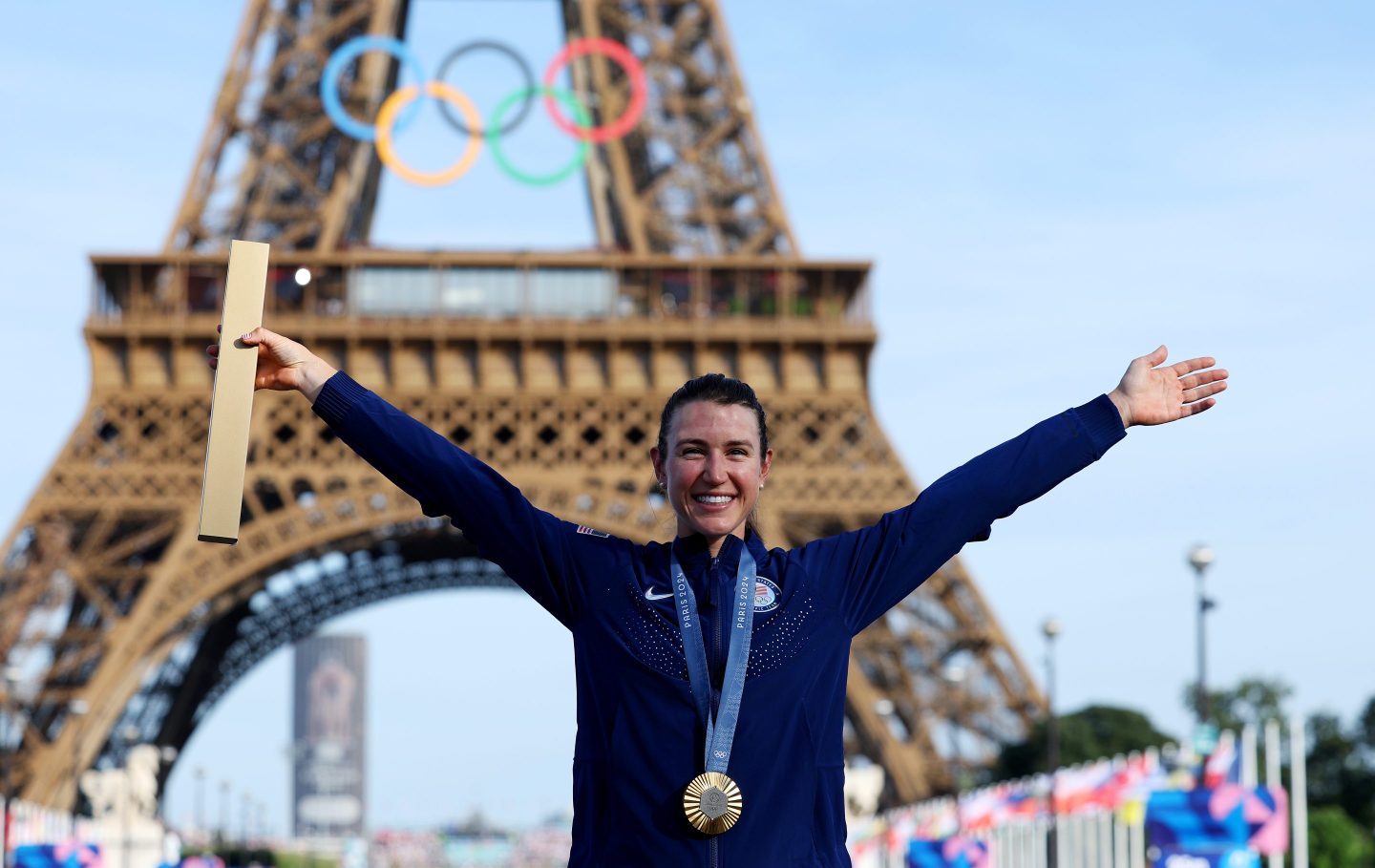
Kristen Faulkner loves a “last-minute attack.”
In 2021, she left her job as an investor at Threshold Ventures to become a professional cyclist. Now she’s a two-time Olympic gold medalist at the just-finished Paris Olympics who sees parallels between her venture career (which also included three years at Bessemer Venture Partners) and how she cycles, especially when it comes to her high-stakes closing move: the “last-minute attack.”
“I love to go all-in,” Faulkner told Fortune. “I love to catch people by surprise. I love catching people off guard, because it’s a mental game, too. And then I love when people say, ‘Wow, she went all-in and backed herself on this—and it worked.’ Maybe that’s from a background in VC. Maybe I’ve always been that way. But it’s just how I am. I love ‘go big or go home.’”
In an interview from Paris, a day after she had won a second gold, Faulkner spoke about what it’s like to win it all, her decision to leave venture capital behind, and why her story isn’t a fairy tale.
This conversation has been edited and condensed for clarity.
Fortune: Walk me through what your life’s like right now. I have a feeling I’m catching you in a whirlwind moment.
Kristen Faulkner: So, the road race happened, I finished, and I was really overwhelmed. I crossed the finish line [winning individual gold] and one of the first things on my mind was, “I need to spin, I need to recover. The work isn’t done. I need to get back to work.” I couldn’t fully embrace the moment, because I still had another race [team pursuit] in two days. The turnaround was really so fast that I just 100% had to focus on recovery. Also, it was a team event, so I felt like I really owed it to my teammates. I couldn’t be at less than 100%. Then, we won gold in the team pursuit, and that’s when I finally started to relax. I came outside the velodrome, and my whole family was there. I had about 20 or 30 people over here, all supporting me—my cousins, aunts, uncles, nieces, nephews, friends. Then the next day was 10 hours of media interviews.
I think it hasn’t fully sunk in yet. I have these two medals, but I also have the Tour de France Femmes, which starts in three days. It’s been one heck of a month, but I don’t think I can fully celebrate. I’m not going to starfish on my bed until after the Tour de France.
Let’s go back in time. You didn’t leave VC terribly long ago, in 2021. How did you know it was time to go?
Faulkner: There were a few things. The first was that I wanted to know if I was good enough to really have a chance of making it. So when it was COVID and people were working remotely anyway, I somehow convinced my boss to let me go to Europe to do my first race there, to see how competitive I was over there. I did my first few races in Europe, and did quite well, and I needed to have a little bit of that confidence. The second thing was that I needed to feel like I really loved it, beyond just the idea of going to the Olympics. I knew it would be a multiyear journey of racing in Europe to get there, that it would be a life I had to adopt. The lifestyle isn’t easy. You’re on the road a lot, staying in hotel rooms, and you’re living in a foreign place without family and friends. You’re on your own most of the time, so I wanted to know if I could do it emotionally. And when I first left my job, I wasn’t making any money really, so I wanted to make sure I had savings. I can live super frugally, but I thought—if I do this, I want to commit to it.
I thought about leaving my job at Bessemer after two years, but it didn’t feel right yet. Because the last thing, I guess, is that I wanted to have enough credibility in VC that if I left, I might be able to come back, because I had deals that I worked on. [At Bessemer] we were the first money in Restaurant365 [a unicorn startup focused on restaurant software], and they’ve since done quite well. Then at Threshold, I also worked on a few deals and I wanted to make sure I had something I could point to, have something to show.
The happiest times of my life have been on a bike, but I really liked venture. People are like, “Oh, she left her finance job because she doesn’t like working behind the desk.” But I really loved my job. [Threshold cofounder] Emily Melton is the best professional mentor I’ve ever had in my life. It was really hard to leave, because I felt like they were there to develop me. I had all these VC goals. I wanted to be a partner by the time I was 30! I wasn’t just leaving a job, I was shifting a whole set of goals I had for myself.
I don’t know if you’ve seen the memes, but I fully expect that you learned absolutely nothing about enterprise SaaS from winning a gold medal in the Olympics. Unless you’re ready to prove me wrong?
Faulkner: [Laughs] No, I don’t think so, but there were some lessons from VC that I did apply. And it was: Do what makes you feel alive.
As a VC, you sit down with entrepreneurs every single day who are going to do something they’re passionate about. They have these big ideas. They’re taking risks. They’re going all-in. I chose VC because I loved working with entrepreneurs. I loved working with people who are passionate, who were dreaming big.
And it felt a bit hypocritical to sit across from them and say, I’m here to support you. Go make your dreams happen. While here I am, too afraid to make my own dreams happen. There was this moment where I thought: How can I sit here, say that I’m in this job to spend time with people like that, and yet I’m not going to be one of those people for my own dream?
Coming from VC has shaped me in different ways. You take a risk, but go all-in. If a VC thinks there’s a 50% chance the company is going to be successful, that doesn’t mean they go 50% all-in for the company. When you invest, assess the risk and make your decision, but then you go all-in. You don’t look back. You have to commit. I think that’s something that shaped me. When I last-minute attack, I don’t look back. I don’t doubt myself. I don’t wonder if I’m going to make it.
You used the phrase “last-minute attack.” What does that mean?
Faulkner: “Last-minute attack” is basically when you jump away from the group close to the finish line, but far enough away that it’s not a sprint. So, say, three kilometers from the finish line. I like it because I’m good at sub-five-minute efforts and I have a really good one-minute power. So, when I jump and go that first minute, it’s kind of hard for people to get on my wheel. Then, once I have a gap, I can usually keep that gap.
It’s my signature move because my power profile really works for it and, mentally, I’m not at all afraid to take that risk. A lot of people would be scared because if you get caught, then you automatically aren’t going to win. There were four of us at the finish and three medals. So, if I attacked and got caught, I’d probably be the one that didn’t get a medal, because I’d have risked it all and been really tired. So, I think it really suits me physiologically and mentally. That’s how I love to play. I love to go all-in.
Is there anything I haven’t asked that I should know?
Faulkner: The one thing I’d say is that the media is making a really big deal of the fact I wasn’t selected for the road team [featuring three women and three men], saying that I only got the spot last-minute, because someone dropped, but that’s not entirely accurate. I kind of knew that I would end up being selected, that I would be the backup. The question was, If I get the chance to do it, do I want to do it, because of team pursuit [a track cycling event in which two teams of four compete against each other]. It just isn’t the whole picture.
Ah, I was going to say: How do you feel about the narrative that’s been spun around your story as an underdog?
Faulkner: I think a bit of the underdog in the sense that no one really expected me to win the road race. But I don’t think it should be as much of a surprise to everyone as the media is making it seem. I was super accomplished on the road. I’ve always been really good at the classics races, and one-day races, and I won U.S. Nationals this year. I think the media’s really enjoying the story that I came out of nowhere, that I shouldn’t have been there. But the reality is that I’ve been in the final selection for most of the big races. It just kind of underplays the career I’ve had up until now.
All right, last question: Do you still have VC goals? Or is VC in the rearview mirror?
Faulkner: I think my VC goals are evolving. I still love the intellectual buzz, so I wouldn’t say I’ve lost my passion for what I had in tech. It’s just not the way I make money right now. But I think at some point I’d love to get back into the tech world in some capacity, whether that’s as an angel investor, being on the board of a company, or working for a company part-time that’s, say, in nutrition tech or sports-related. I’m keeping an open mind, but I’m staying connected to the tech world, from a pure enjoyment standpoint.