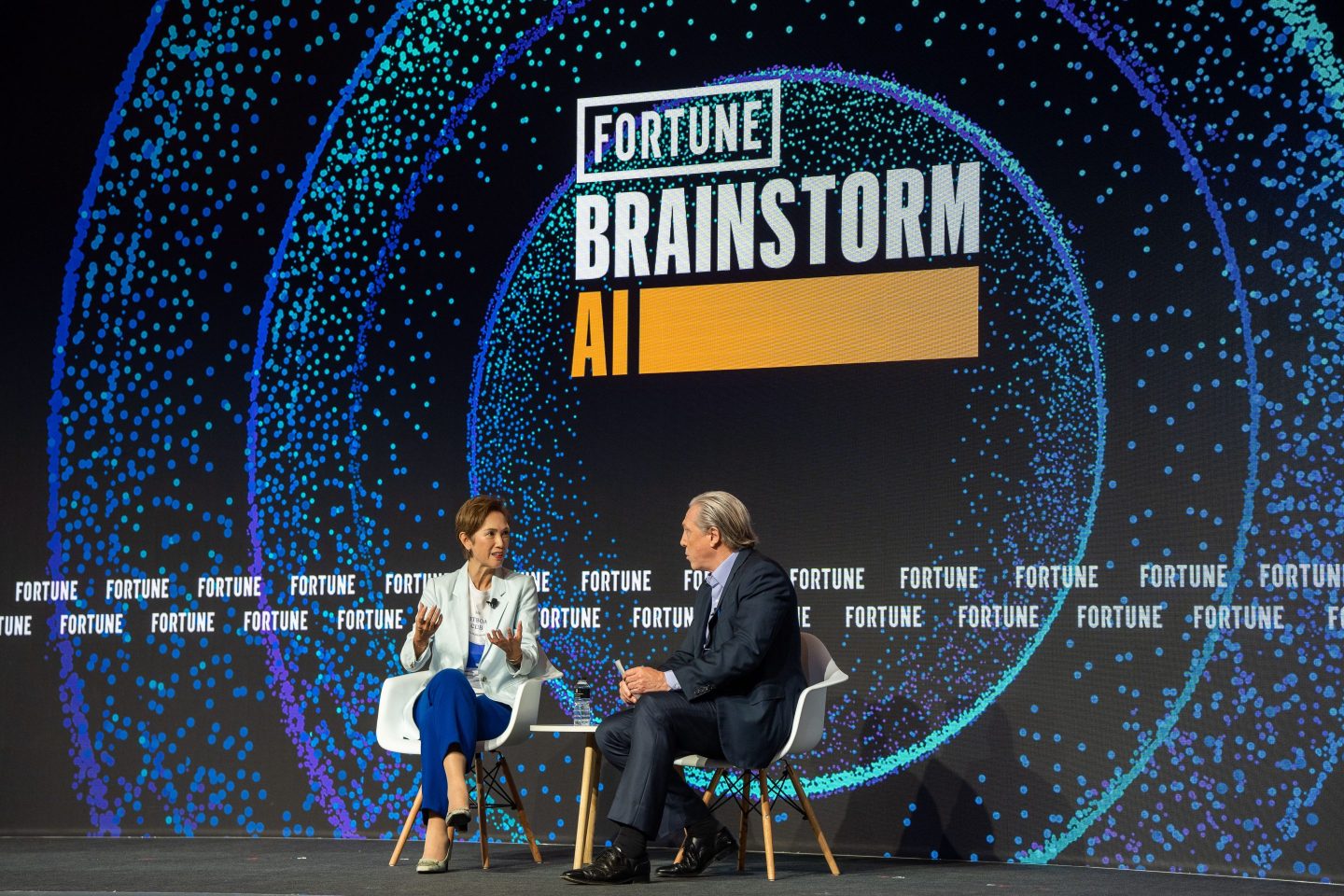
Nicholas Gordon, Fortune’s Asia editor, with a report from our Fortune Brainstorm AI Singapore conference.
Two countries are clearly ahead in the AI arms race. The U.S. is home to startups like OpenAI and Anthropic and Big Tech firms like Microsoft, Alphabet, and Meta. China, while still perhaps playing catch-up to its geopolitical rival, has its own AI startups and tech giants, locked in a fierce battle for market share.
But if there was a common theme to Fortune’s event this week, it was that Singapore—a country roughly the size of New York City, with a population of Minnesota—can keep up with the big boys of AI.
In 2019, the country was one of the world’s first to adopt a national AI strategy. Last December, the government promised over $700 million over the next five years towards AI investments. Founders are attracted to Singapore’s good international connections, straightforward regulations, and responsive government. Officials believe the country had 1,100 AI startups at the end of 2023.
“It’s pretty clear from the outset that a country like Singapore could never compete with China and the U.S. in terms of scale,” Simon Chesterman, vice-provost at the National University of Singapore, said on-stage Tuesday. Instead, smaller countries like Singapore need to “compete on quality,” he said.
The country’s status as a hub for goods, services, and ideas is an asset. If you take all of Singapore’s economic activity into account, “then maybe the data [available] is not as small as we think it is,” Singapore Minister for Digital Development and Information Josephine Teo said on Tuesday.
Singapore also serves as a neutral ground in the politicized global tech sector. Chinese startups are shifting some of their offices to Singapore, reportedly to get some distance from their country of origin before embarking on a global expansion.
That allows local Singapore companies to tap multiple sources of talent and expertise. Singapore “has the best mix of China and U.S. culture,” Kisson Lin, cofounder of Singapore-based startup Mindverse AI, told me during a sideline interview. “It has a lot of talent from the U.S. and China, and from everywhere in the world.”
Still, Singapore’s AI hopes face some challenges. Land, power, and labor in the country are expensive, especially compared to its neighbors. When Singapore imposed a brief moratorium on data center construction in 2019, citing concerns over land use, operators set up shop across the border in Malaysia instead. Singapore’s neighbor now has Southeast Asia’s fastest-growing market for data centers.
Singapore also needs to keep straddling the U.S.-China divide as Washington puts the squeeze on China’s tech sector and preserves its AI advantage. (Elsewhere in town, Singapore ambassador-at-large Chan Heng Chee pressed Secretary of State Antony Blinken on the U.S.’s “looser and looser” definition of national security; Blinken waffled in his reply.)
There’s a more existential worry driving Singapore’s investment in AI: That the U.S.- and China-led tech sectors will ignore what happens in Southeast Asia.
The region “is not well represented in the digital space,” Leslie Teo, from the Southeast Asian Languages in One Network (SEA-LION) Project said on Tuesday. (SEA-LION is a Singaporean government project to build a large language model that incorporates Southeast Asia’s cultures and languages.)
Southeast Asians aren’t the only ones concerned about getting left behind: Korea’s internet giant Naver is building “sovereign AI” that targets customers with needs that “Big Tech can’t fulfill,” as CEO Choi Soo-Yeon told me earlier this year.
Yet it’s still impressive in its own right that Singapore is even in the conversation about AI, let alone considered a leader. “We aren’t trying to be an AI superpower,” Josephine Teo told Fortune’s Clay Chandler in the most recent issue of the magazine. “We don’t need to be.”
Nicholas Gordon
nicholas.gordon@fortune.com
Want to send thoughts or suggestions to Data Sheet? Drop a line here.
NEWSWORTHY
Turkey blocked Instagram on Friday. While the country did not provide a reason, the ban comes days after the country’s communication minister criticized the Meta-owned platform for allegedly blocking condolence posts for assassinated Hamas official Ismail Haniyeh. On Thursday, Malaysia Prime Minister Anwar Ibrahim accused Meta of “cowardice” for taking down his Facebook post offering similar condolences.
China could be self-sufficient in chipmaking equipment by the summer, even if its supply chain still lags far behind the U.S. The claim was made in a panel last week by Gerald Yin, CEO of AMEC, a Chinese company that makes chipmaking equipment, according to the South China Morning Post. Yin’s claim, if accurate, suggests that U.S. controls, which bar the export of advanced chips and chipmaking equipment to China, is accelerating local development.
Nintendo’s operating profit slumped by over 70% last quarter to hit $365 million, far below analyst expectations. The company’s flagship Nintendo Switch console is now seven years old, an eternity in the industry, and firm details on a successor will only come by March. Nintendo is still promising to ship 13 million devices this fiscal year; analysts now think the total will be closer to 10 million.
ON OUR FEED
“My best guess is divine benevolence.”
—Character.ai founder Noam Shazeer, when Fortune’s Allie Garfinkle asked how large language models work. Character.ai allows users to create their own chatbots, oftentimes based on real people like Elon Musk or fictional characters like Dragon Ball’s Goku. The startup was valued at $1 billion in a March 2023 funding round.
IN CASE YOU MISSED IT
How this female VC got hundreds of Silicon Valley investors to pledge to support Kamala Harris by Alicia Adamczyk and Nina Ajemian
Meta, Microsoft, and Google blew blinding amounts of AI smoke during earnings—here’s what we actually learned by Alexei Oreskovic
Amazon finance chief blames weak sales forecast on shoppers distracted by Trump assassination attempt and Olympics by Jason Del Rey
OpenAI settles into its VC era by Sage Lazarro
Google’s Olympics ad was designed to be uplifting. Instead, many are finding it dystopian by Marco Quiroz-Gutierrez
BEFORE YOU GO
Drugmaker Eli Lilly’s rise to become the world’s ninth-most-valuable company is thanks to a 15-year-old bet on research and development. As Erika Fry writes for Fortune’s latest magazine issue, Eli Lilly faced a crisis as patent expiration dates for moneymakers like Prozac loomed—and the drugmaker had nothing in reserve. But the drugmaker caught a lucky break when it stumbled upon tirzepatide, which it rapidly developed into the anti-obesity drug Zepbound. “We were in deep trouble—financially, we had a lot of problems—but actually our strategy was right,” CEO Dave Ricks tells Fry.