For almost two years, Robert Brewin collected data from the bow of a superyacht as it sailed pristine waters from the Caribbean Sea to the Antarctic Ocean.
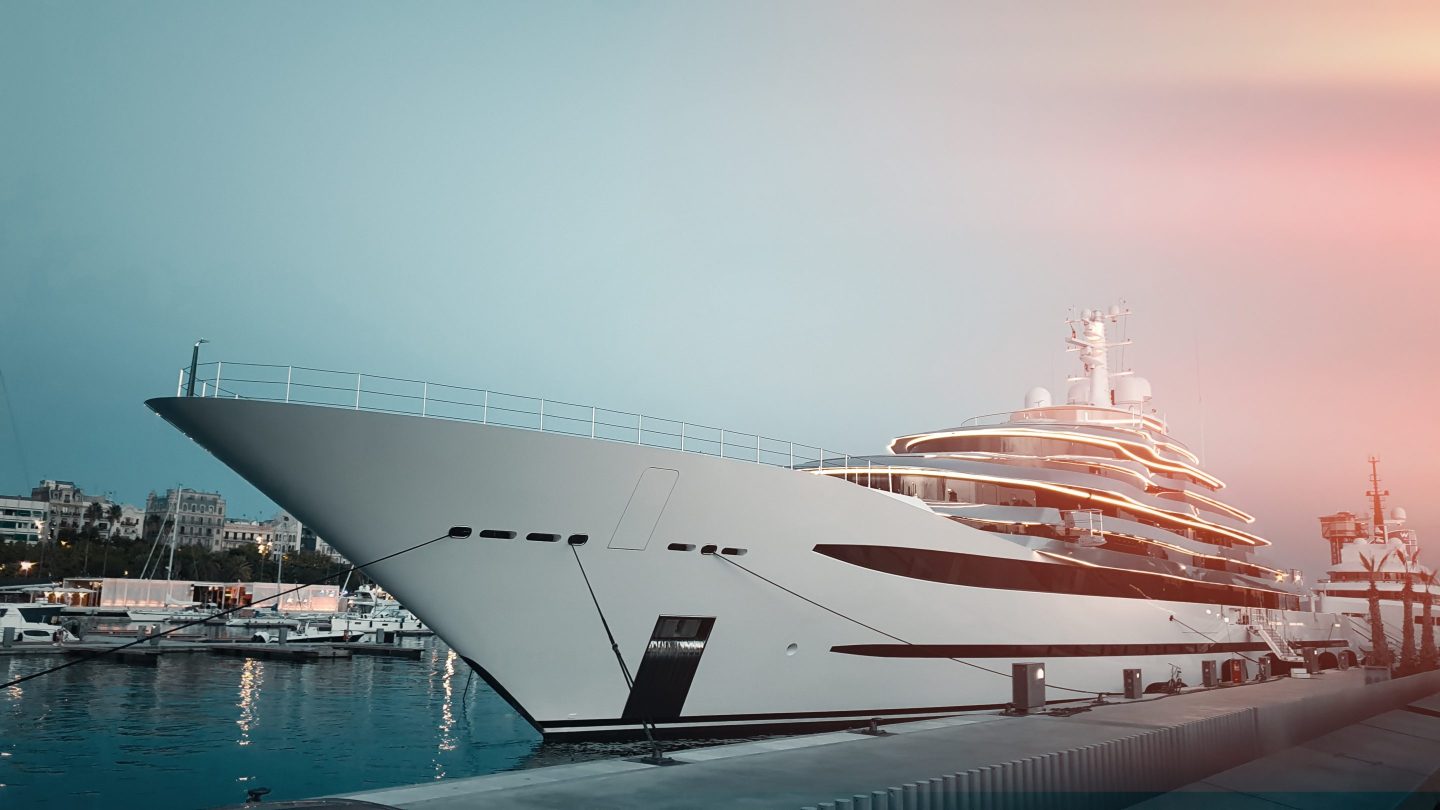
The Archimedes, a 222-foot (68-meter) “adventure” yacht then owned by the late hedge funder James Simons, boasts a gym, a jacuzzi and an elevator. But between 2018 and 2020, Brewin was concerned only with the boat’s Sea-Bird Scientific Solar Tracking Aiming System, installed to measure light reflecting off of the water. A senior lecturer at the UK’s University of Exeter, Brewin and his colleagues were analyzing microplankton — microscopic organisms at the base of the marine food chain — by studying the ocean’s color. The Sea-Bird’s readouts helped them verify satellite imagery.
Brewin’s was not your typical superyacht itinerary, but he is one of hundreds of scientists to have used an adventure yacht — also known as expedition or explorer yachts — to conduct research on the ocean. In a paper published in January, Brewin and his co-authors touted the potential of “harnessing superyachts” for science, concluding that “reaching out to wealthy citizen scientists may help fill [research capability] gaps.”
It’s a view shared — and being pushed — by the Yacht Club of Monaco and the Explorers Club, a New York City-based organization focused on exploration and science (of which, full disclosure, I am a member). In March, the groups co-hosted an environmental symposium that included an awards ceremony for yacht owners who “stand out for their commitment to protecting the marine environment.” The Archimedes won a “Science & Discovery” award.
“If a yacht is operating 365 days a year, rather than having it sit idle it’d be much better for it to contribute a positive return through science and conservation,” says Rob McCallum, an Explorers Club fellow and founder of US-based EYOS Expeditions, which runs adventure yacht voyages.
EYOS charters yachts from private owners for its excursions, and is a founding member of Yachts for Science, a four-year-old organization that matches privately owned yachts with scientists who need time at sea. (Other members include yacht builder Arksen, media firm BOAT International, and nonprofits Nekton Foundation and Ocean Family Foundation.) Yachts for Science will enable about $1 million worth of donated yacht time this year, McCallum says, a figure he expects to hit $15 million by 2029.
“There’s a personal satisfaction that we are contributing to something that is bigger than us,” says Tom Peterson, who co-owns an insurance underwriting company in California and has what he jokingly refers to as a “mini superyacht.” Every year for the past decade, Peterson has donated about 15 to 20 days of time and fuel on the 24-meter Valkyrie to scientists, who he takes out himself as a licensed captain and former scuba dive operator. He often works with the Shark Lab at California State University Long Beach, and allows researchers to stay aboard for days at a time instead of having to constantly make the 1.5-hour trip to and from shore.
To link up with scientists, Peterson works with the International SeaKeepers Society, a Florida-based nonprofit that engages the yachting community to support ocean conservation and research. “The more we understand things about the ocean in general, the better we all are in the long run,” he says.
When “superyacht” and “the environment” appear in the same sentence, it’s usually in a different context. In 2019, one study estimated that a single 71-meter superyacht has the same annual carbon footprint as about 200 cars. In 2021, another paper found that superyachts were the single greatest contributor to the carbon footprint of 20 of the world’s most prominent billionaires, accounting for 64% of their combined emissions.
“If you really want to respect the environment, you can just go surf,” says Grégory Salle, a senior researcher at the French National Centre for Scientific Research and author of the book Superyachts: Luxury, Tranquility and Ecocide. Salle is open to the idea that superyachts could be used to advance scientific research, but says it’s contradictory for anyone to buy a superyacht and claim to be truly concerned about the environment.
McCallum says people who own adventure yachts tend to be younger than your standard superyacht owner, and have a particular interest in remote and pristine places. “They’re not the sort of people that are content to just hang out in the Mediterranean or the Caribbean,” he says. “Antarctica, the Arctic, the remote Indian Ocean, the remote Pacific Ocean, the Subantarctic islands… that’s where you’re going to find us delivering our services.”
Explorer yachts aren’t the only way scientists can reach those destinations, but demand for dedicated research vessels does outstrip available supply. The US National Oceanic and Atmospheric Administration (NOAA), arguably the world’s greatest collector of oceanographic data, has a fleet of 15 research and survey vessels for the use of its scientists. Academic researchers can also apply to use the fleet, often at a subsidized rate. But scientists request roughly 15,000 to 20,000 days of boat time every year. In 2019, NOAA was able to fill just 2,300 of them, according to an internal study.
That gap is particularly problematic as the planet warms. Oceans provide services that scientists call “existentially important,” producing more than half of the oxygen we breathe and serving as the world’s largest carbon sink. They also absorb 30% of our carbon emissions and 90% of the excess heat generated by them.
G. Mark Miller, a retired NOAA Corps officer who was in charge of several of the agency’s research vessels, has a different solution in mind when it comes to bolstering ocean research: smaller boats, fit for purpose. Superyachts can cost north of $500 million, he says; “why don’t we build a hundred $5 million vessels and flood the ocean science community?”
After leaving NOAA, Miller in 2021 launched Virginia-based Greenwater Marine Sciences Offshore with a vision of building a global fleet of research vessels and offering their use at affordable prices. He says hiring a NOAA boat can cost scientists between $20,000 and $100,000 per day. GMSO plans to charge less than $10,000 a day for most missions. The company says it’s close to acquiring its first three vessels.
Miller hopes his business model will help scientists conduct the work they need to — particularly in under-served regions like the Asia-Pacific — without worrying about getting a luxury yacht covered in “muddy worms, plankton goo, dead fish [and] whale snot.” He describes yacht owners donating boat time to scientists as “better than nothing,” and says it can help get regular people interested in science and exploration.
Christopher Walsh, captain of the Archimedes, says he and his crew love taking part in science initiatives, especially when there’s an educational component. “I get a real thrill when we can stream to the classrooms — you can’t imagine the enthusiasm the kids display,” Walsh says. “That gives me a lot of hope for the future.”