Consider the simple equations below:
5+3=8 4+6=10 2+4=7 9–3=6
If your first thought was, Hey, one of these equations is wrong, you’re not alone. (And you’re correct, of course.) Our brains are wired to recognize mistakes first. This “negativity bias” evolved in humans to help us survive. We learned to look for bad or wrong things to avoid danger. Our built-in attraction/aversion to errors and faulty outcomes may have protected us from extinction over the course of human history, but it also taught us to cling to what we know right now instead of being open to the unknown, possibly dangerous future.
Here’s what this negativity bias looks like in our daily lives:
That suitcase you’ve dragged around since college finally gave out, and you’ve spent a couple of hours looking around online for a new one. You’ve found a good deal on a great brand and model, so this should be easy… except you can’t stop scrolling through the ratings on the company’s website. There are dozens and dozens of big thumbs-ups from happy customers, but your eye keeps landing on the few cranky complaints. It doesn’t matter that the negative reviews are mostly about shipping snafus and not the quality of the product. They are lodged in your head, and you end up clicking away despite all your research pointing to this suitcase being just right for you. That’s the negativity bias.
Anyone who has lived or worked in New York City knows the cardinal rule when riding the subway: Do not make eye contact. It’s a corollary to the unwritten rule most of us follow when we encounter strangers. Our default is to keep to ourselves when walking down the street or sitting on an airplane, so that we’re less likely to expose ourselves to other people’s problems or pain. We anticipate the negative possibilities and avoid contact, even though that stranger might actually end up being a lifelong friend or a romantic partner or the source of ideas or information that could change our lives.
Or this: You’ve arranged to meet a new business prospect at a conference in Denver. When you sit down to dinner, the initial small talk focuses on a problem with the hotel room or the flight delay that pushed back the meeting an hour—not the restaurant’s stunning view of the Rocky Mountains, not the sophisticated menu you’d heard so much about. It’s that one thing that didn’t work out that gets the attention, especially when it comes to travel, when we’re already feeling a little disoriented and untethered from our usual routines.
You can understand how negativity bias tends to control your day-to-day narrative. Research has shown that it takes at least three positive emotional impressions to counter every negative impression you experience. How is it that optimists manage to avoid this constant battle against negativity we’re hardly aware we’re waging all the time in our heads?
Optimists believe in and expect positive outcomes. Optimists picture the potential of a good outcome and put all their chips down on it because they have a kind of transcendent confidence (“My hike on Saturday will be great! Who said anything about rain?”).
Does a person’s belief that good things will happen actually make them happen? No, but optimists have confidence in their ability to effect change, which makes them more likely to take action and realize their positive vision. Also, the optimist’s positive frame of mind makes them see good things where others might not. This alone—spending more time focusing on good stuff than bad stuff—explains why optimists tend to be healthier, live longer, and exhibit more resilience in the face of adversity than their pessimistic counterparts.
The future-ready mindstate calls for a more pointed and purposeful positivity, a way of seeing the world that I call “radical optimism.”
Radical optimism is a belief in the potential not for “good” or for “perfect,” but for “better.”
My work in the area of innovation allows me to spend a good deal of time in the realm of better. I have seen extraordinary breakthroughs born of a person’s absolute certainty that there’s something better to be attained—a better technology, a better product, a better service, a better process or protocol, even a better human being. They may not know exactly what that better will be, but they believe that over time, their efforts will produce desirable outcomes.
What innovators know is that better is the result of constant, persistent iteration. They tweak and test and tweak and test some more to improve on what’s in front of them. The best innovators are not trying to hit the ball out of the park—they’re looking for the smallest degrees of better that will move their work to the next level and then the next.
The pursuit of better is about progress, not perfection. Achieving the best is rare—there are only so many GOATs in the world. But when you orient yourself around better, every day is filled with in- finite and immediate opportunities to succeed. The radical optimist chooses to seize these opportunities, creating a rhythm of iteration that hums on multiple levels throughout their day-to-day lives.
Google Glass was one of the most exciting projects I’ve been a part of. Developed by the Google X “moonshot” research lab, the smart glasses went through thousands of iterations as they progressed from idea to prototype to product. With every sprint, the team gathered countless pieces of information that they documented each week in three categories: technological, social, and design. We tested a lot of ideas about how someone might interact with the device. For example, those cool multitouch interfaces that Tom Cruise feverishly manipulates in Minority Report? It turns out they make your arms really tired, really quickly. We also briefly prototyped an idea using another device to record the user’s conversations throughout the day, except we discovered that users actually had no interest in reliving the mostly trivial dialogue they engage in every day.
On a daily—even hourly—basis, the more we tried, the more “better” we achieved.
When an early version of the product was put in the hands of eight thousand beta testers under the Glass Explorer program, the feedback these users provided blew up a number of the developers’ assumptions. Ultimately, Google Glass didn’t turn out to be the next big consumer tech hit many people expected it to be, although the Glass technology contributed to important advancements in multiple areas—health care, journalism, hospitality, and emergency services, to name a few. But everyone I knew on the project showed up every day filled with this exuberant confidence that they would advance learning, whatever the fate of the product. The experience showed me in the most remarkable way how radical optimism’s focus on “better” fuels progress.
I’ve noticed something weird, though. Even while humans tend to fixate on “the best,” we also have a tendency to settle for “not bad” or even “good enough” in ways that not only ensure that nothing will improve, but eventually lead to decline. Take our relationship with gasoline. For decades we’ve been comfortable with the costs (both financial and ecological) we’ve paid for our dependence on fossil fuels. Until recently, most people have largely chosen not to focus on what could be better about their dependence on gas. Enter a global pandemic, a fluctuating economy, a war in an oil-producing region, and a host of other contributing factors, and suddenly every time we fill up the tank, we’re paying more—by far—than ever before in history—and the environmental costs of our settling for the status quo have become inescapable. Think for a moment about all the incremental things we could have been doing all these years to be in a better place than we are right now.
The radical optimist isn’t willing to push “better” to some far-off point in time. We believe that better is possible in the very next moment. We understand that we’re choosing better and behaving in ways that achieve better right now. This provides instant gratification and the motivation to keep choosing better over and over again until it’s who we are—someone who sees the future as the better place we are creating for ourselves.
Being a radical optimist both grounds and elevates your expectations. You’re a clear-eyed realist—you can see there’s a mountain in front of you. But you are confident that there’s better on the other side of that mountain and there’s no question you’re going to make your way to whatever that unknown potential may be.
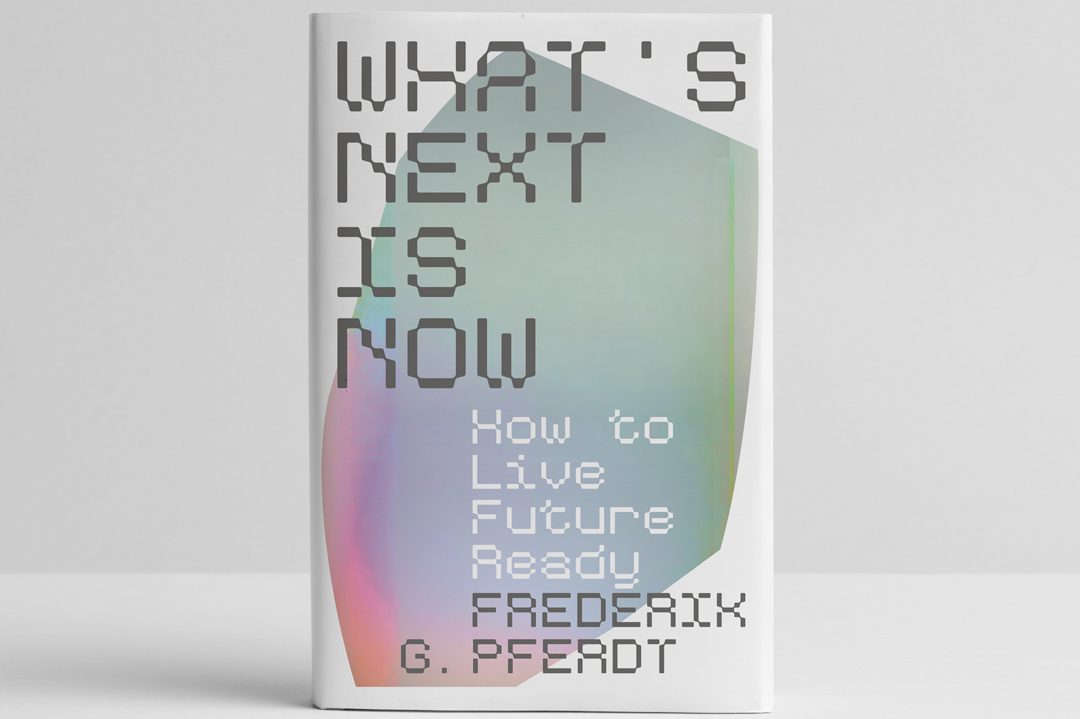
From the book What’s Next Is Now: How To Live Future Ready by Frederik G. Pferdt. Copyright 2024 by Frederik G. Pferdt. Reprinted by permission of HarperCollins Publishers.