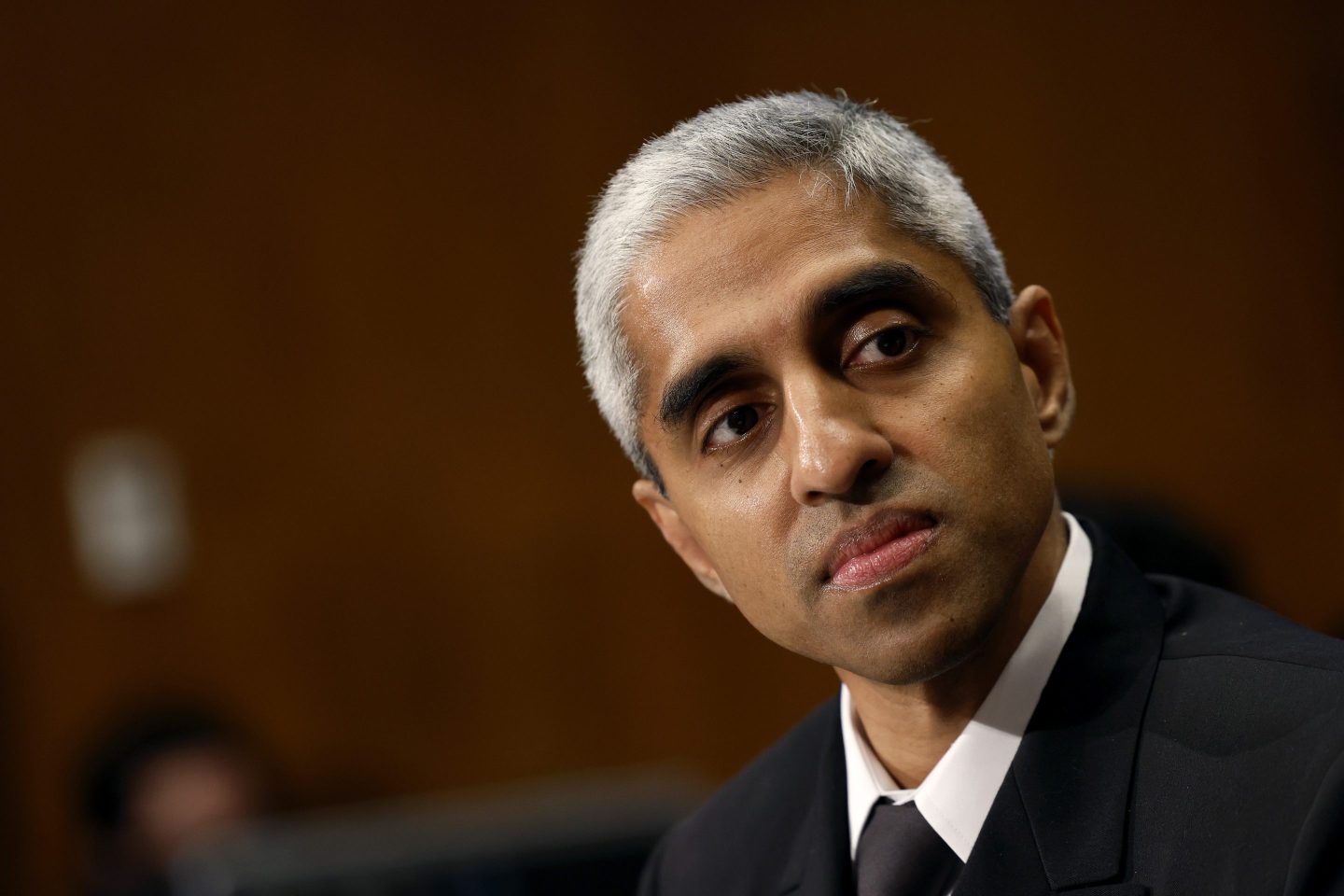
The U.S. surgeon general’s call for warning labels on social media about their services harming children’s mental health puts him on one side of an issue that divides child psychologists.
While a number of studies have shown that excessive social media use harms children, some mental health professionals argue the evidence is inconclusive and that there’s no proof warning labels work. In the view of his critics, Surgeon General Vivek Murthy is feeding into anti-social-media hysteria. “There’s really no good evidence to support the claims that the surgeon general is making,” says Chris Ferguson, a psychology professor at Florida’s Stetson University who studies the effects of technology on children.
Social media, he says, is being used as a scapegoat for the real issues affecting children—like absent fathers and domestic violence. Instead, he says, the surgeon general is inciting “moral panic.” As evidence that social media hasn’t created a youth mental health crisis, Ferguson points to teen suicide rates, which he says have remained largely constant worldwide over the years. Although the teen rate is up in the U.S., the gain is relatively small compared to bigger gains in other age groups, he says.
Conversely, Jean Twenge, a psychology professor at San Diego State University who similarly studies the relationship between children and technology, and has authored several books on the topic including iGen and Generations, believes a social media warning label would be a “great first step” to improving children’s mental health. “Warning labels need to be accompanied by more enforcement and regulation,” she says.
Twenge’s research has found a correlation between mental health issues and use of social media. Her remedy is to raise the minimum age for using social media to 16, and for social media companies to verify it. Currently, social media companies only permit people ages 13 and up to use their services and require no age verification beyond the honor system.
On Monday, the surgeon general wrote in a New York Times opinion essay that warning labels would “regularly remind parents and adolescents that social media has not been proved safe.” He argues that warning labels have been effective in curbing cigarette use, and could do the same for social media.
The surgeon general’s push for social media warning labels comes at an inflection point for the industry now facing significant regulatory attention. The federal government, which had previously left big social media companies largely alone, has passed a law that forces Chinese TikTok parent ByteDance to sell off its American operation or face a ban. And more than 40 states have joined a federal suit against Meta alleging the company knowingly addicted children to its technology, leading to serious mental health problems. Meta, alongside TikTok, Snap, and YouTube, are being sued for similar reasons in a California class-action lawsuit. This month New York State passed legislation that bans social media platforms from algorithmically recommending content to kids.
Still, some researchers think the outcry over social media recalls previous outcries over violent video games and racy music videos. Peter Gray, a research professor of developmental psychology at Boston College, believes social media is actually beneficial to children. He says Common Core, which underpins standard U.S. public education, is to blame for children’s mental health woes, not social media. “I don’t want to blame the Surgeon General because he doesn’t have time to read the actual research. He’s responding to what is almost a national alarm and panic that is being engendered by two or three people,” says Gray.
Among the anti-social-media cabal, he says, is social psychologist Jonathan Haidt, author of the popular 2024 book The Anxious Generation. It cites research showing that social media and smartphones damage the mental health of children.
Haidt and his lead researcher, Zach Rausch, support the surgeon general’s call for warning labels on social media. “We think this is an important first step,” says Rausch, who advocates for phone-free schools and the passage of the Kids Online Safety Bill, which would establish guidelines to protect children on social media. He tells Fortune that warning labels would help empower parents to keep kids away from smartphones and social media.
In addition to warning labels, the surgeon general also says in his New York Times op-ed that social media companies should be required to share all their data on the health effects of their services and allow independent audits of that information. “While the platforms claim they are making their products safer, Americans need more than words. We need proof,” Murthy writes.
TikTok, YouTube parent Google, and Meta did not respond to Fortune’s requests for comment.
In his call for social media warning labels, Murthy cites a 2019 study conducted by researchers from Johns Hopkins University, the University of Maryland, Duke University, and the Washington State Department of Health that found children who use social media were more likely to report mental health issues, even after adjusting for history of mental health problems.
The surgeon general didn’t say what social media warning labels should say or how they should appear. This opacity worries Brown University psychology professor Jacqueline Nesi, who says that mental health outcomes could hinge on how the labels are applied. “I agree that we cannot wait for perfect information to act,” writes Nesi in her Techno Sapiens newsletter on Tuesday, concurring with Murthy. “We need to approach this carefully—if not done well, this type of warning could cause more harm.”
In the New York Times article, Murthy also cited an August 2022 study by Boston Children’s Hospital in which 83% of adolescent respondents said they were at least “slightly” addicted to social media (with 10% saying they are “completely” addicted).
Dr. Emma Woodward, a psychologist at the Child Mind Institute who studies anxiety, believes this research and thinks that children’s anxiety, depression, suicidality, loneliness, and reduced self-esteem are correlated with social media use. She called the surgeon general’s warning label an excellent first step. “It’s an outward visual representation of the risk that this item has to kids and teenagers,” she says. “A warning label would help caregivers to understand, and be able to see, really how risky these platforms are for kids.”