Despite good intentions to make changes that support the environment, companies are still sending items to the landfill that could otherwise be recycled. While the world is producing nearly twice as much plastic waste as it did two decades ago, just 9% of it is being properly recycled, according to a report from the Organization for Economic Cooperation and Development.
Glacier, a company that uses AI-enabled robots to help companies better handle the messy and tedious job of sorting through trash, is hoping to change that. The San Francisco–based company, which was founded by Rebecca Hu, a former Bain consultant, and Areeb Malik, a former Meta software engineer, says its robots can sift through 45 items per minute, including more than 30 different materials, to find items that are recyclable and might otherwise be missed by human detectors.
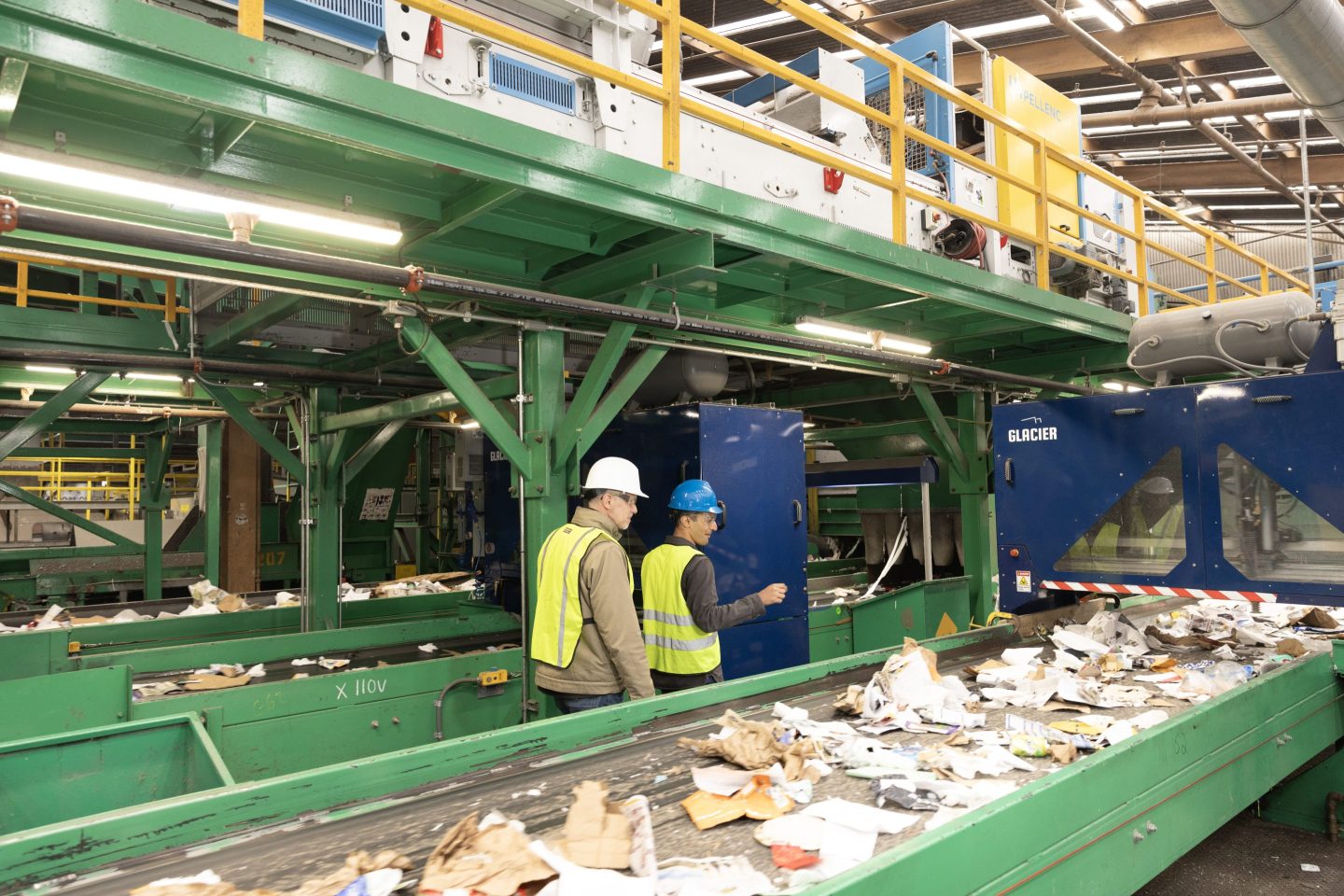
“Today, when you go into a facility that’s using a Glacier robot, you’ll see a conveyor belt, which typically exists in these facilities, and then the robot has two parts to it. The first is our AI vision system, and that’s literally a camera that’s taking 24/7 footage of all the items passing underneath it,” Hu says. “And then the robot has these arms that can know where to pick an item, and then it knows what that item is, so it knows where to actually sort it. In doing so, it’s able to automate that sortation process at a very high degree of accuracy.”
That’s where Glacier’s computer vision technology and sorting robots really shine. The company’s analytics advise customers on how many and what types of items they’re missing. According to Glacier estimates, one robot can help prevent more than 10 million items per year from ending up in landfills.
“We usually recommend that customers start on what’s known as the last-chance line, or the residue line,” Hu says. “In other words, after all of the sorting has happened, there’s usually one conveyor belt, and it’s the very last one in the facility. Everything on that belt is supposed to be trash, and it’s all going to landfill now because the sortation process is so difficult. You can imagine there’s a lot of really good stuff that ends up on that line as well.”
While public awareness and action around recycling continues to get better, there’s still plenty of room for improvement. The current recycling rate in the United States is around 32%, according to the Environmental Protection Agency. The goal of the agency is to get to at least 50% by the end of the decade.
In March, Glacier received a crucial vote of support from Amazon, which invested in the company as part of its Climate Pledge Fund. Glacier also holds the distinction of being the second woman-led climate tech company to receive support from Amazon, which previously committed to investing $53 million in climate tech ventures led by women.
For Hu, being a part of the solution felt personal.
“I often say it’s the first time in my life where I felt like an idea was so compelling that I was willing to take this type of early stage startup risk on it,” she says.
As a first-generation American and the daughter of Chinese immigrants growing up in the suburbs of Chicago, Hu says her family was always resourceful when it came to finding different ways to reuse materials.
“One of the really interesting idiosyncrasies about growing up in that way was at home having this constant mantra of reduce, reuse, recycle, waste nothing. All these yogurt tubs were always getting used as storage containers for something else,” she says. “More broadly speaking, I was getting the sense that I was in a very consumerist society where people just tossing things out, so that was kind of this cognitive dissonance that I always thought about growing up.”
With backing from Amazon and attention from companies eager to improve their eco-footprints, Hu says, Glacier is focused on bringing its technology to more people and building on its AI capabilities. For example, Glacier is working on developing computer vision technology that can identify recycling waste from broader categories, from broad cardboards to more specific items like cat food cans.
“One thing there is no shortage of is items that are coming through these facilities, and so you can imagine if our fleet is taking images constantly, we have access to hundreds of millions of these types of images of recycled items to work off of as our training and validation set,” she says. “Now, the challenge is not collecting those images, but actually figuring out what types of items you should be detecting. We have started collaborating very closely with our recycling-facility customers to understand where most of the value sits.”
While Hu is proud of the results Glacier robots are already demonstrating, she says humans are still an important part of the process.
“I think the jury is still out on whether we will ever have a truly lights-out recycling facility,” she says. “But I think the trend that we’re already seeing and expect to continue over the next many years is that there’s already a significant labor shortage in this industry. And so if we can get robots to do truly the most dull, dirty, dangerous jobs in these facilities, a lot of the existing labor force is being upskilled and trained to do things like maintenance and repair and monitoring, which I think is a much better use of those precious human resources.”