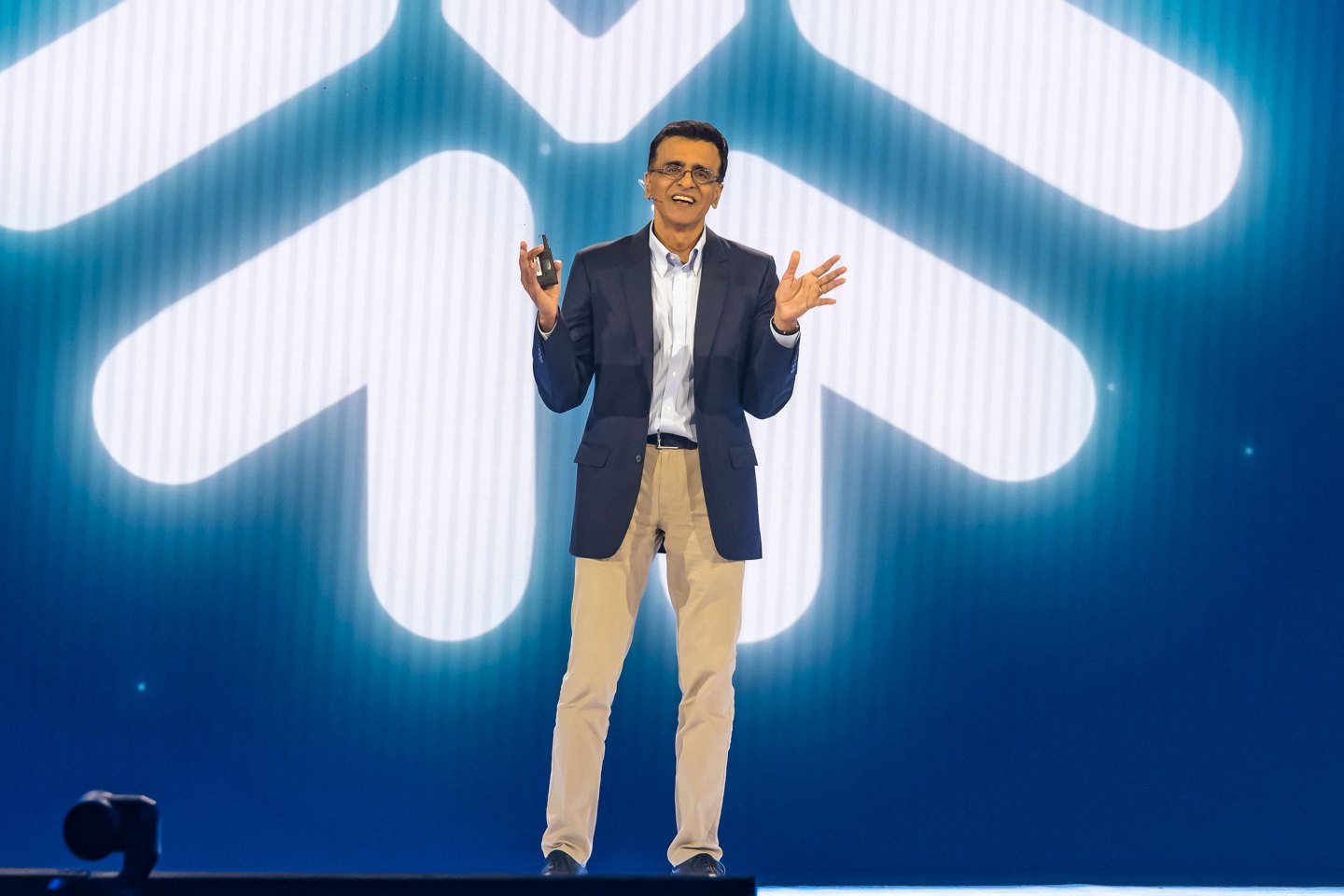
It’s been just three months since Sridhar Ramaswamy, a former Google senior executive, took the reins as CEO of Snowflake, and one big change under the new boss is already easy to spot: The decade-old company long known as the “Data Cloud” now bills itself as the “AI Data Cloud.”
The rebrand may seem like a mere marketing exercise at a time of widespread AI hype, but Ramaswamy is ardent that AI and data are inextricable elements of Snowflake’s business and its future success. AI now “pervades everything that is happening in Snowflake,” Ramaswamy told Fortune in an interview in advance of Snowflake’s annual summit taking place in San Francisco this week. And AI has become “the nervous system” that connects companies internally, he said, helping them create and manage data, but also allowing businesses to exchange information in real time across clouds with other companies.
Ramaswamy stepped into Snowflake’s top job in February after Frank Slootman unexpectedly announced his retirement. He had big shoes to fill: Slootman, a tech industry veteran, led Snowflake through an IPO that transformed it into a public company with a $75 billion market cap. The company’s headcount more than tripled under Slootman as Snowflake expanded its roster of customers and leaned into the competition with fellow data startup Databricks.
Compared to Slootman, who was fond of quoting WWII General George Patton and whose leadership was described as “brash” and “no-nonsense,” Ramaswamy comes off as understated and diplomatic. But the challenges facing Ramaswamy are no less pressing. For one thing, Wall Street is still mourning the departure of Slootman; Snowflake’s stock plunged on the news of the leadership change, and the company, which has yet to turn a profit, now has a market cap of $46 billion.
Meanwhile, the company has faced a difficult news cycle. On Monday, Snowflake pushed back against claims by Ticketmaster parent Live Nation that hackers gained access to data it stored through Snowflake. According to Snowflake, the company has found no evidence that the hack was the result of a vulnerability, misconfiguration, or malicious activity within its product, and in a joint statement with other companies, said that a targeted campaign by hackers to exploit multifactor authentication appears to be the cause.
For Ramaswamy, the Snowflake summit in San Francisco provides a platform to win over investors and rally customers as he makes the case that this is “the year of AI.”
One of Snowflake’s main announcements at this week’s summit is an expanded partnership with Nvidia that allows customers and partners to build customized AI data applications in Snowflake, powered by Nvidia AI Enterprise software and Cortex AI, Snowflake’s LLM and vector search service.
In a virtual fireside chat with Ramaswamy on Monday evening, Nvidia CEO Jensen Huang said that companies need to “take all the most important processes they do, capture them in a data flywheel, and turn that into the company’s AI to drive that flywheel even further.”
Could Snowflake be the next Nvidia?
While some have speculated on whether Snowflake’s AI efforts could launch the company into an Nvidia-like stratosphere of revenue and stock value, Ramaswamy sounds firmly grounded on the here and now.
“I have worked for a trillion-dollar company before, at Google,” he pointed out. “It takes a lot of hard work, I think it was close to 15-18 years before Google became a trillion-dollar company. These are just very long journeys.”
Snowflake is betting that Ramaswamy’s experience and ability to leverage the power of data and AI will put the company on a path that leads to greater success. After leading Google’s $115 billion advertising business in the 2010s, Ramaswamy launched Neeva, an AI-powered search engine that Snowflake acquired one year ago. As part of the acquisition, Ramaswamy joined Snowflake as the SVP of AI, meant to help bring Neeva’s large language model (LLM) technology to the vast amounts of structured and unstructured data housed on Snowflake’s platform.
“This is an area that I’m deeply familiar with,” he said. “My PhD was in databases. I’ve worked in data pretty much all my life.”
Neeva’s LLM expertise turned out to be very interesting for Snowflake as a way to help customers glean structured information from unstructured data—that is, ask questions and get reliable answers from business data. “A natural language interface to all information that we either want to give or to consume is a huge unlock of AI,” he explained. “AI plus snowflake means that you can go from unstructured information to structured information—that fluid access to information offers huge potential for a company like Snowflake.”
When it comes to AI, Ramaswamy says, Snowflake focuses on value creation. “We are not in the business of selling promises,” he said. “We are in the business of getting paid when our customers consume computers on Snowflake and pay us for it.”
Still, he said he believes Snowflake is “well-positioned” to benefit from future customer obligations using AI. “Our customers are not buying GPUs, they’re not buying guaranteed contracts,” he said. “They create obligations, they use what they need from Snowflake, and they make money when they get value from it—it’s a very aligned business model. And our model is very much based on what we are able to deliver for our customers. I think that’s a good thing.”
A huge opportunity in the data space
Snowflake has also made headlines recently for rumored potential acquisitions, including a $1 billion deal for AI model developer Reka AI that has supposedly hit the skids. Snowflake did confirm an acquisition of TruEra, which evaluates and monitors LLM apps and machine learning models in production.
“We tend to be pretty strategic” about acquisitions that fill necessary niches, said Ramaswamy, who would not comment on the Reka rumors. “Neeva was brought into Snowflake because Frank and our owners realized that search was going to be pretty pivotal for AI, and we had great expertise in search and great expertise in AI.” Meanwhile, TruEra’s skills around what is known as “observability” will “be important in the world that we are heading into,” he said.
Ramaswamy is most interested in tackling the customer value opportunity that he says is in front of Snowflake. Cloud computing, he said, is estimated to be a more than $2 trillion prize over the next decade. “A huge part of that is going to be spent on data.”
And AI, he added, will be a key addition to gaining customer value from that cloud equation.
If Snowflake is the nervous system that provides the connectivity between different cloud applications and massive amounts of data, perhaps AI is the brain that can make those connections for the enterprise.
“There’s a huge amount of value to be created for anyone that’s able to crack that,” Ramaswamy said.