• Home
  • News
  • Fortune 500
  • Tech
  • Finance
  • Leadership
  • Lifestyle
  • Rankings
  • Multimedia
Environmentclimate

Outer Banks homes are collapsing due to climate change, but U.S. coastal property values are booming anyway

By
Dylan Sloan
Dylan Sloan
Down Arrow Button Icon
By
Dylan Sloan
Dylan Sloan
Down Arrow Button Icon
June 3, 2024, 4:17 PM ET
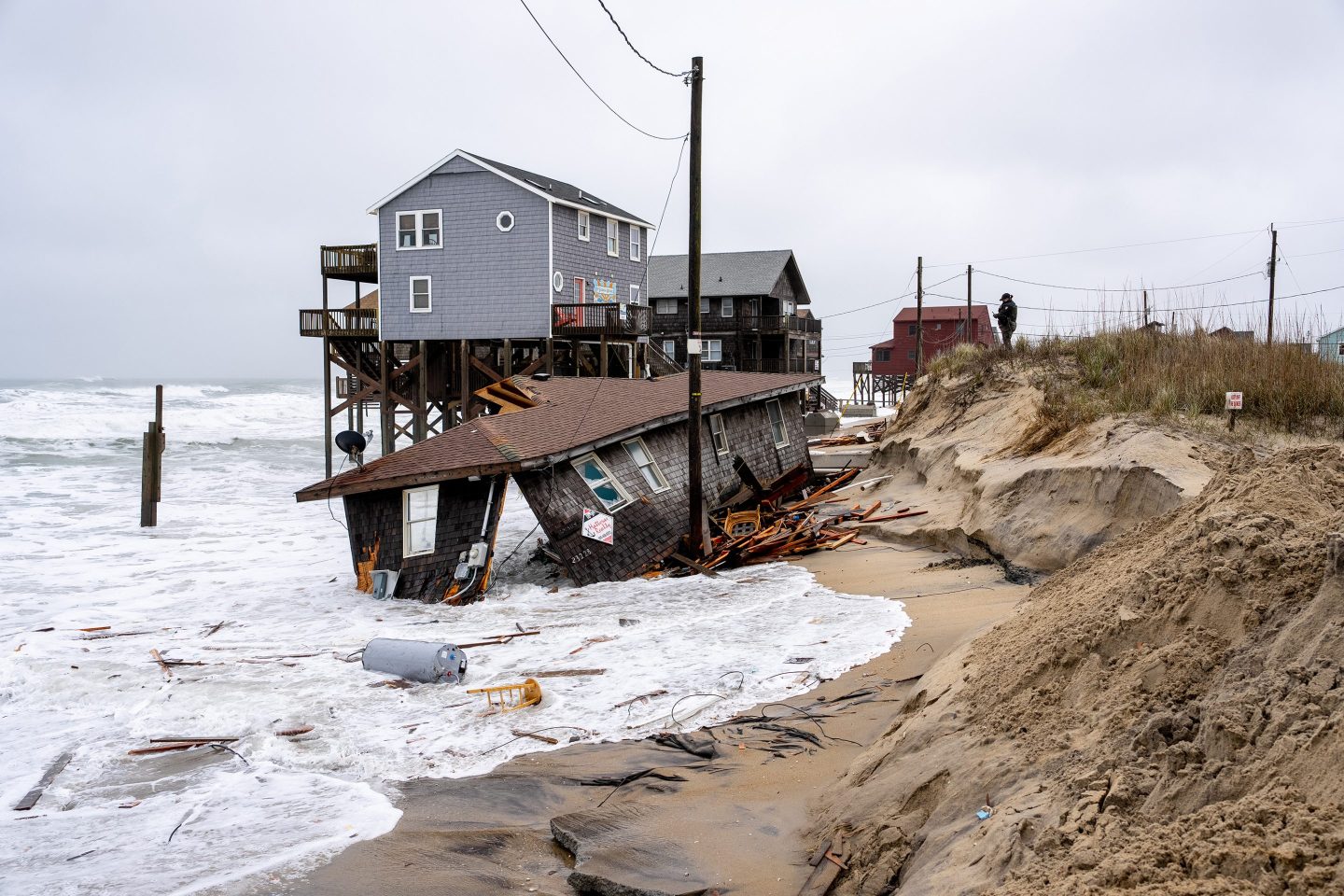
A North Carolina beach house collapses into the ocean.
A house in North Carolina's Outer Banks collapsed into the ocean last week, underlining coastal properties' vulnerability to rising sea levels.Daniel Pullen—The Virginian-Pilot/Tribune News Service/Getty Images

Suffering from rising sea levels, some North Carolina homes are literally underwater. Still, the overall waterfront property market is anything but, with price gains far exceeding inland rates even as climate risks threaten to wipe out coastal homes.

Recommended Video

Last week, a $650,000 beachfront home in North Carolina’s Outer Banks collapsed—the sixth such incident in the region in the past four years. That’s putting a new focus on the climate threats coastal properties are already facing, while the housing market apparently looks the other way.

Research shows that up to 13 million Americans’ homes could be affected by rising sea levels by 2100. But at least for now, waterfront views are having a bigger impact on property values.

In fact, U.S. coastal properties have appreciated faster than those in inland zones, and they’re also being bought up by higher-income owners, according to a paper published this March in the scientific journal Nature Communications.

“Consumers are clearly mindful that…climate change impacts could be within the window of a 30-year mortgage, but their current behavior still implies that to have a view of the ocean is more desirable,” Lawrence Yun, chief economist at the National Association of Realtors, told the paper’s authors.

North Carolina’s Outer Banks, a series of low-lying barrier islands heavily exposed to Atlantic storms, are especially vulnerable to rising sea levels and coastal erosion: Some areas have recorded sea level rises of up to seven inches over just the past few years. Following last week’s house collapse, local authorities shut down a stretch of road and are urging visitors to remain cautious.

North Carolina is far from the only region to already be seeing the effects that climate change can have on coastal areas, which have also experienced more severe storms and heavier rainfall that further erode shorelines.

For example, Salisbury, Mass., homeowners spent half a million dollars trucking in sand to protect their properties from coastal storms earlier this spring. And a $16 million mansion in Dana Point, Calif., is on the verge of collapsing into the Pacific. 

Average sea levels on the American coastline are expected to rise exponentially over the coming decades, putting the 40% of the population that lives in coastal zones under greater flooding threat.

The rising threat of coastal flooding and erosion has sent insurance companies fleeing inland. In Florida, whose highest point is just 345 feet above sea level,multiple major insurers have pulled out of the state, sending consumers’ premiums soaring. 

Despite that, Florida home values have soared since the pandemic, with the average home in the southern part of the state 35% overvalued.

“It’s not a matter of if, but when coastal communities approach complete inundation,” said Duke University economics professor Martin Smith, who cowrote a paper proposing a model for coastal property values. “The question is: Are there more effective ways to manage coastal areas in the next few decades that could smooth this transition?”

Fortune Brainstorm AI returns to San Francisco Dec. 8–9 to convene the smartest people we know—technologists, entrepreneurs, Fortune Global 500 executives, investors, policymakers, and the brilliant minds in between—to explore and interrogate the most pressing questions about AI at another pivotal moment. Register here.
About the Author
By Dylan Sloan
See full bioRight Arrow Button Icon

Latest in Environment

Jaguar
EnvironmentArizona
‘This species is recovering’: Jaguar spotted in Arizona, far from Central and South American core
By Susan Montoya Bryan and The Associated PressDecember 5, 2025
5 hours ago
Steve Jobs holds up the first iPod Nano
Big TechApple
Apple is experiencing its biggest leadership shake-up since Steve Jobs died, with over half a dozen key executives headed for the exits
By Dave SmithDecember 5, 2025
6 hours ago
Paul Atkins
CommentaryCorporate Governance
Turning public companies into private companies: the SEC’s retreat from transparency and accountability
By Andrew BeharDecember 5, 2025
8 hours ago
Four years ago, BKV started buying up the two Temple power plants in Texas—located between Austin and Dallas—which now total 1.5 gigawatts of electricity generation capacity—enough to power more than 1.1 million homes, or a major data center campus. There is room to expand.
Energypower
How a Texas gas producer plans to exploit the ‘megatrend’ of power plants for AI hyperscalers
By Jordan BlumDecember 5, 2025
13 hours ago
satellite
AIData centers
Google’s plan to put data centers in the sky faces thousands of (little) problems: space junk
By Mojtaba Akhavan-TaftiDecember 3, 2025
2 days ago
claude
EnvironmentSan Francisco
San Francisco mourns its albino alligator, Claude, dead at 30 years old
By Janie Har and The Associated PressDecember 3, 2025
2 days ago

Most Popular

placeholder alt text
Economy
Two months into the new fiscal year and the U.S. government is already spending more than $10 billion a week servicing national debt
By Eleanor PringleDecember 4, 2025
1 day ago
placeholder alt text
Success
‘Godfather of AI’ says Bill Gates and Elon Musk are right about the future of work—but he predicts mass unemployment is on its way
By Preston ForeDecember 4, 2025
1 day ago
placeholder alt text
Success
Nearly 4 million new manufacturing jobs are coming to America as boomers retire—but it's the one trade job Gen Z doesn't want
By Emma BurleighDecember 4, 2025
1 day ago
placeholder alt text
Success
Nvidia CEO Jensen Huang admits he works 7 days a week, including holidays, in a constant 'state of anxiety' out of fear of going bankrupt
By Jessica CoacciDecember 4, 2025
1 day ago
placeholder alt text
Real Estate
‘There is no Mamdani effect’: Manhattan luxury home sales surge after mayoral election, undercutting predictions of doom and escape to Florida
By Sasha RogelbergDecember 4, 2025
1 day ago
placeholder alt text
Economy
Tariffs and the $38 trillion national debt: Kevin Hassett sees ’big reductions’ in deficit while Scott Bessent sees a ‘shrinking ice cube’
By Nick LichtenbergDecember 4, 2025
1 day ago
Rankings
  • 100 Best Companies
  • Fortune 500
  • Global 500
  • Fortune 500 Europe
  • Most Powerful Women
  • Future 50
  • World’s Most Admired Companies
  • See All Rankings
Sections
  • Finance
  • Leadership
  • Success
  • Tech
  • Asia
  • Europe
  • Environment
  • Fortune Crypto
  • Health
  • Retail
  • Lifestyle
  • Politics
  • Newsletters
  • Magazine
  • Features
  • Commentary
  • Mpw
  • CEO Initiative
  • Conferences
  • Personal Finance
  • Education
Customer Support
  • Frequently Asked Questions
  • Customer Service Portal
  • Privacy Policy
  • Terms Of Use
  • Single Issues For Purchase
  • International Print
Commercial Services
  • Advertising
  • Fortune Brand Studio
  • Fortune Analytics
  • Fortune Conferences
  • Business Development
About Us
  • About Us
  • Editorial Calendar
  • Press Center
  • Work At Fortune
  • Diversity And Inclusion
  • Terms And Conditions
  • Site Map

© 2025 Fortune Media IP Limited. All Rights Reserved. Use of this site constitutes acceptance of our Terms of Use and Privacy Policy | CA Notice at Collection and Privacy Notice | Do Not Sell/Share My Personal Information
FORTUNE is a trademark of Fortune Media IP Limited, registered in the U.S. and other countries. FORTUNE may receive compensation for some links to products and services on this website. Offers may be subject to change without notice.