
• Home
  • Latest
  • Fortune 500
  • Finance
  • Tech
  • Leadership
  • Lifestyle
  • Rankings
  • Multimedia
MagazineInvesting

Aviation stocks are a bargain. Are they worth the turbulence?

Jeff John Roberts
By
Jeff John Roberts
Jeff John Roberts
Editor, Finance and Crypto
Down Arrow Button Icon
Jeff John Roberts
By
Jeff John Roberts
Jeff John Roberts
Editor, Finance and Crypto
Down Arrow Button Icon
June 3, 2024, 8:00 AM ET
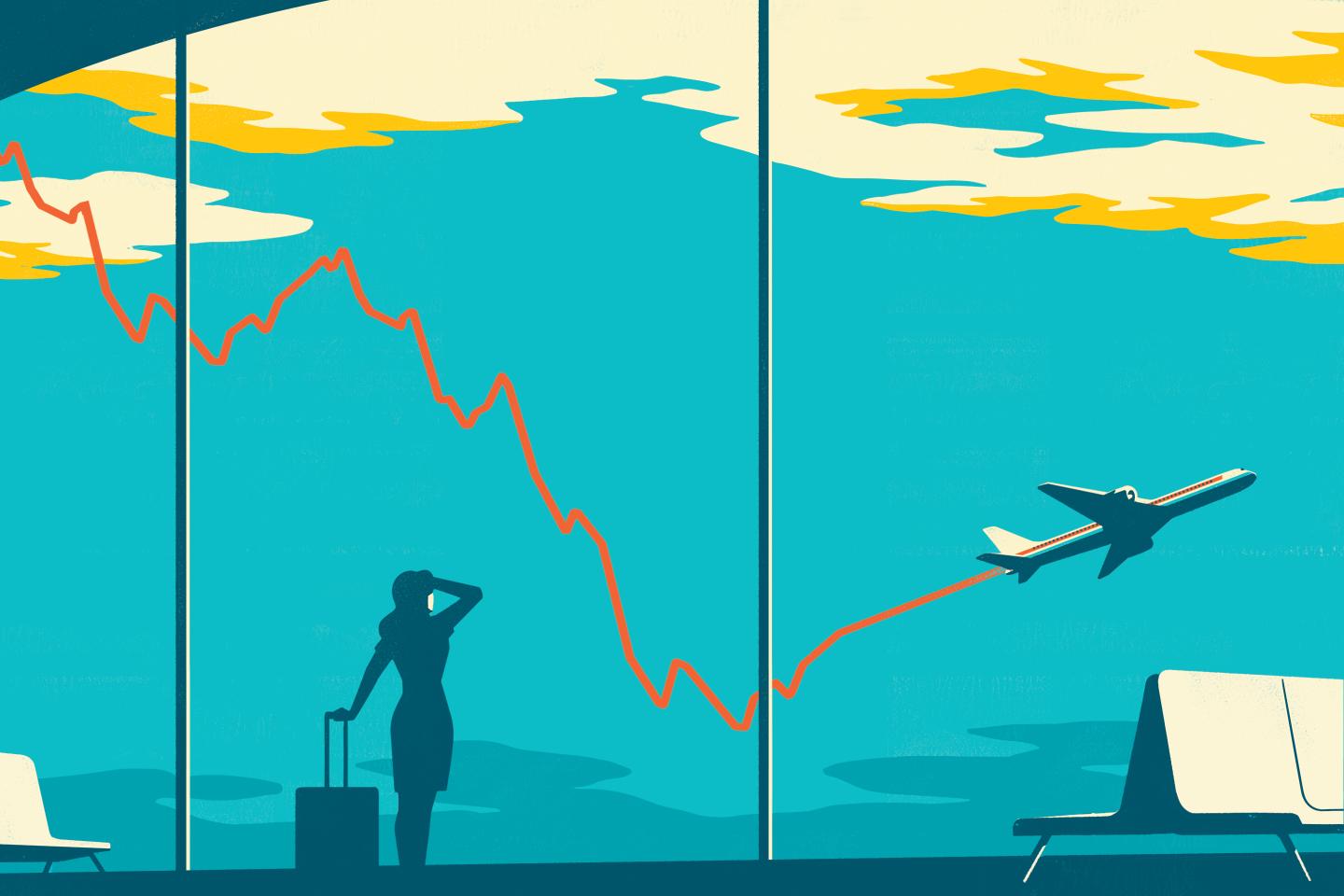
Illustratoin by Chris Gash

In recent months, Boeing’s share price has fallen almost as fast as its aircraft parts have tumbled from the sky.

Recommended Video

There have been a series of harrowing incidents this year involving defects on Boeing planes. Some cases were routine hiccups, but others involved alarming oversights—most infamously, the loose bolts that led a door-plug panel from an Alaska Airlines 737-9 Max to land in the yard of an Oregon schoolteacher on Jan. 5. This latest round in Boeing’s struggle with manufacturing debacles and quality-control problems led CEO David Calhoun to announce his resignation. The Federal Aviation Administration, meanwhile, has cracked down on the manufacturer, limiting Boeing’s ability to deliver new aircraft. 

This has meant headaches for investors: Boeing shares were down more than 30% year to date in mid-May, and other aviation and airline stocks have also tumbled. But in an industry as essential to the economy as aerospace, any bad patch can turn into an opportunity—which raises the question of whether Boeing or the airlines that fly its planes might now be bargains.

Despite the cascade of disasters and the deep-rooted cultural problems underlying them, there’s a case to be made for Boeing as a long-term play—because the company enjoys the benefits of a duopoly. Boeing produced around 40% of the 29,000 commercial aircraft flying today, as Fortune recently reported, and along with Europe’s Airbus it has a lock on that market for the foreseeable future.

Nicolas Owens, an industrials equities analyst at Morningstar, notes that the spectacular nature of aviation mishaps can produce overreaction on the part of investors. The reality, he notes, is that Boeing’s order book is crammed: The company’s report for December revealed net orders of 369, a monthly record, and each represents hundreds of millions of dollars in sales. If and when the company overcomes its quality problems, that revenue stream could flow freely again. (Boeing brought in $78 billion in revenue in 2023.)

Owens adds that broader travel trends also bode in favor of the aircraft manufacturer. “The commercial aerospace sector has a very long runway of strong demand,” he says. “Middle-class people all over the world want to fly, especially in places like India and Asia.”

Chart shows stock price growth for airline stocks

Can airlines fly first class?

Boeing’s door-plug disaster in January also triggered a drop in airline stocks across the board. Since then, though, different carriers’ shares have followed different flight paths—showing how much they vary in their reliance on the manufacturer.

Delta Air Lines, whose fleet comes mostly from Airbus, quickly bounced back. United Airlines shares initially were pummeled when the carrier had to ground dozens of 737-9 Max jets, but they rallied after Boeing agreed to compensate United for lost revenue. Southwest took a more sustained hit, cutting routes and trimming hiring as its plans to add dozens of Boeing planes were delayed. Southwest shares were down 3% year to date through mid-May.

Boeing’s troubles are likely just a temporary setback for airlines, but they’re one more risk factor in an industry that offers investors many reasons to be wary. Airlines are highly cyclical; air travel rises and falls with the macro economy. The industry is also both highly regulated and brutally competitive. Because they need so much cash to operate, most airlines offer modest dividends or none at all, and bankruptcies are a perennial risk.

The biggest knock on the sector may be that its core product—seats on planes—has historically been viewed as a commodity, forcing airlines to compete on price alone. But new trends may be addressing that drawback, at least for the “Big Four” (Delta, United, Southwest, and American Airlines). 

Bernstein analyst David Vernon says that moves by the majors to create more sections within cabins—beyond coach and first-class—and to sell more services à la carte have reduced the commodity effect: “They’re plowing money into their networks, differentiating cabins, and extracting more money from customers.”

Ironically, airlines may also get a boost from Boeing’s woes. Vernon notes that increased FAA oversight will limit Boeing’s output of new aircraft, so the supply of seats will stay tight, protecting carriers’ profit margins from overcapacity. Meanwhile, Vernon notes, players like Delta and United have significantly increased their revenue from credit card operations, diversifying their businesses and making them less dependent on cyclical travel.

A different trajectory

Ultimately, both Boeing and the major airlines represent potential bargains for those with a high tolerance for risk. Those looking to buy aviation-related stocks also have a third option—one that’s, well, flying high.

That option is military aircraft. Boeing and Airbus have footprints in that sector, but so do firms like RTX and Lockheed Martin that are not closely tied to the passenger-jet industry. Geopolitical conflicts around the globe have boosted sales of craft like fighter jets, and contractor order books are likely to grow as Western countries rearm. Stephen Scott, a retired law professor and veteran investor, says he has always stayed away from shares of airlines and commercial manufacturers, but is comfortable buying those that make military aircraft, like General Dynamics. 

“The defense sector is a whole other universe,” Scott tells Fortune. “And there are a lot more players than Boeing and Airbus.” 

This article appears in the June/July 2024 issue of Fortune.

Join us at the Fortune Workplace Innovation Summit May 19–20, 2026, in Atlanta. The next era of workplace innovation is here—and the old playbook is being rewritten. At this exclusive, high-energy event, the world’s most innovative leaders will convene to explore how AI, humanity, and strategy converge to redefine, again, the future of work. Register now.
About the Author
Jeff John Roberts
By Jeff John RobertsEditor, Finance and Crypto
LinkedIn iconTwitter icon

Jeff John Roberts is the Finance and Crypto editor at Fortune, overseeing coverage of the blockchain and how technology is changing finance.

See full bioRight Arrow Button Icon

Latest from the Magazine

Finance
Lorem ipsum dolor sit amet, consectetur adipiscing elit, sed do eiusmod tempor incididunt ut labore et dolore magna aliqua. Ut enim ad minim veniam
By Fortune Editors
October 20, 2025
Finance
Lorem ipsum dolor sit amet, consectetur adipiscing elit, sed do eiusmod tempor incididunt ut labore et dolore magna aliqua. Ut enim ad minim veniam
By Fortune Editors
October 20, 2025
Finance
Lorem ipsum dolor sit amet, consectetur adipiscing elit, sed do eiusmod tempor incididunt ut labore et dolore magna aliqua. Ut enim ad minim veniam
By Fortune Editors
October 20, 2025
Finance
Lorem ipsum dolor sit amet, consectetur adipiscing elit, sed do eiusmod tempor incididunt ut labore et dolore magna aliqua. Ut enim ad minim veniam
By Fortune Editors
October 20, 2025
Finance
Lorem ipsum dolor sit amet, consectetur adipiscing elit, sed do eiusmod tempor incididunt ut labore et dolore magna aliqua. Ut enim ad minim veniam
By Fortune Editors
October 20, 2025
Finance
Lorem ipsum dolor sit amet, consectetur adipiscing elit, sed do eiusmod tempor incididunt ut labore et dolore magna aliqua. Ut enim ad minim veniam
By Fortune Editors
October 20, 2025

Most Popular

Finance
Lorem ipsum dolor sit amet, consectetur adipiscing elit, sed do eiusmod tempor incididunt ut labore et dolore magna aliqua. Ut enim ad minim veniam
By Fortune Editors
October 20, 2025
Finance
Lorem ipsum dolor sit amet, consectetur adipiscing elit, sed do eiusmod tempor incididunt ut labore et dolore magna aliqua. Ut enim ad minim veniam
By Fortune Editors
October 20, 2025
Finance
Lorem ipsum dolor sit amet, consectetur adipiscing elit, sed do eiusmod tempor incididunt ut labore et dolore magna aliqua. Ut enim ad minim veniam
By Fortune Editors
October 20, 2025
Finance
Lorem ipsum dolor sit amet, consectetur adipiscing elit, sed do eiusmod tempor incididunt ut labore et dolore magna aliqua. Ut enim ad minim veniam
By Fortune Editors
October 20, 2025
Finance
Lorem ipsum dolor sit amet, consectetur adipiscing elit, sed do eiusmod tempor incididunt ut labore et dolore magna aliqua. Ut enim ad minim veniam
By Fortune Editors
October 20, 2025
Finance
Lorem ipsum dolor sit amet, consectetur adipiscing elit, sed do eiusmod tempor incididunt ut labore et dolore magna aliqua. Ut enim ad minim veniam
By Fortune Editors
October 20, 2025
Rankings
  • 100 Best Companies
  • Fortune 500
  • Global 500
  • Fortune 500 Europe
  • Most Powerful Women
  • Future 50
  • World’s Most Admired Companies
  • See All Rankings
Sections
  • Finance
  • Leadership
  • Success
  • Tech
  • Asia
  • Europe
  • Environment
  • Fortune Crypto
  • Health
  • Retail
  • Lifestyle
  • Politics
  • Newsletters
  • Magazine
  • Features
  • Commentary
  • Mpw
  • CEO Initiative
  • Conferences
  • Personal Finance
  • Education
Customer Support
  • Frequently Asked Questions
  • Customer Service Portal
  • Privacy Policy
  • Terms Of Use
  • Single Issues For Purchase
  • International Print
Commercial Services
  • Advertising
  • Fortune Brand Studio
  • Fortune Analytics
  • Fortune Conferences
  • Business Development
About Us
  • About Us
  • Editorial Calendar
  • Press Center
  • Work At Fortune
  • Diversity And Inclusion
  • Terms And Conditions
  • Site Map
  • Facebook icon
  • Twitter icon
  • LinkedIn icon
  • Instagram icon
  • Pinterest icon

Most Popular

placeholder alt text
North America
'I meant what I said in Davos': Carney says he really is planning a Canada split with the U.S. along with 12 new trade deals
By Rob Gillies and The Associated PressJanuary 28, 2026
1 day ago
placeholder alt text
C-Suite
Fortune 500 CEOs are no longer giving employees an A for effort. Now they want proof of impact
By Claire ZillmanJanuary 28, 2026
2 days ago
placeholder alt text
Politics
The American taxpayer spent nearly half a billion dollars deploying federal troops to U.S. cities in 2025, CBO finds
By Nick LichtenbergJanuary 28, 2026
1 day ago
placeholder alt text
Success
Every U.S. Olympian is going home with $200,000, whether they medal or not, thanks to a billionaire's $100 million gift
By Jacqueline MunisJanuary 28, 2026
1 day ago
placeholder alt text
C-Suite
Jeff Bezos capped his Amazon salary at $80,000: ‘How could I possibly need more incentive?’
By Sydney LakeJanuary 28, 2026
1 day ago
placeholder alt text
Real Estate
Ryan Serhant thinks the American Dream was just a 'slogan created by banks,' but it was really about FDR, the Great Depression, and an economic crisis
By Sydney Lake and Nick LichtenbergJanuary 26, 2026
3 days ago

© 2026 Fortune Media IP Limited. All Rights Reserved. Use of this site constitutes acceptance of our Terms of Use and Privacy Policy | CA Notice at Collection and Privacy Notice | Do Not Sell/Share My Personal Information
FORTUNE is a trademark of Fortune Media IP Limited, registered in the U.S. and other countries. FORTUNE may receive compensation for some links to products and services on this website. Offers may be subject to change without notice.


Latest from the Magazine

MagazineBonds
Bonds 101: What investors need to know about the ‘shock absorber of the portfolio’
By Jeff John RobertsJanuary 29, 2026
14 hours ago
MagazineSamsung
How Samsung’s first-ever chief design officer is reinventing the electronics giant for the AI age
By Nicholas GordonJanuary 28, 2026
1 day ago
MagazineHyatt Hotels
Hyatt’s high-end makeover: How Mark Hoplamazian built the Berkshire Hathaway of luxury hotels
By Matthew HeimerJanuary 28, 2026
2 days ago
MagazineData centers
Inside a multibillion dollar AI data center powering the future of the American economy
By Sharon Goldman and Nicolas RappJanuary 27, 2026
3 days ago
MagazineTether
Crypto giant Tether has $187 billion in assets, big plans for U.S. expansion—and a CEO who warns the West is heading toward social collapse
By Jeff John RobertsJanuary 27, 2026
3 days ago
MagazineLuxury
The $20,000 longevity weekend for those who recognize that more time is the ultimate luxury
By Jaclyn TropJanuary 25, 2026
4 days ago