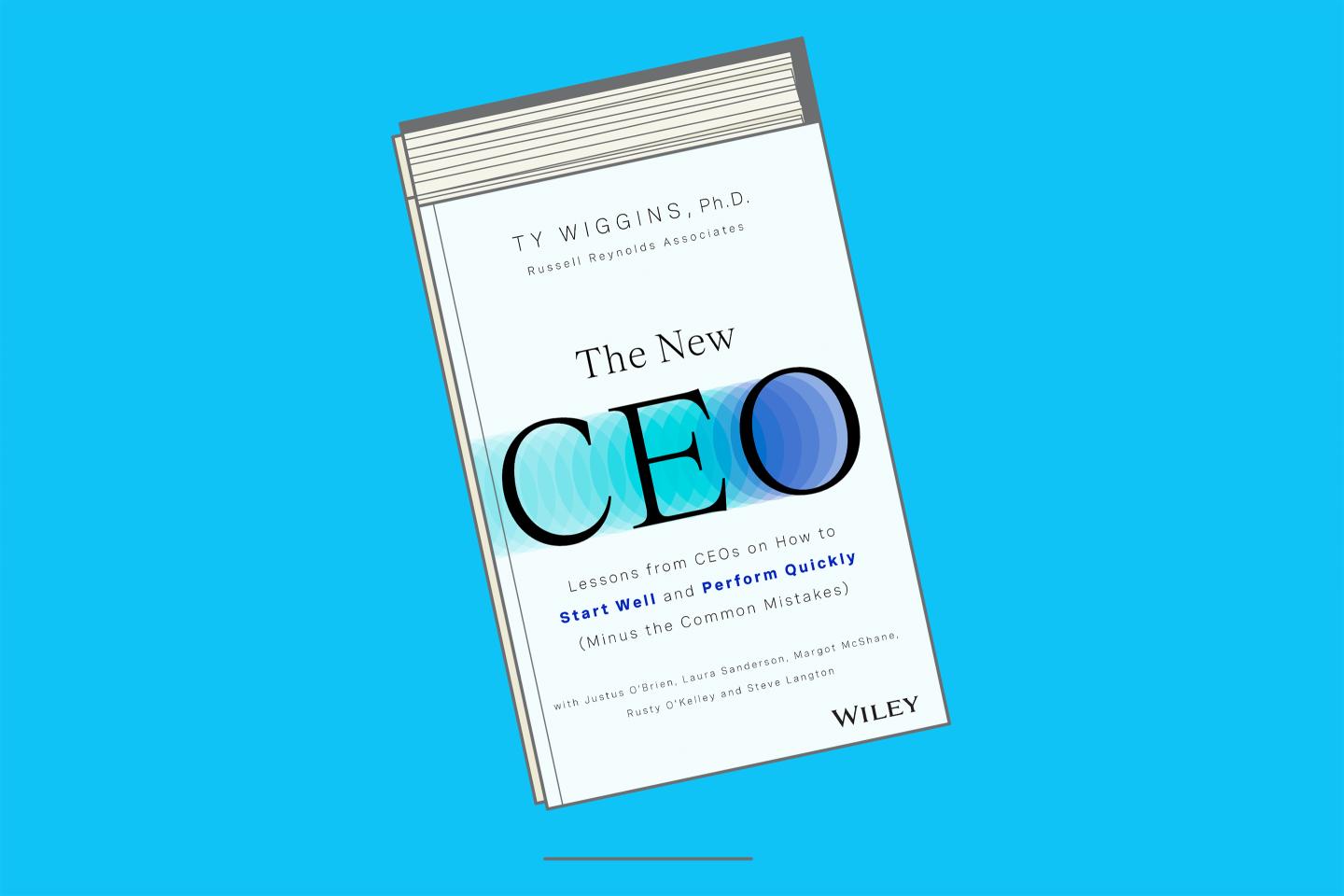
The following is an excerpt from Ty Wiggins’ book The New CEO: Lessons from CEOs on How to Start Well and Perform Quickly.
There are many misconceptions about being CEO. Unfortunately, the one about it being extremely lonely is not one of them. This is what CEOs most frequently tell me when I ask them what the hardest adjustment is about the role.
Carol Tomé was warned before taking the helm of global shipping company UPS that she would feel lonely. She wasn’t fazed. “I would say, ‘How lonely can it really be? It can’t be that lonely?’ What I’ve since learned is that it is extraordinarily lonely,” she laughed.
“When you are a member of an executive team, you hang together,” she told me when we met. “Now, my executive team will wait for me to leave a meeting so that they can debrief together. It’s the reality and you have to get used to it. But it is super lonely.”
Being CEO is like being alone in a crowd: you are rarely physically alone and yet at times you can feel like the only person on the planet. An often-cited study from 2012 found 50% of CEOs reported feelings of loneliness, with 61% believing it hindered their performance.
The reality of the CEO role
Loneliness can manifest in different ways. It’s lonely intellectually as you no longer have any peers to spar with. Hopefully, you have a good relationship with your leadership team and the chair of the board, but it will not be the same. It’s lonely in that there will inevitably be things that you know that you cannot share. It’s lonely in candor as you can’t just say whatever you’re thinking anymore. And it’s lonely emotionally—there are very few people with whom you can really share how you’re feeling.
Sanjiv Lamba, CEO of Linde plc, is another CEO who found the role lonelier than he had expected. “I am the internal candidate, so I should have read the tea leaves,” he told me, with a smile. “But you can’t see it until you are there. It is just the reality of the role.”
Sanjiv described how, at any given time, he can’t talk to his leadership team about many of the things he’s thinking about, even though he has complete trust in them. As he said, “It’s just the nature of the things that you do as CEO and the decisions you are making.”
One response is for CEOs to fight to feel part of a team, for camaraderie, and even a wish to be liked. But this causes knock-on issues as they struggle to separate themselves from their team. As CEO, you are surrounded by your senior leadership team, but you are not really part of it. You will need to regularly disassociate from the team in order to make the tough decisions that are necessary for your organization to succeed, short and long term.
The other coping mechanism is to further isolate yourself and become an island, which only blunts your decision-making, as well as your confidence in your decisions. Isolated CEOs can also start to doubt the level of trust and support from those around them. Unfortunately, it can be a downward spiral that makes a tough role even harder.
When I ask CEOs about the best and worst parts of being CEO, they often give the same answer to both parts of the question: the responsibility.
“You realize there is no one else,” Marc Bitzer, CEO of Whirlpool, the American manufacturer of home appliances, told me. “I’m responsible not just for financials, but for 60,000 people and their families. The buck stops here. If you think too much about it, it can paralyze you.”
For many CEOs, the sense of responsibility extends in a meaningful way to their customers. I am yet to meet a CEO who doesn’t care deeply about their customers. But, for some, the industry they work in makes the weight of that responsibility much more visceral.
Stephanie Tully is the CEO of one of Asia Pacific’s largest low cost carriers, which provides low fares services to approximately 20 million passengers each year. “You’re flying people every day, and you do everything you can, but you have to be ready for literally any situation,” she told me. “I was warned at the beginning that you never sleep easily as the CEO of an airline.”
When you are CEO, you are also in charge of making the decisions that no one else can make—decisions that often have significant ramifications for the future of your organization, its stakeholders, and many people’s livelihoods. Yet, it is this total responsibility that most likely drew you to the role in the first place, the part that you accepted without hesitation.
‘Only the hard stuff’ for CEOs
Doug Mack, a three-time CEO, who has recently stepped down from the helm of Fanatics, which manufactures and retails merchandise for global sports fans, described the complexity of the job as sitting at the “pinch of the hour-glass,” trying to manage the “insatiable expectations” coming above from investors and below from employees. Not to mention, “only the hard stuff ends up on your desk when you’re CEO.”
Doug added, “Anything straightforward, fun, or easy is solved by the incredibly talented people you have in your organization. All the stuff that comes to you as CEO are things that all those smart people already worked on, debated, tried to figure out, and they couldn’t. When you’re the CEO, you’re signing up for that.”
Of course, if you’ve previously held a C-suite or regional GM role, you’ll have already experienced responsibility and accountability, especially around large decisions. You may have been asked to sell-in your point of view or been in the room when the decision was made. But the ultimate decision was made by someone else.
It’s different when the proverbial buck stops with you: no one to defer to, no one to share the responsibility with, and no one to stand beside you shouldering any negative consequences. What makes this even harder is that many of the decisions you’ll make as CEO don’t have a definitive right or wrong answer. Some are judgment calls. Or, in other words, “Whatever you think, boss.”
“There’s lots of people to help and advise, but in the end, you have to make the decisions—it’s a weight you can’t put down,” Lyssa McGowan told me after her first year as CEO of Pets at Home, the United Kingdom’s leading pet care business. In her situation, the “weight” includes the jobs of 16,000 people and around £1.5 billion ($1.9 billion) of shareholders’ money.
Before taking over at Pets at Home, Lyssa had spent years as a divisional leader at a major telco both as its Chief Commercial Officer and then its Chief Consumer Officer. It was some time before the lightbulb moment came that the CEO role wasn’t just a larger mandate and that she couldn’t just apply the lessons she’d already learned.
“I always thought that being a CEO would be, say, 30% harder than being a divisional leader, maybe 40%,” she told me. “But it’s not any percent harder. It has taken me a year to understand that being CEO isn’t a bigger job, it is a different job.” She continued:
“Every week I’m making decisions where I’ve got three ‘not great’ scenarios and I have to pick the least bad one, or the one that I’m at least 50% sure is the least bad one. Then I need to perform alchemy and convince 16,000 people it’s brilliant and amazing and we should all follow it. That’s part of what it means to be a CEO—to create certainty and clarity where there is none.
“And when things go wrong now, I no longer have to convince my boss about the next steps, I have to convince myself. And it turns out I’m a lot harder to convince than any boss I ever had.”
To add insult to injury, the type of decisions that CEOs need to make often carry a time horizon that offers little opportunity for short-term feedback on whether you made the right call or not. You may not find out until months, years, or even decades later. It can weigh heavily on your shoulders. As Ron Williams, former CEO of Aetna and current board director of Boeing, American Express, and Johnson & Johnson, told me, “It’s important to recognize the multiple time horizons you operate across as CEO. You need to get today’s work done today. You need to deliver for the quarter, and you need to deliver for the year. But most importantly, you have to build a sustainable institution for the next CEO to inherit.”
Adapted with permission from the publisher, Wiley, from The New CEO: Lessons from CEOs on How to Start Well and Perform Quickly (Minus the Common Mistakes) by Ty Wiggins, Ph.D., Russell Reynolds Associates. Copyright © 2024 by Russell Reynolds Associates, Inc. All rights reserved. This book is available wherever books and eBooks are sold.
Read more:
- How milestone birthdays can derail CEO focus—and harm company performance
- ‘Founder mode’ is missing a key to growth—take it from a founder and CEO
- My tech startup failed due to 3 mistaken assumptions—entrepreneurs take note
- I’ve led multiple tech businesses. This is the biggest mistake startup leaders make