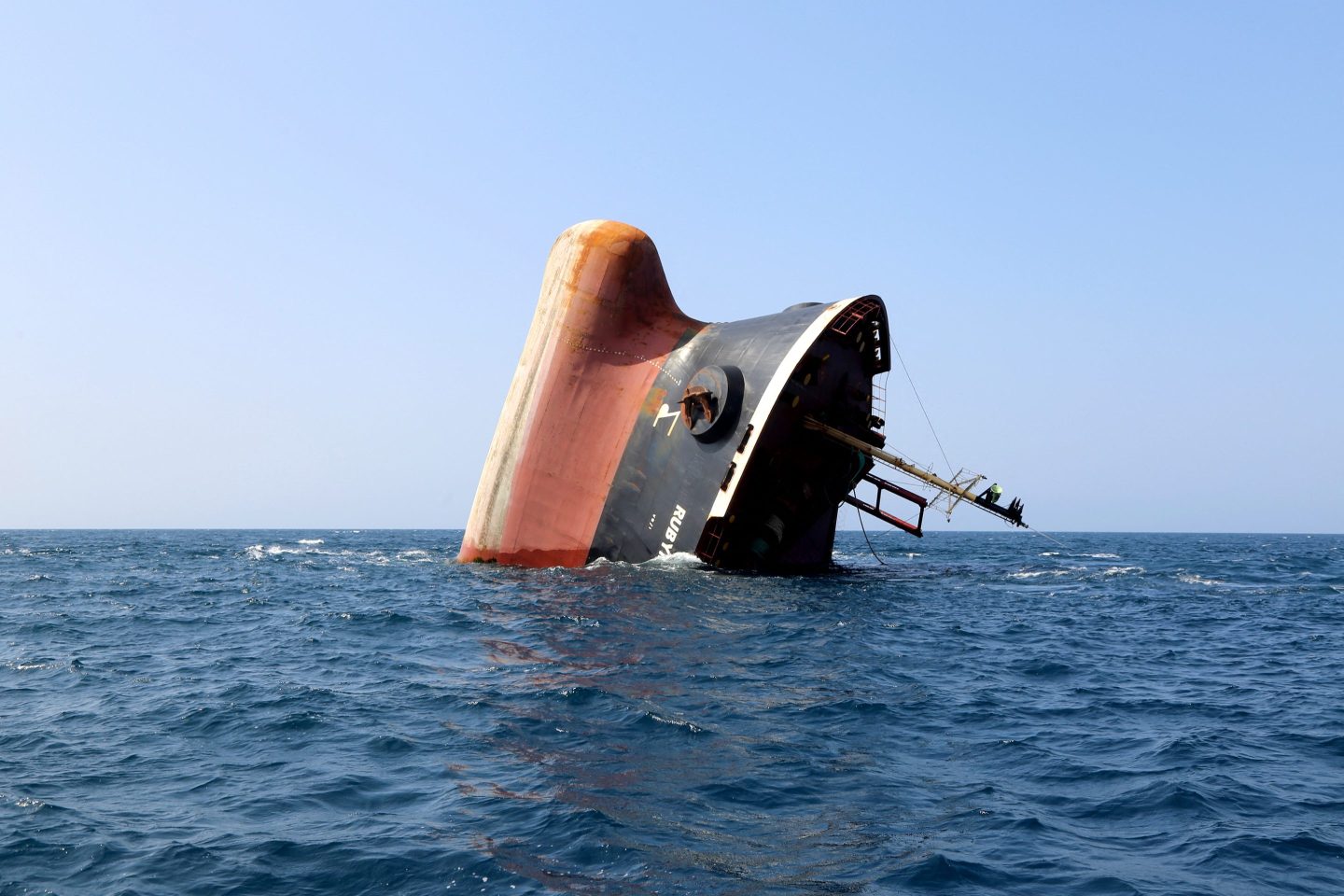
The West finds itself in a simmering standoff with China, Iran, North Korea, and Russia. It’s a standoff occurring on two distinct fronts: the first is a battle of political and diplomatic hearts and minds, fueled by cultural priorities, propagandizing, and media trends; the second is the high seas, a terrestrial final frontier and perhaps the last place where bad actors can hide with ease.
Fishing fleets are illegally fishing across the globe with impunity, violating Exclusive Economic Zones (EEZs) as far as South America; Russia continues to skirt sanctions amidst their war in Ukraine; and now Iran-backed groups are disrupting trade routes through the Red Sea, further stirring an already restless Middle East.
As maritime maliciousness continues to have global implications, this low-intensity conflict will increasingly become one America and its allies can’t afford to lose. Indeed, it’s not a battle over territory where lives and land are most at stake–it’s a war over trade, and the costs will inevitably be economic.
The maritime battleground
Consider the recent actions of the Iran-backed Houthi rebels in Yemen that has been attacking Western vessels in the Red Sea. It’s a massive shipping disruption on a critical trade route, causing huge delays and supply chain uncertainty.
According to Windward’s data, all the world’s top carriers deviated from Red Sea-based routes between December 2023 and January 2024, a reaction that has raised the overall price of shipping containers from East Asia to North Europe by 243% to $5,456.
Egypt, whose Suez Canal had an annual revenue of $9.4 billion in 2023, is suffering a 50% loss of shipping traffic at the hands of the Houthis, with the potential for civil unrest or political upheaval on top of the economic impact. Jordan’s only port, Aqaba, is practically inaccessible without the Red Sea–the alternative would require detouring around the Cape of Good Hope and across the Mediterranean, extending voyages significantly and constraining the viability of the port.
Europe’s Red Sea-bound vessels are also rerouting to the Cape of Good Hope, extending the voyage by 10-14 days and increasing operational costs by roughly $1 million per vessel–which will inevitably trickle down to consumers. And while ultimately less impacted than Egypt and Jordan, other Middle Eastern countries similarly suffer extended voyage times and higher fees. The Houthis claim their actions are retaliation against Israeli military activity. But the impact is far greater on both Europe and Israel’s neighboring Arab countries.
It is alignment, or at least willingness to work with the West, that is the common factor among the countries most impacted by the Houthi attacks.
China’s ties to Iran are no secret. Chinese oil refiners bought over 90% of Iran’s crude exports last year. Vessels passing through the Bab al-Mandeb Strait publicly declare to have Chinese crew aboard to gain immunity from Houthi attacks. In fact, Chinese shipping companies have increased transits through the Red Sea since the attacks began. In light of China’s apparent favorability with the Houthis, the U.S. has even asked China to exert its economic influence over Iran to halt terrorist activity in the Red Sea.
And in the background, veteran maritime instigator Russia has taken advantage of the West’s shifting focus toward the Red Sea to expand its dark shipping operations. Russia’s dark fleet grew by 29% in Q4 2023 to include over 1,800 vessels, helping circumvent recent sanctions and sell oil at a higher price point.
Why it matters
Deceptive and disruptive maritime activity isn’t new. China already dominates the South China Sea, having weaponized their fishing vessels into a pseudo-military fleet which they use to control the Indo-Pacific area. But China has long perpetrated questionable activities beyond regional waters–their distant water fishing fleet is known to employ slave labor to illegally fish around the world and is a primary reason why illegal fishing is now the world’s sixth-largest illicit industry. Some of these Chinese fishing practices are largely illegal, unsustainable, and have huge negative impacts on fish populations and the environment. If left unchecked, illegal Chinese fishing will result in massive economic hits to other countries, particularly to small nations reliant on fishing in their EEZs for sustenance, not to mention the irreversible impact on the environment.
While both Trump and Biden have supported South American counter efforts with funding, equipment, and naval support, solutions have shown few results. The Quadrilateral Security Dialogue (“the Quad”), a strategic alliance between Australia, India, Japan, and the U.S., was also created to maintain a “free and open Indo-Pacific,” guided by the unstated priority of countering China’s growing power. But the Quad summit was postponed twice in the past year and Chinese influence steadily grows while its opponents continue to drag their feet.
Indeed, China overtook Greece as the largest ship-owning nation in 2023, and The People’s Liberation Army Navy (PLAN) is now reportedly the largest in the world. China continues to flout the United Nations Convention on the Law of the Sea within the Exclusive Economic Zones of other countries across the globe, including the United States, Australia, the Philippines, Vietnam, and Malaysia.
Treading water
The implications of rising maritime infractions impinge on the West and particularly the US. If global leaders lose faith in the U.S.’s ability to protect them at sea, it will be yet another concerning shift in global power dynamics. And with 15% of all goods now rerouted due to the Houthis, China will increasingly appear more capable of protecting commerce at sea than Western navies.
Additionally, while decreasing reliance on China is now a priority for many Western nations, many economies, including the U.S. are still heavily reliant on imports. If China emerges as the global maritime superpower, the repercussions will be felt across global trade. Simply by turning to China for assistance in alleviating issues in the Red Sea, the U.S. has all but admitted the shifting currents of global influence and naval power.
As the tides of geopolitical tension swell, new tensions are emerging, transforming the maritime domain into a critical arena with profound implications on geopolitics and the world economy–after all, maritime shipping accounts for 90% of all world trade.
The recent Houthi attacks are just another wave of this war, demonstrating how seemingly local issues can have widespread global impacts. As the West waits to see where and when the next flare-up will be, it is essential for Western leaders to recognize that these “isolated” maritime disruptions are really just pieces of a geopolitical puzzle with far more at stake than hindered trade routes. The US and its allies need to treat it as such.
Matan Peled is a co-founder and the head of U.S. business at Windward.
More must-read commentary published by Fortune:
- $122 Thai delivery and $26 to-go coffees: New wage laws meant to help gig workers are backfiring big-time
- I’m a venture capitalist, and here’s why I believe we need to guarantee everyone’s basic needs: The social floor is actually a trampoline that can propel our economy
- How to fix Boeing, according to a former Airbus technology chief
- DEI is under attack. Here’s the real reason it makes many white men uncomfortable
The opinions expressed in Fortune.com commentary pieces are solely the views of their authors and do not necessarily reflect the opinions and beliefs of Fortune.