• Home
  • News
  • Fortune 500
  • Tech
  • Finance
  • Leadership
  • Lifestyle
  • Rankings
  • Multimedia
EnvironmentScience

Florida scientists have built a ‘Coral Fort’ from plastic straws and other recycled materials to keep fish from eating lab-grown reef

By
David Fischer
David Fischer
and
The Associated Press
Down Arrow Button Icon
By
David Fischer
David Fischer
and
The Associated Press
Down Arrow Button Icon
April 11, 2024, 10:42 AM ET
Coral reef
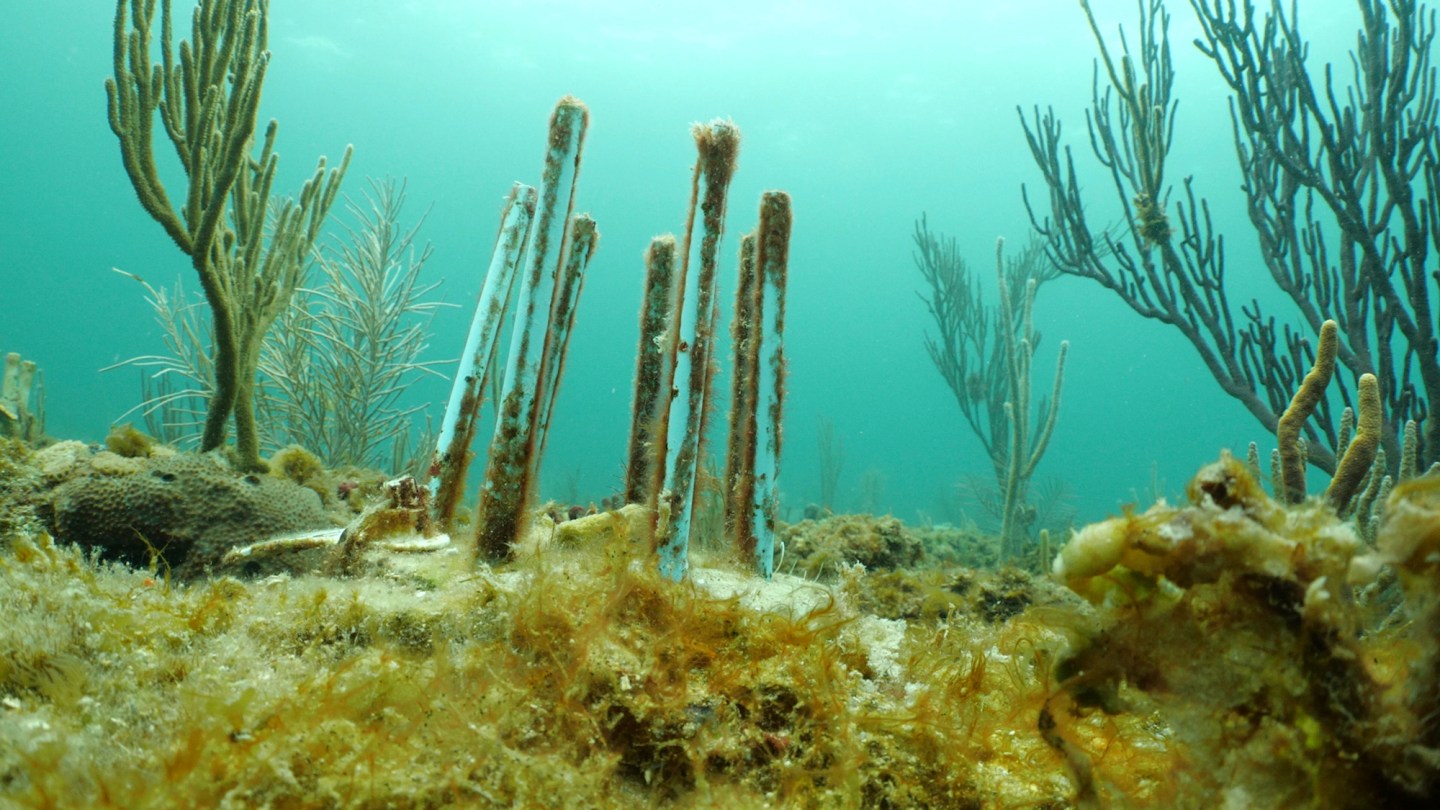
This July 26, 2023 image provided by phade® by WinCup, Inc., shows a "Coral Fort," made of biodegradable drinking straws that researchers are using to prevent laboratory-grown coral from becoming really expensive fish food, off the coast of Fort Lauderdale, Fla. Chris Gug/phade® by WinCup, Inc. via AP

South Florida researchers trying to prevent predatory fish from devouring laboratory-grown coral are grasping at biodegradable straws in an effort to restore what some call the rainforest of the sea.

Recommended Video

Scientists around the world have been working for years to address the decline of coral reef populations. Just last summer, reef rescue groups in South Florida and the Florida Keys were trying to save coral from rising ocean temperatures. Besides working to keep existing coral alive, researchers have also been growing new coral in labs and then placing them in the ocean.

But protecting the underwater ecosystem that maintains upwards of 25% of all marine species is not easy. Even more challenging is making sure that coral grown in a laboratory and placed into the ocean doesn’t become expensive fish food.

Marine researcher Kyle Pisano said one problem is that predators like parrot fish attempt to bite and destroy the newly transplanted coral in areas like South Florida, leaving them with less than a 40% survival rate. With projects calling for thousands of coral to be planted over the next year and tens of thousands of coral to be planted over the next decade, the losses add up when coral pieces can cost more than $100 each.

Pisano and his partner, Kirk Dotson, have developed the Coral Fort, claiming the small biodegradable cage that’s made in part with drinking straws boosts the survival rate of transplanted coral to over 90%.

“Parrot fish on the reef really, really enjoy biting a newly transplanted coral,” Pisano said. “They treat it kind of like popcorn.”

Fortunately the fish eventually lose interest in the coral as it matures, but scientists need to protect the coral in the meantime. Stainless steel and PVC pipe barriers have been set up around transplanted coral in the past, but those barriers needed to be cleaned of algae growth and eventually removed.

Pisano had the idea of creating a protective barrier that would eventually dissolve, eliminating the need to maintain or remove it. He began conducting offshore experiments with biodegradable coral cages as part of a master’s degree program at Nova Southeastern University. He used a substance called polyhydroxyalkanoate, a biopolymer derived from the fermentation of canola oil. PHA biodegrades in ocean, leaving only water and carbon dioxide. His findings were published last year.

The coral cage consists of a limestone disc surrounded by eight vertical phade brand drinking straws, made by Atlanta-based WinCup Inc. The device doesn’t have a top, Pisano said, because the juvenile coral needs sunlight and the parrot fish don’t generally want to position themselves facing downward to eat.

Dotson, a retired aerospace engineer, met Pisano through his professor at Nova Southeastern, and the two formed Reef Fortify Inc. to further develop and market the patent-pending Coral Fort. The first batch of cages were priced at $12 each, but Pisano and Dotson believe that could change as production scales up.

Early prototypes of the cage made from phade’s standard drinking straws were able to protect the coral for about two months before dissolving in the ocean, but that wasn’t quite long enough to outlast the interest of parrot fish. When Pisano and Dotson reached out to phade for help, the company assured them that it could make virtually any custom shape from its biodegradable PHA material.

“But it’s turning out that the boba straws, straight out of the box, work just fine,” Dotson said.

Boba straws are wider and thicker than normal drinking straws. They’re used for a tea-based drink that includes tapioca balls at the bottom of the cup. For Pisano and Dotson, that extra thickness means the straws last just long enough to protect the growing coral before harmlessly disappearing.

Reef Fortify is hoping to work with reef restoration projects all over the world. The Coral Forts already already being used by researchers at Nova Southeastern and the University of Miami, as well as Hawaii’s Division of Aquatic Resources.

Rich Karp, a coral researcher at the University of Miami, said they’ve been using the Coral Forts for about a month. He pointed out that doing any work underwater takes a great deal of time and effort, so having a protective cage that dissolves when it’s no longer needed basically cuts their work in half.

“Simply caging corals and then removing the cages later, that’s two times the amount of work, two times the amount of bottom time,” Karp said. “And it’s not really scalable.”

Experts say coral reefs are a significant part of the oceanic ecosystem. They occupy less than 1% of the ocean worldwide but provide food and shelter to nearly 25 percent of sea life. Coral reefs also help to protect humans and their homes along the coastline from storm surges during hurricanes.


Join us at the Fortune Workplace Innovation Summit May 19–20, 2026, in Atlanta. The next era of workplace innovation is here—and the old playbook is being rewritten. At this exclusive, high-energy event, the world’s most innovative leaders will convene to explore how AI, humanity, and strategy converge to redefine, again, the future of work. Register now.
About the Authors
By David Fischer
See full bioRight Arrow Button Icon
By The Associated Press
See full bioRight Arrow Button Icon

Latest in Environment

AIBrainstorm AI
Google Cloud CEO lays out 3-part strategy to meet AI’s energy demands, after identifying it as ‘the most problematic thing’
By Jason MaDecember 8, 2025
20 hours ago
Apple CEO Tim Cook wearing a white polo shirt and throwing up a peace sign
Big TechApple
Apple won’t be the same in 2026. Meet the company’s next generation of leaders and rising stars after its biggest executive exodus in years
By Dave SmithDecember 8, 2025
1 day ago
coal
EnvironmentCoal
‘You have an entire culture, an entire community that is also having that same crisis’: Colorado coal town looks anxiously to the future
By Brittany Peterson, Jennifer McDermott and The Associated PressDecember 6, 2025
3 days ago
data center
EnvironmentData centers
The rise of AI reasoning models comes with a big energy tradeoff
By Rachel Metz, Dina Bass and BloombergDecember 5, 2025
4 days ago
Jaguar
EnvironmentArizona
‘This species is recovering’: Jaguar spotted in Arizona, far from Central and South American core
By Susan Montoya Bryan and The Associated PressDecember 5, 2025
4 days ago
Steve Jobs holds up the first iPod Nano
Big TechApple
Apple is experiencing its biggest leadership shake-up since Steve Jobs died, with over half a dozen key executives headed for the exits
By Dave SmithDecember 5, 2025
4 days ago

Most Popular

placeholder alt text
Real Estate
The 'Great Housing Reset' is coming: Income growth will outpace home-price growth in 2026, Redfin forecasts
By Nino PaoliDecember 6, 2025
3 days ago
placeholder alt text
Investing
Baby boomers have now 'gobbled up' nearly one-third of America's wealth share, and they're leaving Gen Z and millennials behind
By Sasha RogelbergDecember 8, 2025
1 day ago
placeholder alt text
Success
When David Ellison was 13, his billionaire father Larry bought him a plane. He competed in air shows before leaving it to become a Hollywood executive
By Dave SmithDecember 9, 2025
11 hours ago
placeholder alt text
Success
Craigslist founder signs the Giving Pledge, and his fortune will go to military families, fighting cyberattacks—and a pigeon rescue
By Sydney LakeDecember 8, 2025
1 day ago
placeholder alt text
Uncategorized
Transforming customer support through intelligent AI operations
By Lauren ChomiukNovember 26, 2025
13 days ago
placeholder alt text
Success
‘Godfather of AI’ says Bill Gates and Elon Musk are right about the future of work—but he predicts mass unemployment is on its way
By Preston ForeDecember 4, 2025
5 days ago
Rankings
  • 100 Best Companies
  • Fortune 500
  • Global 500
  • Fortune 500 Europe
  • Most Powerful Women
  • Future 50
  • World’s Most Admired Companies
  • See All Rankings
Sections
  • Finance
  • Leadership
  • Success
  • Tech
  • Asia
  • Europe
  • Environment
  • Fortune Crypto
  • Health
  • Retail
  • Lifestyle
  • Politics
  • Newsletters
  • Magazine
  • Features
  • Commentary
  • Mpw
  • CEO Initiative
  • Conferences
  • Personal Finance
  • Education
Customer Support
  • Frequently Asked Questions
  • Customer Service Portal
  • Privacy Policy
  • Terms Of Use
  • Single Issues For Purchase
  • International Print
Commercial Services
  • Advertising
  • Fortune Brand Studio
  • Fortune Analytics
  • Fortune Conferences
  • Business Development
About Us
  • About Us
  • Editorial Calendar
  • Press Center
  • Work At Fortune
  • Diversity And Inclusion
  • Terms And Conditions
  • Site Map

© 2025 Fortune Media IP Limited. All Rights Reserved. Use of this site constitutes acceptance of our Terms of Use and Privacy Policy | CA Notice at Collection and Privacy Notice | Do Not Sell/Share My Personal Information
FORTUNE is a trademark of Fortune Media IP Limited, registered in the U.S. and other countries. FORTUNE may receive compensation for some links to products and services on this website. Offers may be subject to change without notice.