At Sansan Chicken in the East Village of Manhattan, a cashier will greet you with a wave and a smile—but they’ll be over 8,500 miles away. Instead of a human standing in front of you, you’ll instead see a face on a screen, working over video chat all the way from the Philippines. Brett Goldstein, an AI startup founder and owner of Launch House Ventures, stumbled upon the restaurant late Saturday night when he was hungry for Japanese fried chicken. He told Fortune it’s the future of fast food.
“I had this aha feeling of ‘Okay, this makes a lot of sense,’” he said.
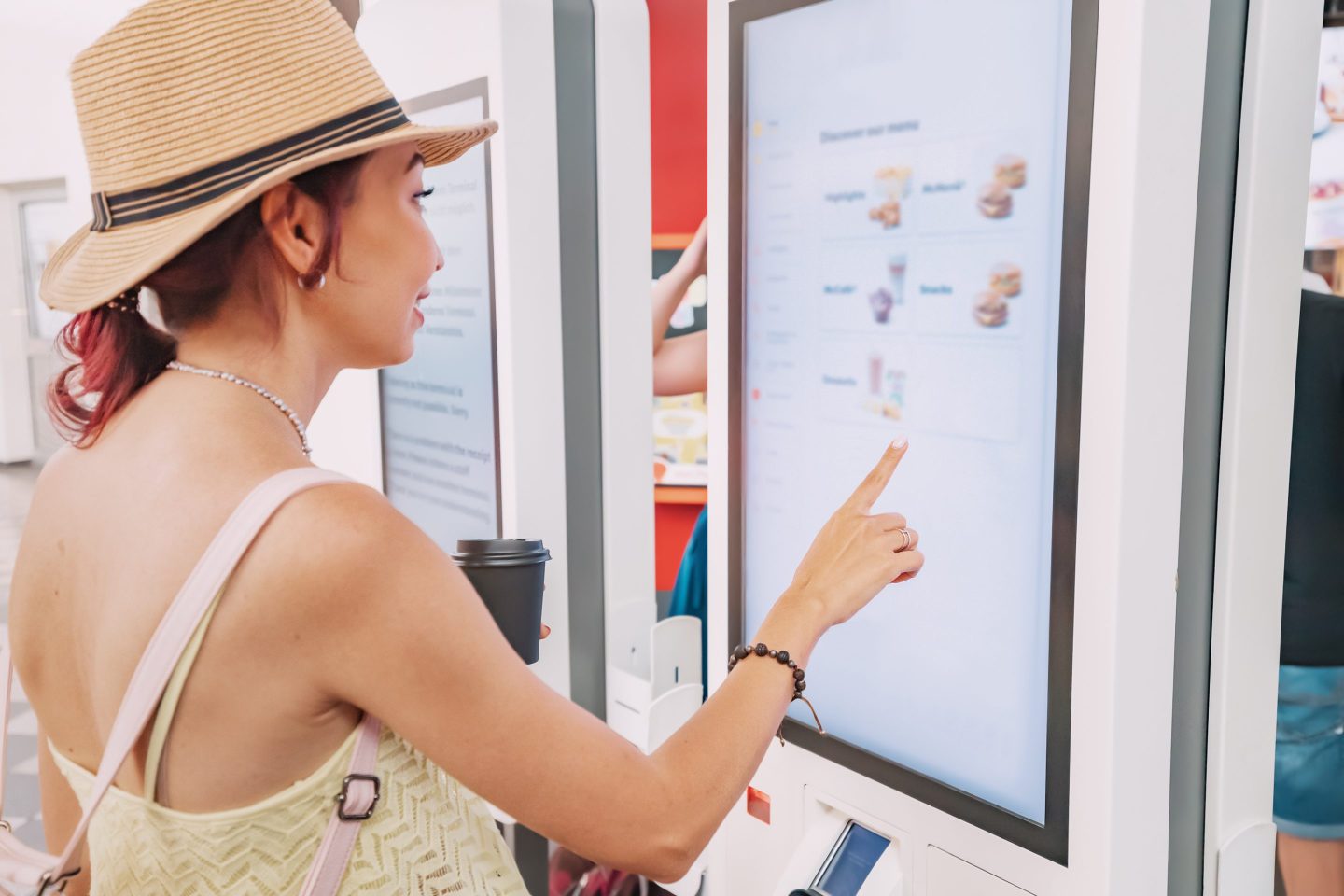
Goldstein shared his experience at the chain on X. He said the service was friendly—more so than the average New York cashier—and that while he placed his order at a self-service kiosk, the cashier stood by and controlled the restaurant’s point-of-sale system in case he had any questions. After Goldstein was finished placing his order, he had an option to tip the remote cashier.
this is insane
— brett goldstein (@thatguybg) April 6, 2024
cashier is literally zooming into nyc from the philippines pic.twitter.com/opAyS8AYUs
Happy Cashier is the company behind the virtual cashiers, and a spokesperson confirmed that it hires employees from the Philippines to video-call into the restaurant.
The food was good, Goldstein said, despite his chicken katsu curry setting him back an “insane” $20. But the real talking point was the impact that virtual cashiers could have on the fast-food industry.
“Put yourself in the restaurateur’s shoes,” he told Fortune. “Minimum wage is going up. Rent is going up. Either they’re going to have to increase the cost of the food, which you can only do to an extent…or you can cut costs.”
Sansan’s virtual cashiers are part of a growing movement of restaurant automation and the introduction of technology that limits the number of human workers in a store at a given time. It’s particularly popular in the fast-food industry, where companies are looking to grow profit margins in a time of mandates increasing minimum wages for these workers.
“They have a clear niche; they’re not going to revolutionize their offering,” Daron Acemoglu, an economics professor at the Massachusetts Institute of Technology, told Fortune. “Their brand is to provide relatively cheap food, so labor costs matter more for them.”
Saving on steep labor costs
Labor accounts for 36% of an average restaurant’s costs, according to a March Bank of America note, and using automation to cut down on menial tasks while outsourcing labor to foreign workers could be a way to save money.
Mohammad Rahman, professor of management at the Mitchell E. Daniels, Jr. School of Business at Purdue University, told Fortune that hiring virtual workers, including those from the Philippines, would cost restaurants like Sansan only 10% of what they would pay in-person cashiers.
The Philippines has the largest business process outsourcing (BPO) industry in the world, generating a projected $35.4 billion in revenue in 2023, according to the Business Process Association of the Philippines. It has employed over 1.3 million Filipinos.
Rahman said that despite a $3.75 hourly wage—the rate for virtual cashiers in similar restaurant concepts—being a pittance for U.S. workers, it’s a substantive amount for workers in the Philippines. The $3.75 hourly wage is about $600 per month, translating to more than 33,900 Philippine pesos (PHP), which is well above the median monthly wage for Filipinos of 18,400 PHP, according to Statista.
“At the end of the day, every individual will make up their mind based on this,” Rahman said. “But it’s important to realize that these technologies can also be very liberating and contribute a lot to the struggling economies in the world.”
But hiring cashiers to work remotely has also raised concerns. Canadian fast-casual chain Freshii used Percy, a video calling system attached to its cash registers, as early as 2022 but did not speak publicly about the technology. An investigation from the Toronto Star found it was employing cashiers from Nicaragua to work for $3.75 an hour, which drew swift criticism, and the restaurant discontinued the service in August 2023, attributing it to a change in ownership. Though Ontario’s minimum wage is $16.55, legal experts dubbed the use of Percy sound.
“It’s just like any other kind of outsourcing,” employment lawyer Jonathan Pinkus told the Star. “If you’re sending jobs to people in a different country, you’re only obligated to comply with the labor standards of that country. Being virtually present in Ontario doesn’t change that.”
Whether or not foreign workers stand to benefit, outsourcing this work puts fast-food restaurants in a precarious position, Acemoglu said. While virtual workers can be called upon in a time of U.S. labor shortages in the fast-food industry, those jobs could just as easily threaten workers looking for those minimum-wage jobs.
“If it displaces workers, especially in the local labor market, from the jobs that were open to them, that would have impacts on their livelihoods and communities,” he said.
A human touch
Virtual workers such as the ones at Sansan strike the sweet spot of automation, Rahman argued. While they save on labor costs, they provide the troubleshooting ability and warmth that completely automated self-service kiosks don’t have.
“Customers expect better services, so if you can bring in that person who is basically virtually there, this person can do all your customer service, just as if the server was just standing there,” he said. “As long as that experience is the same, the customer probably doesn’t care.”
Rahman said leaning more on virtual workers is likely inevitable. “What we’re seeing right now is just a natural evolution of the future of work,” he said.
Large language models such as ChatGPT and Google Gemini could make it possible for AI bots to take people’s orders and answer questions in a matter of a couple of years. AI drive-through company Presto Automation has installed its services in chains such as Del Taco and Checkers, though human workers are still doing much of the work behind the scenes.
But Goldstein, despite seeing the lucrative potential for increased automation in fast-food restaurants, admitted that it did feel a little dystopian to order his fried chicken from someone halfway across the globe. The transition from in-person workers to virtual workers, and maybe eventually to AI, diminishes the intangible draw of dining out in a big city.
“There’s nothing better than human connection, humanity, and personal connection. There’s something very special about physical presence,” Goldstein said. “That’s why we live in New York City.”