In December, negotiators at the COP28 climate change summit meeting agreed to a transition away from fossil fuels. While some officials celebrated this commitment, many environmental advocates noted that, in fact, the major outcome of COP28 in Dubai was the Global Stocktake, which found that greenhouse gas (GHG) emissions are still rising across the world–hitting a record high in 2023 of more than 40 billion tons.
Even in countries where emissions are decreasing (including the United States, where emissions have declined by more than 20% from their 2007 peak), the reductions fall far short of the pace required to meet the 2021 Glasgow Climate Pact mid-century target of net-zero emissions. This shortfall led to pervasive questions among those gathered in Dubai: What comes next? How do we ramp up the global response to climate change?
Some of what is needed is well known. More funding for the energy transition, particularly blended finance to support the investments in clean power generation required in the developing world. Better-defined policies that provide clear incentives for commitments to transformational change by companies, communities, and families. And stepped-up leadership from the business world, which inevitably must play a central role in remaking the foundations of the global economy. But none of this is new.
Sustainability should not become a competitive disadvantage
What has become increasingly apparent is that the key to a sustainable future depends on enterprises rethinking their business models. Both at COP28 and at last month’s World Economic Forum in Davos, it was striking how many business leaders understood that the time has come to move from net-zero GHG pledges (which more than 9,000 companies have now made) to action.
But as CEOs across the world get down to brass tacks and begin to cost out their transition plans, one hears a common concern: that some companies will shirk from the emerging sustainability standards and profit as a result. Or, as economists would say, that free riders will end up the winners as others step up to the requirements of the sustainability imperative and bear costs in doing so that translate into a competitive disadvantage.
Simply put, top executives see a pathway to meeting the demands of climate change and sustainability more broadly but hesitate to undertake the fundamental restructuring required unless they are assured that their competitors–not only domestically but also internationally–will do the same. Similarly, those in the finance world putting up the capital for this transition want assurance that the enterprises to which they lend money will not see their sales or profits collapse in the face of unfair competition from companies ignoring the global commitment to climate change action and thus bringing their goods and services to the market at a lower cost.
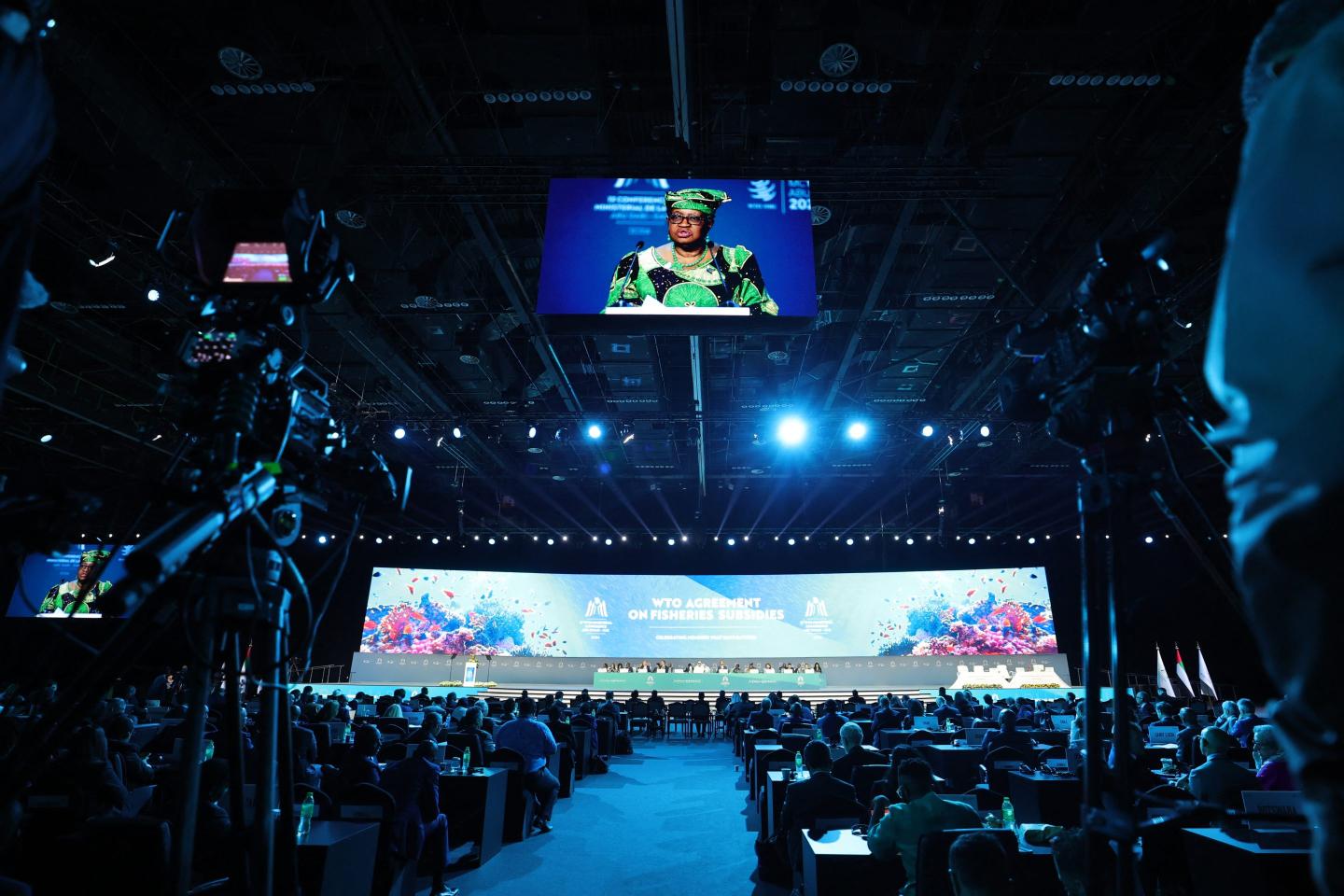
What is needed is a mechanism to ensure that across each industry, companies step forward together. Indeed, one of the biggest stories at COP28 was the presence of the World Trade Organization’s (WTO) dynamic Director General, Dr. Ngozi Okonjo-Iweala, who believes that a reinvigorated trade system could help to disseminate the requisite clean-energy technologies, projects, infrastructure, best practices, and cutting-edge ideas across the world at speed and scale.
The thorny issue of trade blocs and subsidies
As the host government of COP28, the UAE sharpened the focus on trade as a climate change solution by organizing the first-ever thematic Trade Day and Trade Pavilion in the three decades of annual climate change summit meetings. As a result, hundreds of side events and policy discussions in Dubai focused on the potential for a recast trade system to provide the backbone of rules and enforcement that the global economy needs to be aligned with the world community’s commitment to a low-carbon future.
The European Union has added to the logic of trade as the critical point of policy leverage for climate change progress by moving forward with its Carbon Border Adjustment Mechanism or CBAM, which will impose special tariffs on goods entering the EU (initially in five high-emissions industries but eventually more widely) produced in jurisdictions with less full-fledged commitments to climate change action. In particular, the EU intends to gauge the difference between the charge for GHG emissions in the producing nation and the EU’s carbon price (which stood at about $100 per ton through most of 2023) and impose a border carbon adjustment based on the differential.
While some nations and trade ministries squawk about the EU’s green protectionism, many others see the CBAM as conceptually justified. Why should a company be allowed to obtain a competitive advantage in international markets from underperforming on established environmental commitments? From a policy perspective, the EU’s approach or something similar seems essential. It’s the only way to get enterprises across an industry to link arms and move toward a sustainable future without fear that those taking the first steps will pay a competitiveness price.
There are, of course, questions about the analytical underpinnings of the EU protocol for measuring GHGs associated with traded goods, the price basis for the EU tariffs, and why the CBAM only gives credit for explicit carbon pricing and not a wider array of climate change policies reflecting the diversity of GHG emissions control strategies across the world.
These are all issues that the WTO can address. Indeed, it offers a neutral forum for bringing parties together to negotiate sustainability standards and ensuring that the foundations for border adjustment mechanisms are transparent, scientifically grounded, and fair to developing nations.
In a similar vein, the WTO would be well-positioned to reframe the trade system’s approach to contested subsidies, such as the incentives for clean energy found in the U.S. Inflation Reduction Act. Historically, the only question that has been asked when a subsidy is challenged at the WTO is whether it is trade disruptive. But many critics, such as those advancing the WTO reform agenda called the Villars Framework for a Sustainable Trade System, see this as the wrong starting point. Indeed, the 1994 Marrakesh Agreement that set up the WTO declares in its first paragraph that trade relations should be conducted “in accordance with the objective of sustainable development, seeking to protect and preserve the environment.”
Thus, the first question perhaps should be: What is the purpose of the subsidy in question? Followed by: Does the government support enhance sustainability or diminish it? In this regard, fossil fuel subsidies or production-based agricultural programs would be discouraged. But clean energy subsidies or support for farmers moving toward sustainable agriculture would be given the green light so long as these programs meet certain baseline requirements designed to minimize the impact on trade.
As officials from the WTO’s 164 member nations gather in Abu Dhabi for a ministerial conference, an opportunity looms to begin to reform the WTO, position it to deliver on its sustainable development mandate, and set the trade system up as the mechanism for keeping the world on track to deliver the promised reductions in GHG emissions.
With a new focus on establishing agreed-upon (and thus legitimate) bases for sustainability standards and review of subsidies, a revitalized WTO would be positioned to rebuild public trust and political support around the world, giving the trade system a new lease on life. And it might just emerge as the critical institution for a coordinated effort to save the planet.
Dan Esty is the Hillhouse Professor of Environmental Law and Policy at Yale and co-lead of the Remaking Global Trade for a Sustainable Future Project. His 1994 book, Greening the GATT, helped to launch the debate about how to align the trade system with society’s sustainability goals. Professor Esty spent 2022-23 on public service leave from Yale at the World Trade Organization.
More must-read commentary published by Fortune:
- Here’s how the U.S., Europe, and China are faring in the post-pandemic race for economic growth
- Global trade is at a critical juncture–and we can’t take it for granted, WTO meeting chair warns
- Boeing is shaking up its ‘good ole boys’ culture–but the company still has a long way to go before it gets its production and financials right
- The anti-DEI movement has gone from fringe to mainstream. Here’s what that means for corporate America
The opinions expressed in Fortune.com commentary pieces are solely the views of their authors and do not necessarily reflect the opinions and beliefs of Fortune.