
Bricklayers have a tough job. It requires skill and experience. It is hard on the back and knees. Hands too. You have to be outside in all kinds of weather. It’s perhaps not surprising that there aren’t a lot of young people lining up to apprentice. The shortage of skilled brick masons is contributing to a housing crunch across Europe and slowing major building projects in the U.S. too.
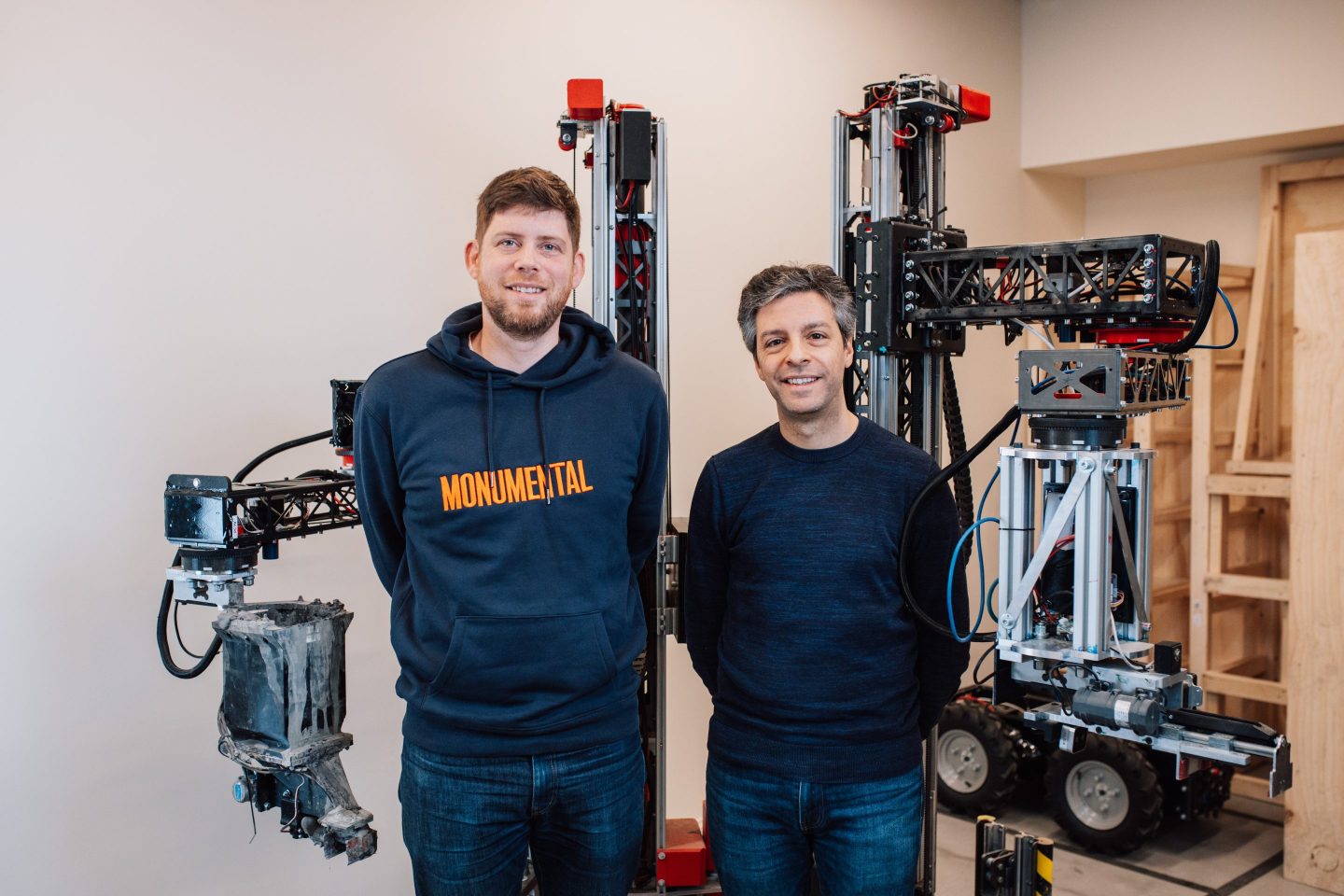
Now Monumental, an Amsterdam-based startup founded by a veteran team of serial entrepreneurs and AI experts, has emerged from two-and-half years operating in stealth mode with what it thinks is the solution: a new breed of bricklaying robots.
The company is also announcing a new $25 million funding round co-led by Plural, the early-stage European venture capital fund run by a number of successful former startup founders. VC firm Hummingbird is the other co-led, with Northzone, Foundamental and NP-Hard Ventures participating in the round too. Monumental’s valuation after the financing round was not revealed.
Monumental’s robots use AI technology pioneered for self-driving cars and a new generation of inexpensive robotic parts to create robots that can work on almost any new building site and at a cost that is comparable to human bricklayers.
It’s an example of an area where robots aren’t taking human jobs. Instead they are filling a gap in the labor market that already exists and which is unlikely to be filled by people in the future.
For example, the Netherlands requires 100,000 new houses a year to keep up with a growing population, driven in part by immigration, as well as government policies to stimulate home ownership. But the country only has enough construction workers to build 60,000 new units annually, with the shortage of bricklayers particularly acute. Meanwhile, in the U.S., the construction industry is facing a labor shortfall of more than half a million workers, with bricklaying one of the specialties where the deficit is most acute.
Salar al Khafaji, the company’s co-founder and CEO, said he became obsessed with the idea of applying AI to projects in the physical world—such as construction and manufacturing—after he sold his previous startup, Silk, which made software to help people visualize data, to data analytics giant Palantir in 2016 for an undisclosed sum.
Construction is a massive industry, responsible for $14 trillion, or 15% of global GDP, in 2022. Al Khafaji said he originally wanted to try to automate work on large infrastructure projects, such as high-speed rail lines and bridges. But these multi-billion dollar projects, which usually involve large government contracts, involve complex contract bidding processes that can take months and years, and usually require partnering with a consortium of companies.
So he began thinking about residential construction, which is expected to account for $1 trillion of annual spending in Europe and about $5.3 trillion in the U.S., which was still a massive market opportunity, but had much shorter contracting cycles. In speaking to general contractors in Europe, they highlighted the shortage of skilled bricklayers as source of construction delays.
In the U.K., for example, there’s a 75,000 person gap between the number of skilled bricklayers required for the level of new home building that the current British government is targeting and the number actually available.
Sten Tamkivi, the Plural partner who lead the firm’s investment in Monumental, said the startup fit his thesis that the way to profit from the AI boom is to go after very specific verticals where the technology is solving a niche need.
Tamkivi, an Estonian who was an early Skype executive and went on to become a serial entrepreneur, said Monumental also fit a key insight about how robotics is changing. It used to be that 80% of a robot’s innovation had to be in the hardware and 20% in the software. “We’re now flipping that,” he said, with the software becoming a key differentiator and the hardware increasingly being commoditized.
Other companies have tried to build brick laying robots before, and they haven’t exactly transformed the industry. But most of these robots were large—and expensive—machines that required a construction site to be specially modified to accommodate them. Others could only lay an unusual type of brick or could only lay one particular brickwork pattern. Also, most of the previous companies tried to sell the physical robots to the construction companies, which often balked at price tags that ran into the hundreds of thousands of dollars for a single machine.
Monumental has tried to address each of these issues. First, its robots are relatively compact and can deal with the chaotic environment of most construction sites using autonomous navigation techniques first used for self-driving cars and trucks to help them steer around obstacles and people. The robots have chunky rubber wheels to help them negotiate bumpy, gravelly, or sandy ground.
The company uses a team of three robots to lay the bricks. One picks up bricks from a pile and drives them over to the bricklaying robot. The next one does the same for mortar, which is typically dispensed from a large storage silo. They hand these off to the bricklaying robot, which has two tower cranes that allow it to lay bricks from ground level up to the top of a building’s ground floor. For higher floors, the robot drives on to a scissor lift that raises it up. The bricklayer deposits mortar and lays the bricks autonomously.
But the process still requires a human mason to do the pointing, smoothing out the mortar, and also to install the wall ties that anchor the bricks to rest of the house’s structure. And while Monumental’s robots are much cheaper than conventional industrial robots, with components that just cost $25,000, or a tenth what competing robots cost, Monumental doesn’t sell them to construction firms. Instead, it sells brick laying services, charging customers by the brick laid, which is exactly how human masons typically charge in Europe, and at a price that is comparable to a human bricklayer. Its service includes a human bricklayer who helps oversee the robots and do the bits of the job that the robots can’t do.
“One of the biggest surprises for us, is that we thought we would have to be slightly cheaper [than human masons],” al Khafaji said. “It turns out no one cares.” This is because most construction contractors charge their customers, the developer, on a cost-plus basis. In fact, some contractors said they’d be happy to pay Monumental a premium to be sure the job would be completed on time.
While Monumental’s robots lay bricks at about the same speed as a human mason, al Khafaji said they could complete jobs faster by deploying swarms of the robots to a single job. Because of the shortage of human bricklayers, this is not something a contractor can usually do with people.
Monumental’s robots can also lay many different brick patterns, which means that large residential housing developments can be designed with houses that look more individual and less cookie-cutter than in the past, Khafaji said. This ought to mean contractors that can offer this feature to developers may win more business.
Khafaji said Monumental will use the new funds to expand its fleet of robots (it currently only has four teams of three in operation) and grow its staff, which currently number just 15.