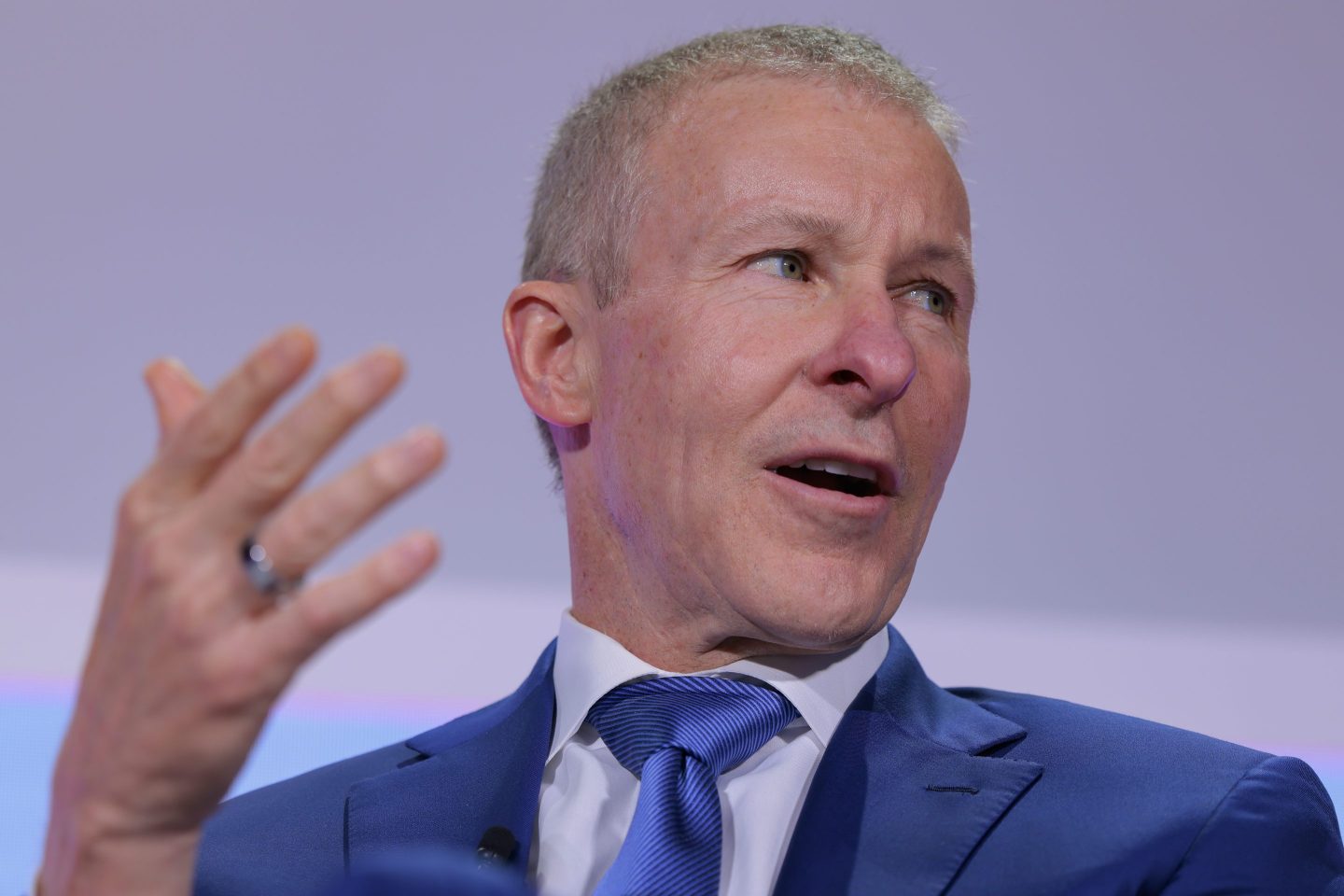
Jan Hatzius, chief economist and head of the global investment research division at Goldman Sachs, has spent the past few years playing Wall Street’s optimist. While most of his peers warned that a recession was inevitable, or at least highly likely, Hatzius argued that the odds were more like 15%—or at worst 35%. He believed that inflation would fade as interest rates rose, without the need for a job-killing recession. So far, that outlook has looked prescient with the economy continuing its run of good form, and Hatzius has capped his last call by issuing a new one, saying in December we are in a “Great Disinflation.”
But that has left another call for Hatzius to make: explaining why consumers still aren’t happy. Compared with the pre-COVID era, U.S. consumer confidence has been in the dumps over the past few years. Even now, with stocks hitting new highs; the unemployment rate near historic lows; and GDP growing at a steady pace, consumers don’t believe in this economy—or the government’s economic policies.
Some 72% of American adults say the economy is doing just fair or poor, according to a January poll from Pew Research. And only 33% of Americans approve of President Joe Biden’s job performance. But ask Goldman’s Hatzius, and he’ll say Americans are being too critical. “Americans appear to be judging the state of the economy and government economic policy more harshly than usual,” Hatzius and his team wrote in a Feb. 5 note to clients.
In the past, the Goldman team explained, economic indicators—including the unemployment rate, income growth, GDP growth, inflation, and more—have been able to “explain survey-based perceptions” of the economy and government policy. But today, when Hatzius and his team compared the Conference Board’s consumer confidence survey and the University of Michigan’s survey on the effectiveness of government economic policy to classic economic indicators, they found that Americans just don’t like this economy.
“Survey respondents are judging the current state of the economy more harshly by 20 pts or 10% and are judging the government’s economic policy more harshly by 40 pts or 35%,” they explained.
Even with consumer confidence measures climbing in recent months, Goldman noted that the large gap between consumer sentiment about the economy and the actual economic indicators has remained “mostly flat.” Why are Americans so down on the economy? Goldman says there are two main reasons—partisanship and the long-term impact of 15% “perceived” inflation.
Political partisanship
The depth of political partisanship when it comes to Americans’ economic views can be seen in Pew’s latest survey of consumers. Just 13% of Republicans currently rate the economy as excellent or good, compared with 44% of Democrats, the poll found. But when Trump was president before the pandemic, the dynamic flipped. A peak of 81% of Republicans said the economy was either excellent or good in early 2020, compared with just 39% of Democrats.
This political partisanship is one of the main reasons that many Americans aren’t enthusiastic about the economy, even though it has surprised experts and defied recession predictions, according to Goldman Sachs.
Hatzius and his team found that Republicans tend to react more negatively to Democrat-led economies than Democrats do to Republican-led economies. And with Biden in office, that means Americans overall have a more negative outlook.
“Confidence tends to drop off sharply among supporters of both parties when control of the White House switches to the party they oppose, but the effect appears to be somewhat stronger among Republicans in recent elections,” the Goldman team wrote, sharing a chart with their findings about U.S. postelection consumer sentiment drops.

No one likes over 15% ‘perceived’ inflation
Of course, there’s another obvious reason why Americans aren’t thrilled with the economy—they’re still struggling after inflation spiked to a four-decade high in 2022. It also turns out that U.S. consumers may have perceived the inflation surge of the past few years as being even worse than the numbers indicate. Year-over-year inflation, as measured by the consumer price index, peaked at 9.1% in June 2022, but Americans actually felt over 15% inflation at that time, according to Goldman Sachs.

Hatzius and his team argued that this is because consumers tend to gauge inflation by looking at the prices of the things they buy most often, like gasoline, milk, or eggs. These everyday items have “an outsized impact on perceptions of inflation,” they explained, pointing to a 2019 study that found consumers rely on price changes they see “in their daily lives while grocery shopping” to gauge inflation more than anything.
The problem with consumers measuring inflation this way, according to Hatzius, is the prices of these everyday items have risen more than they have for other goods and services, creating a higher level of “perceived inflation” that doesn’t match reality.
The Goldman team also found that, historically, it has taken a long time for consumer sentiment to return to normal after periods of inflation. “Frustration with past high inflation appears to depress confidence for a while, perhaps because consumers continue to find price levels unreasonable for some time,” they explained.
That means that the negative impact of the recent inflation surge on Americans’ confidence didn’t peak until earlier this year, despite inflation fading since mid-2022. And while Hatzius predicted that it “will fade meaningfully further” this year, he warned it won’t disappear entirely until after Election Day.