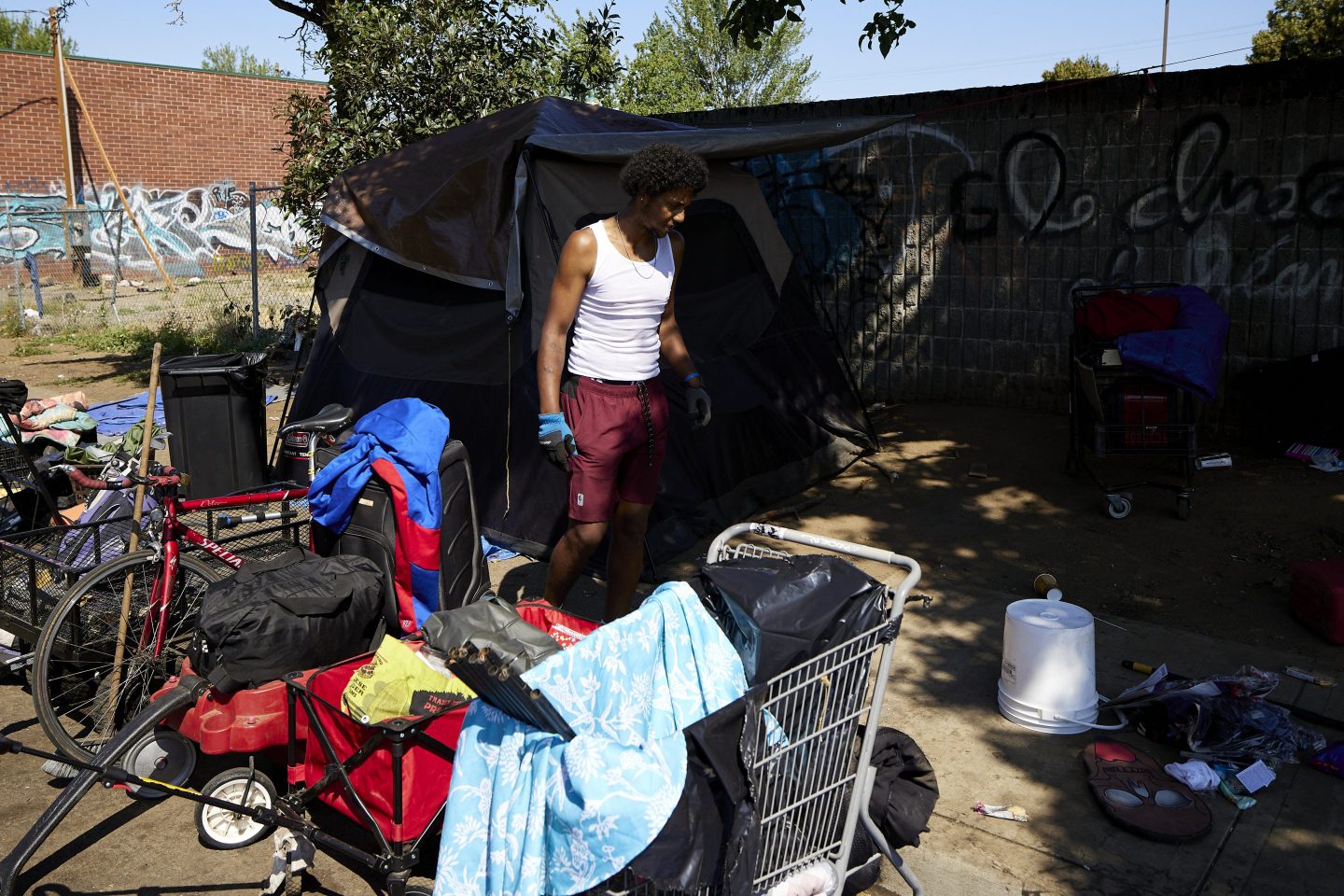
Tossing tent poles, blankets and a duffel bag into a shopping cart and three wagons, Will Taylor spent a summer morning helping friends tear down what had been their home and that of about a dozen others. It wasn’t the first time and wouldn’t be the last.
Contractors from the city of Portland had arrived to break down the stretch of tents and tarps on a side street behind a busy intersection. People had an hour to vacate the encampment, one of more than a dozen cleared that July day, according to city data.
Whatever they couldn’t take with them was placed in clear plastic bags, tagged with the date and location of the removal and sent to an 11,000-square-foot warehouse storing thousands like them.
“It can get hard,” said Taylor, 32, who has been swept at least three times in the four years he’s been homeless. “It is what it is. … I just let it go.”
Angelique Risby, 29, watched as workers in neon-yellow vests shoveled piles of litter into black garbage bags. Risby, who has been homeless for two years, said she was prepared for a drill she’s done multiple times.
“Everything that I own,” she said, “can fit on my wagon.”
More than 500,000 homeless across the U.S.
Tent encampments have long been a fixture of West Coast cities, but are now spreading across the U.S. The federal count of homeless people reached 580,000 last year, driven by lack of affordable housing, a pandemic that economically wrecked households, and lack of access to mental health and addiction treatment.
Records obtained by The Associated Press show that attempts to clear encampments increased in cities from Los Angeles to New York as public pressure grew to address what some residents say are dangerous and unsanitary living conditions. But despite tens of millions of dollars spent in recent years, there seems to be little reduction in the number of tents propped up on sidewalks, in parks, and by freeway off-ramps.
Homeless people and their advocates say the sweeps are cruel and a waste of taxpayer money. They say the answer is more housing, not crackdowns.
The AP submitted data requests to 30 U.S. cities regarding encampment sweeps and received at least partial responses from about half.
In Phoenix, the number of encampments swept soared to more than 3,000 last year from 1,200 in 2019. Las Vegas removed about 2,500 camps through September, up from 1,600 in 2021.
But even officials at cities that don’t collect data confirmed that public camping is consuming more of their time, and they are starting to track numbers, budget for security and trash disposal, and beef up or launch programs to connect homeless people to housing and services.
“We are seeing an increase in these laws at the state and local level that criminalize homelessness, and it’s really a misguided reaction to this homelessness crisis,” said Scout Katovich, a staff attorney with the American Civil Liberties Union, which has filed lawsuits challenging the constitutionality of sweeps and property seizures in a dozen cities, including Minneapolis, Miami, Albuquerque, Anchorage and Boulder, Colorado.
“These laws and these practices of enforcement do nothing to actually alleviate the crisis and instead they keep people in this vicious cycle of poverty,” she said.
But California Gov. Gavin Newsom, whose state is home to nearly one-third of the country’s homeless population, says leaving hazardous makeshift camps to fester is neither compassionate nor an option.
He is among Democratic and Republican leaders urging the U.S. Supreme Court to take up a controversial 9th Circuit appellate court ruling that prohibits local governments from clearing encampments without first assuring everyone living there is offered a bed indoors.
San Francisco, which was sued by the ACLU of Northern California last year for its sweeps and property seizures, is under a court order to enforce the ruling.
“I hope this goes to the Supreme Court,” said Newsom, a former mayor of San Francisco, in a September interview with news outlet Politico. “And that’s a hell of a statement coming from a progressive Democrat.”
‘We’re not trash, we’re people’
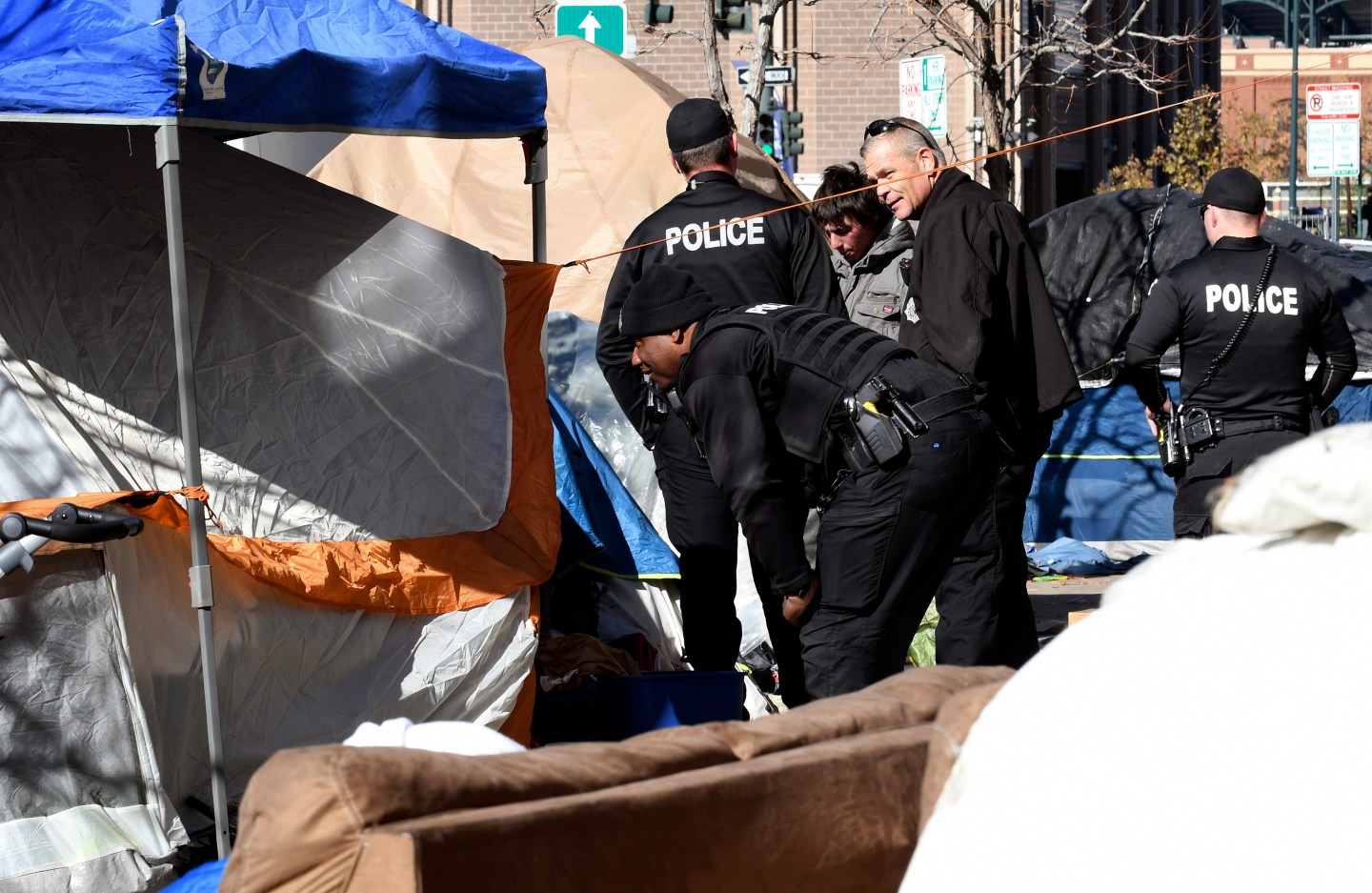
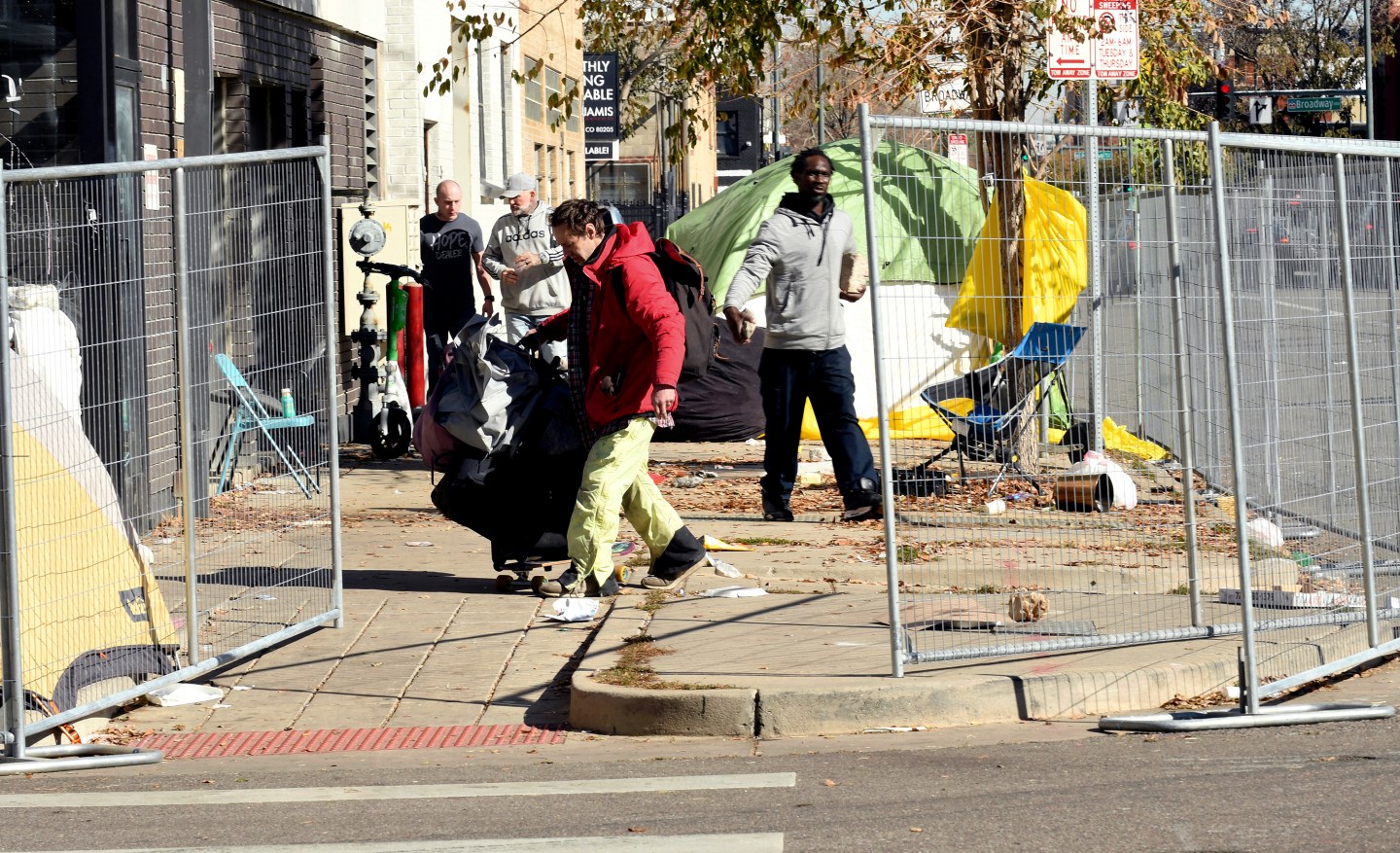
Earlier this month, crews in Denver erected metal fencing as police officers called to residents to leave an encampment covering several downtown blocks. A bonfire blazed against temperatures in the teens and snow covered the ground around tents.
“The word ‘sweep’ that they use … that’s kind of how it feels, like being swept like trash,” said David Sjoberg, 35. “I mean we’re not trash, we’re people.”
He said he and his wife would “wander a couple blocks from here and see if we get yelled at for being there.”
David Ehler Jr., 52, left the encampment with his toiletries, a sleeping bag, tent and a propane heater.
Ehler has been homeless in Denver for about two years after a friend kicked him out. He said work was hard to come by in Connecticut, where he lived before Colorado, and the public has no idea how big a problem homelessness is.
“It started ever since the COVID, people losing their jobs, losing their houses, losing their apartments, losing everything,” he said. “And this is where they end up.”
Sometimes, numbers can’t explain what a city is doing.
The city of Los Angeles said its sanitation department responded to more than 4,000 requests a month from the public at the end of 2022 to address homeless encampments, double the amount the previous year.
But the agency would not explain whether that meant the encampment was dismantled or simply cleaned around or how large the encampments were, directing AP to the city attorney’s website for definitions. The city defines an encampment as a place where at least one person is living outdoors.
In contrast, Portland clears some 19 encampments every day on average, according to the mayor’s office. Crews have shut down nearly 5,000 camps in the city of 650,000 since November 2022, but residents continue to report new clusters that need to be dismantled.
Crews have even found bodies of overdose victims in tents, said Sara Angel, operations manager for the contractor that clears encampments for the city.
“If we never cleaned a camp in the city of Portland, I just don’t know what Portland would look like,” she said. “I don’t think that we’re making it better by moving them, but I don’t think that we’re making it worse.”
Removing encampments is costly — an expense more cities, counties and states have to budget for. Several cities queried by the AP provided some cost breakdowns, but officials at others said comprehensive costs were difficult to get given the multiple departments involved, including police, sanitation and public health.
Denver reported spending nearly $600,000 on labor and waste disposal in 2021 and 2022 to clean about 230 large encampments, some more than once. Phoenix said it spent nearly $1 million last year to clear encampments.
Despite all that spending, said Masood Samereie, little seems to change on the streets. The San Francisco real estate broker has seen businesses lose customers because of people camped on sidewalks, some clearly in mental distress, and he wants tents gone.
“It’s throwing money at it without any tangible or any real results,” Samereie said.
Being homeless is supposed to be a temporary event, he added. “Unfortunately, it’s becoming a way of life, and that is 100% incorrect.”
For homeless people, sweeps can be traumatizing. They often lose identification documents, as well as cellphones, laptops and personal items. They lose their connection to a community they’ve come to rely on for support.
Roxanne Simonson, 60, said she had a panic attack during one of the four times she was swept in Portland. She recalled feeling dangerously overheated in her tent. “I started yelling at them, ‘Call an ambulance, I can’t breathe.’ And then I changed my mind, because if I go, then I would lose all my stuff,” she said.
‘You can do better than this’
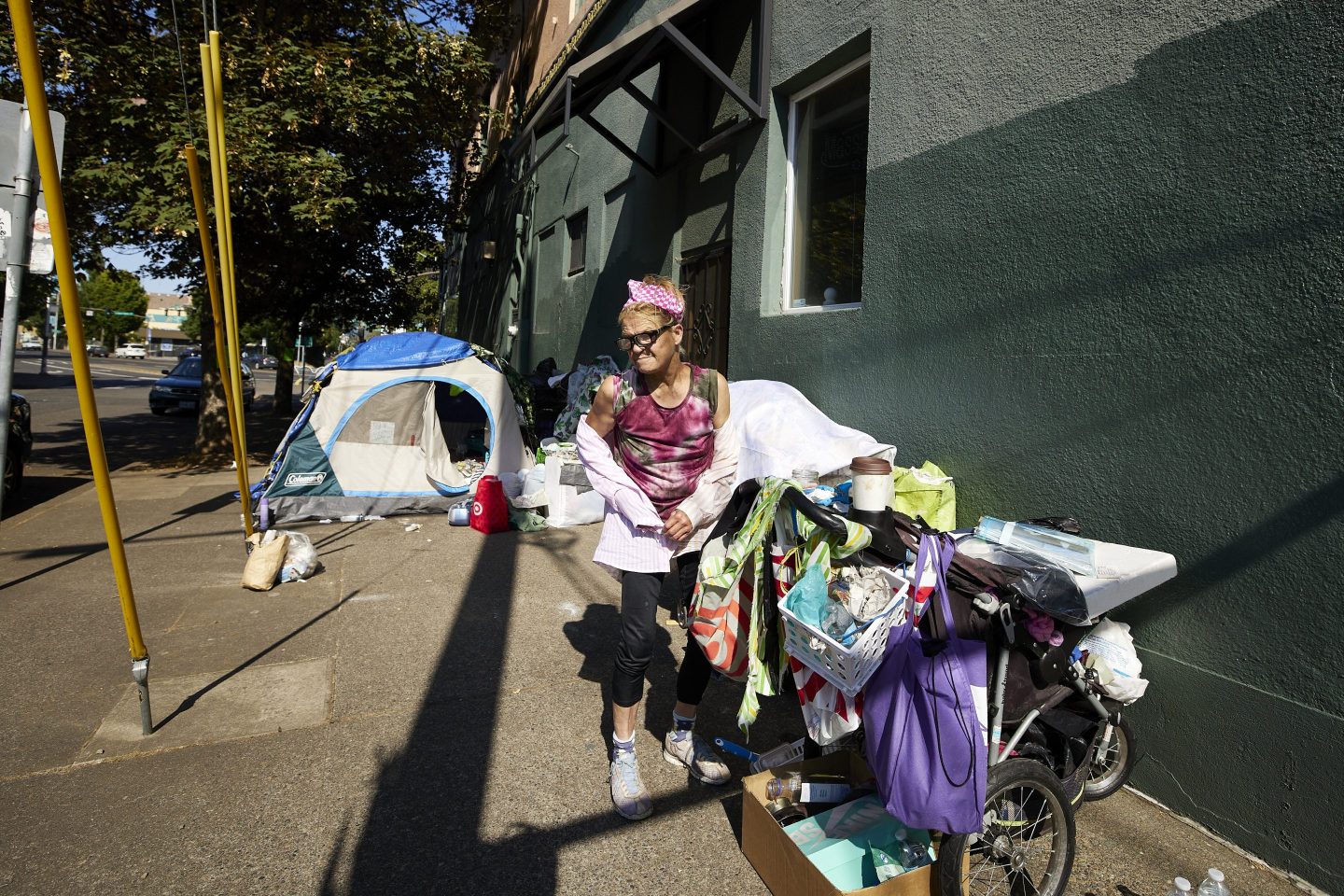
And yet, cities can’t stand by and do nothing, said Sam Dodge, who oversees encampment removals for the city of San Francisco. His department, created by the mayor in 2018, coordinates multiple agencies to place people into housing so crews can clear tents.
“Saying, ‘This is not working, this is dangerous, you can do better than this, you have a brighter future than this,’ I think that’s caring for people,” said Dodge, who has worked with homeless people for more than two decades. “It seems immoral to me to just … let people waste away.”
One August morning, Dodge and his crew surveyed about a dozen structures and tents, some inches away from vehicles zipping by.
Four outreach workers fanned out, asking people if they had a case manager or wanted shelter indoors. Police officers stood by as Department of Public Works employees, masked and wearing gloves, hauled away a rolled-up carpet. The block was crammed with bicycles, ladders, chairs, mattresses, buckets, cooking pots, shoes and cardboard.
City officials are particularly frustrated by people who have housing, but won’t stay in it.
Michael Johnson, 40, has been homeless in San Francisco for six years. Before that, he lived with his pregnant girlfriend and was a driver for a commuter van tech start-up. But he lost his job, and their baby died.
He was assigned a coveted one-room pre-fabricated structure with a bed, desk and chair, a window and locking door. But his friends aren’t there and to him, it feels like jail, so he’s sleeping in a tent.
At his tent, friends hang out, including Charise Haley, 31, who says shelter rules can make grownups feel like children. She left one shelter because residents weren’t allowed to keep room keys and had to ask staff to get in.
“Then you get pushed somewhere else,” she said. “There’s too many directions. But never an end solution.”
There are many reasons why someone might reject shelter, say homeless people and their advocates. Some have been assaulted at shelters, or had their belongings stolen. Sometimes, they don’t want to pare down their belongings, or follow rules that prohibit drugs and drinking, officials say.
Of the 20 people at the San Francisco encampment, six accepted temporary housing and seven declined, said Francis Zamora, a spokesperson for the Department of Emergency Management.
Two people already had housing and five wouldn’t communicate with outreach workers, Zamora said. The city has connected more than 1,500 people to housing this year. It’s unclear, however, if they remain housed.
Many cities say they link camp residents to housing, but track records are mixed. Homeless people and their advocates say there are not nearly enough temporary beds, permanent housing or social services for drug or behavioral health counseling so people caught up in sweeps just get kicked down the road.
2,300 people removed; three found permanent housing
In New York City, more than 2,300 people were forcibly removed from encampments from March to November 2022, according to a June report from Comptroller Brad Lander. Only 119 accepted temporary shelter, and just three eventually got permanent housing. Meanwhile, tent encampments had returned to a third of the sites surveyed.
“They just totally failed to connect people to shelter or to housing,” Lander, who opposes sweeps, told the AP. “If you’re gonna help them, you have to build trust with them to move them into housing and services. The sweeps really went in the opposite direction.”
A spokesperson for Democratic New York City Mayor Eric Adams, Charles Lutvak, disagreed. He said that 70% of camp sites cleared were not re-established and homeless residents accepted offers of shelter at a rate six times higher than under the previous administration.
“Despite the inherent difficulty of this work, our efforts have been indisputably successful,” Lutvak said in a statement.
The city of Phoenix cleared out a massive downtown homeless encampment by a court-ordered deadline this month, and said it had helped more than 500 people find beds in shelters and motels.
Encampments were not a serious issue in Minneapolis until the pandemic, when they became more commonplace and much larger, drawing thousands of complaints. In response, the city closed down more than two dozen sites where 383 people were camped from March 2022 until February.
At the same time, Hennepin County, which includes Minneapolis, launched a program last year aimed at finding short- and long-term housing for homeless people, including some living in encampments.
“We are hyper-focused on housing,” said Danielle Werder, manager of the county’s Office to End Homelessness. “We’re not walking around with socks and water bottles. We’re walking around saying, ‘What do you need?’”
In Portland, the encampment dismantled in July was cleared again, in September and November. Two dozen newly installed boulders helped keep the camp from being reestablished along parts of the sidewalk.
Kieran Hartnett, who’s lived in the neighborhood for seven years, said there was fighting, drug use, open fires and vehicle break-ins around the encampment. Some tents were on grass just outside his house, which was particularly stressful when people started acting in erratic ways.
He hopes the people moved from the site are getting help.
“I understand the argument that clearing them just moves them to somewhere else, and they don’t really have a better place to go,” he said. “On the same account, I feel like you can’t allow things to just fester.”
“There’s not a good solution to it,” he said.
____
Har reported from San Francisco, Casey reported from Boston. Thomas Peipert in Denver, and Angeliki Kastanis and Christopher Weber in Los Angeles contributed.