• Home
  • Latest
  • Fortune 500
  • Finance
  • Tech
  • Leadership
  • Lifestyle
  • Rankings
  • Multimedia
TechBaidu
Asia

Baidu reveals expectations-beating earnings and touts its new ChatGPT-like AI models, amid leadership chaos at U.S. competitor OpenAI

By
Lionel Lim
Lionel Lim
Asia Reporter
Down Arrow Button Icon
By
Lionel Lim
Lionel Lim
Asia Reporter
Down Arrow Button Icon
November 22, 2023, 4:53 AM ET
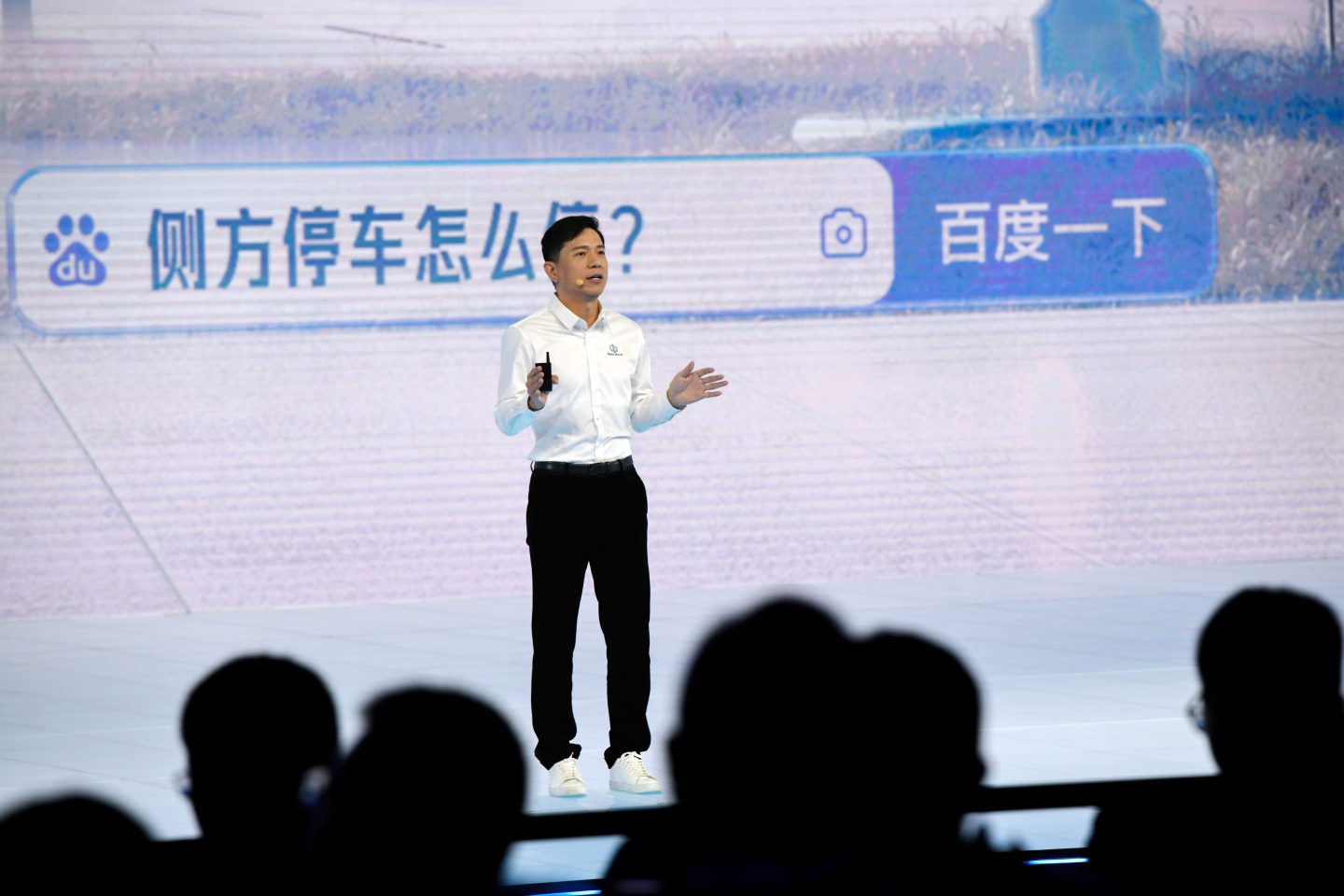
Robin Li, the CEO of Baidu Inc, speaking at the Baidu World Conference in Beijing on Oct. 17.

Baidu shares jumped almost 4.5% during Wednesday trading in Hong Kong following expectations-beating revenue from the Chinese tech giant. Baidu is trying to solidify an early lead in the race to win China’s AI market, starting with the launch of its ChatGPT-like ERNIE Bot earlier this year.

Recommended Video

Baidu generated revenue of $4.7 billion for the three months ending Sept. 30, a 6% year-on-year increase. The company also earned $916 million in net income, compared to a $20.6 million loss for the same quarter last year.

“Our AI-centric business and product strategy should set the stage for sustained multiyear revenue and profit expansion within our ERNIE and ERNIE Bot ecosystem,” CEO Robin Li said in a statement on Tuesday.

Baidu and Li, also the company’s founder, hope AI will revive the tech company’s fortunes, after the company lost ground to competitors like Tencent and Alibaba. The company is primarily known for its search engine, but is now shifting to new sectors like automated driving and generative AI.

Baidu launched ERNIE earlier this year, though observers were underwhelmed by the presentation compared to its non-Chinese peers like Google and Microsoft. Yet the Chinese company has continued to update the model and its chatbot, releasing ERNIE 4.0 in October.

The tech company also shared details on its robotaxi service, named Apollo Go, which operates in major cities like Wuhan, Shenzhen, and Beijing. The autonomous ride-hailing service carried 821,000 passengers last quarter, a 73% increase from a year ago.

China’s race for AI

Baidu is part of a growing rush in China’s tech sector to launch generative AI products, and arguably leading the way: The company is the only Chinese firm featured in Fortune‘s inaugural AI Innovators list, released on Tuesday, which highlights 50 companies at the forefront of AI.

The company’s ERNIE bot is perhaps China’s closest equivalent to OpenAI’s ChatGPT, currently banned in China. The bot outperforms ChatGPT in several Chinese-language tasks, Baidu says.

Yet Baidu’s Big Tech peers are also barreling into the space. Alibaba, Tencent, and JD.com have all announced their own large language models. (JD.com CEO Sandy Xu Ran is joining Baidu’s board as an independent director, the company announced Tuesday.) Several smaller AI companies and startups are also developing their own models: There are now over 130 large language models being developed in China today, according to one estimate.

Yet China’s AI companies need to work within the limits of what Beijing allows. According to rules approved in July, Chinese developers must ensure that their AI services align with “core socialist values” and national security. Yet they also highlight the importance of innovation, and revisions weakened provisions on how to penalize companies that break the rules.

Developers in China face another threat: U.S. rules limiting the sale of advanced AI chips from firms like Nvidia to Chinese companies. Last week, Alibaba shelved its plan to spin off its cloud computing division as an independent company, blaming uncertainty from U.S. export controls.

On Tuesday, Li warned that these restrictions could force the consolidation of large language models in China. Baidu has enough AI chips stockpiled in the near term, he said.

Existential risk

Regulation and access to chips are the primary risks faced by China’s AI sector, seemingly more real-world concerns compared to the recent worries in the U.S. about safety and more existential threats from the new technology. OpenAI, the developer behind ChatGPT, fired its CEO Sam Altman on Friday, reportedly due to concerns that he was moving too quickly on releasing the organization’s products. (Altman returned as OpenAI’s CEO on Wednesday morning, ending days of negotiations to bring him back to the organization.)

“The debate around the existential risks around [artificial general intelligence] has not been as much of a priority within the Chinese AI community, which has focused more on developing solid use cases for enterprise deployments of generative AI,” Paul Triolo, an associate partner for China and technology policy lead at the advisory firm Albright Stonebridge, told Fortune on Monday.

Conversations on AI risk “will be very much a government-driven thing in China. No CEO is going to be forced out because of disputes over the lack of guardrails to tackle the existential risks of AGI,” he added.

Baidu established an ethics committee in October to “guide the practices of technology professionals,” the company said in its earnings statement.

Additional reporting by Nicholas Gordon
Join us at the Fortune Workplace Innovation Summit May 19–20, 2026, in Atlanta. The next era of workplace innovation is here—and the old playbook is being rewritten. At this exclusive, high-energy event, the world’s most innovative leaders will convene to explore how AI, humanity, and strategy converge to redefine, again, the future of work. Register now.
About the Author
By Lionel LimAsia Reporter
LinkedIn icon

Lionel Lim is a Singapore-based reporter covering the Asia-Pacific region.

See full bioRight Arrow Button Icon

Latest in Tech

InvestingStock
There have been head fakes before, but this time may be different as the latest stock rotation out of AI is just getting started, analysts say
By Jason MaDecember 13, 2025
31 minutes ago
Politicsdavid sacks
Can there be competency without conflict in Washington?
By Alyson ShontellDecember 13, 2025
1 hour ago
InnovationRobots
Even in Silicon Valley, skepticism looms over robots, while ‘China has certainly a lot more momentum on humanoids’
By Matt O'Brien and The Associated PressDecember 13, 2025
3 hours ago
Sarandos
Arts & EntertainmentM&A
It’s a sequel, it’s a remake, it’s a reboot: Lawyers grow wistful for old corporate rumbles as Paramount, Netflix fight for Warner
By Nick LichtenbergDecember 13, 2025
7 hours ago
Oracle chairman of the board and chief technology officer Larry Ellison delivers a keynote address during the 2019 Oracle OpenWorld on September 16, 2019 in San Francisco, California.
AIOracle
Oracle’s collapsing stock shows the AI boom is running into two hard limits: physics and debt markets
By Eva RoytburgDecember 13, 2025
8 hours ago
robots
InnovationRobots
‘The question is really just how long it will take’: Over 2,000 gather at Humanoids Summit to meet the robots who may take their jobs someday
By Matt O'Brien and The Associated PressDecember 12, 2025
21 hours ago

Most Popular

placeholder alt text
Economy
Tariffs are taxes and they were used to finance the federal government until the 1913 income tax. A top economist breaks it down
By Kent JonesDecember 12, 2025
1 day ago
placeholder alt text
Success
Apple cofounder Ronald Wayne sold his 10% stake for $800 in 1976—today it’d be worth up to $400 billion
By Preston ForeDecember 12, 2025
1 day ago
placeholder alt text
Success
40% of Stanford undergrads receive disability accommodations—but it’s become a college-wide phenomenon as Gen Z try to succeed in the current climate
By Preston ForeDecember 12, 2025
1 day ago
placeholder alt text
Economy
For the first time since Trump’s tariff rollout, import tax revenue has fallen, threatening his lofty plans to slash the $38 trillion national debt
By Sasha RogelbergDecember 12, 2025
23 hours ago
placeholder alt text
Economy
The Fed just ‘Trump-proofed’ itself with a unanimous move to preempt a potential leadership shake-up
By Jason MaDecember 12, 2025
21 hours ago
placeholder alt text
Success
At 18, doctors gave him three hours to live. He played video games from his hospital bed—and now, he’s built a $10 million-a-year video game studio
By Preston ForeDecember 10, 2025
3 days ago
Rankings
  • 100 Best Companies
  • Fortune 500
  • Global 500
  • Fortune 500 Europe
  • Most Powerful Women
  • Future 50
  • World’s Most Admired Companies
  • See All Rankings
Sections
  • Finance
  • Leadership
  • Success
  • Tech
  • Asia
  • Europe
  • Environment
  • Fortune Crypto
  • Health
  • Retail
  • Lifestyle
  • Politics
  • Newsletters
  • Magazine
  • Features
  • Commentary
  • Mpw
  • CEO Initiative
  • Conferences
  • Personal Finance
  • Education
Customer Support
  • Frequently Asked Questions
  • Customer Service Portal
  • Privacy Policy
  • Terms Of Use
  • Single Issues For Purchase
  • International Print
Commercial Services
  • Advertising
  • Fortune Brand Studio
  • Fortune Analytics
  • Fortune Conferences
  • Business Development
About Us
  • About Us
  • Editorial Calendar
  • Press Center
  • Work At Fortune
  • Diversity And Inclusion
  • Terms And Conditions
  • Site Map

© 2025 Fortune Media IP Limited. All Rights Reserved. Use of this site constitutes acceptance of our Terms of Use and Privacy Policy | CA Notice at Collection and Privacy Notice | Do Not Sell/Share My Personal Information
FORTUNE is a trademark of Fortune Media IP Limited, registered in the U.S. and other countries. FORTUNE may receive compensation for some links to products and services on this website. Offers may be subject to change without notice.