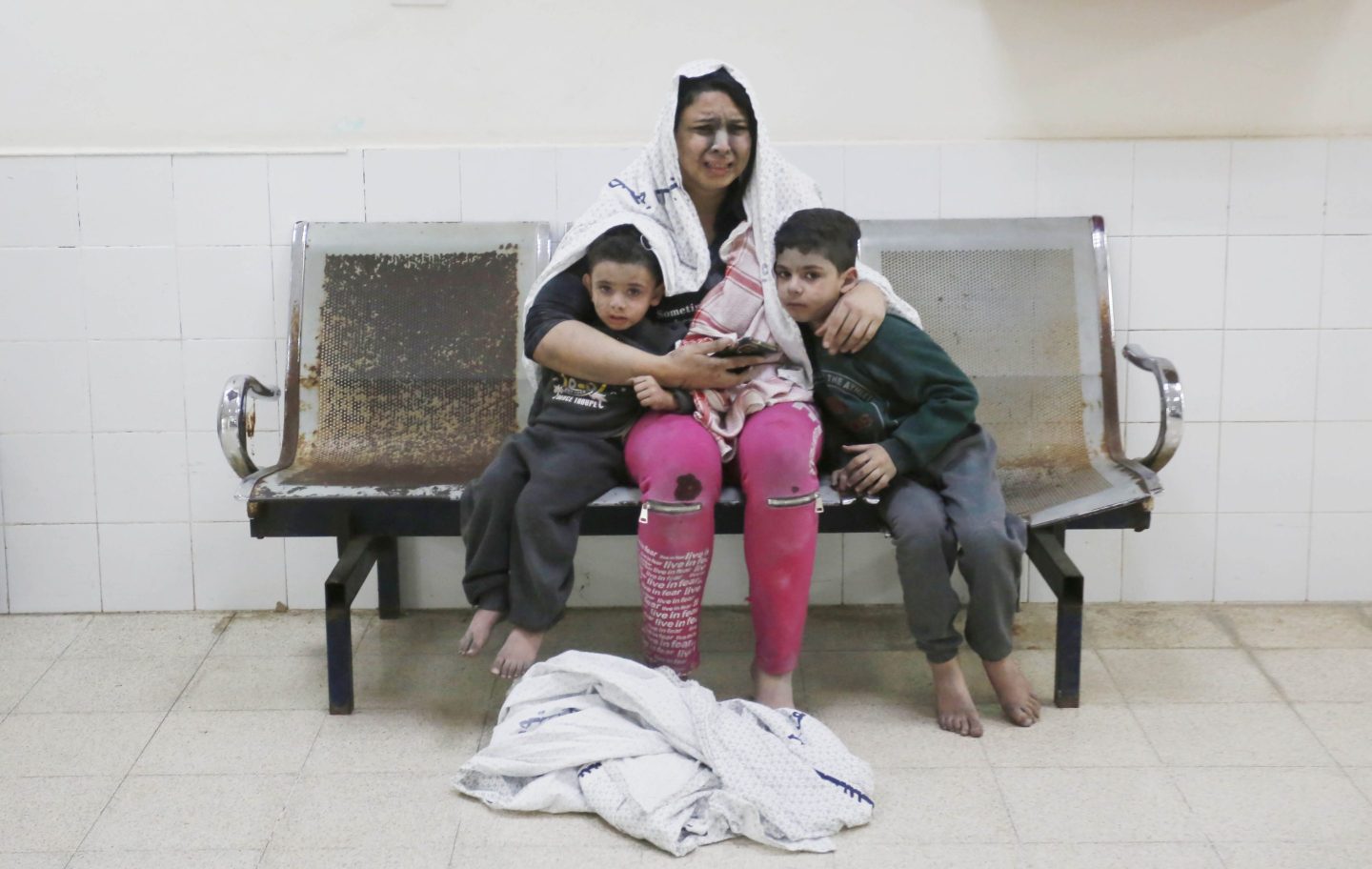
For the wounded, injured and sick in Gaza, there is seemingly no escape. On Oct. 17, 2023, news broke that at least 500 patients, staff and people seeking shelter from Israeli bombs had been killed in an explosion at a hospital, according to health authorities in the Hamas-run enclave.
It amounts to a devastating loss of life during a campaign of bombing that has not spared the frail or sick. Just days earlier, the World Health Organization said in a stark assessment that an order to evacuate from hospital beds and head south amounts to a “death sentence.”
By that time, four hospitals had already ceased functioning in Gaza’s north because of damage from Israeli bombs.
Beyond the sheer immediate devastation of the current conflict – in which thousands of Israelis and Palestinians have been killed – there will be significant and undoubtedly long-lasting implications for the Gaza Strip’s health system.
As a Palestinian expert in global health who has worked with medical professionals from Gaza, I know that even before this latest escalation of violence, health services in Gaza were in a poor shape. Insufficiently and poorly resourced for decades, doctors and hospitals also had to contend with the devastating effects of a 16-year blockade imposed by Israel, in part with coordination with Egypt.
A system completely overwhelmed
The immediate concern in Gaza is for those seeking assistance due to the bombing campaign that Israel ordered after an attack on its people by Hamas fighters. An expected ground offensive will only further risk more civilian casualties.
Hospitals in Gaza are completely overwhelmed. They are seeing around 1,000 new patients per day, in a health system with only 2,500 hospital beds for a population of over 2 million people. It has forced hospitals to tend to patients in corridors and nearby streets. People maimed in the bombing are being treated for horrific injuries without basics such as gauze dressings, antiseptic, IV bags and painkillers. Those experiencing traumatic injuries are unable to receive sufficient care, increasing rates of infection and amputation.
And things may soon get worse. According to the United Nations’ Office for the Coordination of Humanitarian Affairs, Gaza’s hospitals have been forced to work without electricity, using fuel to run generators to ensure life-saving equipment remains functioning. The U.N. estimates this fuel will run out any day due to a complete siege placed on Gaza by Israel.
Such conditions have led to concerns that alongside the massive number of bombing victims, Gaza health services will soon have to contend with the outbreak of disease. Patients with immediate health needs, like dialysis or chemotherapy, are among those being ordered to leave and head for greater safety in Gaza’s south, although evacuation routes have also been bombed.
A century of underfunding
The current devastation to Gaza’s health system is obvious. But Gaza’s health care system was already under stress before the latest bombardment. In fact, policies that stretch back decades have left it unable to meet even the basic health needs of Gaza’s residents, let alone respond to the ongoing humanitarian catastrophe.
In just over a century, the health system in Gaza has been administered by six authorities: the Ottomans until the end of World War I, the British during the mandate period from 1917 to 1947, Egypt from 1949 to 1967, Israel under occupation starting in 1967, and then a Ministry of Health led first by the Palestinian Authority from 1995-2006 and since then by Hamas.
What each have had in common is that, from my perspective as a global health expert, they invested little in Palestinian health. For periods of the 20th century, the health priorities of successive governing bodies appeared focused more on reducing the spread of communicable disease to protect foreigners interacting with the native Palestinian population.
There was seemingly far less attention paid to building health infrastructure, adequately training health personnel, promoting preventive care and other long-term initiatives that make up a sustainable health system.
Under Israeli occupation from 1967, several Palestinian hospitals were turned into detention centers or military offices, while others were closed, and new ones were prohibited from opening. Palestinian physicians working in the occupied territories earned one-third the salary of their Israeli counterparts.
As a result of this neglect, health indicators throughout what are now called the occupied territories – the West Bank and Gaza Strip – have been poor.
Maternal and infant mortality – typical indicators of health system functioning – tends to be high. For example, in the mid-1980s, infant mortality was over 30 per 1,000 live births for Palestinians, compared with just under 10 per 1,000 among the Jewish population of Israel. And infant mortality has remained stubbornly high in Gaza.
Meanwhile, a lack of a reliable drinkable water infrastructure and overall unsanitary conditions resulted in the spread of parasitic and other infectious diseases, like rotavirus, cholera and salmonella – which remain leading causes of death in Gaza’s children.
Dying before they can leave
Most residents of Gaza fled there in 1948 after being displaced from their homes in what became the state of Israel. They were classified as refugees, many receiving limited services from the United Nations Relief and Works Agency for Palestine Refugees in the Near East that was established in 1949.
Since then, chronic underfunding of public hospitals has meant that Palestinians in Gaza have remained reliant on outside money and nongovernmental organizations for essential health services. This started a trend of humanitarian dependence that continues to this day, with many of Gaza’s health facilities funded by the United Nations, humanitarian agencies like Doctors Without Borders and religious organizations.
During the passage of the Oslo Accords in the mid-1990s, the Palestinian Authority was established to administer services in the occupied territories. The accords called for health responsibilities to be transferred to the newly formed Palestinian Ministry of Health as preparation for a sovereign Palestinian state, which the accords called for within a five-year period.
The Palestinian Authority received a significant influx of humanitarian aid as it took on civil responsibilities, including health. As a result, health indicators for Palestinians, including life expectancy and immunization rates, started to improve in the late 1990s.
But as it became increasingly clear that the overarching goal of the Oslo Accords for Palestinians – statehood – would not materialize, disillusion with the Palestinian Authority led to victory for Hamas in 2006 elections held in Gaza. Since then, Hamas has been considered the de facto governing body in Gaza, while the Palestinian Authority operates in the West Bank.
The rise of Hamas, which the U.S., Israel and others designate as a terrorist group, saw Gaza become isolated from the international community. It also coincided with Israel imposing a full land, sea and air blockade of Gaza.
There is no doubt that the blockade has rapidly accelerated the deterioration of the health system in Gaza and directly impacted the mortality rate.
Gazans who need advanced care, whether for cancer or other chronic illnesses, traumatic injuries and other life-threatening ailments, often can only access needed services in Israeli hospitals and require a permit to cross the border from Gaza. Some die before the permit process is complete.
Gaza health services after the siege
This vulnerable health system is now facing unprecedented challenges, staffed by health professionals who have committed to stay with their patients even under hospital evacuation orders and at risk of death.
It is uncertain what the health system of Gaza will look like in the future.
In years past, international aid would help repair and rebuild some, but not all, of the infrastructure damaged in airstrikes, especially schools and hospitals.
But Israeli Prime Minister Benjamin Netanyahu has promised a “long and difficult war.” And with the level of destruction seen in just a few days, it remains unclear just what will be left in the aftermath.
Already at least 28 doctors and other health workers have been killed in Gaza, with ambulances and a number of hospitals rendered useless by the bombs.
Replacing this human capital and vital infrastructure could take years, if not generations – and that is without the limits of a punishing blockade and continued bombardment.
Yara M. Asi is Assistant Professor of Global Health Management and Informatics, University of Central Florida.
This article is republished from The Conversation under a Creative Commons license. Read the original article.