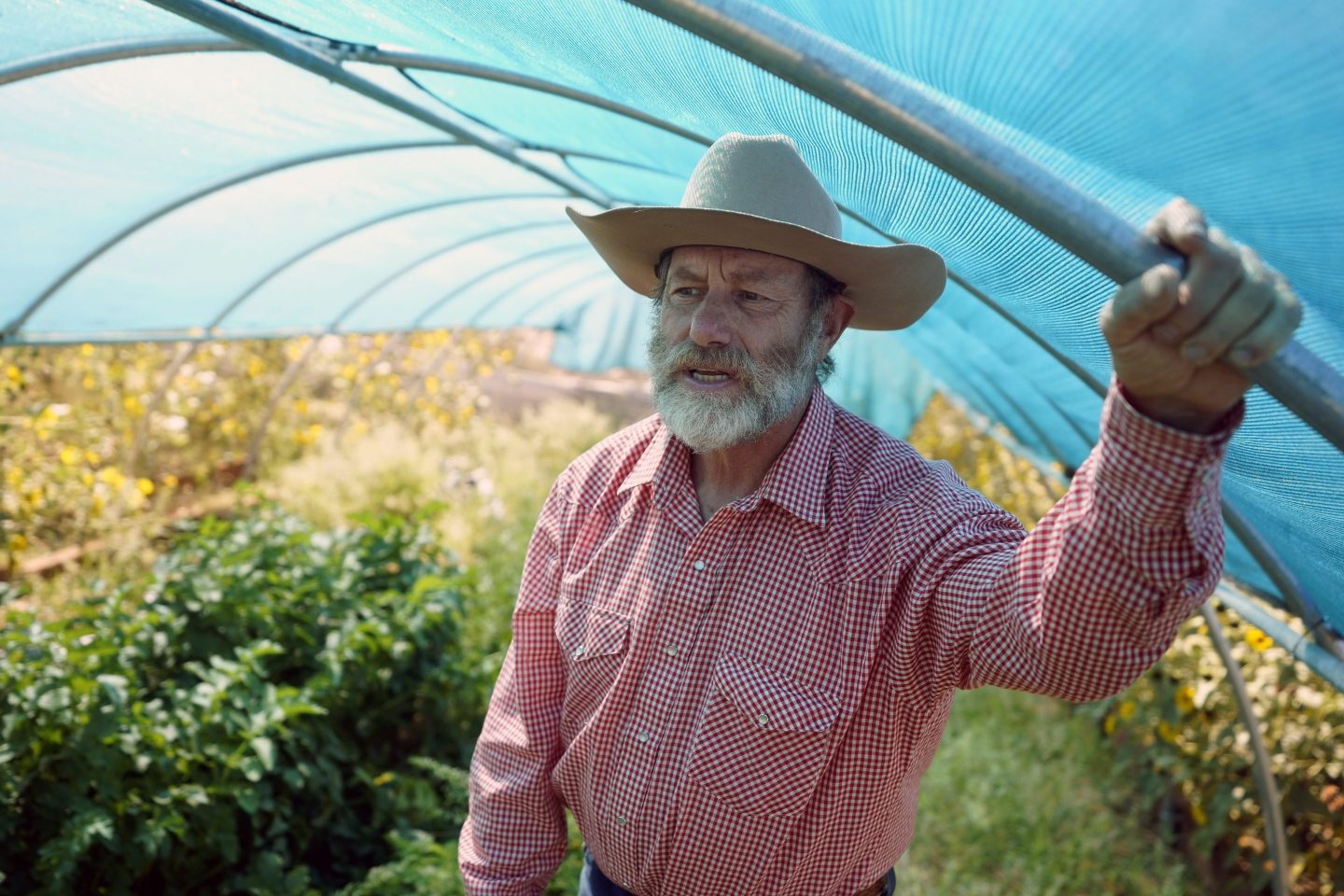
In the hills of a dry, remote patch of California farm country, Lee Harrington carefully monitors the drips moistening his pistachio trees to ensure they’re not wasting any of the groundwater at the heart of a vicious fight.
He is one of scores of farmers, ranchers and others living near the tiny town of New Cuyama who have been hauled into court by a lawsuit filed by two of the nation’s biggest carrot growers, Grimmway Farms and Bolthouse Farms, over the right to pump groundwater.
The move has saddled residents in the community 100 miles (160 kilometers) northwest of Los Angeles with mounting legal bills and prompted them to post large signs along the roadway calling on others to boycott carrots and “Stand with Cuyama.”
“It’s just literally mind-boggling where they’re farming,” Harrington said, adding that his legal fees exceed $50,000. “They want our water. They didn’t want the state telling them how much water they can pump.”
The battle playing out in this stretch of rural California represents a new wave of legal challenges over water, long one of the most precious and contested resources in a state that grows much of the country’s produce.
For years, California didn’t regulate groundwater, allowing farmers and residents alike to drill wells and take what they needed. That changed in 2014 amid a historic drought, and as ever-deeper wells caused land in some places to sink.
A new state law required communities to form local groundwater sustainability agencies tasked with developing plans, which must be approved by the state, on how to manage their basins into the future. The most critically overdrafted basins, including Cuyama’s, were among the first to do so with a goal of achieving sustainability by 2040. Other high and medium priority basins followed.
But disputes arose in Cuyama and elsewhere, prompting a series of lawsuits that have hauled entire communities into court so property owners can defend their right to the resource beneath their feet. In the Oxnard and Pleasant Valley basins, growers sued due to a lack of consensus over pumping allocations. In San Diego County, a water district filed a lawsuit that settled about a year later.
It’s a preview of what could come as more regions begin setting stricter rules around groundwater.
The lawsuit in Cuyama, which relies on groundwater for water supplies, has touched every part of a community where cellphone service is spotty and people pride themselves on knowing their neighbors.
The school secretary doubles as a bus driver and a vegetable grower offers horseshoe repair. There is a small market, hardware store, a Western-themed boutique hotel and miles of land sown with olives, pistachios, grapes and carrots.
From the start, Grimmway and Bolthouse participated in the formation of the local groundwater sustainability agency and plan.
Their farms sit on the most overdrafted part of the basin, and both companies said they follow assigned cutbacks. But they think other farmers are getting a pass and want the courts to create a fairer solution to reduce pumping throughout the basin, not just on their lots.
“I don’t want the aquifer to get dewatered because then all I have is a piece of gravel, no water, which means it’s desert ground, which is of no value to anybody,” said Dan Clifford, vice president and general counsel of Bolthouse Land Co. “What we’re trying to get is the basin sustainability, with the understanding that you’re going to have a judge calling balls and strikes.”
Grimmway, which has grown carrots in Cuyama for more than three decades, currently farms less than a third of its 20 square miles (52 square kilometers) there and has installed more efficient sprinklers to save water. Seeing groundwater levels decline and pumping costs rise, the company began growing carrots in other states, but doesn’t plan to uproot from Cuyama, said Jeff Huckaby, the company’s president and chief executive.
“It’s one of the best carrot-growing regions that we’ve come across,” Huckaby said, adding that arid regions are best so carrot roots extend below ground for moisture, growing longer. “The soil up here is ideal, temperatures are ideal, the climate is ideal.”
California has been a “Wild West” for water but that’s changing. The company has cut back its water use in Cuyama and hopes to remain there for decades, he said.
Until the lawsuit, 42-year-old cattle rancher Jake Furstenfeld said he thought the companies were working with people in town, but not anymore.
Furstenfeld, who sits on an advisory committee to the groundwater agency, doesn’t own land and doesn’t have an attorney. But he’s helping organize the boycott and has passed out yard signs.
“It’s been called David versus Goliath,” he said.
Many residents are worried about the water they need to brush their teeth, wash clothes and grow a garden. The water district serving homes in town said rates are rising to cover legal fees. The school district, which is trying to stay afloat so its 185 students can attend school locally, is burdened with unexpected legal bills.
“Without water, we have no school,” said Alfonso Gamino, the superintendent and principal. “If the water basin goes dry, I can kind of see Bolthouse and Grimmway going somewhere else, but what about the rest of us?”
Before the state’s groundwater law, most groundwater lawsuits were filed in Southern California, where development put added pressure on water resources. Legal experts now expect more cases in areas where farmers are being pushed to slash pumping.
“For an average person or a small user it is disruptive because must people haven’t been involved in lawsuits,” said Eric Garner, a water rights attorney who worked on California’s law. “For large pumpers, lawyers are an inexpensive option compared with having to replace their water supply.”
Most of the country’s carrots are grown in California, with consumers demanding a year-round supply of popular baby carrots. The state’s climate is a prime place for growing and carrots are one of California’s top 10 agricultural commodities, valued at $1.1 billion last year, state statistics show.
Along the highway, Grimmway’s fields are doused with sprinklers for eight hours and left to dry for two weeks so carrot roots stretch in search of moisture. Critics question the companies’ use of daytime sprinklers, but Huckaby said Grimmway uses far less water than the alfalfa grower who farmed there before.
The suit in Cuyama, filed two years ago, has an initial hearing in January. In a recent twist, Bolthouse Farms has asked to withdraw as a plaintiff, saying the company has no water rights as a tenant grower and plans to slash its water use 65% by 2040. The company that owns the land, Bolthouse Land Co., is still litigating.
Jean Gaillard, another Cuyama advisory committee member, sells produce from his garden to locals. He tries to conserve water by alternating rows of squash between corn stalks and capturing rainwater on the roof of an old barn.
Paying a lawyer to represent him rather than re-investing in his produce business is problematic, he said. Meanwhile, his well water has dropped 30 feet (9 meters) in the past two decades.
“We feel we are being totally overrun by those people,” Gaillard said. “They are taking all the water.”