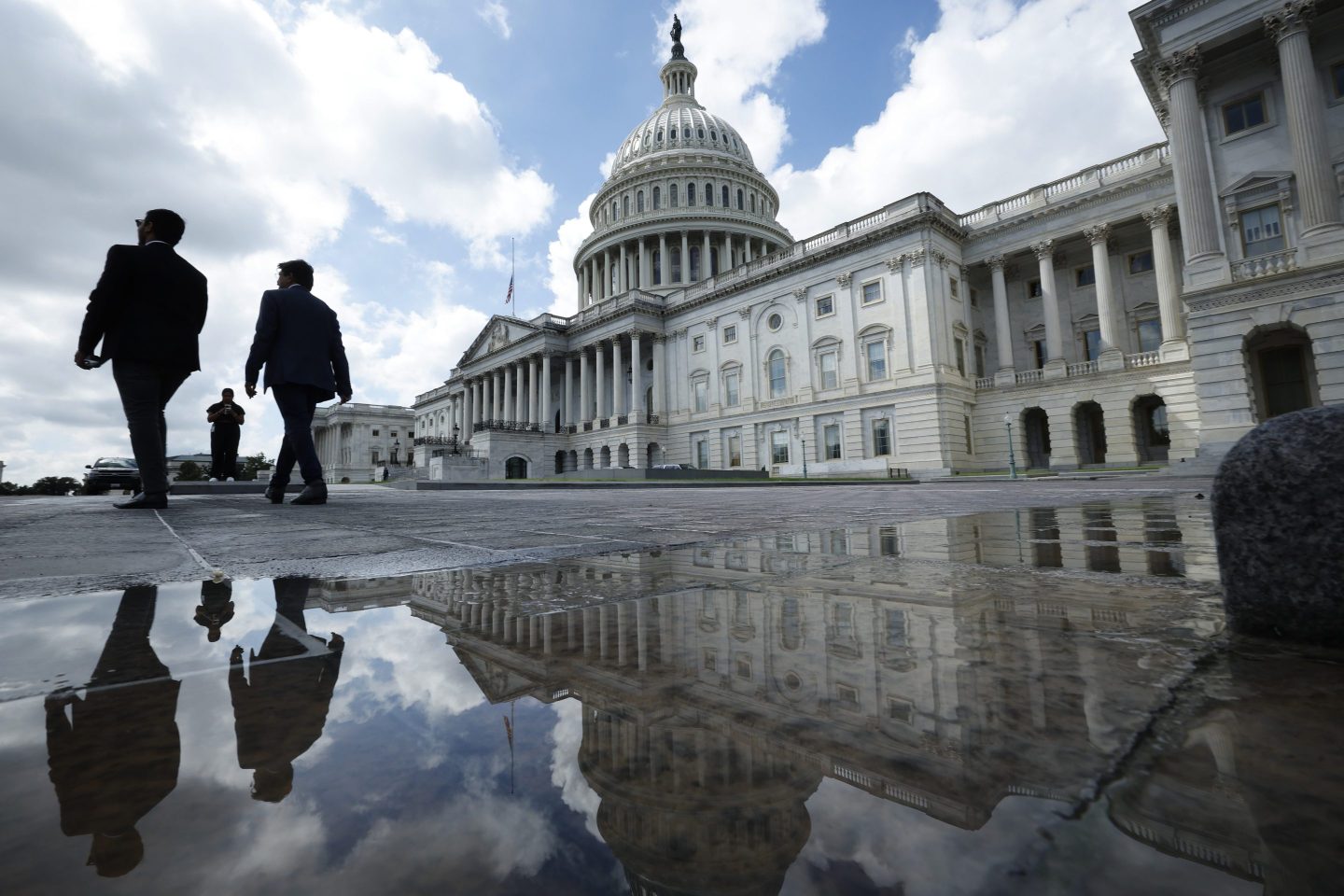
With the current vitriol in Washington, DC, the possibility of another government shutdown this fall seems high. The question then becomes, how bad will the economic damage be? The answer depends entirely on the length of the shutdowns–and their frequency.
There have only been three budget-related shutdowns of more than one week in U.S. history: one in 1995-1996 that lasted 21 days, a second one in 2013 that lasted 16 days, and the most recent one in 2018-2019 that lasted 35 days.
In each case, the howls of anguish from across the country, especially the appearance of federal government workers in food lines since hundreds of thousands of them received no pay during the shutdown, created immense pressure on Washington and brought the shutdown to a rapid conclusion.
However, for these three shutdowns, the estimates of the damage to the economy were minimal. In the case of the 2019 shutdown, the $21.4 trillion U.S. economy took an estimated $3 billion hit–only 0.01% of GDP.
Certainly, there was a temporary disruption in the operations of the government because of the shutdown. It impacted things like SBA loans to small businesses, federal mortgage loan applications, the processing of export licenses, loans, and guarantees, and the processing of federal contracts to small businesses. It brought delays in passport processing and the closure of national parks, disappointing thousands of vacationers. It halted the distribution of important food and cash assistance such as the Supplemental Nutrition Assistance Program (SNAP), the Temporary Assistance for Needy Families (TANF) program, and the Special Supplemental Nutrition Program for Women, Infants, and Children (WIC). It even presented the specter of travel delays as it impacted the availability of TSA agents and air traffic controllers.
Government shutdowns are a political and legislative negotiating tactic. One side deeply opposes spending on a certain program and has the votes to block approval of the budget unless that program is reduced or eliminated–or another side insists on the addition of a program and has the votes to block the budget unless that program is included. It’s a political game of who will blink first and concede to the other side–unless there is some grand compromise.
A central premise articulated by those trying to reduce spending in the debates leading to government shutdowns is that increased government debt would bring about a crisis–and the government would face an inability to obtain additional funding through debt. In fact, in August of 2023, Fitch Ratings cut the U.S. debt by one notch, from AAA to AA+, citing the “deterioration” of the country’s finances, the growing debt burden, and the “erosion of governance.” S&P made a similar move in 2011. However, those moves made essentially no difference, and there’s never been a hint that the U.S. government would be unable to fund its debt.
That being the case, it’s not unreasonable to expect more such shutdowns going forward. Like presidential impeachment, shutdowns might turn into one of the recurring features of American political life.
Although past government shutdowns barely made a dent in the U.S. economy, the political fallout negatively impacted those perceived as being the cause of shutdowns. Georgia Representative and House Speaker Newt Gingrich’s political career was adversely impacted by the 1996 shutdown. Some believe Donald Trump lost more than he gained in the 2019 shutdown and that it had some impact on the 2020 election.
Nevertheless, the level of rancor and depth of the political divisions in Washington are such that we can expect more shutdowns in the future. As disruptive as future shutdowns will be, if they remain as short as the 1996, 2013, and 2019 shutdowns, the economy will continue to shrug them off.
The real risk arises if these hardball negotiating tactics become routine. If that happens, negotiators will begin to test the limit of shutdowns and the day will surely come that one will be extended well beyond the 35 days of the 2019 shutdown. The economy can survive a shutdown of a few weeks. Real and enduring damage can come if political hardball tactics bring about a shutdown that lasts for months.
Richard Vague’s career has spanned fields as varied as banking, energy, government, and the arts. He recently served as Secretary of Banking and Securities for the Commonwealth of Pennsylvania. Vague previously was a managing partner of Gabriel Investments, an early-stage venture capital firm, co-founder, chairman, and CEO of Energy Plus, an electricity and natural gas supply company, and co-founder and CEO of two banks: First USA, which was sold to Bank One, and Juniper, which was sold to Barclays PLC. He is the author of The Paradox of Debt: A New Path to Prosperity Without Crisis.
More must-read commentary published by Fortune:
- Indeed CEO: ‘AI is changing the way we find jobs and how we work. People like me should not be alone in making decisions that affect millions’
- Why critics love to hate Elon Musk–and why his fans adore him
- Burnout is attacking our brains and making it harder to excel at work. ‘Deliberate calm’ can help us adapt
- The U.S.-China trade war is counterproductive–and the Huawei P60’s chip is just one of its many unforeseen ramifications
The opinions expressed in Fortune.com commentary pieces are solely the views of their authors and do not necessarily reflect the opinions and beliefs of Fortune.