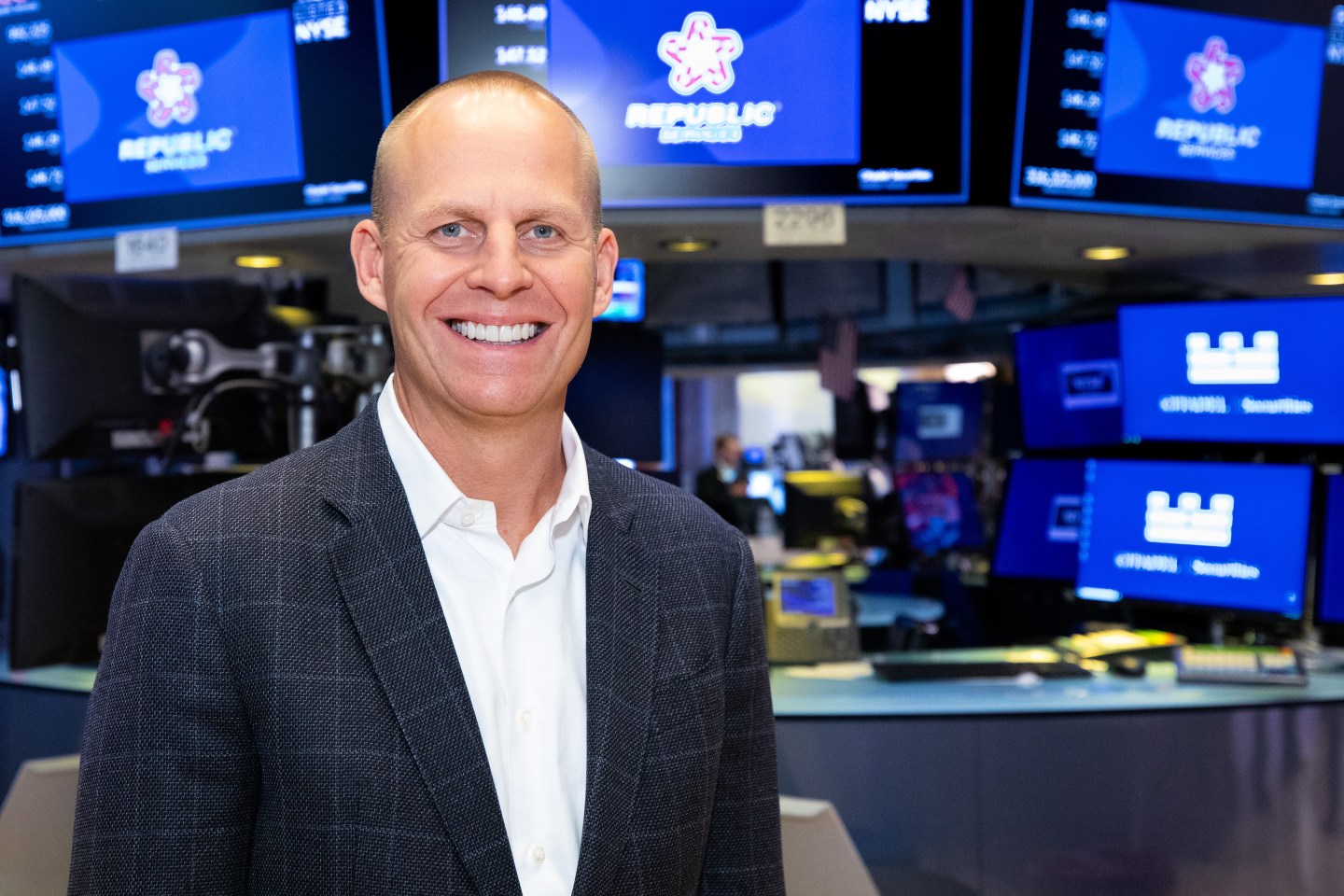
Jon Vander Ark doesn’t mind anyone calling the company he leads, Republic Services, a garbage company. After all, founded in 1996, the company made its name hauling trash and still makes 5 million collections a day. But Vander Ark, CEO since 2021 and a 13-year veteran of Republic Services, has been working to modernize its business model to go after the higher-growth, higher-profit recycling market.
“I’ve seen us go from a garbage company to a waste company to a waste and recycling company to now an environmental services and sustainability company,” says Vander Ark.
Last year, Republic managed 8 million tons of recyclable items, and extracted 2.4 million tons of materials that can have a second life. This strategy has boosted its stock in the last two years and given the company a market cap of $45 billion. What’s more, under Vander Ark, Republic has gone after the fast-growing environmental services and consulting business, making a number of acquisitions. Vander Ark’s moves raised revenue 20% last year to almost $14 billion.
The CEO says the way for Republic to thrive in this hyper-politicized environment around climate change is to simply be pragmatic about the focus on cost savings and revenue potential as Americans recycle more. For instance, Republic now has a fast-growing business recovering plastic consumer packaging for circularity, a term that refers to components being constantly re-used. It takes thrown away plastics and recycles them to produce high-quality plastic used by consumer packaged goods companies. “We think about circularity and de-carbonization as two fundamental mega-trends,” says Vander Ark.
This interview was edited and condensed for clarity.
Fortune: How do we in the U.S. become a less wasteful society? And if we manage to do that, is that bad for business?
It would not hurt business. In fact it helps. We’re already seeing that in terms of shrinking solid waste on a per capita basis. Typically a market grows with population, but solid waste is shrinking because we’re diverting more and recycling is growing faster to make up the difference. Our aspiration is to accelerate that trend. So we look at every ton that goes into a landfill and challenge ourselves and ask, “How could we take that out and create value with it?” I pay for something to go to a landfill. But if I can recycle it, I get value for it on the other end.
When you look at how far along many European countries are in recycling in contrast to how much Americans throw out as trash, it’s tempting to see Americans as lazy. Can recycling really become part of our culture?
We’re certainly behind the Europeans. They’re a very source-separated environment and things are very clearly separated for plastic, aluminum, glass and paper. That’s how the U.S. was originally and recycling rates didn’t really move for a period of time. When it did take off is when we moved to single stream, which is to put everything in one big container, which made it easier for people to recycle. But that has complications. You have some people who don’t care and they’re still putting garbage in and contaminating that load. And then you have at the other end, the wishful recycler who wants that greasy pizza box to be recycled so badly, but it can’t be.
It seems like a lot of packaging is wasteful and impedes recycling. What can be done?
Take plastic packaging. Not all plastics are recyclable. So take a clamshell that is used for your take-out chicken rotisserie. It was made with post-consumer recycled content (material made from the items that consumers recycle every day such as aluminum, cardboard boxes, paper, and plastic bottles). But that shell itself is not going to be recycled, it’s going to the landfill. So part of the opportunity is to design for recyclability upfront.
What do you make of the current pushback against ESG (environmental, social, and governance) standards for publicly traded companies? Could this hurt your business, or does this ESG emphasis march forward?
“ESG” needs to be unpacked. It’s like a pig, a chicken and duck that get lumped together. All different, but all worthy topics. The “E” part of this is here to stay. We think about circularity and de-carbonization as two fundamental mega-trends that whatever the political sentiment, companies are investing billions of dollars in. There’s a global consensus there and we see those as tailwinds for our business.
Another CEO recently told me that you can get consumers on board with green initiatives more easily if one doesn’t mention climate change, and by emphasizing reducing waste and saving money. Do you agree?
We’re not running away from climate change. We get that the world is heating up and humans are a factor in that and we don’t hide from that. I would say this: if something’s going to be environmentally sustainable, it’s got to be economically sustainable. So we don’t do things as science projects or for charity. It’s our business and we’re going to make money and grow.
You have a goal that by 2030, half of your new garbage and recycling trucks will be electric vehicles. That’s ambitious but what stops you from going even faster?
Just like a passenger car, if you retrofit a diesel truck, you add too much weight with the batteries and so it becomes economically inefficient. But when you design it from scratch, you take enough weight out so it can run a full 10.5-hour day and 125 miles without having to stop, so you don’t lose productivity.
Do you ever get offended by someone calling Republic Services a garbage company despite all the push you’ve made into recycling and environmental services?
We’re not offended by that because people get too easily offended. That’s what we called ourselves a decade ago and I’ve seen us go from a garbage company to a waste company to a waste and recycling company to now an environmental services and sustainability company. And as that’s evolved, so has our mindset. We still have landfills and they are going to be with us for a long time, so we don’t run from that. But we’re way bigger and way more than that now.