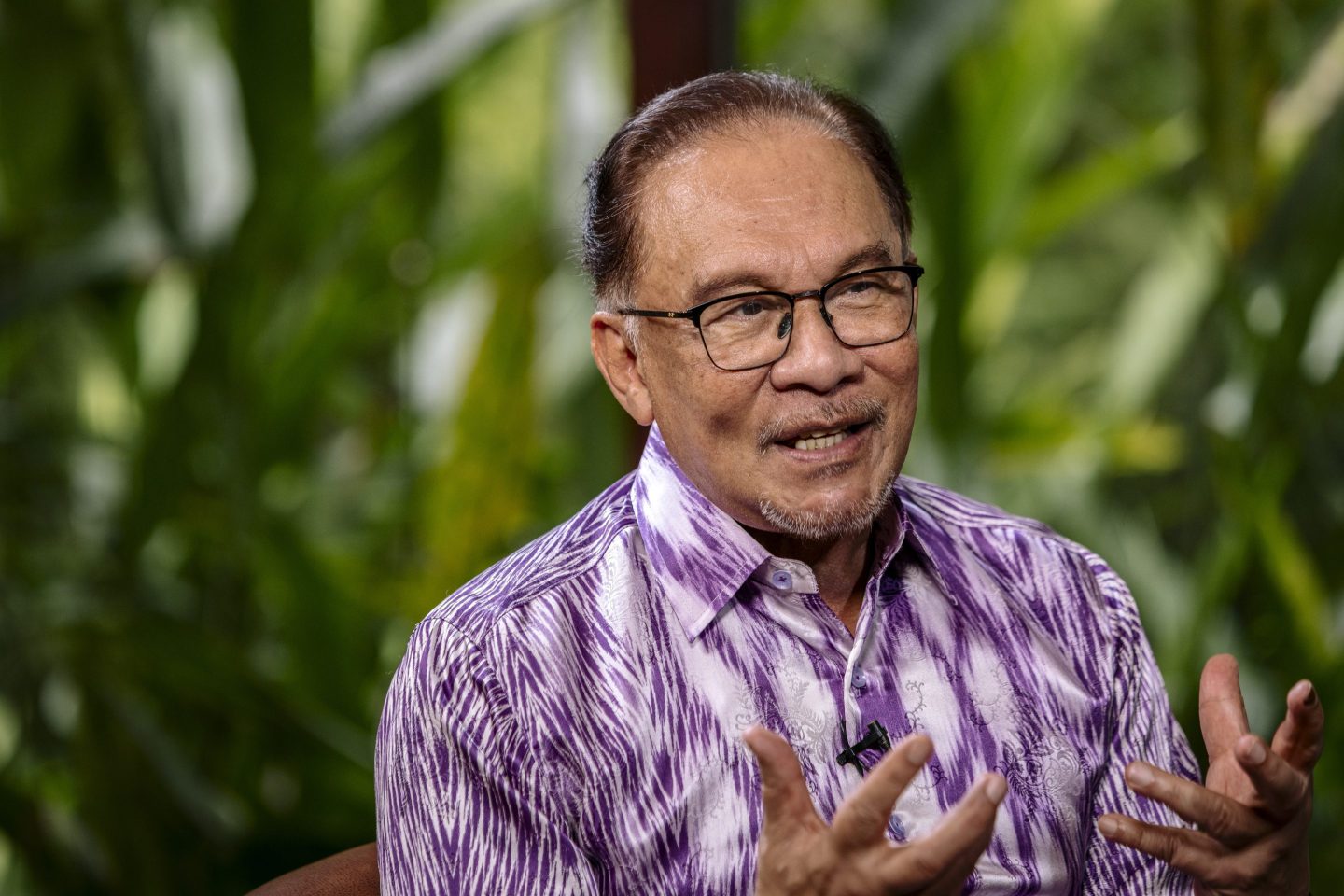
For Anwar Ibrahim, the 25-year path to becoming Malaysia’s prime minister was at times “torture.”
His ascent initially seemed as if it would be swift when he was named deputy prime minister in the early 1990s, supporting his onetime mentor, Mahathir Mohamad. But when that relationship soured, Anwar found himself sacked, beaten, and ultimately imprisoned for nearly a decade on bogus charges of corruption and sodomy. (It is a criminal offense to be gay in the Muslim-majority country.)
Anwar joined forces again with Mahathir in 2018 following the multibillion-dollar 1MDB scandal, in which over $4 billion was stolen from the Malaysian sovereign wealth fund, aided by a former Goldman Sachs managing director. Although the investment bank paid a settlement for its involvement, Anwar is still fighting to get the rest of the money back from the Wall Street giant. The scandal had brought down then–Prime Minister Najib Razak, and Mahathir returned to power in hopes of getting Malaysia back on track. But the country went through years of political instability afterward, with multiple leaders being elected and ousted in rapid succession while its economy slumped amid weakening exports and a global slowdown.
In November 2022, the Malaysian king named Anwar as the country’s 10th prime minister after a deadlocked vote in a historic election. Yet soon after, Anwar faced another test: A state election on Aug. 12, involving six of Malaysia’s 13 states, which turned out a mixed early verdict. Although the outcome was generally predicted, the opposition made up ground in some key areas.
Now 76, Anwar has much to do to maintain stability and improve Malaysia’s economic world standing. Fortune editor-in-chief Alyson Shontell sat down with him in Ipoh in late August to discuss his bold 10-year plan for the country. It has multiple pillars, including becoming a top 30 economy worldwide, increasing the percentage of women in the workforce, and climbing to higher rankings on the Global Competitiveness Index, the Corruption Perceptions Index, and the Human Development Index.
Much of the plan‘s success hinges on persuading large global companies to bring high-paying jobs to Malaysia, which hopes to position itself as an attractive supply-chain solution. Anwar recently struck an impactful deal with Elon Musk to bring Starlink and Tesla opportunities into the country and hopes more deals will follow. But he will need to also convince these leaders that his government is stable enough to stay in power and see his vision through.
The interview has been lightly edited for length and clarity.
Alyson Shontell: Prime Minister, it is a pleasure to be here with you today. Nine months ago, you won a historic election in Malaysia to become the 10th prime minister of the country. Congratulations. Two weeks ago, there was another set of elections that some said was going to be your first big test. How do you feel the results went?
Anwar Ibrahim: We managed to sustain the level of support, particularly in the key states, the three economically thriving states, as opposed to the more rural hinterland that we lost to the more conservative Islamic party. I thought that is a clear signal that the government is stable, and we are here for the next four years.
And that, in and of itself, is significant. As you know better than anybody, it’s been a tumultuous past few years for Malaysia. It’s been a tumultuous path for you to be in the seat that you’re in today—about 25 years in the making, a decade of that spent in jail for things that you say did not do, that would not be crimes, frankly, in other parts of the world. What from that experience has prepared you to be prime minister? And how did it change you as a person?
With 25 years in and out of jail, there’s a learning curve. I think you become more mature, patient, and saner in this world full of insanity. And I think I’ve learned immensely about freedom, patience, and about economic policies. I would like to focus effectively on how to contribute to this country and make it vibrant and great again.
There were moments when you didn’t feel as if you would survive, and friends even asked you, “Why would you go back into government? You might be thrown back in jail. It could be disastrous.” Why? Why, in that moment, did you decide, “I’m going to give this another shot, and I’m going to be prime minister.”
It’s interesting because I had a long conversation after I was released, at the invitation of Nelson Mandela. We were talking about how mad, or quite insane we are, or crazy. So we reached a consensus: We are not insane, but certainly we’re quite crazy. Because we believe we have a sense of conviction, we believed it was best for people, for our country, and the country deserved better, essentially. That propelled us to work harder and be really determined in the face of adversities. And I’m not exaggerating, it was a tough period not just for me; my wife, my family, and my colleagues suffered immensely, too.
But after all this, this is probably part of the [challenge I] wanted to accept because we’re talking about effecting change. I’m against a system with endemic corruption, with authoritarian traits. So it’s not going to be an easy feat. And you accept the fact that you are actually trying to change the system, how things should be different. Naturally, it would be at the expense of the ruling clique or elite. But now at least we can see this ray of hope for the country. There is stability. There is clarity in economic policy and a general acceptance by the public that in order to evolve as a successful country, we must effect real change and reform in this country.
As you mentioned, and you’ve said before, corruption has been endemic to this country, and a big opening to allow you to be in the prime minister seat today was the 1MDB scandal that prior administrations had been caught up with, and that you’re now trying to settle with Goldman still. How much of a setback for Malaysia do you feel that incident was, and how do you plan to get the money back from Goldman?
In a sense it was a major setback because the perception always has been negative. I was in New York some years back, and the only thing they asked us about Malaysia was 1MDB, or they’d say that Malaysia is essentially a very corrupt country. So we have to really say to them: “Look, we have a different set of leaders, a different set of policies, and we are quite determined to change and rid the country of corruption.”
Given it’s been about eight months, we have been quite successful. No negotiated tenders, which has been the practice. No issue of commissions through procurements of military recruitment from foreign countries.
It can be done, but you have to be really tough and at times quite unpopular. If there are clear signs of determination and policies following through, then I think generally the international community can accept that they can follow it.
That is why in the three or four months, there’s suddenly this mushrooming of investments from the United States, Europe, and from China. Huge numbers coming in, and they see it as a change, ease of doing business, clarity of policy, and transparent in terms of our implementation.
You’ve outlined a big plan for Malaysia over the next 10 years called the Madani Economy. It has a number of parts to it, but the overall picture, as you said in a recent speech, is “We’re caught in a vicious cycle of high costs, low wages, low profits, and a lack of competitiveness.” Where do you start? What steps do you need to take today to reach the ambitious goals you have for Malaysia in the next 10 years?
First there must be clarity in the policy they see. For example, we are talking about the industrial master plan. Must it be the old approach of sectoral or mission approach? Do you have to stimulate this one entity or [something] geographically different? These issues will be addressed if there’s clarity, and then ease of doing business.
In the last few months, I haven’t found difficulty in getting investors to come in. We will facilitate the approvals. So if that can happen, then naturally the issues we talk about will be resolved. Of course, it will take time and effort. You ask most of these companies, American companies from IT, say, Dell in the past, or Elon Musk at the present, or a company in China. All of them, almost without exception, will see that we have first-class professional engineers. What we lack is probably the issue of governance, issue of clarity, and issue of ease of doing business.
So it is partly the responsibility of authorities in the government to make the necessary changes, accelerate the process of approvals, and, at the same time, to give the additional niche training to what is being required in that area, where we are still deemed to be rather lacking.
A big foreign deal was Elon Musk committing to doing quite a bit here with Tesla and Starlink. Those negotiations were relatively fast. Indonesia had been courting Musk for a long time, and yet he chose Malaysia. What did you say to Musk? How did you get that done?
As much as I know about him, he knows a bit about me. So I said, “Look, I’ve suffered immensely in the past. Now I’ve been given this opportunity. I’m in business. I want to effect the change, and I want to now do whatever is necessary. I love my country, and I think it has huge potential and capacity.” And I made it clear and blunt to him to say that he does not need to worry about all the other nitty-gritty, bureaucratic encumbrances that he may face in dealing with some other countries.
The other thing is that he knows the history of this country. And even in SpaceX, he has three major companies engaging in the operations of space in terms of the spare parts, so he can gauge our potential. What was lacking then resulted from clear policy and commitments by leadership, and [that is where] we have complemented them. And of course, I’m exceedingly pleased that they came up with a very fast decision and set up their regional office here.
Are there other deals like that in the works? I assume you’re talking to many Western companies.
Yes. Infineon, for example, came in with the decision about a month and a half ago by the board, 5 billion euros to expand in Malaysia and the biggest single investment outside Germany. And then Geely from China, they are starting an automobile city in the state in the south of this province, which is ongoing. They’ve got about 1,000 of their Chinese professionals in the operation already. And they know, not just me, the whole team knows once you’re committed, we cannot give the impression that we are laid-back or we’re not doing anything, and we must [do] whatever is necessary to make sure that this process goes at a fast pace.
So there’s a bit of a dilemma. Part of the goal is to get more foreign companies to come into Malaysia, and China is also a big partner. And, of course, China and the U.S. are not getting along. How do you plan to position Malaysia when you’re sandwiched between the two and you need both?
Thus far we don’t have that much of a problem. We engage and we maintain. China is a major player in terms of investments, in terms of neighborly relations. Trade is a major player. And I explained to my colleagues in the States: “Look, it’s an important neighbor. It’s not a zero-sum game as far as we’re concerned.” And the [U.S.] has a long tradition of cultivating friendship for decades, and also they know the track record of our country. Some of the biggest major players have been here, even the traditional ones like Motorola, Intel, in the past, and they know our capacity. And I think we should then use this to our advantage.
We are a small country. We’re not here to try to broker a deal with the United States and China. We know that, and they know. We make it very clear. I’ve engaged with [Antony] Blinken and [John] Kerry recently, and, of course, Xi Jinping and Li Qiang in China, and continue to communicate by making very clear our approaches and what is imperative in Malaysia.
Another part of the Madani Economy plan is to get more women in the workforce. There’s a goal of getting to 60% participation. How do you plan to do that? Is it overhauling education? Is it systemic? How are you going to improve those numbers?
Beyond moral suasion is a clear policy against any form of discrimination that happens to be taking place. In universities, with more than 50% female students, there’s no reason why they cannot be accommodated. Of course, I’m a bit biased. I have six children, five girls.
And a very powerful wife [who was the country’s first female deputy prime minister].
And a powerful wife. But I think, to be fair, it will be of immense help to the country. This group of people has not been fully utilized. Many brilliant people of professional qualifications are not given the opportunity. So there must be a clear policy to encourage it in politics and management, in the private sector, and more so in government service.
What about within your own cabinet? There’s only a few women. Do you have plans to add more?
Yes, but, of course, the cabinet we started off with is relatively smaller. Although in terms of the historic antecedents, it’s quite prominent and has given key positions [to women]. In the past it was women affairs and welfare. Now we’re in education and health, which to me is very good that two key ministries are held by women. But I agree. I concede the fact that we need to then expose and give opportunity to more women, not only in a political leadership positions, but in professional, managerial positions.
So quite a bit to do. As we said at the beginning, it’s been 25 years of waiting for this, and now is your time to take Malaysia where you want it to go. Do you worry about failure?
It’s interesting, Alyson, I didn’t actually think too much about the possibility of failure. I think we are here, we have failed in the past, and we have learned and have the humility to acknowledge our limitations in the past. And I think now is the time for us to execute. And if you do the right thing and you mean well and you know what’s rotten about the system, you have to correct it. I think there is no reason, no cause, to be unduly worried about the possibility of failure.
And what about your legacy? What do you want your legacy to be when people remember you in this position? And what do you want global leaders to think of Malaysia now?
I would make the same point. I’m not too concerned about that. But I think what is important is you do your best. And this country has this immense capacity to emerge as a viable, successful, developing economy, or emerging economy. And I think we should just focus on that. And I am quite realistic. I’m not crazy. Although, as I’ve said earlier with Mandela, we do acknowledge the both of us are quite crazy. But the capacity is enormous. We have been here effectively just six months, and you can see the trend, the focus, the interests of the Republic. The general affinity and discipline among the public. The interest by foreign investors, and even on general issues of governance, there is a shift. And I think if we can continue and sustain this effort, we can strive.
A version of this interview appears in the October/November 2023 issue of Fortune with the headline, “In focus: Anwar Ibrahim.”