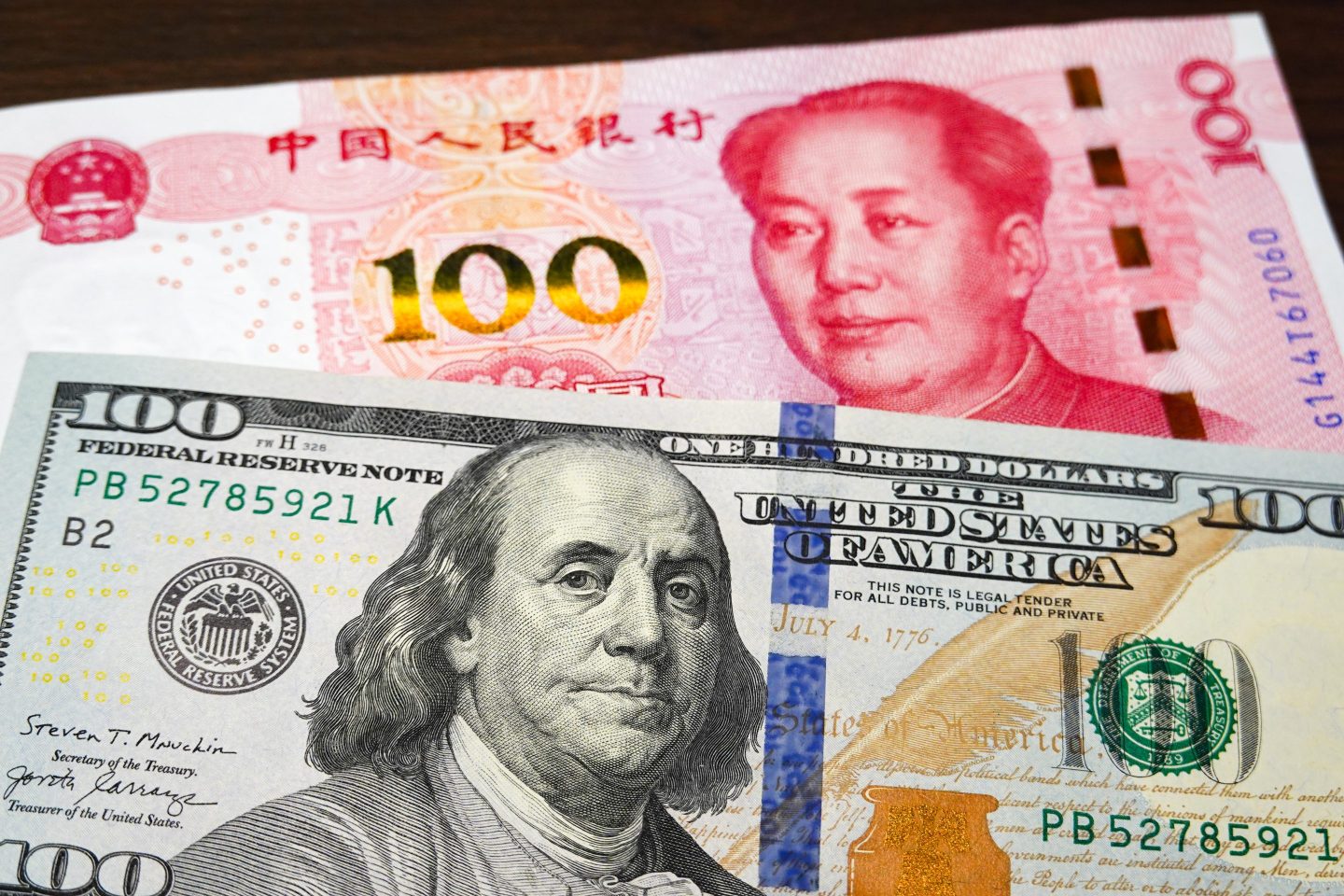
China’s economic woes are starting to resemble the decades-long problems of Japan.
In the 1970s and ’80s, Japan’s economy quickly developed into a powerhouse, just as China’s has over the past few decades. The country’s technological advancement, export-led growth, and centralized economy even earned it the moniker “Japan Inc.” among Westerners.
Japanese unemployment remained low, and asset prices in the country surged during this period, particularly in the 1980s when the economy grew at an average annual rate of 3.9%, topping the 3% average in the U.S. over that decade. But eventually, excessive enthusiasm over Japan’s prospects led to stock and real estate bubbles that began to unravel in the late ’80s. Between late 1989 and mid-1992, the Japanese stock market sank 60%. And over the next decade, land values continued to decline, dropping 80% from their September 1990 peak by the end of 1999.
As a result, throughout the ’90s, the Japanese economy grew just 1% annually, falling behind other developed nations. And since then, Japan’s aging population and rising debt have led to persistent economic stagnation and prolonged periods of deflation, forcing the Bank of Japan to keep interest rates near zero or negative for more than 25 years.
Now, as China’s economy transitions from a period of rapid export-led and debt-fueled expansion toward a more consumer-centric model, a crop of familiar issues have surfaced in that country.
An ongoing real estate crisis, an aging population, surging youth unemployment, and trillions of dollars in burdensome local government debt have created a crisis of confidence among both Chinese consumers and foreign investors. And a recent economic slowdown in China even led inflation to fall 0.3% year over year in July, marking the first period of deflation in the country since the COVID shock of 2020.
Some experts have cautioned that one month’s data doesn’t make a trend, and long-term Chinese deflation is far from a certainty, but Richard Koo, chief economist at Nomura Research Institute, argues that China is undergoing a balance sheet recession that could lead to a “lost decade” similar to what Japan experienced in the ’90s. This is when consumers and businesses opt to save money or pay down debt instead of investing or spending, which leads to a lack of economic growth and falling prices.
But in an ironic twist, as China faces the prospect of a slowing economy and persistent deflation, Japan may finally be climbing out of its decades-long economic nightmare.
The end of Japan’s stagnation and deflation?
Japan’s core inflation, which excludes fresh food products, rose 3.1% in July, following a 3.3% increase in June. It marked the 16th straight month that core inflation held above the Bank of Japan’s 2% target.
In its annual economic white paper, Japan’s Cabinet Office argued that the rise in inflation could signal the end of an era of sluggish economic growth and deflation.
“Japan has seen price and wage rises broaden since the spring of 2022. Such changes suggest the economy is reaching a turning point in its 25-year battle with deflation,” the government said, adding that “we shouldn’t dismiss the fact a window of opportunity may be opening to exit deflation.”
The government noted that Japanese companies are passing on higher production costs to consumers and argued that a tight labor market means wages are more likely to rise now than in previous decades. The recent rise in Japanese inflation is beginning to change consumers’ expectations for future price hikes as well, which is critical for preventing a return to deflation, the government added in its white paper.
Investors, recognizing the issues facing the Chinese economy in comparison to Japan’s post-COVID economic rebound, have sent the nation’s stock markets in opposite directions. The CSI 300, which tracks the performance of the top 300 firms on the Shanghai and Shenzhen exchanges, has dropped 3% year to date, while the Nikkei 225, an index that serves as a proxy for the Tokyo Stock Exchange, has jumped 25% over the same period.
Warren Buffett’s Berkshire Hathaway also made waves this year with its decision to enter Japan in a big way. Berkshire now owns more than 8% of each of the top five conglomerates in Japan—Itochu, Mitsubishi, Mitsui, Sumitomo, and Marubeni.
Although investors are growing increasingly optimistic about Japan’s prospects and the country’s government certainly struck an optimistic tone in its annual report on Tuesday, it was also careful not to declare victory over deflation too soon.
“We need to eradicate the sticky deflationary mindset besetting households and companies,” it said. “We must be absolutely certain we aren’t ruining the green shoots emerging toward overcoming deflation.”
And it makes sense that the government would be so cautious. Even amid negative interest rates, Japanese deflation and economic stagnation have persisted for decades, leading Japanese firms to lose power on the global stage. In 1995, when Fortune released its first Global 500 list, measuring the world’s largest firms by revenue, 149 Japanese companies were featured, and six firms landed in the top 10. In 2022, just 49 Japanese companies made the list, and not a single one made the top 10.