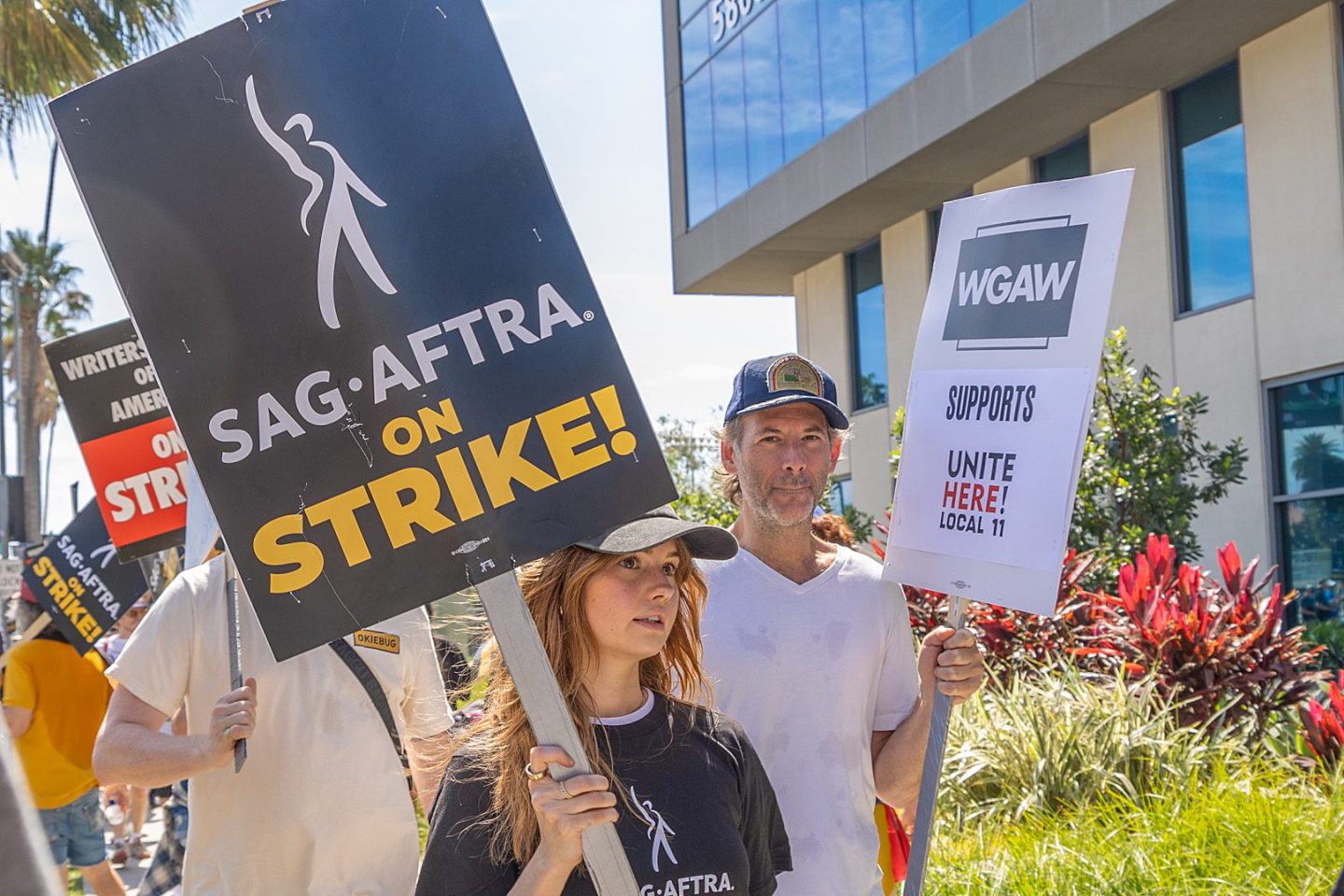
Artificial intelligence has surged to the forefront of Hollywood’s labor fights. Standing alongside more traditional disputes over pay models, benefits and job protections, AI technology is the wild card in the contract breakdowns that have led actors and writers unions to go on strike.
The technology has pushed negotiations into unknown territory, and the language used can sound utopian or dystopian depending on the side of the table. Here’s a look at what the unions and their employers each say they want.
WHY IS ARTIFICIAL INTELLIGENCE SUCH A HOT-BUTTON ISSUE?
As the technology to create without creators emerges, star actors fear they will lose control of their lucrative likenesses. Unknown actors fear they’ll be replaced altogether. Writers fear they’ll have to share credit or lose credit to machines.
The proposed contracts that led to both strikes last only three years. Even at the seeming breakneck pace at which AI is moving, it’s very unlikely there would be any widespread displacement of writers or actors in that time. But unions and employers know that ground given on an issue in one contract can be hard to reclaim in the next.
Emerging versions of the tech have already filtered into nearly every part of filmmaking, used to de-age actors like Harrison Ford in the latest “Indiana Jones” film or Mark Hamill in “The Mandalorian,” to generate the abstracted animated images of Samuel L. Jackson and a swirl of several aliens in the intro to “Secret Invasion” on Disney+, and to give recommendations on Netflix.
All sides in the strikes acknowledge that use of the technology even more broadly is inevitable. That’s why all are looking now to establish legal and creative control.
Actor and writer Johnathan McClain said the battle echoes fights over automation across other industries, but foretells many more to come as tech becomes better.
“It’s easy to marginalize what we do because it’s entertainment” McClain said on the picket lines outside Warner Bros. Studios. “And I get it. But I feel on some level we are, as far as this tech conversation is concerned, a little bit of a canary in a coal mine. This is an important moment and we’ve got to really make a decisive stand.”
THE ACTORS’ TAKE
AI discussions between the Screen Actors Guild–American Federation of Television and Radio Artists and the Alliance of Motion Picture and Television Producers, which represents employers, went from a theoretical framework to a bitter battle that spilled into the public when the strike broke out July 13.
In a description widely shared by outraged actors on social media, SAG-AFTRA released this characterization of the studios’ AI position, which the AMPTP called a deliberate distortion:
“We want to be able to scan a background performer’s image, pay them for a half a day’s labor, and then use an individual’s likeness for any purpose forever without their consent,” the union said. “We also want to be able to make changes to principal performers’ dialogue, and even create new scenes, without informed consent. And we want to be able to use someone’s images, likenesses, and performances to train new generative AI systems without consent or compensation.”
The AMPTP said in a statement in response that its offers included an “AI proposal which protects performers’ digital likenesses, including a requirement for performers’ consent for the creation and use of digital replicas or for digital alterations of a performance.”
SAG-AFTRA used similar language in describing what they wanted, emphasizing the need to protect “human-created work” including alterations to the “voice, likeness or performance” of an actor.
It may be fitting that “voice” comes first on that list. While many viewers still cringe at the visual avatars of actors like Hamill and Jackson, the aural tech feels further along.
The voices of the late Anthony Bourdain and the late Andy Warhol have both been recreated for recent documentaries.
Union members who make a living doing voiceovers have taken note.
WRITERS WANT THEIR LINE OF CREDIT
In screenwriters’ contract talks, which broke down in early May, the Writers Guild of America said it would allow for the use of AI — but only insofar as it was a tool for them to use in their own work.
They would be willing, potentially, to shape stories with help from AI software. But they do not want it to affect the credits that are essential to their prestige and pay.
The guild wants to prevent raw, AI-generated storylines or dialogue from being regarded as “literary material” — a term in their contracts for scripts and other story forms a screenwriter produces. This means they wouldn’t be competing with computers for credit — or for an original screenplay Oscar.
The writers also don’t want those storylines or dialogue to be considered “source material” — their contractual language for the novels, video games or other works that writers may develop into scripts.
The AMPTP said in a document outlining its position that writers “want to be able to use this technology as part of their creative process, without changing how credits are determined, which is complicated given AI material can’t be copyrighted.”
The studios also emphasized that previous writers’ contracts established that any “corporate or impersonal purveyor” of literary is not a screenwriter.
“Only a ‘person’ can be considered a writer,” the AMPTP said. “AI-generated material would not be eligible for writing credit.”
While this position could assuage writers’ worries about sharing credit with AI, it could also lead to no one getting credit when they “collaborate” with AI.
Modern screenwriting contracts, and who gets what credit, are already a bramble that the guild often has to step in and sort out. Detailed legal language is pulled out to determine whose name is preceded by “written by,” whose name comes before “story by” or whose name follows “from characters created by.”
Putting artificial intelligence into the mix threatens to turn each of those terms into an even stickier thicket.