How will artificial intelligence affect working people and their unions? As a union member for more than 50 years, I have some ideas on that, but first I thought I’d ask Chat GPT, the artificial intelligence software.
It generated a five-point, 181-word response. The gist of its somewhat redundant reply centered on workforce protection by fighting for safeguards against job displacement, negotiating for job guarantees, pushing for ethical guidelines and standards relating to privacy and bias, promoting training programs to help workers adapt to A.I.-driven workplaces, and negotiating for an equitable distribution of the benefits of A.I.
All in all, not bad for a machine, and notably, it also focuses on what unions have always done: work to improve the lives of working people through collective action. And, importantly, Chat GPT added that the impact of A.I. on workers is unpredictable as it will to a great degree be based on the actions of governments and the power of unions to balance the A.I.-induced corporate drive for profitability with a sharing of the profits it might help create.
As unnerving as artificial intelligence might seem, we’ve been here before. The assumptions often made about the dire fate of unions and collective action in the face global change haven’t always proven true, nor has the role of unions in moderating the harshness of change always been recognized. For example, the damage and inequity created by great economic transformations such as the first assembly lines, followed by automated and robotic assembly lines, was moderated by workers in the 1930s who held sit-down strikes and successfully demanded their power be recognized.
When the shipping industry fought to standardize containers in the 1950s–dramatically reducing labor needs–Harry Bridges, the fiery leader of the International Longshore and Warehouse Workers Union declared the union would accept modernization, if the companies “start making it work for us” and if workers get a “piece of the machine.” Many believed Bridges had no choice. What is clear is that his leadership and the strength of the ILWU left the shipping industry with no choice but to generously share its new profits. The industry was forced to establish a multi-million-dollar pension fund that allowed some workers to retire early, and those that remained won job security, higher wages, safer workplaces, and a 35-hour workweek. More than a generation later, port workers are now fighting a new fight against robots and A.I. on the docks, threatening to use their power to shut down the ports if there is not a deal that is equitable and retains human workers.
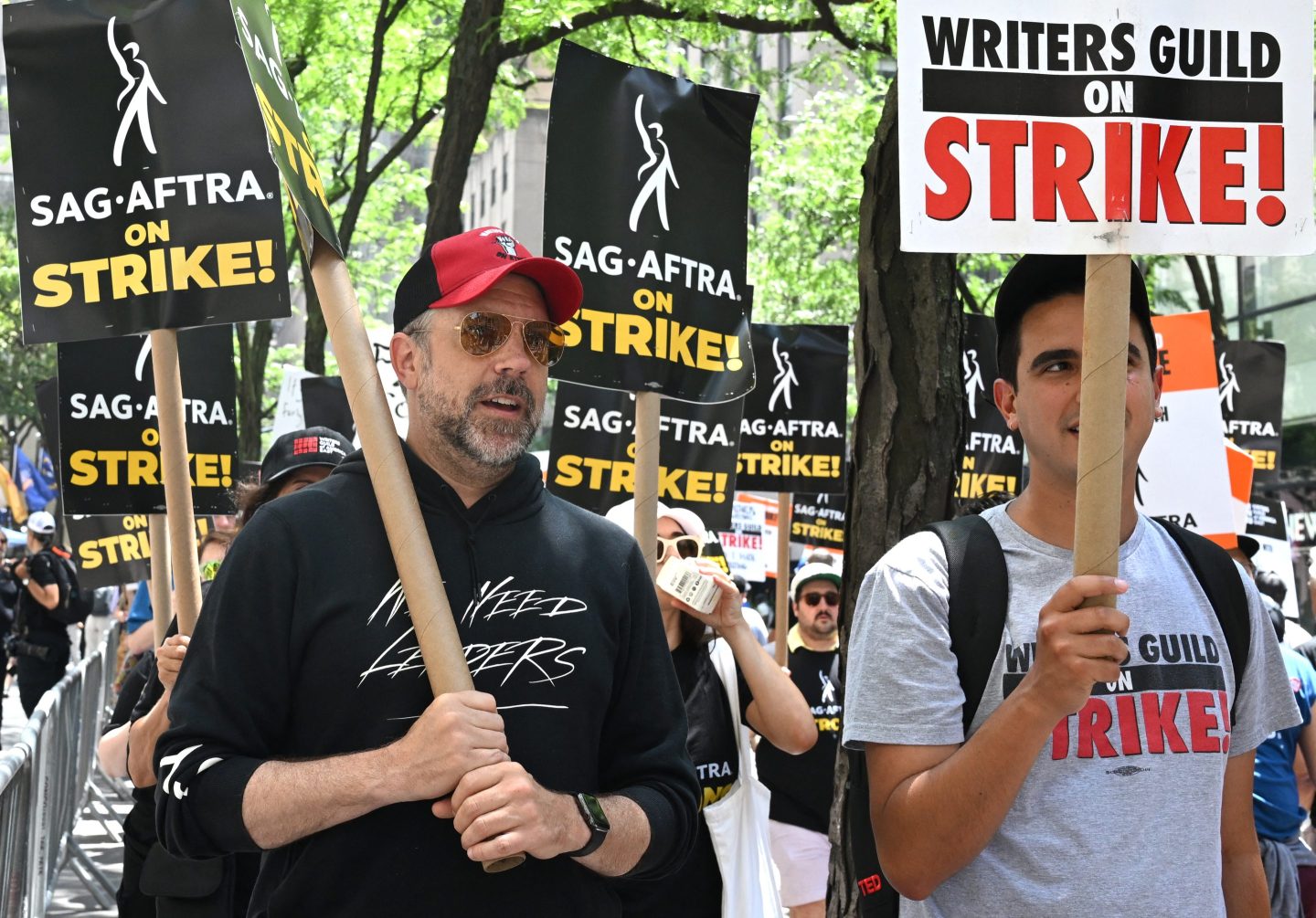
Workers with the Writers Guild of America and SAG-AFTRA are currently on strike, in part over the use of A.I. But the Guild is not fighting to ban its use. On the contrary, writers and actors are on strike to allow them to make measured use of its benefits, but also to contain it to prevent damage to their livelihoods.
Workers’ unions in the energy sector have fought for–and won–what is termed a “just transition” as carbon-based energy jobs are replaced by renewable energy jobs. Under the Inflation Reduction Act, renewable energy jobs–many of which paid a fraction of what oil and gas jobs paid and without the benefits–will become good, union jobs.
And unions continue to fight to reform U.S. labor laws so that workers truly have a free choice to join or form a union, which would outlaw the kind of A.I.-based union busting being pioneered by corporations such as Amazon. Other workers who can benefit from enforcing the fundamental right to unite in the workplace include tech workers themselves, who have been organizing from Google to Microsoft, and whose voices can serve as a guard against A.I. abuse.
A.I. is an amazing advancement, and it is only early in its development. As with any technology, it is up to humans to determine whether change advances civilization by broadly improving life or cripples it with increased inequality. If workers have a strong, united, and collective voice through unions, we will be equipped to harness future technologies to benefit working people and society at large, not only corporations seeking ever greater profits.
One last question for Chat GPT: What did Samuel Gompers, the American labor leader, mean by his famous statement more than 100 years ago that unions wanted “more of the opportunities to cultivate our better natures?”
“In summary, the quote reflects the labor movement’s aspirations for a society that values education, intellectual growth, justice, compassion, and personal fulfillment, aiming to create a better and happier world.” Not bad at all… for a machine.
Edward M. Smith is a former national union leader and currently Chairman and CEO of Ullico Inc., a labor-owned insurance and investment company.
The opinions expressed in Fortune.com commentary pieces are solely the views of their authors and do not necessarily reflect the opinions and beliefs of Fortune.
More must-read commentary published by Fortune:
- ‘The global economy is due for a reality check,’ warns the central banks‘ bank
- A much-feared emerging markets crisis didn’t happen. Is the global economy off the hook?
- ‘The Feckless 400’: These companies are still doing business in Russia–and funding Putin’s war
- Great Place To Work CEO: ‘It’s time to acknowledge why diversity makes us uncomfortable’