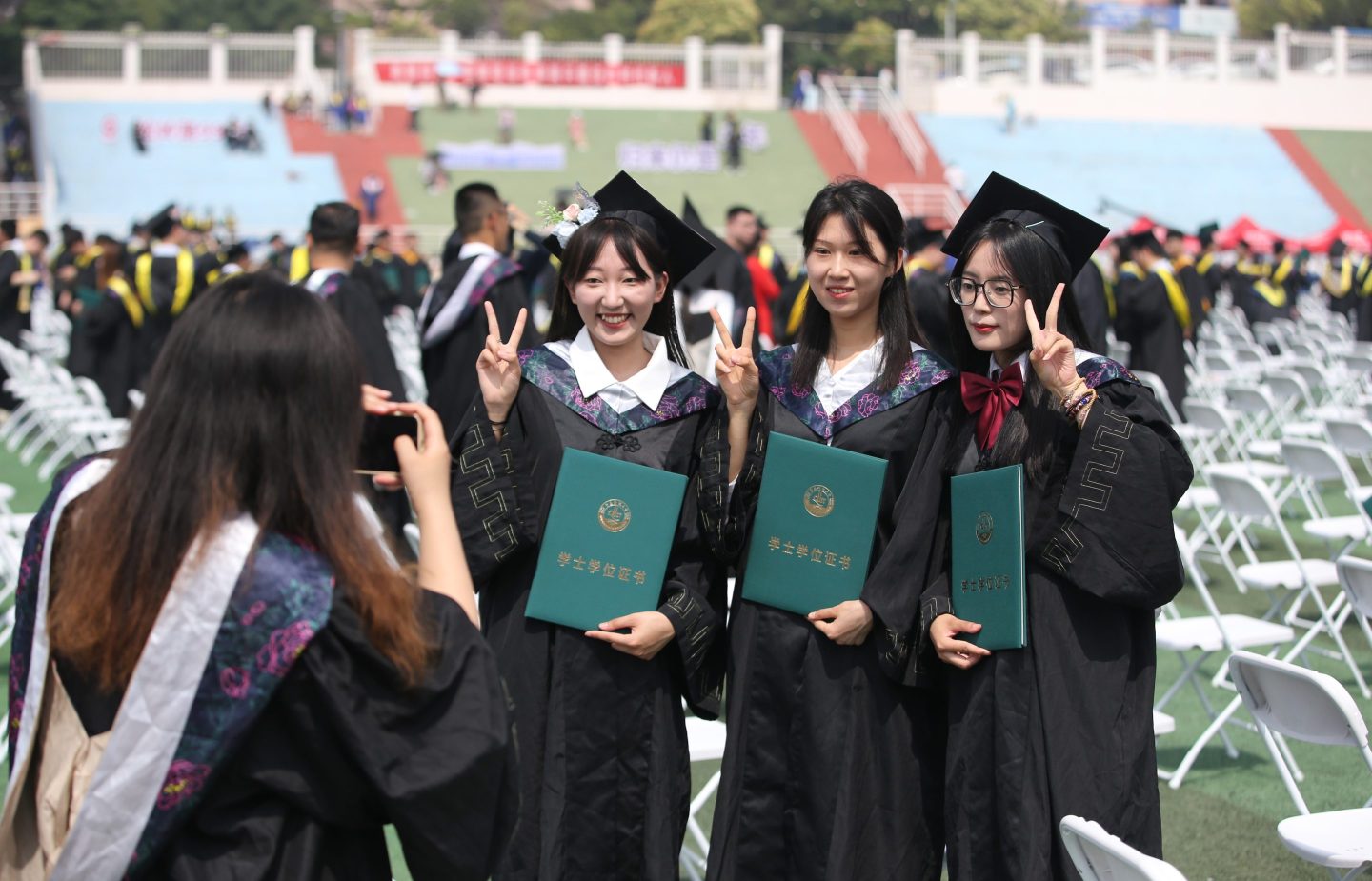
The trouble began in April. That month, Chinese government data showed that one in five young workers—between the ages of 16 and 24—was unemployed, a record high. The next month, it was even worse. The problem is likely to just metastasize over the coming months: Another 11.6 million graduates will leave college in June to a dearth of job openings and a stumbling economy. China’s Gen Z is just like America’s, only much more burned out and with slim economic hopes.
The economic data from the world’s second largest economy is grim reading. Key economic indicators such as retail sales, manufacturing, exports, and investment are still growing, but not meeting the sky-high expectations proclaimed in the immediate aftermath of the country’s reopening from COVID-zero. A surprise plunge in exports in May now means that China is trading less than this time last year—when Shanghai, its busiest port, was in the middle of a two-month lockdown.
Worryingly, China’s youth unemployment rate is surging even as the overall unemployment rate holds steady. Urban unemployment stood at 5.2% in May, while youth unemployment was four times higher at 20.8%.
China’s work culture is famously tough, especially in the tech sector. Internet companies there are renowned for the so-called 996 working culture: working from 9:00 am to 9:00 pm, six days a week. Some young Chinese have even left professional careers for lower-paying manual labor to get out of the country’s tough offices. The surging youth unemployment rate suggests they’re opting out entirely.
President Xi Jinping has resorted to several appeals to young workers to roll up their sleeves and adopt a patriotic hard work ethic, encouraging the young to “eat bitterness”—a Chinese term that connotes grit and enduring hardship—to succeed. In July 2021, at the 100th anniversary of the Chinese Communist Party, Xi said that young people have a responsibility to “rejuvenate the nation,” just like their ancestors did, which involved working tirelessly and struggling even.
But a look at Chinese youth culture shows a “moonlight clan” that is “lying flat” and does not want to eat a “lunch of suffering.” Take a look at China’s Gen Z and the major struggle of their young careers.
‘A piece of blank paper’
The dearth of job openings is fueling a sense of disillusionment among China’s young.
Photos of graduates slumped on the ground, or throwing away their degrees, or digitally inserted in front of a burning building litter the country’s social media, as young Chinese joke that their time spent in higher education was wasted.
Employers are reportedly turning away qualified graduates, fearing that China’s extended lockdowns under COVID-zero have prevented university students from getting important skills and work experience.
“They said I’m a greenhorn. In the words of my interviewer, I am a piece of blank paper without any actual work experience,” Connie Xu, a 22-year-old graduate who has been hunting for jobs, told the South China Morning Post earlier this month.
China’s social media-savvy youth have come up with several new terms to describe the drudgery of everyday working life. There’s the years-old phrase “lying flat,” which long predates the U.S. term “quiet quitting,” for the idea of just doing the bare minimum to get by and rejecting social expectations. There’s the “moonlight clan,” young people who spend their paychecks on small luxuries rather than save for an unattainable standard of living.
Even food is seen through a lens of ennui and absurdity: “white people food” was recently trending on Chinese social media with photos of Western cuisine such as ordinary sandwiches, cucumbers and carrots, as office workers reject the full meals of Chinese cuisine in favor of a “lunch of suffering” at their desks.
What’s causing China’s youth unemployment?
In the immediate term, China’s sluggish post-COVID economic recovery is worsening the youth employment situation.
“Corporates are reluctant to hire because of soft consumer demand, while consumers are reluctant to spend because of [a] weak labor market,” wrote Larry Hu, chief China economist for the Macquarie Group, in a note in mid-June.
The government’s capital-intensive model of development has done little to spur youth employment, says Eswar Prasad, a senior trade policy professor at Cornell University and the former China head for the International Monetary Fund.
“Frictions like skill mismatch, compounded by overall weak employment growth, have dampened employment prospects for Chinese youth,” Prasad told Fortune. “Many youth are caught in the midst of the economy’s transition to a less manufacturing-intensive economy as well as the government’s attempts to reduce inefficient employment levels in bloated state-owned enterprises.”
China’s unemployed youth can be put into two categories, suggests Gerard DiPippo, a senior fellow at the Center of Security and International Studies’ economics program.
“One is the less educated, so those who might not have gone to college, or people that normally would have worked in manufacturing or construction,” DiPippo says, noting that the two sectors are “doing quite badly in China by Chinese standards.” (China’s economy is in the midst of a property bust, hitting home prices and dragging down a major source of wealth for Chinese families).
More educated talent would normally aim for one of China’s tech giants, like Alibaba or Tencent. Yet “they’ve slowed their hiring substantially in recent years,” DiPippo says. He adds that hiring in the gig economy, which also absorbs a lot of young labor, has likely peaked.
Local governments are now proposing different forms of employment to get young people working. In March, Guangzhou—China’s wealthiest province on its southern coast—proposed sending 300,000 unemployed young people to work in the countryside. And at the beginning of June, Henan, China’s third-most populous province, ordered its universities to start a “100-day sprint” to find graduates jobs in state-owned enterprises, government departments and rural projects.
The national government, for its part, has offered a 15-point plan to boost youth employment, including measures like offering subsidies to small- and medium-size enterprises to recruit college graduates, support for aspiring entrepreneurs, and encouraging state-owned enterprises to hire those early in their career.
What else is happening?
Chinese officials recognize that the economic recovery is quickly losing steam. Families are wary of investing in new homes, thanks to the ongoing property bust. Businesses are holding back on investment. And consumer spending is slowing down after an initial post-COVID burst. Banks including Barclays, Goldman Sachs, UBS, and Nomura are all lowering their full-year GDP forecasts for China.
China’s central bank cut a short-term interest rate in mid-June, a signal that the country’s economic policymakers think more stimulus is needed. Beijing will likely continue to cut interest rates, while also offering more tax breaks for consumers and financing for infrastructure, according to a Bloomberg survey of economists.
But there’s an uncomfortable truth: Even if Beijing gets the recovery back on track, the country is not going to grow at the frantic pace reported in the 2000s and 2010s. Even before COVID, China’s GDP growth was slowing, hitting 6.0% in 2019 compared to 9.4% a decade earlier. Most economists think that China will settle at a GDP growth rate between 4% and 5% in the years to come.
A country with moderating growth means fewer jobs—especially skilled jobs—for millions of new Chinese graduates.
“The next few years will be the most challenging period for employment since the start of China’s reform and opening-up policy,” writes Wang Mingyuan, a researcher at the Reform and Development Institute of Beijing, a think tank. Wang’s article, according to Baiguan, a China-focused newsletter that translated the piece into English, is now a popular read among investors and policymakers in China.
Unemployment risks becoming a “pervasive social problem,” Wang warns, “with one in every four or five households having an unemployed member.”
But to get GDP growth–and youth employment—back on track, Beijing will need the help of the private sector. That would shift away from the greater regulations and focus on state-owned enterprises under current President Xi.
“With the labor force shrinking and with public investment proving inefficient and creating financial risks, productivity growth will be crucial to China’s prospects of sustaining decent GDP growth in the coming years,” Prasad said. That means supporting private business, he adds.
Yet for now, China seems wedded to its policies of more moderate stimulus, disappointing both economists and job seekers hoping for a faster economy.
“There are a lot of expectations on the Chinese government to have more stimulus policies,” said Zhu Min, a former official at the International Monetary Fund, at China’s “Summer Davos” event in Tianjin on Thursday.
“I don’t think this is real,” he added.