• Home
  • Latest
  • Fortune 500
  • Finance
  • Tech
  • Leadership
  • Lifestyle
  • Rankings
  • Multimedia
CommentaryLabor

U.S. workforce data is behind the times. It’s time to measure what matters most to the American people

By
Rachel Korberg
Rachel Korberg
and
Jenny Weissbourd
Jenny Weissbourd
Down Arrow Button Icon
By
Rachel Korberg
Rachel Korberg
and
Jenny Weissbourd
Jenny Weissbourd
Down Arrow Button Icon
June 12, 2023, 11:42 AM ET
U.S. workforce data points to a tight labor market–but that doesn't reflect the quality of jobs on offer.
U.S. workforce data points to a tight labor market–but that doesn't reflect the quality of jobs on offer.Mario Tama - Getty Images

On Friday, the U.S. Government released its influential, monthly jobs report, which showed that unemployment rose slightly to 3.7%, but remains close to its recent 50-year low. This simple report–which primarily focuses on the unemployment rate–can cause the stock market to rally or drop, spur a company to offer lower or higher wages, and factor into how the Fed sets interest rates. But the report–like much of our workforce data–hasn’t kept up with the changing realities of the job market, like the explosion of gig work, which goes uncounted. And even though it reports on average wages, it still doesn’t tell us much of what Americans say matters most to them about their jobs: whether the pay is enough to achieve a good quality of life for themselves and their families, if the benefits keep them healthy or let them take a day off when their kid is sick, and if they feel respected and have purpose on the job. 

If we don’t reimagine U.S. workforce data (and soon), it could leave the country behind the times. We’d be less equipped to handle major trends that have already caught many policy and business leaders flat-footed, such as the “Great Resignation,” where 98.3 million people quit their jobs in a two-year period, or the recent precipitous decline of mothers and caregivers in the workforce. In a U.S. economy dominated by services that maintains its competitive edge thanks to the talent and innovation of our workforce, accurately measuring worker experiences is not a “nice-to-have”–it’s key to global competitiveness. 

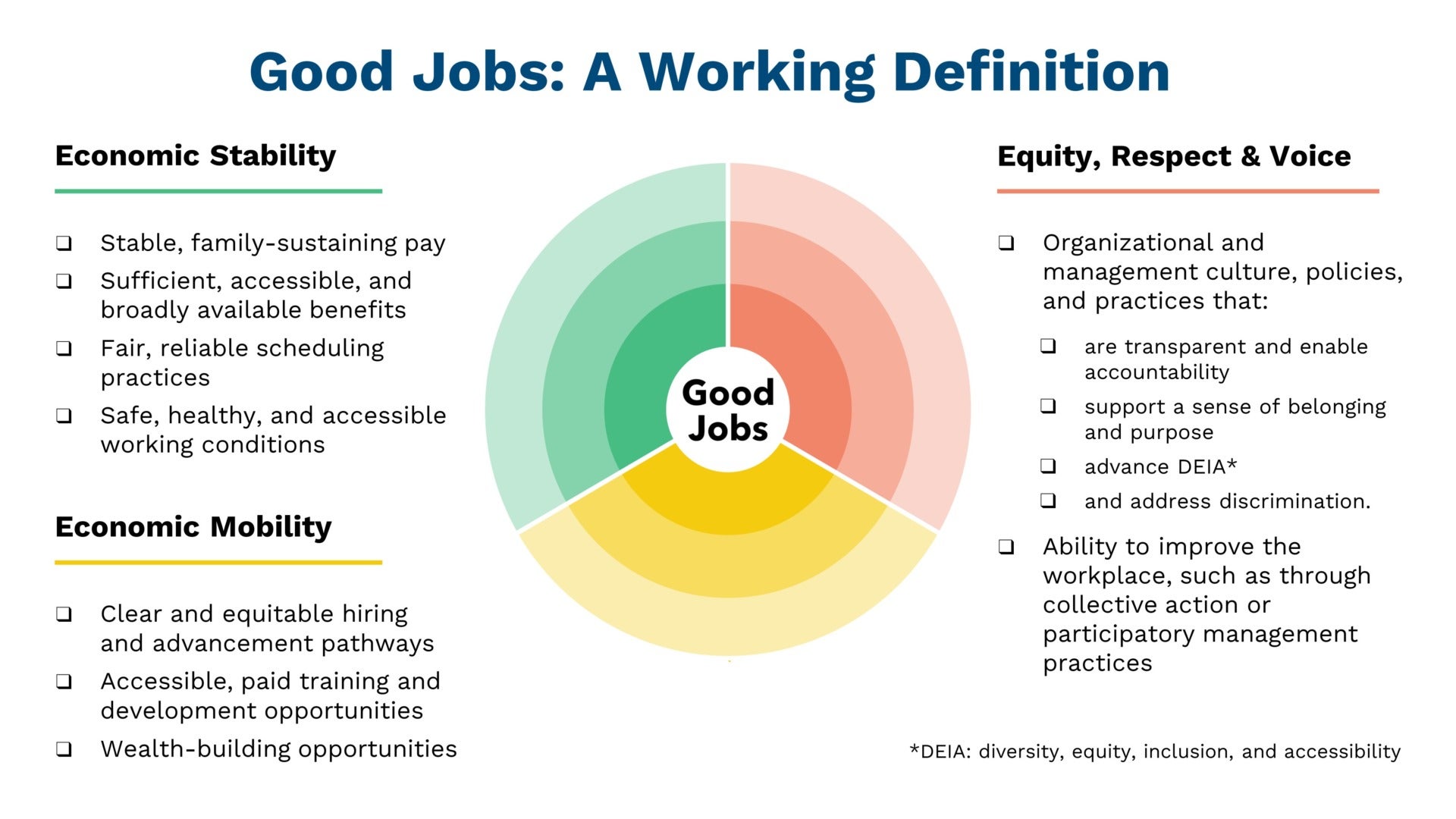
A recent report lays out a pathway the U.S. Government and other data providers could follow to reimagine key datasets to paint a more accurate picture of the U.S. economy and job quality. It calls for regular, systematic data that includes anyone who is working (whether you’re a contract or gig worker or an employee earning W-2 wages) and measures all key aspects of job quality, not just pay. It draws on the most broadly-shared definition of what constitutes a “good job,” signed by a group of nearly 250 leaders in business, labor, education, and policy, from Chipotle to the Service Employees International Union, along with workers themselves. A good job enables you to get by, get ahead, and ensures you have a say.

Statistics can make even the most precarious jobs look like success stories if we only take quantity into account and ignore job quality.

As tornadoes, wildfires, and hurricanes sweep the country, Joel Salazar, 35, is part of the current boom in relief services, a growing sector that looks like a win in the jobs report. He cleans up after natural disasters “to give a hand to communities in need and help them rebuild,” he told us. But in bringing 18 communities back from the brink, Joel has faced dangerous safety hazards that put his health at risk, with low pay, and no benefits.

“When I was sick, the money wasn’t enough to get medications, and I didn’t have any health insurance,” Joel says. He has recently begun organizing other disaster workers like him to improve their jobs through the nonprofit Resilience Force.

These are the stories that U.S. labor market data doesn’t capture systematically. The real-life work experience of millions of Americans has a huge impact on employee productivity, a company’s bottom line, national economic health and security, and the well-being of our families and communities.

Now, it is incumbent upon government and private industry to ensure that our workforce data–including the monthly jobs report–tells a fuller story about working in America. In a recent blog post, leaders at the Department of Labor committed to taking action to measure what matters to workers. Their Good Jobs Initiative has already helped to embed powerful good jobs incentives and measurement opportunities into more than $97 billion in Bipartisan Infrastructure Law grants.

There are concrete steps that we can take to update statistical surveys so they are better able to measure key job characteristics such as benefits, schedule stability, worker voice, and whether equal access to opportunity plays out by race, gender, age, disability, or otherwise. Investors and business leaders can pilot scorecards that simplify data disclosure and help them assess how their jobs stack up to industry peers. And influential media voices can start to cover a more holistic jobs story, moving beyond just employment numbers and pay to whether jobs truly offer dignity and mobility.

We will all benefit from better data. Federal policymakers, and the public, can learn whether the trillions of dollars that the federal government is investing in American industry are delivering on their promise to create good, family-sustaining jobs. Employers and investors can understand how a company’s investments in people add up (or don’t) to a decent quality of life, which evidence shows boosts employee productivity, retention, and the bottom line. And workers can more easily seek out opportunities that improve their lives and their economic contributions.

The next time you read the monthly jobs numbers, be sure to ask what’s not included–and what disruptive trend or big idea you might be missing without more insight into the daily realities of work in America. Let’s make 2023 the year we start measuring the true health of the economy: whether jobs are supporting a competitive U.S. workforce that can get by and get ahead.

Rachel Korberg is the executive director and co-founder of the Families and Workers Fund, a coalition of more than 25 diverse philanthropies working together to build a more equitable U.S. economy that uplifts all. Jenny Weissbourd is a program director with the Families and Workers Fund, where she leads policy and programmatic partnerships. Jenny collaborates with governments, nonprofits, and employers at the federal, state, and local levels to support them in improving jobs and delivering equitable, effective public benefits.

The opinions expressed in Fortune.com commentary pieces are solely the views of their authors and do not necessarily reflect the opinions and beliefs of Fortune.

More must-read commentary published by Fortune:

  • The ‘Elon Paradox’: He sells Teslas–but you’d expect him to drive a Ram. Here’s what your car says about your politics
  • The alt-right economy is failing. Here’s the real performance of anti-woke entrepreneurs
  • The debt ceiling deal has reduced access to supplemental food plans. Here’s why that’s a false economy
  • E-bike injuries: ‘We’re only seeing the tip of the iceberg,’ trauma experts warn
Join us at the Fortune Workplace Innovation Summit May 19–20, 2026, in Atlanta. The next era of workplace innovation is here—and the old playbook is being rewritten. At this exclusive, high-energy event, the world’s most innovative leaders will convene to explore how AI, humanity, and strategy converge to redefine, again, the future of work. Register now.
About the Authors
By Rachel Korberg
See full bioRight Arrow Button Icon
By Jenny Weissbourd
See full bioRight Arrow Button Icon

Latest in Commentary

Finance
Lorem ipsum dolor sit amet, consectetur adipiscing elit, sed do eiusmod tempor incididunt ut labore et dolore magna aliqua. Ut enim ad minim veniam
By Fortune Editors
October 20, 2025
Finance
Lorem ipsum dolor sit amet, consectetur adipiscing elit, sed do eiusmod tempor incididunt ut labore et dolore magna aliqua. Ut enim ad minim veniam
By Fortune Editors
October 20, 2025
Finance
Lorem ipsum dolor sit amet, consectetur adipiscing elit, sed do eiusmod tempor incididunt ut labore et dolore magna aliqua. Ut enim ad minim veniam
By Fortune Editors
October 20, 2025
Finance
Lorem ipsum dolor sit amet, consectetur adipiscing elit, sed do eiusmod tempor incididunt ut labore et dolore magna aliqua. Ut enim ad minim veniam
By Fortune Editors
October 20, 2025
Finance
Lorem ipsum dolor sit amet, consectetur adipiscing elit, sed do eiusmod tempor incididunt ut labore et dolore magna aliqua. Ut enim ad minim veniam
By Fortune Editors
October 20, 2025
Finance
Lorem ipsum dolor sit amet, consectetur adipiscing elit, sed do eiusmod tempor incididunt ut labore et dolore magna aliqua. Ut enim ad minim veniam
By Fortune Editors
October 20, 2025

Most Popular

Finance
Lorem ipsum dolor sit amet, consectetur adipiscing elit, sed do eiusmod tempor incididunt ut labore et dolore magna aliqua. Ut enim ad minim veniam
By Fortune Editors
October 20, 2025
Finance
Lorem ipsum dolor sit amet, consectetur adipiscing elit, sed do eiusmod tempor incididunt ut labore et dolore magna aliqua. Ut enim ad minim veniam
By Fortune Editors
October 20, 2025
Finance
Lorem ipsum dolor sit amet, consectetur adipiscing elit, sed do eiusmod tempor incididunt ut labore et dolore magna aliqua. Ut enim ad minim veniam
By Fortune Editors
October 20, 2025
Finance
Lorem ipsum dolor sit amet, consectetur adipiscing elit, sed do eiusmod tempor incididunt ut labore et dolore magna aliqua. Ut enim ad minim veniam
By Fortune Editors
October 20, 2025
Finance
Lorem ipsum dolor sit amet, consectetur adipiscing elit, sed do eiusmod tempor incididunt ut labore et dolore magna aliqua. Ut enim ad minim veniam
By Fortune Editors
October 20, 2025
Finance
Lorem ipsum dolor sit amet, consectetur adipiscing elit, sed do eiusmod tempor incididunt ut labore et dolore magna aliqua. Ut enim ad minim veniam
By Fortune Editors
October 20, 2025
Rankings
  • 100 Best Companies
  • Fortune 500
  • Global 500
  • Fortune 500 Europe
  • Most Powerful Women
  • Future 50
  • World’s Most Admired Companies
  • See All Rankings
Sections
  • Finance
  • Leadership
  • Success
  • Tech
  • Asia
  • Europe
  • Environment
  • Fortune Crypto
  • Health
  • Retail
  • Lifestyle
  • Politics
  • Newsletters
  • Magazine
  • Features
  • Commentary
  • Mpw
  • CEO Initiative
  • Conferences
  • Personal Finance
  • Education
Customer Support
  • Frequently Asked Questions
  • Customer Service Portal
  • Privacy Policy
  • Terms Of Use
  • Single Issues For Purchase
  • International Print
Commercial Services
  • Advertising
  • Fortune Brand Studio
  • Fortune Analytics
  • Fortune Conferences
  • Business Development
About Us
  • About Us
  • Editorial Calendar
  • Press Center
  • Work At Fortune
  • Diversity And Inclusion
  • Terms And Conditions
  • Site Map
  • Facebook icon
  • Twitter icon
  • LinkedIn icon
  • Instagram icon
  • Pinterest icon

Latest in Commentary

powell/trump
CommentaryFederal Reserve
Is Powell’s Fed head independence dead? Trump outfoxes himself this time
By Jeffrey SonnenfeldJanuary 13, 2026
8 hours ago
paramount
CommentaryM&A
A cautionary Hollywood tale: the Ellisons’ lose-lose Paramount positioning
By Jeffrey Sonnenfeld and Stephen HenriquesJanuary 12, 2026
1 day ago
Walken
Commentarybeverages
Molson Coors CEO: We’re doing our part to solve society’s ‘occasion problem’ – and we’re getting some unexpected help
By Rahul GoyalJanuary 12, 2026
1 day ago
AsiaChina
What global executives need to ask about China in 2026
By Joe Ngai and Jeongmin SeongJanuary 11, 2026
2 days ago
Justin Harlan
Commentaryremote work
I run one of America’s most successful remote work programs and the critics are right. Their solutions are all wrong, though
By Justin HarlanJanuary 11, 2026
2 days ago
Gene Ludwig
Commentaryaffordability
Millions of Americans are grappling with years of declining economic wellbeing and affordability needs a rethink
By Gene Ludwig and Shannon MeyerJanuary 11, 2026
2 days ago

Most Popular

placeholder alt text
Economy
Treasury spent $276 billion in interest on the national debt in the final three months of 2025, says the CBO—up $30 billion from a year prior
By Eleanor PringleJanuary 12, 2026
1 day ago
placeholder alt text
Economy
‘Sell America’: Investors dump U.S. assets in fear of the end of Fed independence
By Jim EdwardsJanuary 12, 2026
1 day ago
placeholder alt text
Newsletters
The oil CEO who stood up to Trump is a follower of the disciplined 'Exxon way' and has a history of blunt statements
By Jordan BlumJanuary 13, 2026
10 hours ago
placeholder alt text
Success
An exec at $62 billion giant Colgate says Gen Z workers, despite getting flak for being woke and lazy, are actually ‘pushing us to get better’
By Emma BurleighJanuary 10, 2026
3 days ago
placeholder alt text
Tech
Elon Musk asked people to upload their medical data to X so his AI company could learn to interpret MRIs and CT scans
By Sasha RogelbergJanuary 11, 2026
2 days ago
placeholder alt text
Real Estate
'Something big' just happened in the U.S. housing market, real estate CEO says. And it could mean the difference of being able to buy a home or not
By Sydney LakeJanuary 12, 2026
1 day ago

© 2025 Fortune Media IP Limited. All Rights Reserved. Use of this site constitutes acceptance of our Terms of Use and Privacy Policy | CA Notice at Collection and Privacy Notice | Do Not Sell/Share My Personal Information
FORTUNE is a trademark of Fortune Media IP Limited, registered in the U.S. and other countries. FORTUNE may receive compensation for some links to products and services on this website. Offers may be subject to change without notice.