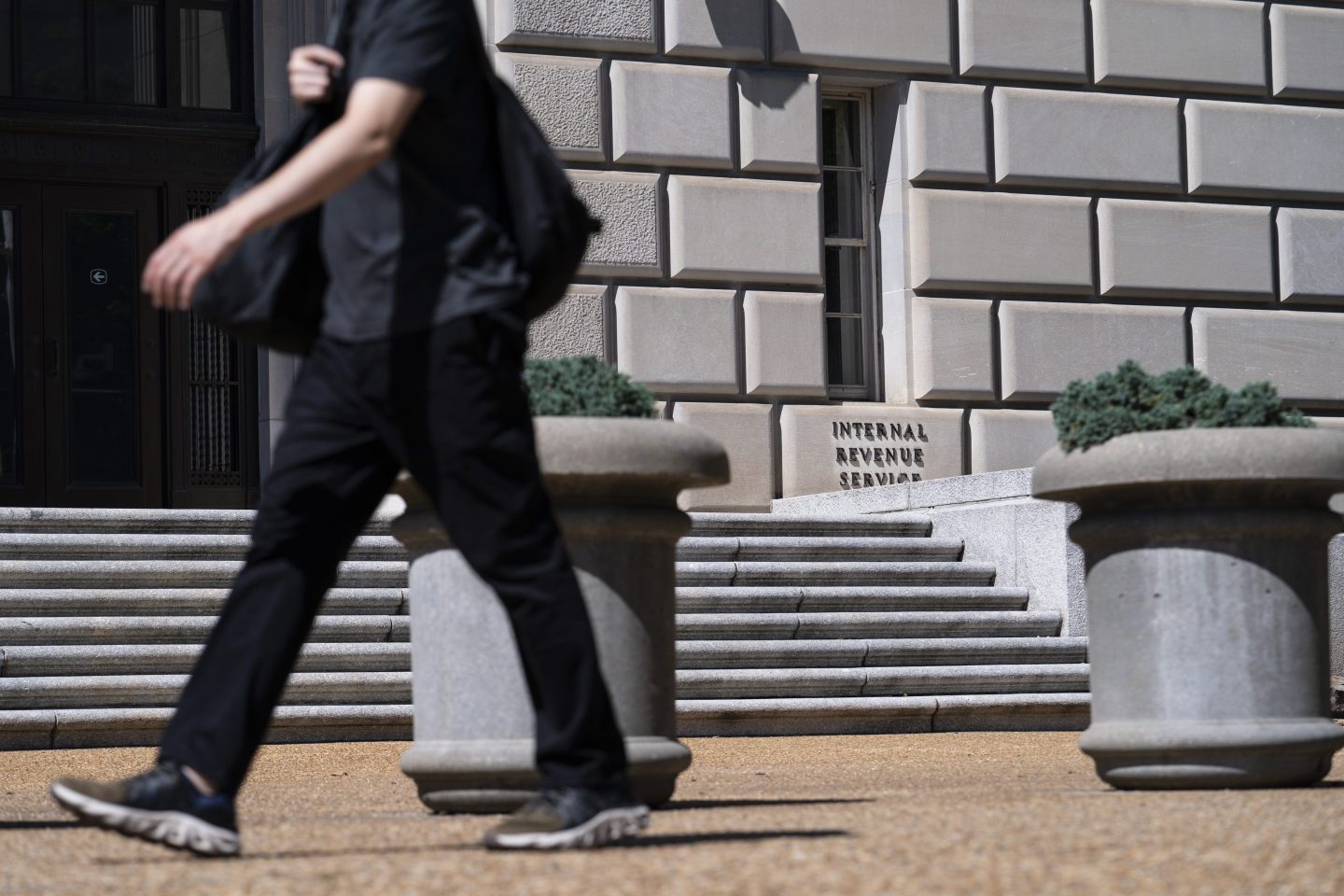
Depending on whom you ask, Biden’s mission to add billions of dollars in funding for the IRS is either absurd or brilliant. The White House says additional IRS funding is needed to “finally [crack] down on high-income individuals and corporations who too often avoided paying their lawfully owed taxes and improve service for the millions of Americans that do pay their taxes.” The other side of the aisle calls it an “absurd” way to create a “supercharged IRS.” Either way, it looks like the recent budget deal gives the naysayers their way, for the moment. It also leaves the question outstanding: Is there any way to solve the tax gap–hundreds of billions of dollars annually that are owed but not paid?
No matter your perspective on who should pay what in taxes, all American taxpayers should agree that we want the rules to be followed equally. Our system relies on voluntary compliance. Much like the cashbox by a roadside farm stand, you take an apple, you leave the money.
The latest estimate from IRS puts the gross tax gap at nearly $500 billion. (A good sign of why IRS funding is needed? The most recent estimate covers only 2014-2016.) It’s a shocking number. Biden’s idea was that by infusing more cash into the IRS, he can hire more agents and recoup some of the money owed. Experience has shown resources put into tax compliance pay for themselves and then some by narrowing the tax gap. One of the authors was a trial attorney in the Tax Division at Justice Department, where the typical return on investment was nearly ten dollars recovered for every dollar spent.
The extra funding is off the table for now, but there is an even more cost-effective way of finding that lost cash that no one is talking about: whistleblower rewards. The IRS has a whistleblower program that has generated big revenues for the government by paying out 15-30% of the funds recovered. That’s a pretty low price tag for closing the gap, particularly because the IRS only pays when money is actually recovered. While the IRS whistleblower program has returned vast sums to the public, the program lacks some key features that could make it far more effective.
There have been some early signs of real improvement under the new director, who seems to be setting it on a better course.
Speed it up
Currently, the average time from a whistleblower’s tip to the IRS to an award is over 10 years. Stories of whistleblowers who died while waiting to find out if their risk and sacrifice for coming forward was successful abound. The agency has been taking some steps to accelerate the administrative process, and it should continue to look for any other possible ways to make it more efficient. Extra funding can breathe new life into that program by increasing staffing and breaking the logjam of cases. The IRS should also explore partial payments when portions of claims become ripe, by considering disaggregating them by taxpayer, year, and even type of collected funds (criminal v. civil, for example).
Recognize that whistleblowers are on the same team
Whistleblowers and their counsel want to help the government recover unpaid taxes. Let us. Collaboration between whistleblowers, their counsel, and the government is a hallmark of every other major whistleblower program.
Recent statutory changes have made it even easier for the IRS to leverage the expertise and brainpower of whistleblowers and their counsel during the process of developing their tips into solid audits and recoveries. However, some of the most experienced whistleblower counsel are telling us it’s still not the case. This requires more than just the positive changes we anticipate in the whistleblower office; it requires the whole agency to welcome the contributions of whistleblowers to its mission.
Stop fighting meritorious whistleblowers
The law creating the IRS whistleblower program gives whistleblowers the right to appeal the IRS’s determination over whether and how much of an award the whistleblower should receive. But legal counsel for the IRS, the Office of Chief Counsel, has sought to block nearly all of these appeals on flimsy jurisdictional grounds. The D.C. Circuit recently stopped the most aggressive version of this move, but the problems don’t stop there.
IRS lawyers regularly slow-roll cases, dragging out a whistleblower’s journey even further. This is not to say every whistleblower appeal is meritorious. Many are not. But the government’s goal should never be winning for winning’s sake–it should be getting the right answer about whether a whistleblower deserves an award, and if so, the proper amount. The IRS attorneys’ practice of making these appeals as onerous as possible for whistleblowers has had the unfortunate effect of eroding trust in the whistleblower program as a whole.
Generating revenue for the country is an issue that enjoys rare bipartisan support–the government needs to make it clear that there is political will to bring to these cases. The IRS can take a page from the SEC’s book here–and be an agency that gets behind the program.
Since 2010 when The Dodd-Frank Act added healthy whistleblower rewards and protections to incentivize people with knowledge of securities fraud to come forward, the SEC’s program has been overwhelmingly successful. The SEC’s 2022 report by the Whistleblower’s Office notes that they continue to see record numbers of tips coming in. Information from whistleblowers brought in “more than 6,099 tips and $6.3 billion in total monetary sanctions” and “$4.0 billion in disgorgement of ill-gotten gains and interest” in the last year alone. Just recently, they set a new record with a blockbuster $279 million award.
By contrast, the IRS program is in decline. Rewards to whistleblowers by the IRS have actually been going down over the past few years. If the IRS were to inject life and political will into its whistleblower program, it would be even easier for them to root out tax evasion and other violations, because under the IRS provisions, you don’t even have to prove fraud, you only have to prove a violation.
By taking these steps, the new leadership at the IRS whistleblower office can continue injecting life and political will into their program. And doing so will greatly help the IRS root out tax evaders and close the tax gap.
It’s important to remember that whistleblower reward programs encourage people to report large and complex schemes, not accidental underpayments by everyday Americans. IRS whistleblower awards are typically paid only when the amount of disputed tax is at least $2 million. Whistleblowers generally expose the big evaders who are armed with offshore shell companies and tricky accounting–and these are precisely the schemes that the IRS has difficulty detecting without an insider’s help.
Recognizing this, many states are now offering their own whistleblower rewards to protect their tax revenue. And as expected, it’s proving very lucrative. New York State has already had big successes, recovering $330 million from Sprint and $105 million from a hedge fund based on whistleblower cases under its False Claims Act. DC has just launched a similar program. Maryland has recently started one modeled off the IRS, though hopefully with a more streamlined approach. These programs reflect a growing consensus that whistleblowers can play a key–and cost-effective–role in protecting the public purse.
Surely even in a politically divided climate, we can agree that if we are using tax dollars to find unpaid taxes, getting the best return on investment would be desirable. We must incentivize those with inside information to expose the big players who have robbed the country of billions of dollars.
Chris McLamb and Mike Ronickher are attorneys in the whistleblower practice at Constantine Cannon.
The opinions expressed in Fortune.com commentary pieces are solely the views of their authors and do not necessarily reflect the opinions and beliefs of Fortune.
More must-read commentary published by Fortune:
- The ‘Elon Paradox’: He sells Teslas–but you’d expect him to drive a Ram. Here’s what your car says about your politics
- The alt-right economy is failing. Here’s the real performance of anti-woke entrepreneurs
- The debt ceiling deal has reduced access to supplemental food plans. Here’s why that’s a false economy
- E-bike injuries: ‘We’re only seeing the tip of the iceberg,’ trauma experts warn