
Good morning.
A year ago when I first spoke with David Wyshner, CFO of tech company Kyndryl, he was spending a great deal of his time working to attract new investors. Existing as a legacy spinoff from IBM, and going public without the benefit of an IPO meant having to come up with an effective way to start telling the company’s story in order to survive. Fast forward to today, Kyndryl is now one of the largest corporations in the U.S. by revenue, propelled by a three-part strategy that’s also led to millions in cost savings.
Kyndryl Holdings landed at No. 225 on the 2023 Fortune 500 list, generating revenue of $18.3 billion in 2022. The revenue threshold for making the Fortune 500 list was $7.2 billion this year, up 13% from a year ago.
Kyndryl is IBM’s previously managed IT infrastructure services business. It was officially spun off from the tech giant in November 2021, making 2022 its first full year as an independent company trading on the New York Stock Exchange under the ticker KD. Kyndryl’s chairman and CEO is Martin Schroeter, a former CFO at IBM. The company claims to be the world’s largest IT infrastructure services provider. Deutsche Bank is just one of the large financial institutions on its roster of clients.
Three-A strategy
Kyndryl faced an uphill battle, saddled with 40% of its contracts that were making little or no profit at the time of the spinoff. A year ago, Kyndryl executives, led by Schroeter, initiated a plan to position the company for long-term sustainable, profitable growth, Wyshner says.
“We laid out a series of strategies called the ‘Three A’s’: going after alliances, advanced deliveries, and accounts,” he says. “We put numbers associated with them in terms of what they can contribute over time. And we said we’re going to report on these metrics each quarter and each year so that people could see our progress.”
Is he sharing the Three A’s strategy in his storytelling to investors? “So much so, that the joke with my investor relations team is that we’re going to dress up as the Three A’s for Halloween,” Wyshner quips. But the strategy, “I think really resonates with our shareholders because they see how the combination of them can really have a transformational impact on us as a company,” he says.
When it comes to alliances, “it’s moving from having been an IBM captive to working with a broader range of leading technology providers,” Wyshner says. Kyndryl had $1.2 billion in signings with cloud hyper-scalers (or massive cloud providers), taking advantage of alliances with AWS, Microsoft, and Google Cloud. This exceeded the company’s billion-dollar target.
Kyndryl is striving to emerge from a legacy of past IBM contracts and eventually move toward a hybrid infrastructure and more efficiency. To take full advantage of customers’ need to modernize and move to the cloud, Wyshner has steadily invested in training. Team members, called “Kyndryls,” now have more than 35,000 certifications on the major cloud platforms, a 100% increase from a year ago, according to the company.
Regarding advanced delivery of information to customers, Kyndryl has redeployed more than 5,500 delivery professionals to serve new revenue streams and backfill attrition. This resulted in annualized savings of $275 million versus a $200 million target, Wyshner says.
“With advanced delivery, we can be even better in terms of the infrastructure services we provide our customers, and we can reduce our costs at the same time,” he says.
With the accounts initiative, Kyndryl is making progress in addressing elements of its business with substandard margins, and helping modernize its clients’ IT systems, with applications like Kyndryl Consult. There was $210 million in annual savings from the accounts initiative versus a $200 million target, Wyshner says.
“It’s really satisfying to see our organization rally around a set of initiatives,” he says. “We communicated them clearly internally, and had people delivering on them in ways very consistent with the faster, more focused culture that we’re striving for.”
But getting an organization with about 90,000 employees worldwide on the same page during a transformation can have its challenges. “Cultural change takes time,” Wyshner says. “But we’re committed to that.” Becoming an independent company, moving off of several hundred IBM systems, and developing new ways of doing things is no small feat. “It’s been a lot of work, but I think it’s really exciting to tackle,” he says.
As the company works its way through legacy contracts, Wyshner is looking forward to the progress of the Three A’s over time, and “the best ways to tell that story,” he says.
Sheryl Estrada
sheryl.estrada@fortune.com
Big deal
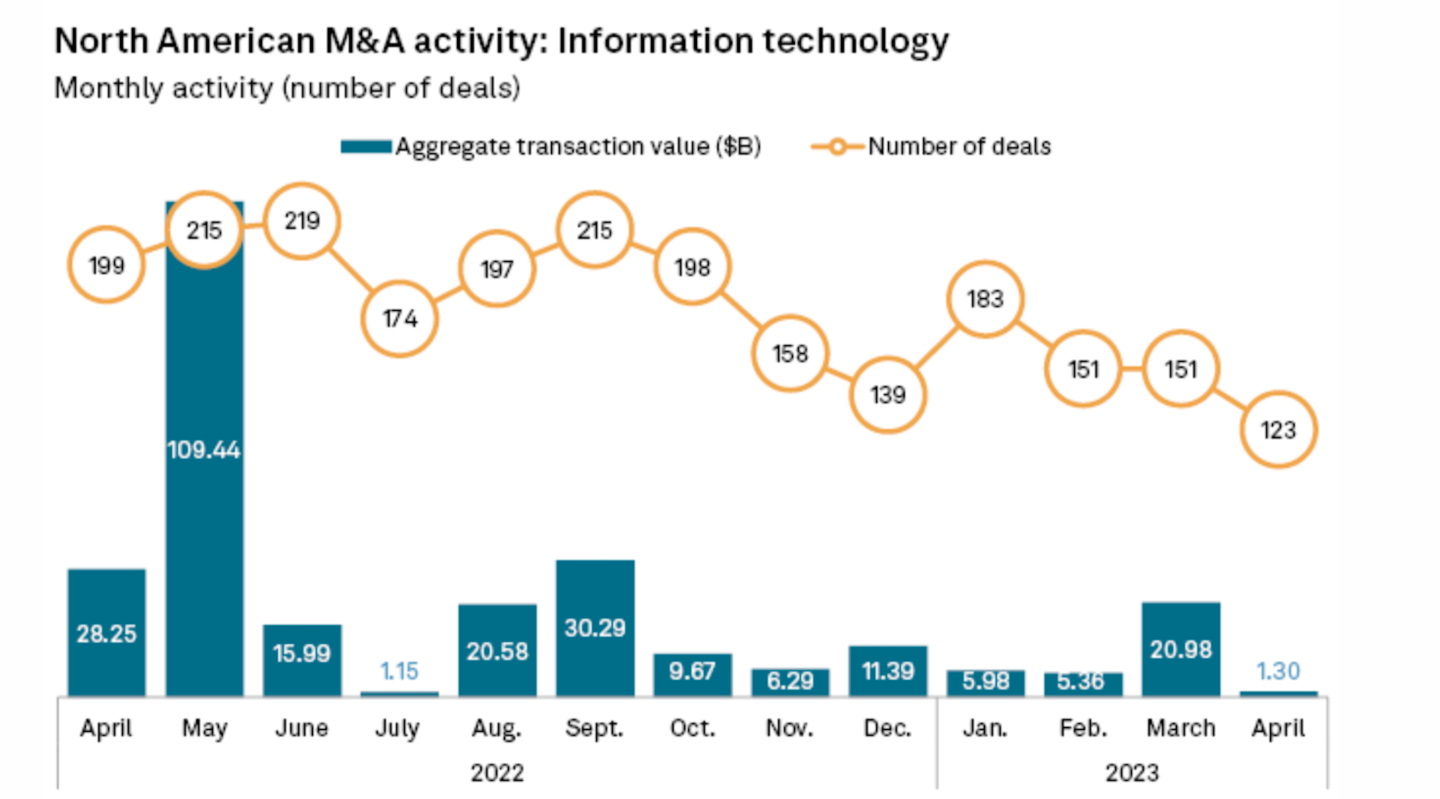
A new S&P Global Market Intelligence report found IT companies in North America saw decreased M&A activity in April compared to the same period in 2022. In April, there were 123 M&A transactions announced worth a total of $1.30 billion. In comparison, in April 2022, there were 199 deals struck with a total value of $28.25 billion, according to the report.
Going deeper
"Why Conflicting Ideas Can Make Your Strategy Stronger," a new report in Harvard Business Review, argues that successful strategies are those conceived as portfolios of options as opposed to roadmaps. To create these strategies, "managers must embrace incompatible and misaligned ideas, communicate multiple and conflicting narratives, and share ideas as they think of them as opposed to the traditional sequence of thinking then sharing," according to the report. And to do this—leaders must create a culture in which people can disagree without being punished for it, the research finds.
Leaderboard
Ravit Ram was promoted to CFO at Motus GI Holdings, Inc. (Nasdaq: MOTS), a medical technology company, effective immediately. Ram’s appointment is part of the previously announced transition plan for Andrew Taylor, who stepped down as CFO on June 2 to pursue other opportunities. Ram brings more than 20 years of experience to the role. Most recently, she served as a senior member of the Motus GI management team, including site manager, and VP of global operation and finance, since 2018. Before Motus GI, she served as a site manager, and VP of finance and supply chain at EndoChoice, an international medical technology startup that was acquired by Boston Scientific. Before that, Ram served as global director of operations and controller at Given Imaging, which was acquired by Medtronic.
Vikas Mehta was named CFO at Komodo Health, a health care technology company. Mehta brings more than two decades of experience. He was central in digital transformation at Fortune 50 companies including Nike, Walmart, Microsoft, and Paypal. Most recently, Mehta served as the CFO of Anaplan, where he was responsible for finance, audit, legal, procurement, investor relations, accounting, and strategy. Before Anaplan, he was CFO of Nike Direct, where he provided leadership and direction across the supply chain and finance functions to drive digital transformation during the height of the pandemic.
Overheard
“Vision Pro is something that investors will need to try before they believe. There are so many questions I have, that may take months to answer as content and applications build.”
—Gene Munster, a longtime Apple analyst at Deepwater Asset Management, wrote on Twitter. On Monday, tech giant Apple made the highly-anticipated unveiling of its Vision Pro headset that can "transport users into a movie theater or replay a fond, recorded memory of a child’s birthday party—all without having to leave their living rooms," Fortune reported. The new headset catapults Apple into a new product line—its first addition in years.
This is the web version of CFO Daily, a newsletter on the trends and individuals shaping corporate finance. Sign up to get CFO Daily delivered free to your inbox.