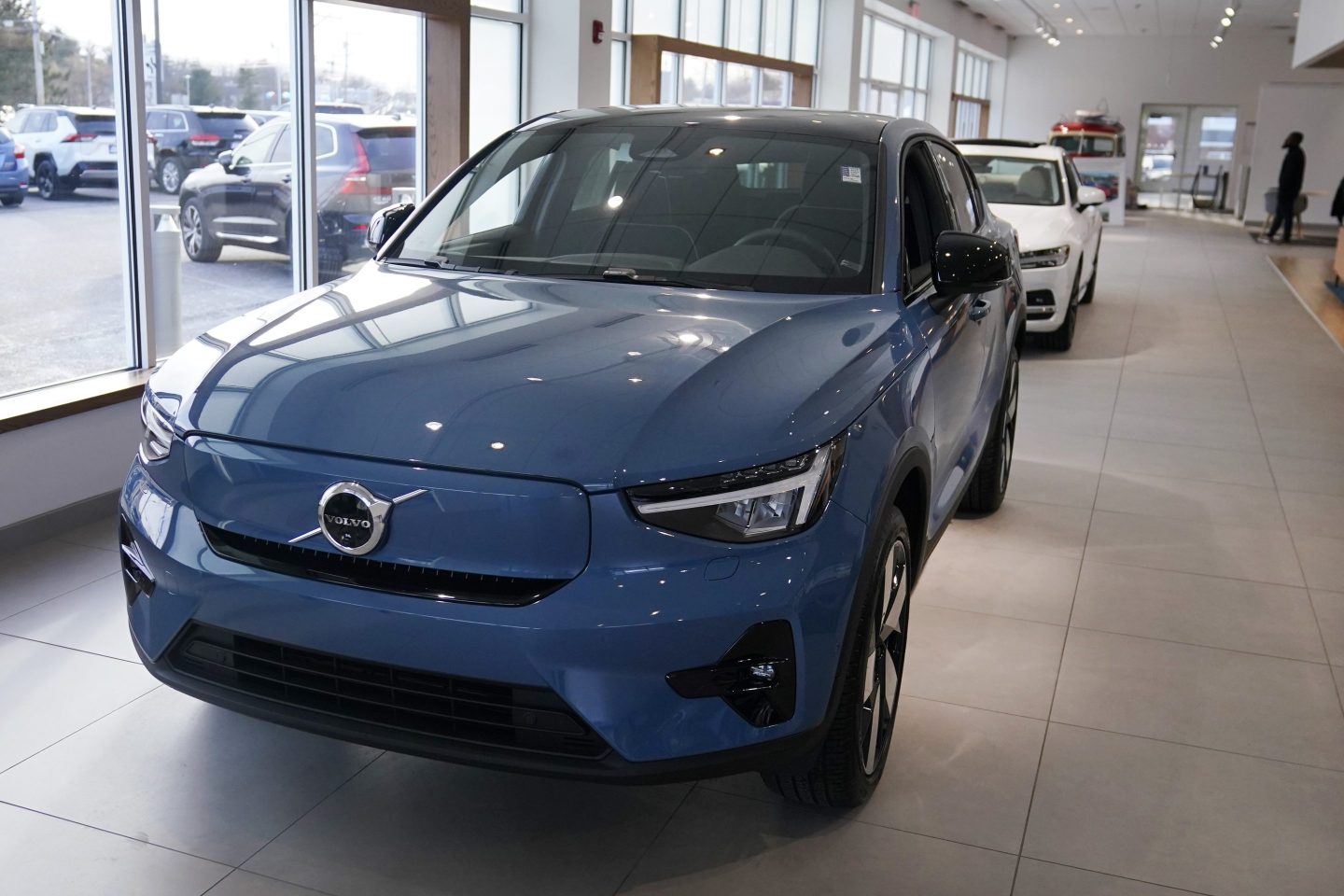
Thanks to a boost from the government, leasing — not buying — is becoming the most affordable way to get your hands on an electric vehicle.
Last year’s Inflation Reduction Act provided a federal tax credit of up to $7,500 to use toward an EV. Under the rules, a dealer can apply that credit to any leased electric vehicle, no matter where it’s made, to reduce a customer’s monthly payment.
Not so for people who buy an EV.
For buyers, only EVs made in North America qualify for the full tax credit. And only 10 of the 49 electric vehicles for sale in the United States this year meet that requirement. Even then, the EV must contain certain percentages of battery parts from the United States or countries with which it has a trade deal for the buyer to receive a full $7,500 credit.
Why the distinction between leased and purchases vehicles?
The Treasury Department says that in establishing the tax credit, Congress classified leased — but not purchased — EVs as “commercial” vehicles. Under the law, commercial vehicles are exempt from the North America manufacturing and battery-content requirements. The result is that people who lease enjoy a much wider selection of EVs that qualify for the $7,500 credit.
“Lease affordability has surpassed purchase affordability” in a J.D. Power index that includes total cost of ownership, said Elizabeth Krear, vice president of the EV practice at J.D. Power.
Many consumers have become aware of the difference and are capitalizing on it. In April, Krear said, leases accounted for 41% of all U.S. EV deliveries — four times the percentage in December, before the new rules took effect.
Geoff Pohanka, president of a 21-dealership group in Maryland, Virginia and Texas, said he is anticipating an increase in leasing. Buyers, he predicts, will increasingly recognize that the tax credit will help defray the typically substantial cost difference between an EV and a similar gas-powered vehicle.
“It definitely makes sense,” he said. “Incentives can move the market if that narrows the affordability issue between gas and electric cars.”
Pohanka, whose group sells vehicles from multiple automakers, said the tax credits have just begun to lower the cost of leasing. Still, the rules governing the credit are complex enough that some buyers appear unsure if they would qualify for it. The rules not only make distinctions between leased and purchased vehicles. They also include income thresholds that disqualify some buyers.
To qualify for the tax credit, a car cannot cost more than $55,000. SUVs, pickups and vans can’t exceed $80,000. And a buyer’s gross income must be no more $150,000 if single, $300,000 if filing jointly and $225,000 if head of a household.
Given the confusion he has noticed among customers about qualifying for the tax credit, Pohanka said some EVs are sitting longer on dealer lots than they otherwise would.
“This disruption, I think, is very damaging to the momentum on electric vehicles,” he said.
Critics, including some lawmakers on Capitol Hill, say they regard the Treasury rules that allow many leased, but not purchased, EVs to receive the full tax credit to be an unfair loophole. They argue that it benefits automakers that produce all their vehicles overseas and have yet to build EV and battery factories in the United States. These foreign manufacturers, they say, can devote themselves to leasing EVs in the United States at the expense of domestic automakers.
Sen. Joe Manchin, a West Virginia Democrat and a key author of the tax-credit language, wanted the North American manufacturing requirement to help boost U.S. manufacturing jobs. He included the battery requirements to incentivize companies to build a domestic EV supply chain. But Manchin says the Biden administration is circumventing the law’s intent by allowing tax credits for vehicles manufactured overseas.
“The administration continues to ignore the purpose of the law, which is to bring manufacturing back to America and ensure we have reliable and secure supply chains,” he said in a statement.
Foreign automakers had complained that they were excluded from the tax credit for buyers despite doing what the bill intended — building U.S. battery and assembly plants.
The Treasury Department denies creating a loophole and says it was Congress that exempted commercial vehicles from the manufacturing and battery requirements. When a dealer buys a vehicle and leases it to someone, it amounts to a commercial transaction. The dealer or a finance company receives the tax credit and retains ownership of the vehicle.
“Eligibility for the commercial vehicle credit is a straightforward reading of the Inflation Reduction Act as written by Congress and application of longstanding tax law regarding leased assets,” Ashley Schapitl, a spokeswoman, wrote in a statement. “There was no room for Treasury interpretation.”
Hyundai, with three EV models made in South Korea and for sale in the United States, is among the beneficiaries of the leasing provision. A spokesman for the Korean automaker said that leases amounted to 30% of its U.S. EV deliveries in the United States from January through March. In 2022, that proportion was only 5%.
The average monthly ownership cost on an EV leased for three years has dropped $403 since December, largely because of the tax credits, J.D. Power found. By contrast, for an EV purchase financed over five years, the average monthly cost has declined by only $118.
Hyundai is offering to lease an Ioniq 5 SE rear-wheel-drive EV for $499 a month for three years, though the customer must put down nearly $4,000. Buying the same EV would cost $865 a month for five years at the average new-auto loan rate of 7%.
Though it may be cheaper, leasing won’t fit into everyone’s financial plans. Unlike with a purchase, monthly payments don’t end when a loan is paid off.
Experts note, too, that not everyone who leases an EV will receive the tax credit, even if they qualify for it. The automakers and dealers are allowed to decide whether to pass along the tax credit to their customers; they aren’t required to do so.
Krear said some companies are passing the entire $7,500 credit on to qualifying consumers, thereby reducing their monthly payments. Others are passing on only a portion of it.
Eventually, as automakers make adjustments to comply with the North American manufacturing and battery-composition requirements, buying an EV could cost less than leasing over the long run, Krear said, though there are too many variables to predict when that might happen.
“At that time, it will be a different playing field,” she said.