In 1989, New York real estate developer Seymour Durst commissioned Manhattan’s now-famous National Debt Clock. He wanted to highlight how much the national debt rose during the Reagan administration and call attention to the huge debt being passed on to future generations. But even a debt critic like Durst underestimated how much America loves spending, as it took less than 20 years for the unofficial tracker to run out of digits as the country’s bill surpassed $10 trillion in 2008. The debt has continued to rise since then, and in January breached the $31.4 trillion ceiling set by the current debt limit, a century-old political tool that now has Congress and the White House scrambling for a solution. Republicans argue that debt is a burden for future generations, but some experts say the standoff could be the bigger threat, as yet another ominous clock ticks towards an unprecedented default on the government’s debt.
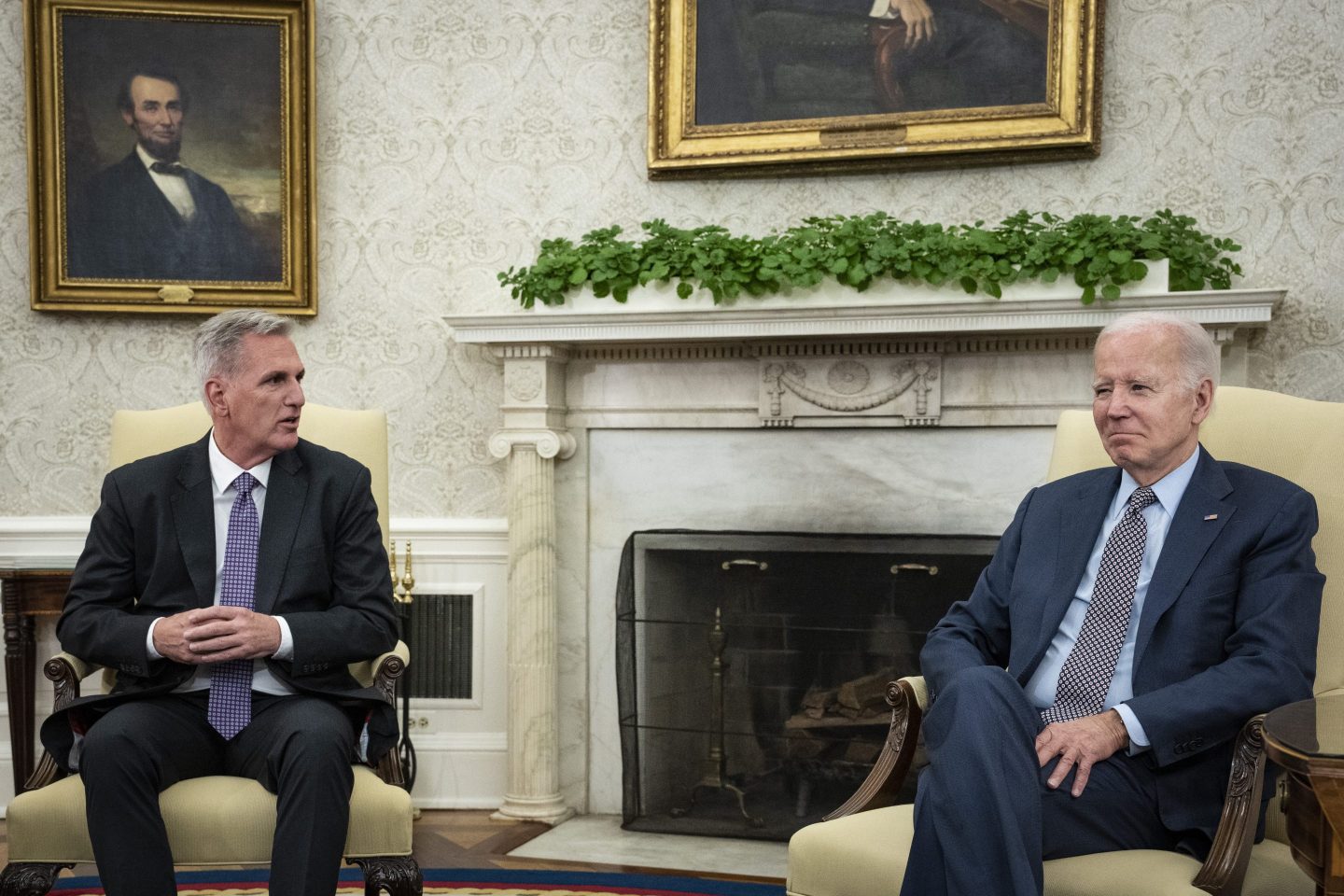
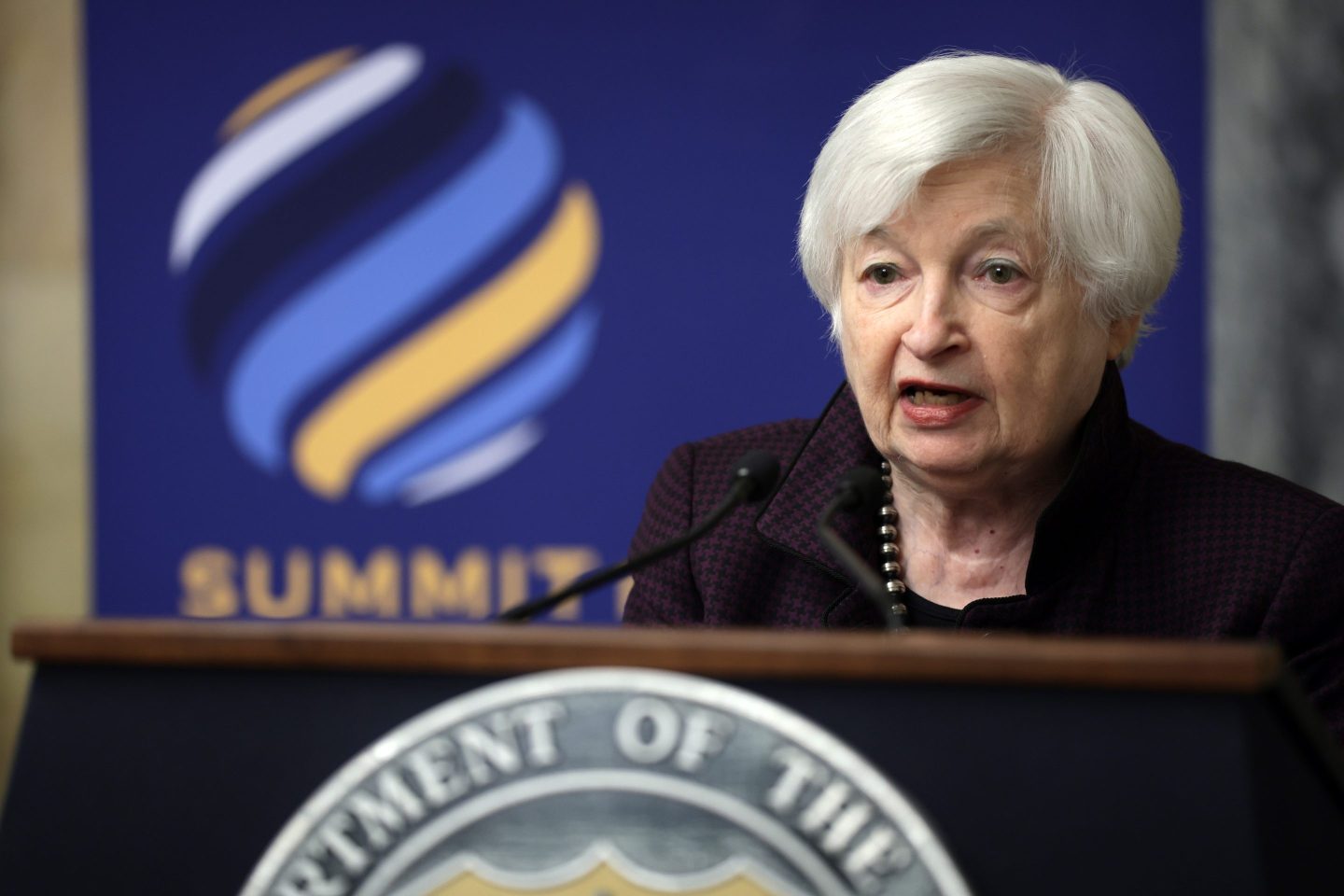
Talks between President Joe Biden and Republican House Speaker Kevin McCarthy to raise the debt ceiling so the government can continue borrowing money to pay its bills are progressing slowly. Time is running short, as the Treasury could run out of cash as early as June 5, according to Treasury Secretary Janet Yellen.
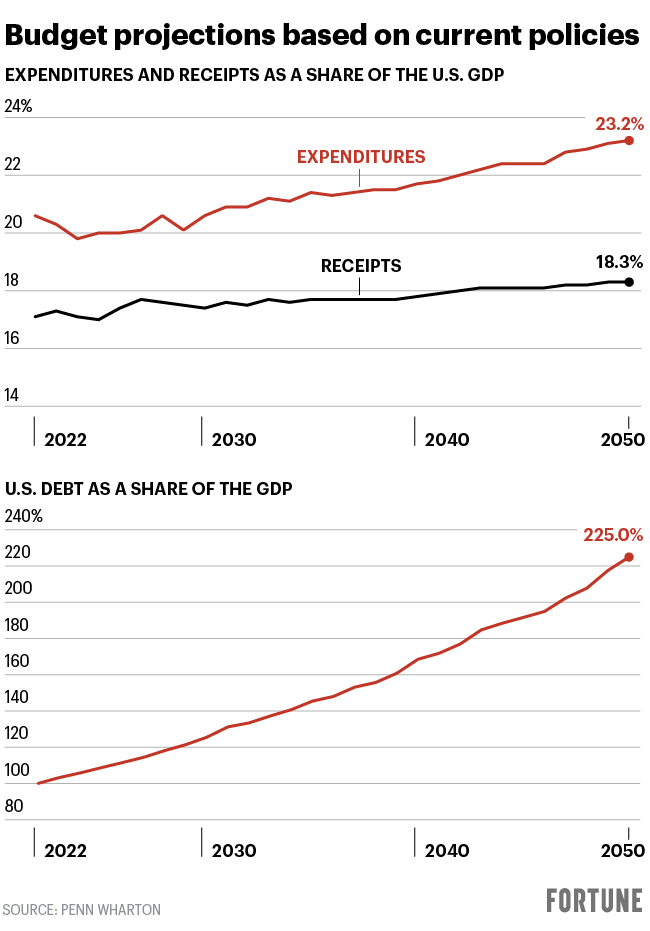
At the debate’s core is the national debt. The U.S. government has been running a deficit since 2002, spending more than it earns, meaning that it has had to borrow larger and larger amounts to make its payments. And not only is the debt rising, it’s growing faster than the economy. The nation’s debt-to-GDP ratio, which measures debt over a longer period of time relative to the economy’s size, was 121% last year. That number could rise to 225% by 2050 under current policies, according to a Wharton School model.
“The trajectory for the debt is clearly a problem, and I think everybody agrees, because if you look at the forecast, we have debt increasing with no end in sight,” Louise Sheiner, policy director of the Brookings Institution’s Hutchins Center on Fiscal and Monetary Policy, a center-left monetary and fiscal policy research organization, told Fortune.
But the U.S. is also accustomed to running up a tab, as the government has run a surplus only five times in the last 50 years. Economic policy experts and former government officials tell Fortune that addressing the country’s fiscal sustainability is important, but there is no universally agreed-upon point where debt begins to harm the economy. Meanwhile, mechanisms that weaponize the debt for political goals, like the ongoing ceiling standoff, might do much more damage than high debt ever could, and even risk creating the sort of intergenerational crisis Republicans say they are desperate to avoid.
“Regardless of whether you think there is or isn't a problem, and regardless what you think of the merits of McCarthy's plan, the approach being taken is not okay,” Bobby Kogan, senior director of federal budget policy at the Center for American Progress, a progressive think tank, told Fortune. “You can't hold hostage the entire U.S. and global economy.”
Balancing the budget
The reason the U.S. has rarely been able to reduce its debt in recent decades is that deficits are extremely hard to avoid.
Balancing America’s budget is an “equation” with two components, Linda Bilmes, a senior lecturer at Harvard Kennedy School who focuses on budgetary and public finance issues, told Fortune. “There's a revenue side and a spending side...You cannot balance the budget or get anywhere close to it by cutting spending without raising revenues. The equation just does not work.”
More revenues mean higher taxes, and less spending means fewer government-funded programs. The last time the U.S. had a surplus was for four years during the Clinton administration, when the government brought in more revenues through higher gas and marginal incomes taxes while cutting spending including military budgets, said Bilmes, who also served as the Commerce Department's assistant secretary and CFO under Clinton. The administration's efforts, especially higher taxes and military spending cuts, received "an enormous amount of pushback," she added.
But replicating that success today might be even more difficult. An aging economy has increased spending on Medicare and Social Security, benefits that are only expected to rise in the coming decades. And while experts say pulling both levers to reduce the deficit—raising taxes and cutting spending—is needed for any realistic budget-balancing plan, it might be easier said than done. Democrats focus on higher taxes to reduce the deficit, while Republicans argue for spending cuts, but neither side seems willing to entertain concessions for the other’s priority.
It doesn’t help that both sides of the equation are politically extremely sensitive, as most Americans’ faith in the tax system is already shaken and important programs like defense, Social Security, and healthcare programs make up the bulk of spending. Additionally, the debt burden rises in tandem with interest rates, which the Federal Reserve has been raising over the past year in its effort to control inflation. While the interest rate the U.S. is now paying on its debt is still relatively low by historical standards, 2.07% last year compared to its peak of over 15% in the mid-1990s, higher interest rates for the foreseeable future will theoretically make the debt harder to pay off.
“Both parties have taken off the table significant changes in Social Security, Medicare, or the tax code as it applies to almost all Americans. But once you do that, then you are not going to have a plausible plan for putting the budget on a sustainable path in the long run,” Doug Elmendorf, dean of Harvard Kennedy School, told Fortune.
Elmendorf, who also directed the Congressional Budget Office during the Obama administration, said cuts to those key programs, as well as higher taxes “beyond just the top few percent of the income distribution,” would be necessary to stabilize the budget.
Crisis or headache?
The complexity of balancing the budget also shows why the debt ceiling—an urgent threat that risks sparking a U.S. and global recession—is not the right tool to tackle the debt issue, experts say.
“Federal debt is a long-term problem, not a short-term problem,” Elmendorf said.
While there is plenty of evidence suggesting the U.S. defaulting on its debt would be an economic catastrophe, there is little indication that raising the debt further to finance robust government spending will have negative effects.
“There's no magic level of debt-to-GDP at which you get into trouble with investors,” Megan Greene, global chief economist at the Kroll Institute, a research firm focused on transparency and good governance, told Fortune. “The debt level in and of itself, there's no threshold above which it gets to be a problem.”
Countries have defaulted on their debt before with lower debt burdens relative to their economy. Argentina, for instance, had a debt-to-GDP ratio of 55% in 2001 before it defaulted, although most of its debt was denominated in foreign currency, a problem the U.S. does not have.
The U.S. is in a unique position because of the dollar’s role as the world’s reserve currency, which allows it to carry debt cheaper than other countries. And with Treasury securities, the U.S. also boasts the world’s largest and most liquid government securities market. Some experts argue that these qualities together allow the U.S. to sustain much higher levels of debt.
“The U.S. has this exorbitant privilege of having the global reserve currency, which means everybody wants to hold dollar-denominated assets so there's an insatiable demand for U.S. debt. And also the Treasury market is the deepest and most liquid asset class in the world. So that means investors are less worried about buying up U.S. debt,” Greene said.
And while the national debt overall has grown, the interest the U.S. has to pay on its debt is still low by historical standards. The U.S. was able to finance its debt for very little during the free money era of low interest rates that is now ending, meaning its debt burden was actually quite small. But even after the recent rise of interest rates, interest on debt in 2023 is projected to be around 20% lower than it was in the mid-90s, according to Brookings’ Sheiner.
If interest rates stay high for a long time and start amplifying the debt burden, reducing the deficit might become more urgent, Sheiner said, especially as the trust funds financing Social Security and other benefits are projected to run out in around a decade if Congress does not adjust their structure. But she, as did all the experts Fortune spoke with, maintained that the national debt is not urgent enough to risk a government default.
America’s risky game
If the debt ceiling standoff goes on too long, it could damage markets, lead to cuts in veterans funding, and spark a recession. It also might imperil America’s privileged standing in the global financial system, the position that has so far enabled it to run up so much debt without facing a default.
The closer the U.S. gets to a default the more foreign investors are likely to lose confidence in the U.S. economy. On Wednesday, Fitch Ratings, a credit rating agency, placed the country’s perfect credit on watch ahead of a possible downgrade, citing “increased political partisanship” standing in the way of a debt ceiling resolution. The impasse, and the slim chance that the two political parties will be able to reach a compromise on the national debt in the near future, risk undermining the country’s legitimacy worldwide.
“There's an opportunity cost in terms of the loss of soft power in the U.S. ... No matter how much we do in rallying the world around Ukraine, it is not a substitute for the fact that we are a laughingstock because no other country in the world has this problem,” Harvard’s Bilmes said.
In the nearer term, the ceiling debate and the risk of default pose a more serious threat to U.S. economic growth than the national debt’s ticking clock. While McCarthy claimed his spending cuts proposal would help future generations, experts like Sheiner say that they would likely not make a significant dent in the national debt. Meanwhile, reducing investments in climate resilience, cutting new funding for the Internal Revenue Service, and expanding work requirements for government program eligibility could drag down economic growth and create an even larger intergenerational burden.
“Everybody cares about the debt because we think of it as hurting the future,” Sheiner said. “But if the future is what you care about, then doing things that hurt the future doesn't make sense.”