Recent debt ceiling headlines can be summed up in two words: “No Deal.”
The headlines are wrong. The “no deal” they refer to is only one between President Biden and House Speaker Kevin McCarthy. There is a different deal, a bipartisan debt-ceiling deal in the House—if they vote.
The House already passed the bill Republicans prefer—let’s call that Option 1. Option 2 might be a compromise bill co-sponsored by a group of bipartisan representatives, perhaps one put forward by the Problem Solvers Caucus that raises the debt ceiling and includes more moderate cost cutting. And Option 3 should rationally be the bill the president prefers—a “clean” debt ceiling bill addressing only that immediate need. If these additional options were to reach the House floor, there would be some measure of bipartisan support, and one or more would attain the magic 218 yeas to pass.
Once Congress is freed to participate in the process of solving this problem—or, viewed more cynically, once they are robbed of the shield the President and the Speaker are currently providing them—the question may yet become how many, on both sides, dare to go on record that they do prefer disaster? A clean debt ceiling bill needs only five Republicans to join all the House Democrats to pass. As the clock ticks down, it seems like that there’d be at least five Republicans, motivated by principles or electoral prospects, who choose averting global financial disaster over going down with the ship. Or perhaps, were Congress to reclaim its rightful power as the legislative branch, the Option 2 compromise bill would pass, as many Democrats would also like to see some fiscal sanity.
If either of these passed the Republican House with bipartisan votes, it’s doubtful that the Senate would stand in the way with default looming.
This is not to minimize the complexity of partisanship created by our divisive election system, which drives both sides to rationally prioritize their most intransigent voices because that’s what it takes to win party primaries. That difficulty is no excuse to not demand that Congress do its job—vote, negotiate and vote again until they succeed. It took 15 votes for this Congress to elect a Speaker, but they didn’t stop voting until they succeeded. As we saw then, the transparency and accountability of casting a public vote has a motivating effect, absent from the current machinations, that is desperately needed.
So why don’t they vote? Because look behind the scenes on Capitol Hill and you’ll find that another deal’s already been made, and it’s a raw one for the American public. It’s an arrangement—one of many in our political system—designed to make sure that legislative bodies work for partisan benefit rather than problem-solving.
That little-known arrangement is called the Hastert Rule (named after a disgraced former Speaker of the House), and its consequences are playing out now in a high-stakes political battle that could well lead to the United States’ first default on its debt payments—an eventuality that should strike fear in all of us. But while the brinkmanship over the debt ceiling is causing appropriate panic among economists, business leaders, and responsible citizens of all stripes, the reasons for it—that deal I mentioned—ought to spark outrage among all voters across the political spectrum.
Here’s why: Under the Hastert rule, the Speaker will not allow a floor vote on any bill unless a majority of the majority party (i.e., the Speaker’s party) supports it. And that’s true even if a majority of the entire House would vote to pass it. What’s worse: A newer version of the Hastert rule now in vogue decries that the Speaker should not allow a vote on any bill unless it can be passed with only majority-party votes.
While in this case, the Speaker is a Republican, it should be noted that the Hastert Rule has become a well-accepted practice for every Speaker of the House, Republicans and Democrats alike. And the Senate, now controlled by the Democrats, has its own version too—but more on that in a bit.
The rule, to be sure, isn’t an official piece of legislation or a well-preserved point of order from America’s earliest Congresses. It’s a new cynical tradition, adopted by ruling parties, and intended—yes, intended—to frustrate bipartisanship if that crossing of party lines erodes the power of the majority in any way.
The consequences of this unfortunate norm boggle the mind. Consider that many potential bipartisan deals on important issues are not even worth negotiating, because unless Speakers ignore the Hastert Rule (which they do from time to time, but rarely), bipartisan legislation supported by a majority of the country or by a majority of the House (but not by a majority of the majority party) has no chance of passing—because there will never even be a vote. That’s worth repeating: There will never even be a vote on bills that could pass with bipartisan support…in our democracy.
Article One of the Constitution grants Congress the power to set the rules of how they operate, and they do at the opening of every Congress at the same time that they elect the Speaker. Those official rules combined with the other customary norms and practices of how laws are made combine to create what I call the “legislative machinery.” Our legislative machinery has been egregiously co-opted by both parties and designed, not to support bipartisan problem solving, but to entrench and divide the spoils of power. It allows each party’s naked electoral calculus to suffocate the legislature’s ability to work collectively—even when constituents want compromise and collaboration, and even when a majority of representatives themselves want it.
Crazy. Think about it. In your firms, companies, and organizations, if you wanted to solve your biggest problems, I suspect that one thing you probably would not do is bring everybody together, and say: “Hey, before we get to work, let’s count off here, and divide into two warring teams.” But that’s how it is every single day in Washington, D.C., not because it’s broken, but rather because it’s working exactly as it’s designed.
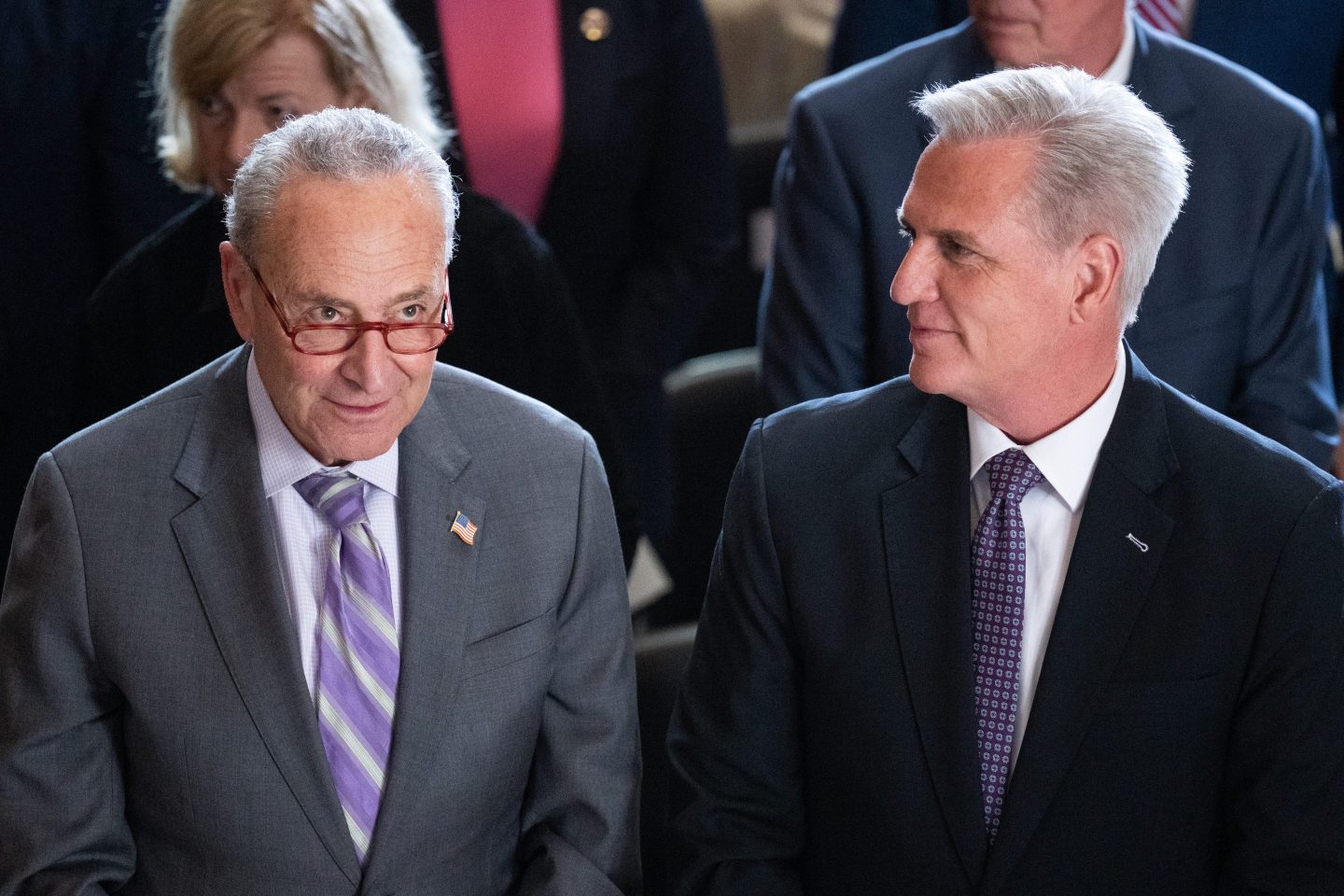
To be clear, although the focus at this point in the current crisis is on the Republican-held House, Democrats employ the same tools with equal enthusiasm. Note that Majority Leader Chuck Schumer has already “guaranteed” that he’ll never allow a vote on the Republican debt ceiling bill that already passed the House. If there were no more Hastert Rule, no more unnamed mirror in the Senate nor other practices like them, it would be far easier to solve challenges such as the one before us now.
The good news for this crisis is that the Hastert Rule is not a rule at all. It’s a wink-and-a-nod agreement—a shady practice perfected in the proverbial smoke-filled rooms of the Capitol. It can be discarded far more quickly than it was conceived and in time to avoid the catastrophe of default.
How? The American people have to demand it. The call of the public and united business voices must be clear to both Speaker McCarthy and Majority Leader Schumer: Let Congress vote.
Katherine Gehl is the co-author of The Politics Industry—How Political Innovation Can Break Partisan Gridlock and Save our Democracy.
The opinions expressed in Fortune.com commentary pieces are solely the views of their authors and do not necessarily reflect the opinions and beliefs of Fortune.











